HE CAME TO FIRE THE DISHWASHER AND THEY THREW OUT THE MAN IN THE LEG BRACE
Chapter 1
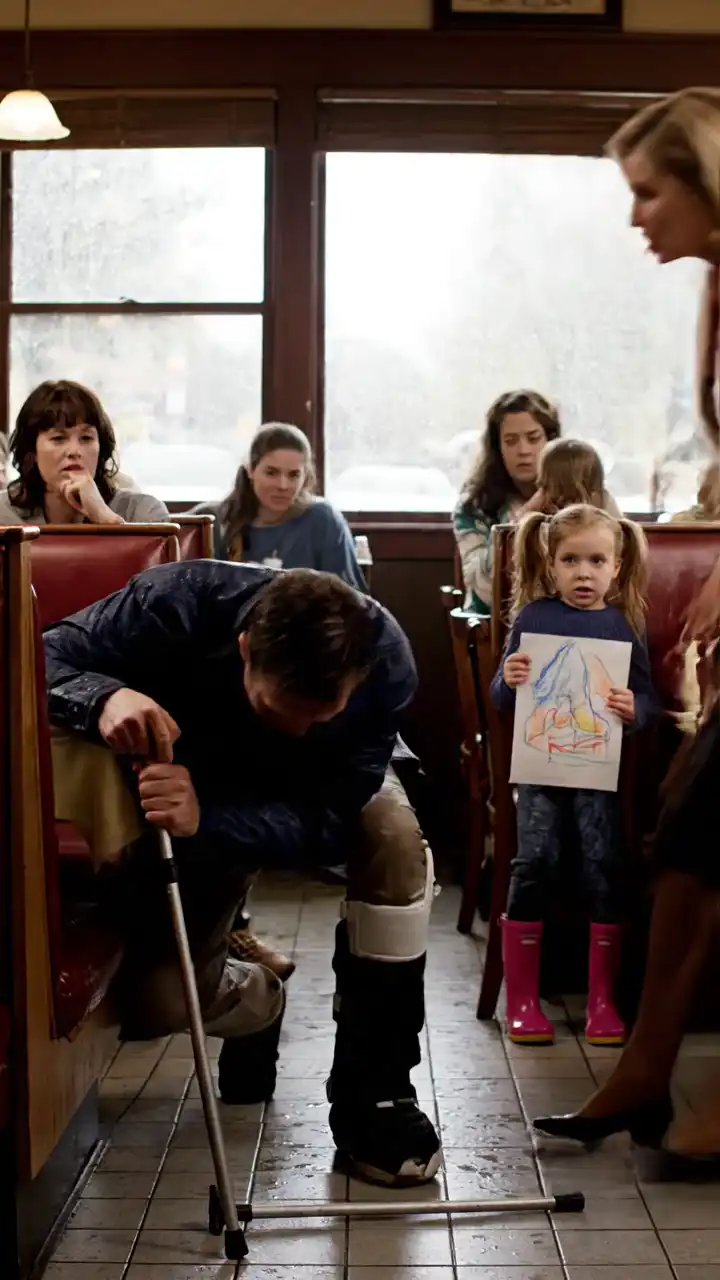
The first thing everyone saw was the cane sliding across the tile.
It hit the leg of a table at Juniper Table and clattered so loud that half the lunch crowd turned at once. A glass of sweet tea shivered near the edge of a booth. A little girl in pink rain boots stopped coloring and stared with her mouth open. By the host stand, a server carrying two soups froze mid-step.
And in the middle of all those eyes, I was bent awkwardly beside booth twelve, one hand braced on the seat, my bad leg trembling under the metal brace I wore from ankle to thigh.
“Don’t touch my purse,” the woman snapped.
Her voice cut through the room sharper than the cane had.
I straightened too fast and pain shot up my left side. The leather handbag was still hanging from the hook under the table where it had swung when the little girl kicked her feet. I had only reached to lift the purse strap away from the floor because it was caught under my cane.
But by then it didn’t matter what I had meant to do.
The woman had already stood up. She was elegant in the expensive way that looked unwrinkled even in rain, with a pale trench coat and a gold bracelet that flashed when she pointed at me.
“He was reaching under our table,” she said, loud enough for everybody. “I want the manager. Now.”
The little girl looked from me to her mother. “Mommy, he was helping.”
“Hush, Leni.”
People always think humiliation comes as one big moment. It doesn’t. It comes in tiny physical pieces. The hand that won’t stop shaking. The heat in your face. The silence that spreads around you while strangers decide what kind of person you are. The knowledge that if you bend for your cane too soon, it will look like guilt, and if you leave it there, it will look worse.
I kept my eyes on the floor for one second too long.
That was when Theo Marsh came out from the back office.
Theo owned Juniper Table, and he moved fast when there was trouble, wiping his hands on a clean dish towel as if calm could be put on like an apron. He was broad-shouldered, gray at the temples, the kind of man people trusted because he spoke low and stood straight. I had only met him once before, two days earlier, when he’d told me over the phone to come by at one o’clock sharp if I wanted the job.
Now his eyes moved from the woman, to my cane on the tile, to me.
“What happened?” he asked.
The woman lifted her chin. “Your employee was under my table.”
Employee.
That word should have helped me. It should have made things simple. Instead, it made the room tighten.
I wasn’t really his employee. Not yet. I was supposed to meet him privately before service. We had unfinished business from a letter he had sent three weeks earlier to an address I hadn’t used in years. A formal notice from the owner of Juniper Table regarding staffing review and termination procedure. Except I had never worked there. Never once. I had only come to find out why my name was attached to his payroll records.
But how do you explain something that strange while thirty people are watching you look exactly like a man caught doing what he shouldn’t?
I opened my mouth.
Theo got there first.
“Sir,” he said to me, clipped and controlled, “step away from the guests.”
Sir. Not my name. Not a question. Just distance.
My stomach dropped.
“I was just getting my cane,” I said.
The woman gave a bitter laugh. “From under my handbag?”
The little girl tugged at her sleeve. “Mommy, his stick got stuck.”
No one listened to children when adults were busy being certain.
Theo bent, picked up my cane, and held it out without stepping any closer than necessary. Even that small caution landed like a slap. A few people by the windows had already taken out their phones, not filming outright, just holding them in that modern half-ready way. One young man in a denim jacket whispered something to his girlfriend and shook his head.
Theo said, “Let’s move this outside.”
I took the cane. “I came because you asked me to.”
He frowned. “I asked you to come in for a meeting, not to bother customers.”
That hurt more than I expected, because it meant he really didn’t remember our call clearly, or didn’t want to.
The woman crossed her arms. “If this is how you run this place, I’ll be posting about it.”
The little girl slid out of the booth before her mother could stop her. She held up a crumpled drawing from the table, a page she’d been coloring with purple marker. On the bottom edge, where rainwater from someone’s umbrella had smeared the paper, was a quick sketch of a man with one long leg and one short one, bending toward a purse hook.
“He wasn’t taking it,” she whispered. “He was like this.”
Her mother snatched the drawing from her hand and folded it once, hard.
“Leni, sit down.”
Theo exhaled through his nose. “Miss, thank you. Sit, please.”
The child obeyed because children always obey the wrong person in tense rooms.
I should have left then. Pride said leave. Pain said sit. Curiosity, stupid and stubborn, said stay.
Because the truth was, I had not limped all the way from the bus stop in rain with my folder of papers tucked under my jacket just to be thrown out like a thief before I got one answer.
I said quietly, “I need five minutes with you.”
Theo’s face hardened the way a locked door hardens. “Not now.”
Then a voice from the corner near the pie case said, “He should take the five minutes.”
Everyone turned.
I hadn’t noticed the older woman before because she sat alone by the wall, almost hidden behind a fake fern and the dessert cooler. She wore a brown coat too heavy for spring and had a yellow legal pad beside her coffee. She looked like somebody’s aunt, or a retired school secretary killing time. Her silver hair was pinned back carelessly, and her reading glasses hung on a chain against her chest.
Theo looked irritated. “Ma’am, this isn’t your concern.”
“It became my concern when you accused a disabled man before asking one proper question.” She reached into her coat pocket, not for drama, just for her phone. “And when a child at that table was ignored after telling you what she saw.”
The woman in the trench coat went red. “Excuse me?”
The older woman stood slowly, like someone who understood exactly how attention worked and had no fear of it. “My name is Darlene Voss. I’m an attorney, and I happened to witness the entire thing.”
The room changed, but only a little. Not enough to save me. Just enough to make people curious.
Theo’s jaw flexed. “An attorney for who?”
She looked at me for a beat, and I knew with a strange cold certainty that she had no idea who I was. “At the moment,” she said, “for the truth.”
The hostess whispered, “Oh my God,” under her breath.
I wished I could disappear.
Instead, my phone started vibrating in my coat pocket.
Unknown number.
I almost ignored it. My hands were unsteady, and I hated taking calls in public, hated how my fingers fumbled when people watched. But the screen kept lighting up.
Darlene glanced at it. “You may want to answer that.”
I don’t know why I listened to her.
I put the phone to my ear. “Hello?”
A man’s voice came through, rushed and formal. “Mr. Rainer Holt?”
My throat tightened. “Yes.”
“This is Cedargate Fidelity. We’ve been trying to reach you regarding the estate review. Your signature is required before any board action can proceed on the Marsh Hospitality group.”
The room didn’t hear the whole sentence. They only heard enough.
My own name. Estate. Board action. Marsh Hospitality.
Theo went still.
The dish towel slipped from his hand and landed at his feet.
Chapter 2
If humiliation arrives in pieces, so does silence.
The whole restaurant seemed to inhale and wait, as if one wrong sound might crack the moment apart. I could still hear the voice on my phone talking about deadlines, trustees, filings, and a conference call scheduled for two-thirty. But Theo was staring at me now with a look that no longer matched the room’s version of me.
“Mr. Holt?” the caller said again.
I turned away from the crowd as much as I could. “I can’t talk right now.”
“It’s urgent. Ms. Bellacre from your counsel’s office has been trying to locate you all morning.”
“I said not now.”
I hung up before he could protest.
When I looked back, Theo had stepped closer for the first time. Not enough to touch me. Just enough to make the distance itself feel deliberate.
“What did he mean,” Theo asked carefully, “Marsh Hospitality?”
The woman in the trench coat gave a brittle little laugh. “So now he gets a hearing?”
Darlene Voss answered before I could. “He should have had one before you tried to throw him out.”
Theo didn’t look at her. “Rainer. My office.”
The fact that he said my name this time made every pair of eyes in the room sharpen.
I had spent years learning how to keep my face still when pain hit, when pity hit, when suspicion hit. But some wounds go older than the body. My father used to say that a room could smell weakness before a dog could. He said it while locking me out of family meetings, while telling investors his son was “not built for pressure,” while making me enter charity galas through side doors so I wouldn’t distract from the brand.
So when Theo finally remembered I was a person, not a problem, I didn’t feel relief. I felt tired.
“I’d rather stay where everyone can hear,” I said.
The trench coat woman scoffed. “Please. He loves an audience.”
Her daughter looked down at her lap, small hands folded around the ruined drawing.
Theo rubbed his forehead. “Fine. Then say what you came to say.”
I reached into my satchel and pulled out the cream envelope that had started all this. The paper was already soft at the corners from how many times I had unfolded it. Juniper Table letterhead. A formal tone. My name typed correctly. Notice of review regarding conduct concerns and possible termination.
Theo took it from me.
I watched his eyes move line by line. Then back to the top. Then to the signature block.
“That’s not my signature,” he said.
“Your name is on it.”
“It’s not my signature.”
Darlene stepped nearer. “May I?”
He hesitated, then handed her the letter. She adjusted her glasses and scanned it quickly.
“Printed from your system?” she asked.
Theo nodded once, stiffly. “Looks like it.”
The trench coat woman tapped her manicured nails on the booth. “Can someone explain why this man was creeping under tables if he came for paperwork?”
I answered her because no one else would. “My cane got tangled under your purse strap.”
“You expect me to believe that?”
“No,” I said. “I expect you to remember your daughter already told you.”
That landed. Her face pinched. Around the room, people who had enjoyed the easy version of the story became less comfortable.
Leni looked up at me. “I told them.”
“I know,” I said softly.
Theo glanced toward the child, then back at me. Something uncertain flickered across his face. “Why didn’t you come to the host stand?”
“Because your assistant told me to wait near booth twelve. She said you were handling invoices and would come out.”
The hostess, a college-aged girl with a name tag reading BRI, looked startled. “I didn’t—”
Then she stopped. “No. Wait. Cammie told me that. She said if a man named Rainer Holt came in, have him wait by twelve because Mr. Marsh would want privacy.”
Theo’s eyes narrowed. “Cammie isn’t here today.”
“She called out.”
Darlene folded the letter once and held it between two fingers. “Then perhaps Cammie should become very available.”
Theo’s mouth flattened. “I’ll deal with my staff.”
The way he said my staff hit me wrong. Like ownership. Like the same hierarchy that had gotten me here.
I should explain something: I was not rich in the way people dream about. I took the bus because I liked not depending on chauffeurs who reported my whereabouts. I rented a narrow upstairs apartment in Bellmere because it was easier to breathe there than at the estate house outside town. I wore secondhand jackets because good wool lasted and I didn’t care what label was inside. But my last name belonged to an old business family whether I liked it or not. Holt Restaurant Holdings had merged in messy layers over the years with other groups, trusts, and properties, one of them being Marsh Hospitality. My grandfather built the first pieces. My father weaponized the rest. After he died six months earlier, lawyers started circling like gulls around a fishing dock.
I had stayed out of it as long as I could.
Then this letter arrived with my name listed not as owner, not as trustee, but as “dish support staff under performance review.”
At first I thought it was a clerical joke. Then a cruel one. Then maybe a test.
Because if you grow up around powerful men, you learn that humiliation is often paperwork wearing a tie.
Theo said, “Come to the office.”
Again I shook my head. “No.”
He looked surprised. “Why?”
Because I didn’t trust closed doors. Because rooms with leather chairs had changed my life more brutally than hospital rooms ever had. Because my father’s brother once smiled kindly while forging my consent on a restructuring document when I was twenty-three and medicated after surgery. Because when men in charge say let’s speak privately, what they often mean is let me decide the version that survives.
So I said the simplest truth. “Because I’ve been handled enough.”
The words came out rougher than I intended. A few people heard. Theo definitely heard.
Darlene’s gaze shifted to me then, deeper, less casual. Like she had just realized the problem was larger than one lunchroom misunderstanding.
“Then let’s keep it in the open,” she said.
Theo looked like he wanted to protest, but one of the servers approached from the kitchen window holding a cordless restaurant phone.
“Mr. Marsh,” he murmured, “there’s a woman on line two. Says it’s legal. Says it can’t wait.”
Theo took the phone. “Theo Marsh.”
He listened for two seconds and all the color left his face.
His eyes flicked to me.
“Yes,” he said. “He’s here.”
Now the room really did freeze.
Whoever was on the other end kept talking. Theo’s shoulders, which had been square with anger a minute earlier, shifted into something I had seen in men like him before: fear dressed as caution.
He cleared his throat. “I understand.”
Then he handed the cordless phone toward me with both hands, almost ceremonially.
“She says she represents you.”
Darlene gave the tiniest smile. “Atmosphere changed.”
I took the phone.
“Rainer?” said a crisp female voice. “This is Corinne Bellacre. I’m so sorry. We finally traced you through the trust office. Please do not leave that restaurant.”
“I wasn’t planning to.”
“You should know before anyone else says it badly: as of this morning, the board voted to activate the succession provision. You are now majority controlling beneficiary over the Marsh division assets held under the Holt reorganization.”
The room felt suddenly too bright.
I sank down onto the edge of an empty chair because my leg was shaking harder. “No.”
“Yes.”
“That wasn’t supposed to happen unless—”
“Unless your uncle declined. He did. In writing. Thirty-seven minutes ago.”
I stared at the rain-striped front window. Across the street, a florist was dragging tulips under an awning.
Corinne lowered her voice. “And there’s another issue. We believe someone has been moving your name through employee records inside subsidiary locations. Not randomly. Deliberately.”
I closed my eyes.
A setup. Not a mistake.
When I looked up, every face near me had become a question mark.
Theo said quietly, “Rainer?”
I heard myself answer in a voice that no longer sounded like the man on the floor reaching for his cane.
“I think,” I said, “someone wanted me to come here looking small.”
Chapter 3
Lunch service limped on after that, if you could call it service.
Nobody wanted to leave and miss whatever came next, but nobody wanted to look obvious either. So people lingered over coffee they didn’t need, cut sandwiches into tiny pieces, checked phones without seeing them. The dining room hummed with fake normalcy, the most fragile sound in the world.
Theo closed the front door and flipped the sign to LIMITED SERVICE. Then he told Bri to comp booth twelve and any table that wanted to go. Not one person left.
The trench coat woman, whose credit card later revealed her name was Vanessa Creed, sat straighter in her booth as if refusing to surrender moral territory. Her daughter Leni had gone quiet in the way children do when adults make a room dangerous. She kept smoothing the folded drawing against her knees, trying to flatten the crease her mother had made.
Darlene Voss moved from the wall table to one near the center, legal pad open, coffee untouched. She didn’t grandstand. She just stayed. The sort of staying that told everyone she would remember details later.
Theo asked me again to come to his office. This time I agreed only after he left the door open and Darlene came too.
His office sat just off the kitchen, smelling faintly of onions, toner, and cedar cleaner. Through the open door I could see a sliver of the dining room and hear plates touching down. A framed photo of the restaurant’s opening night hung behind his desk. Theo younger, hair darker, arm around a smiling woman I assumed was his wife. On the other side stood a man in a suit I recognized immediately even though I hadn’t seen him in four years: my uncle Byron Holt.
My stomach tightened.
Theo saw me looking. “You know him.”
“Yes.”
Theo followed my eyes to the photo, and his expression changed from confusion to dread. “He helped finance this place.”
Of course he did.
Byron loved charming hardworking men with dreams. He called it investing in people. What he really invested in was dependency.
Darlene leaned back in her chair. “Start at the beginning, Mr. Marsh.”
Theo stayed standing. “Three years ago I was about to lose this restaurant before it opened. Construction delays, a predatory loan, my wife’s cancer treatments—we were drowning. Byron Holt stepped in through a holding company and saved us. Or that’s what I thought. The terms were ugly but survivable. Then a year later the payroll company changed. Then certain staffing authorizations started coming from the parent office.”
“Did you question them?” Darlene asked.
“Yes. I was told not to get precious. That corporate oversight came with the money.”
I let out a breath that hurt. It was always the same language. Make people feel childish for noticing the trap.
Theo looked at me directly. “I swear to you, I didn’t put your name into any payroll record.”
“Then why was I listed as dish support staff?”
His gaze dropped, then lifted again. “Because dish support is the lowest-access role in our system. Temporary. Disposable. Easy to move around without notice.”
A strange bitter laugh escaped me. “That tracks.”
He winced at that, and for the first time I believed his regret was real.
Darlene tapped her pen on the legal pad. “Someone wanted him documented as low-status in a subsidiary location. Why?”
I answered before Theo could. “Because if questions about control ever came up, they wanted a paper trail that made me look confused, unstable, maybe delusional. The disabled son with employment misunderstandings. The relative who thinks he owns things.”
Theo sat down heavily on the edge of his desk. “Jesus.”
I hated that reaction. Men always said God’s name when they finally saw a cruelty that had been ordinary to somebody else for years.
In the dining room, a child cried suddenly, then hushed. We all looked out. Leni had spilled water on her lap and flinched as Vanessa pulled her arm too hard with a napkin.
“Easy,” I muttered before I could stop myself.
Darlene noticed. “You know children?”
“My sister had twins before she died.”
The room went still for a different reason.
I did not like mentioning my sister Mara. Even now, three years gone, the word died sounded wrong beside her name. Mara had been the only one in our family who saw me whole. After the accident that ruined my leg and crushed two vertebrae when I was nineteen, everyone else learned new ways to measure me. She learned new ways to include me. Then she got sick fast, absurdly fast, and left behind two little boys who were eventually sent to school in Switzerland because my uncle said “stability matters.”
Stability. Another word with blood under it.
Theo said, more gently than before, “I’m sorry.”
I shrugged because sorry did not travel backward.
A server appeared in the doorway. “Mr. Marsh, Cammie’s here.”
Theo stiffened. “I told her not to come in.”
“She came anyway.”
“Bring her.”
Cammie Rusk walked in with mascara smudged under one eye and rain on the shoulders of her pharmacy scrub jacket. She wasn’t in uniform. She looked like she had come from somewhere else in a hurry and regretted every step. Mid-thirties maybe. Thin, brittle, tired in the way of people holding together too many bills.
Her eyes landed on me first. Then the letter in Darlene’s hand. Then Theo.
“I didn’t steal anything,” she said immediately.
Theo’s voice dropped low. “Then start better.”
Cammie folded her arms around herself. “I only did what they told me.”
“Who?”
She hesitated. Darlene wrote one note and waited. It was more effective than pressure.
Cammie swallowed. “A man from the parent office. Not Mr. Marsh. Another one. Kent Harrow.”
That name I knew too. Byron’s fixer. Always smiling. Always carrying folders.
“He said a VIP family member might come in under sensitive circumstances,” Cammie went on. “He said if anyone asked questions, I was to log Mr. Holt as temporary dish support and keep him away from the office until corporate arrived.”
Theo stared at her. “You did all this because some corporate man told you to lie?”
Tears sprang into her eyes, angry more than ashamed. “My son needs therapy. I can’t lose this job. They said Juniper Table would be audited. They said if I cooperated, no one would get hurt.”
No one would get hurt. Another favorite lie.
I asked, “Did Harrow tell you why me?”
“No. But he said you wouldn’t push back. He said you never do.”
That one landed in the center of my chest.
Darlene looked up sharply. “When did he tell you that?”
“On the phone last week. And this morning he told me to make sure booth twelve stayed open.”
“The booth by the purse hook,” Darlene said.
Cammie nodded helplessly. “He said a family would be seated there. He said if Mr. Holt reached under the table for any reason, it would support a behavioral concern report.”
I stared at her. The room around us thinned out.
They had staged the angle. The waiting spot. The family. Maybe even the purse placement.
Not because they could guarantee what I would do, but because men like Byron built traps wide enough that gravity did the rest.
Theo put a hand over his mouth.
Darlene’s pen stopped moving. “Who was the family?”
Cammie blinked. “A reservation from corporate. Name Creed.”
From the dining room, Vanessa’s laugh rang out at something no one else found funny.
Darlene stood.
Theo said, “Sit down.”
She ignored him and walked toward the dining room. We followed.
Vanessa looked up as we approached, annoyance already loaded in her face. “Is this really necessary? My daughter is upset.”
Darlene stopped at the edge of the booth. “Did corporate invite you here today, Ms. Creed?”
Vanessa froze. Just a second. But it was enough.
“I made a reservation.”
“Through whom?”
Vanessa reached for her water glass and missed it slightly. “Your tone is inappropriate.”
Darlene’s reply was flat. “Your daughter told the truth the first time. I suggest you try it.”
Leni whispered, “Mommy.”
Vanessa’s jaw tightened. “A friend arranged lunch.”
“What friend?”
She looked around the room and realized the audience had turned. Not gossiping now. Watching.
“A consultant,” she said at last. “He handles public relations scenarios.”
Theo’s voice was deadly calm. “Public relations for what?”
Vanessa licked her lips. “For acquisition cleanup.”
I thought I understood, and I hated myself for still being surprised.
Darlene asked, “Did he tell you to accuse Mr. Holt if he touched your bag?”
Vanessa said nothing.
Leni looked at me, then at the drawing in her lap, and held it up with both small hands.
“He helped,” she said.
That should have been a tiny line in a huge room, but somehow it was the only sound that mattered.
Vanessa’s shoulders dropped. The performance left her face all at once, and what remained was uglier because it was ordinary.
“He said nobody would care,” she murmured. “He said people already decide those things for themselves.”
No one in the restaurant moved.
Because the worst part was, she was right.
Chapter 4
By two o’clock the rain had stopped, but the windows still held gray light that made everyone look more tired than they were.
Corinne Bellacre arrived in person instead of staying a voice on the phone. She came in a navy suit with no umbrella and the kind of stride that told a room she had no intention of asking permission to rearrange it. Behind her came a younger man carrying two banker’s boxes and a portable scanner, because apparently some truths now arrived with office equipment.
If the lunch crowd had been waiting for a spectacle, Corinne disappointed them by being brisk.
“Mr. Marsh,” she said. “We will need payroll access, reservation logs, surveillance copies, vendor communications, and any messages from a Mr. Kent Harrow.”
Theo nodded immediately. “You can have all of it.”
She turned to me then, and her expression softened just one degree. “Rainer, sit if you need to.”
I hated that I did need to.
Pain had started chewing steadily up my spine from standing too long, but I refused the office chair and chose a plain dining chair near the window instead. I wanted to stay where I could see everything. Darlene sat beside me like she had been appointed by fate. Leni had fallen asleep with her cheek against the booth wall, exhausted by adult deceit. Vanessa stared at nothing, mascara shadowing the corners of her eyes. She had stopped defending herself, though not, I thought, from remorse. More from collapse.
Corinne spread documents across two pushed-together tables. Payroll entries. access reports. reservation notes. Juniper Table’s daily floor charts. Theo’s hands shook once when he handed over his master login, then stilled.
The younger man scanned and sorted.
Names began to emerge.
Kent Harrow. Byron Holt. A shell consulting firm called Alder Civic Strategies. Three “reputation management rehearsals” billed across different subsidiary locations. And my own name, appearing and disappearing in systems where it had no business being.
Every time it showed up, it was attached to the same kind of role. Temporary. Auxiliary. Low oversight. Easy to dismiss.
I stared at the printouts until the lines blurred.
Corinne spoke quietly enough that only our table heard. “We suspected record manipulation after the trustees found anomalies in the insurance allocations. We did not know it had gone this far.”
I laughed once without humor. “Far is a family tradition.”
Theo was speaking to one of his servers near the register when an older man at table four waved him over sharply. I recognized him as the only customer who had never looked directly at the drama. He had sat through everything with a navy cap on his lap and a bowl of soup gone cold, while a frail woman in a wheelchair beside him stared at the sugar caddy with the patient vacancy of someone used to being overlooked.
Now he said, “We’ve been waiting forty minutes for her mashed potatoes.”
The sentence shouldn’t have hit me hard. But all day had been about seeing who gets ignored first, and there it was again: the quiet old woman left at the edge while the room chased a bigger fire.
Theo shut his eyes briefly. “I’m sorry. I’ll fix it.”
The older man muttered, “She’s diabetic.”
Before Theo could move, I pushed my chair back.
Corinne said, “Rainer—”
“I can carry a plate.”
My leg protested as I stood, but sometimes doing one useful thing keeps you from shattering in public.
Theo started toward the kitchen with me, then stopped. “You don’t work here.”
The words hung between us. Both true and not true.
I met his eyes. “I know.”
He swallowed. “I didn’t mean—”
“I know.”
In the kitchen, steam fogged the pass window. A cook named Marisol plated the potatoes and gravy with the tense concentration of someone who knew the whole building sat one dropped fork away from disaster.
“I’ve got it,” she said.
“So do I,” I answered.
She looked at my brace, then at my face, and handed me the plate without pity. Bless her for that.
When I brought it out, the old woman in the wheelchair blinked up at me with pale blue eyes. Her husband reached immediately for the tray stand.
“Thank you,” he said, defensive from habit.
“It should’ve come sooner.”
The woman looked at the food, then at me. “Pretty place,” she whispered, as if she had just arrived.
Her husband softened. “Yes, Nell. Pretty place.”
That should have been the end of it, one small correction in a ruined day. But Leni had woken up and was watching. She slid out of the booth again, drawing in hand, and walked over to the wheelchair with the solemn courage only children and drunk people ever have.
“This is for him,” she said, holding out the crumpled page to Nell, then pointing at me. “He helps.”
The entire restaurant saw it. The little drawing, damp and creased, with the bent man under the table and the purple purse strap caught around the cane.
Nell took the paper like it was something precious. “Sweet picture.”
Vanessa covered her mouth.
I looked away because I didn’t know what to do with kindness when it arrived late and witnessed.
From the front door came another disturbance: a man in a charcoal raincoat striding in too quickly, irritation already on his face. Kent Harrow.
I had expected him older, maybe, or heavier with consequence. Instead he looked blandly expensive, the kind of consultant who could ruin lives while discussing artisanal coffee. He saw Corinne, stopped, and recalculated in real time.
“Well,” he said with a thin smile, “this seems dramatic.”
Theo moved first. “You set this up in my restaurant?”
Kent spread his hands. “Let’s avoid emotional language.”
That nearly made Marisol throw a spoon at him.
Corinne stepped forward. “Mr. Harrow, don’t say another word unless you’d like it preserved.”
He glanced at me then, and his smile changed. “Rainer. You made this harder than it needed to be.”
There it was. Not apology. Annoyance.
“For who?” I asked.
“For everyone.” He shrugged. “Your uncle was trying to prevent instability.”
Darlene said, “By fabricating employee records and orchestrating a public accusation against a disabled beneficiary?”
Kent gave her an assessing look. “And you are?”
“The reason you should choose your next sentence carefully.”
A few customers actually nodded.
Kent looked back to me. “You were never meant to be embarrassed. We only needed documentation that you were not prepared to exercise operational judgment.”
I almost admired the ugliness of the phrasing. It managed to say humiliate without saying humiliate.
Theo took one step toward him. “You used my staff.”
“You accepted capital,” Kent replied. “Capital has needs.”
That was the moment Theo Marsh changed in my eyes. Not when he apologized. Not when he offered files. But when he stopped being afraid of the wrong thing.
He said, very quietly, “Get out.”
Kent smiled again. “You don’t understand your position.”
“No,” Theo said. “I understand it now.”
Kent turned to me with a last attempt at reasonableness. “Rainer, if you escalate this, the press will have questions. They’ll talk about your medical history. Your past leave periods. Your capacity assessments after the accident.”
The old family knife, polished and ready.
I felt every eye in the room return to me. Waiting to see if shame still worked.
My hands were cold. My leg burned. For one raw second I was nineteen again, drugged and bruised in a rehab facility while men in suits discussed my future in the hallway as if I were an asset with damaged packaging.
Then Leni’s small voice came from beside the booth.
“He was just getting his stick.”
Kent glanced at her, annoyed by the interruption.
And somehow that saved me.
Not because a child can defeat a man like him. But because the sentence was so simple it stripped away every layer he had built. All his strategies, all his language, all his paperwork, and underneath it was one plain truth a six-year-old had seen in one second.
I looked at Kent and said, “You don’t get to decide what kind of man I look like.”
Corinne stepped beside me. “Security is on the way.”
Kent’s composure cracked. “From a restaurant?”
Theo answered, “From the building. And from every future place your name won’t be welcome.”
Kent left with the stiff speed of a man trying not to run.
The room stayed silent until the door shut behind him.
Then Nell, the old woman in the wheelchair, tapped the drawing with one thin finger and said to no one in particular, “People should ask first.”
The words were soft. They landed like judgment.
Chapter 5
By late afternoon the restaurant smelled like burned coffee, lemon cleaner, and the remains of a day that would never be fully scrubbed out.
Most of the customers had finally gone, though not before paying, over-tipping, or awkwardly not knowing where to look. A few offered me sympathetic half-smiles on the way out, as if they wanted credit for having revised their opinion. I didn’t blame them exactly. But I didn’t need their redemption. I needed the truth to stop moving.
Theo locked the door for real at four. The staff gathered in uneven clusters near the counter, too rattled to clock out and too curious to leave. Vanessa asked twice if she should go, then stayed anyway, maybe because leaving would have required choosing a version of herself to live with.
Corinne had the key documents spread across the biggest table in the dining room by then. Darlene remained beside her, less spectator now than collaborator. They had found enough to draw a line through the whole scheme.
But there was still one question chewing at me.
Why Juniper Table? Why today? Why not some boardroom where men could perform concern with cleaner hands?
Corinne answered without meaning to. She set down a stapled packet, and on the cover page was an internal memo header: SUCCESSION COMMUNICATION RISK RESPONSE.
Below it, in Byron’s language if not his exact hand, was the strategy.
If beneficiary appears publicly disorganized, dependent, or behaviorally inappropriate in an operating location, concerns may be raised regarding discretionary control and stewardship image. Use witness-rich environment. Avoid overt hostility. Allow subject to reveal limitations naturally.
My stomach turned.
Not just power. Theater.
Darlene read over my shoulder and went still in a way that was colder than anger. “They turned a lunch crowd into evidence.”
Theo sat down hard across from us. “Because he uses a cane.”
“Because he thinks slowly when ambushed,” I said.
Corinne’s eyes flicked up. “Do you?”
“Sometimes.” I smiled without warmth. “That’s the thing about pain. It doesn’t make you stupid. It just makes impatient people think you are.”
No one argued.
I read the rest. Suggested triggers: confusion at point of service, dispute over access, guest discomfort, inability to regulate scene independently.
Then one line lower down, almost casual.
If possible, use child witness to heighten optics and sympathy transfer away from subject.
The page blurred. I handed it to Darlene because my fingers had started shaking again.
Across the room Vanessa made a choking sound.
“I didn’t know that part,” she said. “I swear to God, I didn’t.”
No one rushed to comfort her.
Leni, who had spent the last hour with crayons from the host stand and a grilled cheese she finally ate, looked up at her mother with the blunt sad eyes children get when they realize adults are breakable and wrong.
“You said we were helping somebody,” she whispered.
Vanessa folded in on herself.
What happened next surprised me more than the documents had.
Theo stood and went to the shelf behind the register. From a locked drawer he took out an old paper file, not digital, thick and worn at the edges. He carried it to me with both hands.
“I think this belongs in the open too.”
Inside was the original financing agreement with Byron’s holding company. Attached to it were side letters, covenant amendments, and personal guarantees. Buried near the back was a handwritten note on cream stationery.
Theo had once considered it a kindness. I could see that from the crease marks.
The note was from Byron.
If my nephew Rainer ever presents himself to staff or management in any ownership capacity, please contact me directly before acknowledging him. He can become confused about his position and is best handled gently, not publicly contradicted.
Handled gently.
There are phrases so polished they almost hide the bruise underneath.
The room seemed to tilt. I had known Byron belittled me. I had expected fraud, coercion, manipulation. But seeing it written into the daily reality of businesses, seeing strangers coached to treat me like a delicate liar, made something old and hard inside me finally crack.
I laughed once, and it came out sounding too close to grief.
Theo’s face tightened. “I should have questioned it.”
“Yes,” I said.
He took that without defense.
“I’m sorry,” he said. “Not the cheap kind. The kind that knows it should’ve done better.”
I believed him. That was inconvenient.
Corinne set her palm flat on the table. “This note alone is devastating. Combined with the payroll manipulations, the staged reservation, the risk memo, and witness testimony, your uncle’s position is not just weakened. It is untenable.”
Darlene added, “And if Ms. Creed cooperates fully, the public accusation portion becomes impossible to deny.”
Vanessa looked up, eyes swollen. “I’ll testify.”
Corinne nodded once. “You’ll do more than that.”
Outside, the rain finally broke open into sun. It came through the front windows in slanted gold bars, catching dust, glassware, and the stainless edge of the pie case. The restaurant looked gentler than it had any right to.
My phone buzzed again. This time the screen showed BYRON.
No one told me not to answer. No one had to.
I put him on speaker and laid the phone on the table.
His voice came smooth as old wood. “Rainer. I hear there’s been some confusion.”
Theo muttered under his breath.
I said, “You sent people to stage a scene.”
A pause. Tiny. Measured.
“You’re upset.”
“Answer.”
“I was trying to protect the company.”
“The company from what?”
“From instability.”
I looked around the room. At Theo, whose restaurant had nearly been used as a weapon. At Cammie, who had sold a lie because fear had gotten there first. At Vanessa, who had rented out her own child’s innocence for a lunch reservation. At Nell’s forgotten mashed potatoes, now a cold plate in a cleared dining room. At my own cane leaning against the chair like evidence no one could talk away.
Then I asked the question I should have asked years ago.
“Or from me being seen?”
He didn’t answer right away. That was answer enough.
When he finally spoke, his voice had lost some of its polish. “You were never built for this.”
Something in me went very calm.
“My body isn’t your argument anymore,” I said.
He exhaled. “Don’t be melodramatic.”
That line would once have reduced me to silence. In my family, the cruelest thing they could call your pain was dramatic. It made reality feel embarrassing.
But not now. Not in that room.
Darlene leaned forward. Corinne had already begun recording officially. Theo’s staff had gone completely still.
I said, “You put me in a dishwasher role in your records.”
“A temporary protective category.”
“You instructed businesses to call you before acknowledging me.”
“You’ve had vulnerable periods.”
“You used a child witness.”
He snapped then, irritation finally stronger than caution. “Oh, for God’s sake, it was a lunch table, not a firing squad.”
The whole room flinched.
Because that was it. The naked thing.
Not whether he did it. Only whether it should count.
Corinne ended the silence. “Thank you, Mr. Holt.”
He knew at once. “Who else is there?”
“No one you can handle gently,” Darlene said.
The line went dead.
No one moved for a long moment. Then Cammie started crying quietly in the corner, not for herself, I think, but because sometimes hearing evil in its own casual voice removes the final excuse.
I pressed my fingers to my eyes. I was not a man who cried easily in front of people. Years of training, bad training, had seen to that. But grief doesn’t always come as tears. Sometimes it comes as exhaustion finally telling the truth.
Leni walked over and stood beside my chair.
I lowered my hand.
She held out a fresh drawing this time. Not crumpled. Careful. In it, a man with a cane stood upright by a table while a little girl pointed at the floor and a bunch of adults looked surprised.
She said, “I made you taller.”
A laugh escaped me before I could stop it.
“Thank you,” I said.
Theo turned away sharply, pretending to inspect the coffee machine.
Darlene smiled into her legal pad.
And I understood then why the first scene had been chosen for me. They wanted a picture of weakness.
Instead, thanks to a child no one bothered to hear, they had created a picture of exactly who they were.
Chapter 6
Three months later, the brass sign outside Juniper Table still caught the afternoon sun the same way, but everything else felt different.
I came back on a Thursday, not at lunch rush this time but in the slow hour between late breakfast and noon. The sidewalks of Alder Creek were dry, lined with hanging baskets and people pretending they had always known how to apologize with their eyes.
The lawsuits had begun, then multiplied, then settled in waves. Byron resigned from every board seat before he could be removed from some and indicted from others. Kent Harrow vanished into the private consultant fog where men like him try to outwait memory. Vanessa Creed gave testimony, entered counseling, and, according to Darlene, had stopped using her daughter as a social accessory. I didn’t know if that was redemption, but it was at least movement.
Cammie kept her job.
That had been Theo’s choice, and not an easy one. He put her on probation, required everything in writing, and told her in my hearing, “Fear explains it. It doesn’t excuse it.” She nodded like someone who needed exactly that sentence.
As for me, the board did what boards do when caught being cowards. They called me resilient in public statements. They praised continuity. They invited photographers. I accepted none of it unless I had to. I took the controlling position because refusing it would only leave the machinery in worse hands. Then I started reading every contract they once assumed I would sign blind.
It turned out I was built for this after all. Just not their way.
When I entered the restaurant, the bell over the door gave a lighter sound than I remembered. Bri, now promoted to floor manager, looked up and broke into a real smile.
“Table by the window?” she asked.
“If it’s free.”
“It’s yours.”
Theo came out from the kitchen carrying a tray of iced tea. He stopped when he saw me, then nodded toward the corner booth.
“Nell and her husband are here,” he said quietly.
I turned and saw them at once. Same man, same navy cap on his lap. Same woman in the wheelchair, though today she wore a lavender cardigan and looked more awake. A plate of mashed sweet potatoes sat in front of her before anything else.
She noticed me and smiled. “Pretty place,” she said again.
Her husband chuckled. “He remembers you, Nell.”
“I remember him too,” she said, and tapped the table. “He asks first.”
Theo looked at me after that, and I could tell he had built part of the new place around those words. Menus printed larger. A little lower counter section near the register. Staff training posted in the hallway under a plain heading: START WITH DIGNITY.
No fanfare. Just policy made human.
I sat by the window and set my cane against the wall carefully this time. A minute later Leni came in with her grandmother, not her mother. She saw me and hesitated, then walked over with a seriousness that made me smile before she even spoke.
“I’m seven now,” she announced.
“That’s a strong age.”
She considered that. “I draw better.”
“So I’ve heard.”
She handed me a folded page from her backpack. On it was Juniper Table, the window, a booth, and a man with a cane sitting at a table while everybody else was the same height.
“No purse this time,” she said.
“Good choice.”
Her grandmother, a warm-faced woman named Joelle, thanked me for being kind to her and looked embarrassed for family reasons I understood too well. I told her what I had learned the hard way.
“Children notice the truth before adults organize against it.”
She squeezed Leni’s shoulder. “That they do.”
After they sat down, Theo brought me coffee in a thick white mug. He stayed standing a second, towel over his shoulder, not quite the owner who had first walked toward me in suspicion and not quite only the man who regretted it.
“We started a community meal on Sundays,” he said. “Seniors, caregivers, anybody who gets overlooked when places get busy. No cameras. No PR.”
I looked around the room. Marisol was laughing in the kitchen pass. Bri was helping Nell’s husband cut meat without making him feel helpless. A teen busser bent down to hear an old man’s order instead of shouting over him. Tiny things. The only things that ever really change a place.
“That sounds right,” I said.
Theo nodded. “I learned slow.”
“So did I.”
He gave a small smile. “You coming to the staff meeting next week?”
I raised an eyebrow. “As what?”
“As the man who reminded us what kind of place this has to be.”
It was not a grand title. That’s why I liked it.
When he walked away, I took out Leni’s new drawing and set it beside my mug. The sunlight warmed the paper. Outside, people passed without knowing the whole story. That was fine. Most truths end up living in changed behavior more than in public memory.
Nell lifted her spoon across the room like a tiny salute.
I returned it with my coffee cup.
For years I had believed dignity was something you protected alone, quietly, before anyone could take it from you. But I know better now. Dignity is also what we owe each other in the first five seconds, before explanations, before records, before status, before proof.
Ask first. Listen when the child speaks. Do not confuse disability with weakness, or power with worth.
Every person who walks through a door deserves that much.
Maybe more.
Disclaimer: Mention of any brand or trademark is for identification only and does not imply partnership or endorsement
MY HUSBAND USED MY MONEY, GOT ENGAGED TO HIS MISTRESS, AND STOOD THERE WHILE SHE SLAPPED ME

THE MAID OF HONOR POURED WINE ON ME AT MY BRIDAL SHOWER AFTER STEALING MY FIANCÉ. SHE DIDN'T KNOW THE ROOM WAS ABOUT TO HEAR WHAT HE'D BEEN SAYING TO BOTH OF US.

THE MAID OF HONOR POURED WINE ON ME AT MY WEDDING AND CALLED ME CRAZY. SHE FORGOT I STILL HAD THE VOICE NOTE SHE SENT MY FIANCÉ.