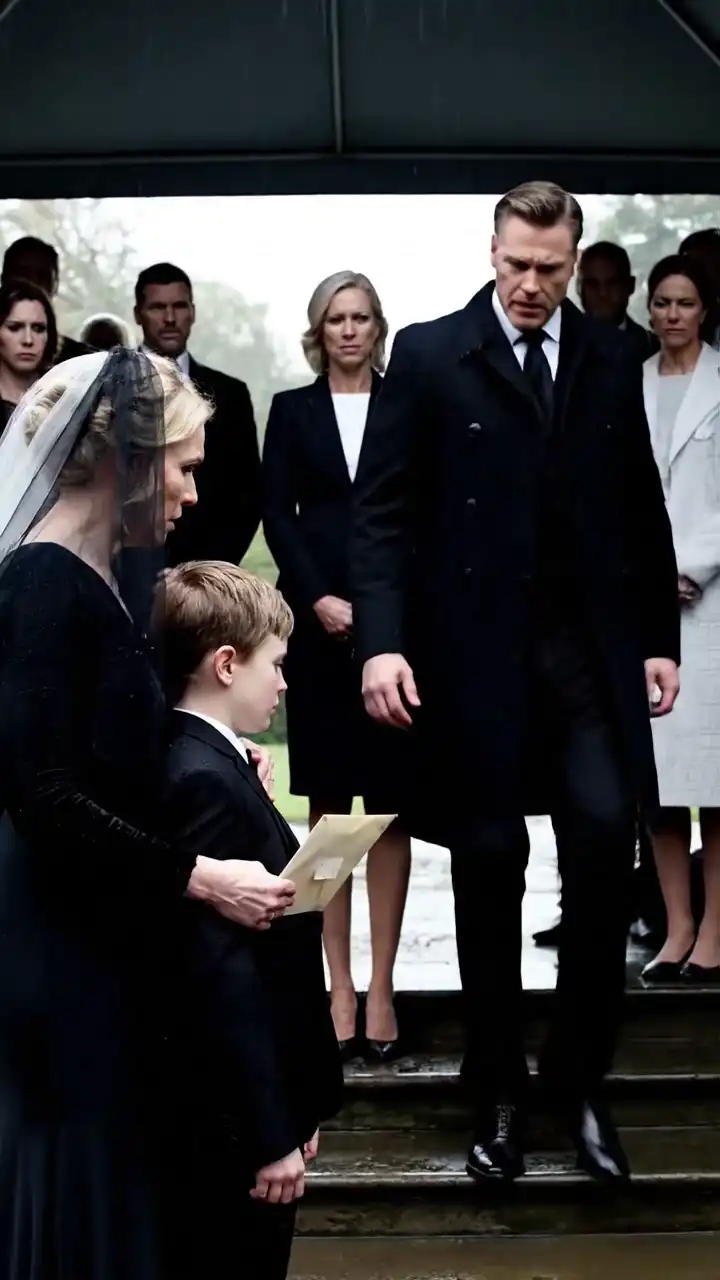
HE STOOD IN MY HUSBANDS FUNERAL AND SAID I WAS NEVER REALLY HIS WIFE
Chapter 1
The first thing people saw was the envelope in my hand.
It was cream-colored, sealed, and slightly bent where my fingers had pressed too hard into the paper all morning. I had tucked it under my black clutch when I got out of the car at Ridgeway Memorial Chapel in Bellmere, but by the time the service ended and people spilled out under the gray awning, I was holding it again without realizing it. Maybe because it was the only thing Ellis had left me that made no sense.
My son, Jonah, stood beside me in a little black blazer that had belonged to my nephew two years earlier. He was eight, all elbows and worried eyes, and he kept pressing himself against my side as if he could feel the room turning.
The pastor had barely finished saying, “May we carry him in mercy,” when a man I had never seen before stepped out from the line of mourners and blocked our path.
He was tall, sharp-faced, and dressed too well for grief. His black coat fit like it had been tailored that morning. Rain spotted his shoulders. He looked at me once, then at the envelope, then back at me like he already knew exactly what it was.
“You shouldn’t be holding that,” he said.
The crowd didn’t move, but it leaned.
I tightened my fingers. “Excuse me?”
“That envelope doesn’t belong to you.”
Jonah looked up at me. “Mom?”
I put my hand on his shoulder. “Stay close.”
The man took one step nearer, enough for the people behind him to stop pretending they weren’t listening. On the chapel steps, my sister-in-law Trina lifted her chin like she had been waiting for a scene all day.
The man said it louder this time. “You were never legally entitled to any of Ellis Vance’s documents.”
For one second I thought I had misheard him. Funeral air does strange things to the body. You hear words as if they are coming through water.
Then Trina said, clear as a bell, “Tell them your name.”
He turned slightly, as if he were being introduced at a banquet and not at my husband’s funeral.
“Graham Sutter,” he said. “I’m Ellis’s attorney.”
A murmur moved through the crowd.
I stared at him. “Ellis had a lawyer?”
Graham didn’t soften. “For the last fourteen months, yes.”
Fourteen months. Ellis had been dead for four days, but I could still count backward with painful clarity. Fourteen months ago he had started making those long drives to Ashcreek. Fourteen months ago he had become more careful with his phone. Fourteen months ago he had also started bringing home groceries in double, leaving sticky notes for Jonah, and looking at me at dinner like he wanted to tell me something and couldn’t.
Trina came down one step, then another, one hand resting against the silver cross at her throat. She was Ellis’s younger sister and had spent the entire visitation greeting people like she was the widow.
“You really should stop this now, Maren,” she said.
I felt every face land on me.
Stop what.
As if I had done something beyond standing in the wrong place in black shoes that pinched.
“I buried my husband this morning,” I said. “I’m not doing anything.”
Graham looked at the envelope again. “That was delivered in error.”
“It was brought to my house.”
“Because your address was still on file.”
Still.
The word hit harder than it should have.
Jonah squeezed my hand. “Mom, are we leaving?”
Before I could answer, Trina folded her arms and said the thing that split the air open.
“You need to stop calling yourself his wife.”
The silence after that was so total I could hear rain ticking off the awning into the flower beds.
Someone in the back whispered, “What?”
My ears rang.
I laughed once, because shock sometimes comes out sounding like the wrong emotion. “I’m sorry?”
Trina’s eyes were red but cold. “Ellis ended things. Legally, maybe not how they should have been handled yet, but everyone close to him knew. You two weren’t a real couple. You were living in his house. That’s not the same thing.”
A few people looked away.
A few did not.
Humiliation has a heat to it. It starts in the chest, then climbs your throat and settles behind your eyes. I could feel it happening while Jonah stood close enough to hear every word.
Graham extended his hand. “Give me the envelope, Mrs. Holt.”
I almost missed that name.
Not Vance. Holt.
My old name. The name from before Ellis, before Jonah, before all the years I had spent learning the shape of a life built halfway out of love and halfway out of survival.
“Why did you call me that?” I asked.
He blinked, then seemed annoyed with himself. “Maren, give me the envelope.”
Jonah looked from me to Trina to the man in the black coat. “Why is he calling you not his wife?”
No one answered him.
I crouched down fast, because if I stayed standing I might have fallen. “Baby, we’re going home in a minute.”
“Were you Dad’s wife?”
The question was so small, and it hurt more than any accusation.
“Yes,” I said, looking only at him. “Yes, I was.”
Trina made a sharp sound in her throat. “That depends on what paper you want to look at.”
I stood back up slowly. “Then maybe we should all look at paper.”
The envelope shook in my hand. I hadn’t opened it because the front was addressed in a line of formal type that made my stomach turn.
To Be Opened Only In The Presence Of Dr. Naomi Kessler
That was all.
No firm name. No explanation. Just Ellis’s handwriting below it, slanted and familiar.
For Maren
The moment Graham saw the front, something in his expression changed. Not panic exactly. More like calculation interrupted.
“Where did you get that?” he asked.
“At my mailbox.”
“That document was not supposed to go to you before review.”
“Review by who?”
He didn’t answer.
Instead, Trina stepped closer and lowered her voice enough to make it crueler. “Maren, please. Don’t make this uglier.”
Uglier.
I looked around at the mourners pretending not to listen, at the drooping white lilies around the chapel doors, at the hearse still idling by the curb because the burial had been delayed by rain. My son was holding my coat with both fists. My husband was in a polished casket thirty feet away.
It was already ugly.
“Who is Dr. Naomi Kessler?” I asked.
At that, an older woman near the doorway sucked in a breath. I recognized her vaguely from the hospice unit, one of the volunteer coordinators.
Graham said, “This is neither the place nor the time.”
“That didn’t stop you.”
He held out his hand again. “Give it to me.”
I didn’t.
Then a quiet voice came from behind the cluster of mourners.
“She should keep it.”
Everyone turned.
A woman in a charcoal coat stood near the chapel door holding a folded umbrella and a leather satchel. She was in her late fifties, silver hair pinned back, no makeup, tired face. I knew her after a second from the hospital corridor where Ellis had spent his last week.
Dr. Naomi Kessler.
She looked straight at the envelope in my hand.
“That letter was left under medical witness,” she said. “If Ellis named her, it stays with her until it is opened.”
Trina’s face tightened. “You had no right to come here.”
Naomi’s eyes moved to her. “I came because your brother asked me to.”
You could feel the crowd lean again.
Graham exhaled once, controlled and irritated. “Doctor, with respect, legal disposition is not your lane.”
“No,” she said. “But truth is.”
For the first time that morning, I felt something other than shame.
Not relief. Relief was too generous.
It was the sharp, dangerous feeling that comes right before a locked door opens.
Chapter 2
The burial was postponed another hour because the cemetery road had flooded, but after what happened on the chapel steps, no one cared about the weather anymore.
People clustered under umbrellas and talked in careful little knots. Some tried not to look at me. Some stared openly. The worst were the ones who gave me that thin, pitying glance people reserve for women they think have been stupid in public.
I knew the look. I had worn it before, after Jonah’s father left when I was twenty-three and pregnant, after rent notices, after waitressing double shifts at Mason Dock Grill while pretending I wasn’t counting quarters in my apron pocket. Bellmere had always been the kind of town that could turn a person into a cautionary tale by supper.
When I married Ellis Vance six years later at the county clerk’s office in Dunbar, I thought I was done being looked at that way.
Now I stood under a funeral awning in a black dress from a clearance rack, clutching a sealed envelope while my dead husband’s sister implied I had invented my own marriage.
Naomi Kessler came to stand beside me as if we had planned it. Up close, she smelled faintly of rain and hospital soap.
“Is there somewhere private?” she asked.
“Not with that many people watching.”
She glanced toward Jonah, who was sitting on a bench with a paper cup of hot chocolate one of the church ladies had found for him. “Then not here.”
Graham intercepted us before we could move. “Doctor.”
She did not stop walking. “Mr. Sutter.”
He fell into step anyway. “You understand that whatever is in that envelope may affect probate.”
Naomi said, “I understand your client didn’t want it buried.”
“My client is deceased.”
She looked at him. “Exactly.”
I had reached the limit of what my body could hold without exploding. “Can someone please tell me what is happening?”
They both looked at me then, and I hated that I still felt like the least informed person in my own life.
Naomi spoke first. “Your husband asked me to witness a sealed statement and a legal packet three days before he died.”
The words landed in pieces.
“Legal packet,” I repeated. “Why would my husband leave legal documents with his doctor?”
“Because he believed they might disappear if he didn’t.”
I looked immediately at Graham. He gave a tiny, offended shake of his head, but not a surprised one.
“Disappear where?” I asked.
Naomi did not answer directly. “He was weak. He could not get to a notary office, and he did not trust delay.”
A cold feeling spread through me.
Ellis had pancreatic cancer. By the end, pain and medication had flattened time into fragments. There were days he knew me instantly and days he looked at the wall before remembering what room he was in. But three days before he died, he had squeezed my wrist and said, “If anyone says I left you blind, don’t believe them.”
I had thought he meant emotionally. I had thought he was apologizing for dying.
Now I wasn’t sure what he had meant at all.
“What packet?” I asked.
Naomi glanced toward Graham. “It should be opened with all interested parties present.”
Trina appeared beside us as if she had been summoned by the phrase interested parties.
“That can be arranged,” she said. “At Ellis’s house.”
My house, I almost said.
Then I stopped myself.
That was exactly how people got trapped. They used the language of possession before the facts were stable.
Jonah walked over, clutching the hot chocolate with both hands. “Are we going home now?”
Trina’s gaze dropped to him, and for one quick second I saw something softer in her face. It vanished just as fast.
“We need a little more time,” I told him.
“Because of the envelope?”
“Yes.”
He looked at it like it might start talking. “Did Dad write in it?”
“I think so.”
“Then don’t let them take it.”
His voice was quiet, but Graham heard him. So did everyone within six feet.
A flush crept up my neck. Children had no instinct for social softness. They walked straight into the center of what adults were trying to blur.
Naomi nodded once, almost to herself. “He knows.”
“Knows what?” I asked.
But she only said, “Bring him with you.”
So an hour later, after the grave service passed in a daze of wet grass, mud, and folded flags of sympathy, a dozen people ended up in the living room of the house Ellis and I had shared on Alder Brook Road.
The house was full of casseroles and funeral flowers and the stale heat of too many bodies in black coats. The framed school picture of Jonah on the mantel suddenly seemed indecently intimate with strangers in the room.
Graham stood near the fireplace with a leather portfolio.
Trina remained by the front window, arms crossed.
Ellis’s cousin Daryl sat on the edge of the armchair like he had come hoping for drama and gotten front-row seats.
Mrs. Wilburn from next door had inserted herself by offering coffee and never leaving.
And Naomi placed her satchel carefully on our dining table and looked at me.
“Before this is opened,” Graham said, “I need to state for the record that any document executed during advanced illness may be subject to challenge on competency grounds.”
Naomi said, “Then state also that Ellis Vance was oriented to person, place, date, and intent when he signed.”
Graham’s mouth tightened. “You evaluated him?”
“I treat dying people, Mr. Sutter. I know when a man is confused, and I know when a man is frightened.”
No one spoke after that.
I broke the seal with my thumbnail.
For a second I couldn’t unfold the paper because my hands had gone numb. Then I forced them steady.
The first page was a typed statement with Ellis’s signature at the bottom and Naomi’s witness signature below it.
The second was a photocopy of a marriage certificate.
My marriage certificate.
Issued in Mercer County seven years ago.
I stared at it until the words blurred.
Date of marriage. My name. Ellis’s name. The county seal.
Then the next line.
Bride: Maren Elise Holt
Groom: Ellis Daniel Vance
Valid and recorded
My head lifted.
“Why would anyone question this?”
But Graham was already looking at something else in the packet with a face I couldn’t read.
Naomi said quietly, “Keep going.”
There was another certificate beneath it.
I pulled it free.
It was also a marriage certificate.
Same groom.
Different bride.
Dated nine years earlier in Haviland, Tennessee.
Bride: Corinne Leigh Sutter
My lungs forgot how to work.
The room changed shape around me.
Trina closed her eyes.
Graham looked down.
And suddenly I understood why he had looked at me on the chapel steps as if I were standing in the wrong place.
“Corinne,” I said, the name barely leaving my mouth. “Sutter.”
I looked at Graham.
His voice, when it came, was low and flat. “Corinne was my sister.”
Jonah tugged my sleeve. “Mom?”
I could not answer him.
Because in that moment, with two marriage certificates on my dining table and my dead husband’s attorney staring at them like a wound he had expected but still hated to see, I realized the first terrible truth.
Someone had lied for years.
I just didn’t know if the lie had started with Ellis, with Graham, or with the dead woman whose last name was standing in my living room.
Chapter 3
There are humiliations that happen quickly, like a slap.
And there are humiliations that unfold slowly, while people watch your face adjust.
This was the second kind.
No one moved for several seconds after I found the second certificate. I could hear the ticking of the wall clock in the kitchen and the soft scrape of Jonah’s shoe against the hardwood.
Then Daryl let out a breath. “Jesus.”
Graham shot him a look that shut him up.
I read the second certificate again, because maybe my eyes were wrong. Maybe grief was making words rearrange themselves.
But they did not change.
Corinne Leigh Sutter had married Ellis Daniel Vance in Haviland nine years earlier.
Nine years earlier meant two years before he married me.
Two years before he stood in a county clerk’s office and slid a cheap ring on my finger while Jonah played with a toy truck on the floor.
Two years before he told me, “I know I’m late to your life, but I’m here now.”
I sat down hard in the dining chair because my knees had started shaking.
“Was he married to her when he married me?” I asked.
Graham answered like a man forcing each word through his teeth. “Legally, yes. Unless there was a divorce decree we never found.”
“Never found?”
“My sister disappeared from Bellmere eight years ago. She struggled with opioid dependency. She left without notice. Ellis reported that he hadn’t seen her in months. No divorce was filed in Tennessee, Missouri, or here.”
The room smelled suddenly sour, like cold coffee and funeral flowers turning.
“So your sister vanished,” I said. “And you let me marry him?”
Graham’s expression changed for the first time. Not softer. Sharper.
“I didn’t know about you at first.”
“At first?”
“He kept your marriage quiet.”
Trina looked away.
I turned toward her. “You knew?”
She took a long breath. “I knew there were problems.”
“That is not what I asked.”
Her eyes came back to mine, full of old anger and new shame. “I knew Ellis had married Corinne. And I knew he claimed she was gone for good.”
“Gone for good is not divorced.”
“I know that now.”
“No,” I said, my voice rising before I could stop it. “No, you knew that then. You just didn’t care because it was easier to let me look foolish later than make your brother look dirty then.”
Jonah flinched at my tone. I immediately hated myself for it.
Naomi stepped in. “Maybe the child should be in another room.”
“No,” Jonah said at once, and his face was pale but stubborn. “I’m staying with Mom.”
No one argued with him.
Mrs. Wilburn, who had no business being there but had become part of the furniture, whispered, “That poor boy.”
I wanted to scream at her.
Instead I picked up Ellis’s statement with fingers that no longer felt attached to me.
The first lines were in the clean, practical language he always used when he was trying not to sound afraid.
If this packet has been opened, then I am either gone or unable to stop people from talking over me.
I swallowed and kept reading.
I know what it looks like on paper. I know what I failed to fix in time.
Maren, if they have told you that you were never my wife, they are using the law to hide the whole truth instead of facing it.
The whole room seemed to lean inward.
I read aloud because my voice was the only thing keeping me from collapsing.
“Corinne and I married when we were both too young and too damaged to know what marriage required. We lived together less than a year. By the end she was using heavily, disappearing for days, and signing my name to debts. I should have filed immediately when she left, but I was ashamed, broke, and stupid. Later I was told she had died in a motel outside Tulsa. I believed it because I wanted a clean ending.”
Graham closed his eyes.
My mouth went dry. “Told by who?”
Naomi said, “Keep reading.”
“I later learned there was no death certificate and no confirmed identification. By then Maren and Jonah were my family. I delayed again. Every month I delayed, the thing became harder to confess.”
The words blurred for a second. I steadied the page.
“I did marry Maren in good faith and in full love, knowing too late that my first marriage may still have been active in law. If that invalidates what we were on paper, it does not invalidate what we were in life. She is the person who cared for me, built my home, and raised our son under my roof with more loyalty than I deserved.”
Our son.
The room went very still.
I read the line again in silence because I thought grief had made me insert it.
But there it was.
Raised our son.
Jonah looked up at me. “What does that mean?”
My heart slammed once against my ribs.
Ellis had always called Jonah “my boy” in the easy, affectionate way a stepfather does after enough years. Jonah’s biological father, Ben Creed, had signed away contact when Jonah was three. There had never been confusion about that. At least none I knew of.
Graham noticed my face. “There are more pages.”
There were.
Behind the statement was a legal filing draft, unsigned by the court but prepared for submission. Petition to establish paternity. Attached affidavit. Private DNA result.
The paper slid in my hand.
“No,” I whispered.
Naomi’s voice was gentle. “Read the date.”
I did.
The DNA test had been done six years earlier.
Six years.
One year before Ellis and I married.
Jonah was standing beside me now, trying to see the pages. I turned them down without thinking.
Graham spoke into the silence. “My God.”
I looked at him with a fresh kind of fury. “You knew enough to accuse me at a funeral, but not enough to know this?”
“I knew Ellis was hiding things. I did not know this.”
Trina had gone white. “He thought Jonah was his?”
Naomi answered for me. “No. He knew.”
The room shifted again.
I heard myself say, “That’s impossible.”
But memory is a cruel thing. Once a hidden truth enters the room, old moments begin standing up inside it.
The summer Ellis had insisted on taking Jonah for bloodwork after a routine school form. The week he drove alone to Kansas City and came back quiet. The night I woke to find him sitting at the foot of Jonah’s bed in the dark. The way he had once said, “Sometimes life starts before people are ready to claim it.”
I had never asked what he meant.
Because women who have already been abandoned once become experts at not asking the question that might take the next thing away.
“Ben is Jonah’s father,” I said, but now the sentence sounded borrowed.
Naomi watched me with the sad steadiness of a person who had carried truth too long for other people. “Did Ben ever agree to testing?”
“No.”
“Did Ellis ever tell you he had?”
“No.”
Then I knew.
Not all of it. But enough for the floor to tilt.
Years ago, before Ellis and I had ever admitted what we were becoming, there had been one terrible month after Ben left and before the world settled into the story I later told everyone. I was angry, lonely, ashamed, and barely holding together. Ellis had been a friend then. He helped me move boxes from my apartment on Kessel Street. He brought groceries. He sat on the floor with Jonah, who was still in diapers, and made a stuffed dog bark in a ridiculous voice until I laughed for the first time in weeks.
One night I had cried in his truck so long he drove me nowhere, just kept the engine running so I could fall apart in heat instead of in the cold parking lot outside my apartment.
We crossed a line that month.
Only once, I had told myself.
Only once, and too late to matter.
I pressed my hand over my mouth.
Trina stared at me. “You didn’t know?”
I shook my head.
And that was the ugliest part. The thing everybody in the room could now see plainly on my face.
The single mother. The overlapping timelines. The dead husband. The invalid marriage. The child at the center. The whole thing looking from the outside exactly like the kind of mess people warn their daughters not to become.
Jonah’s voice trembled. “Mom?”
I dropped to my knees in front of him.
“Baby, listen to me.” My throat hurt. “Nothing about your dad loving you changes. Do you hear me? Nothing.”
“But why are they saying papers?”
Because adults ruin love with documents. Because law catches what life does while nobody is looking. Because truth arrives with dates on it.
Instead I said, “Because we’re finding things out too late.”
He started crying without sound, tears just spilling down his face. I held him against me on the dining room floor while the adults stood around us with legal papers and guilt.
No one had to say it out loud.
To anyone watching, I was exactly what they had accused me of being.
A woman publicly stripped of the life she claimed.
Only I had the sickening feeling that Ellis had not hidden all this to deceive me.
He had hidden it because he was trying, badly and too late, to protect something.
I just still didn’t know what.
Chapter 4
By evening, the casseroles were untouched, the flowers had started dropping petals on the mantel, and half the town probably knew some version of what had happened in my dining room.
I sent Jonah upstairs with my cousin Lila, who had finally arrived from Carrow Bend and took one look at my face before saying, “I’ll handle the child. You handle the fire.” God bless women who know when not to ask first.
Downstairs, only four of us remained at the table.
Me. Trina. Graham. Naomi.
The legal packet lay open between us under the yellow cone of the dining light.
Rain tapped against the window over the sink. The house sounded strange without funeral traffic, like it was waiting to hear what it had become.
“I want everything,” I said. “No more half-truths. No more protection. No more waiting for the right time.”
Graham rubbed a hand over his mouth. He looked older now than he had at the chapel, less polished, more tired. “Then I’ll start with the worst part.”
“Good.”
He glanced at Trina, then back at me. “Corinne did not disappear on her own the way Ellis told people.”
My hands curled under the table.
“She came back once,” he said. “Five years ago. She came to my office in Haviland first, not Bellmere. She was sober, thin, and furious. She said Ellis had abandoned her and built a new life while she was alive on paper and invisible in every other way.”
“Alive on paper,” I repeated.
“She wanted money.”
Trina made a bitter sound. “There it is.”
Graham ignored her. “I told her if she wanted legal action, she needed to file formally. She said she didn’t want a courtroom. She wanted leverage.”
I looked at the paternity affidavit. “Against Ellis.”
“Yes.”
“How did she know about Jonah?”
His eyes shifted to the side for the first time. “Because Ellis told her too much.”
I sat back.
The story was beginning to take shape now, jagged and ugly.
Corinne reappears. She learns Ellis has a home, a woman, a child. She learns the marriage may be invalid. And then what? She threatens him? He panics? He pays her?
Naomi answered before I asked. “He told me he was being blackmailed.”
Trina turned to her. “You knew that?”
“He told me near the end. Not the whole chain. Just enough.”
Graham nodded reluctantly. “Corinne contacted Ellis directly after leaving my office. I don’t know how she found him. She demanded monthly payments in exchange for staying away and not contesting anything publicly.”
“Anything,” I said. “Meaning me. Meaning Jonah.”
“Yes.”
I laughed once, and it was ugly. “So everyone was protecting me by letting me live in a lie.”
“No,” Trina snapped, sudden and raw. “I was protecting my brother from dying hated.”
I looked at her.
The truth had finally worn through her posture. She no longer looked like a woman guarding a reputation. She looked like a sister who had spent years carrying anger she didn’t know where to set down.
“He was ashamed,” she said. “Do you understand that? He knew what he did. He knew he should have told you. Every time he was going to, something got worse. Corinne wanted more money. His business slipped. Then he got sick. He kept saying he needed one clean week to fix it all.”
“One clean week,” I said. “He had six years.”
Her eyes filled. “I know.”
Naomi opened another folded sheet from her satchel. “There’s more.”
We all looked at her.
“This was not inside the main packet because Ellis hadn’t decided whether to include it. He told me if the funeral turned hostile, I should bring it out.”
“Bring what out?” I asked.
She slid the paper toward me.
It was a handwritten note. Ellis’s handwriting, unsteady but unmistakable.
Maren
If Graham is there, he needs to tell you what he never did
I felt a chill.
I looked up at him. “What didn’t you tell me?”
Graham’s jaw tightened. “This is unnecessary.”
Naomi said, “No, it isn’t.”
“Tell me,” I said.
He stared at the table for so long I thought he might refuse.
Then he said, “Corinne is dead.”
The room seemed to contract around the sentence.
Trina whispered, “What?”
He looked at none of us as he spoke. “She died eighteen months ago in a recovery housing fire outside Green Hollow, Arkansas. I was notified because my office had once represented her in a debt matter and my name was in an old emergency contact file. The identification took time. By then Ellis had already sent money for years under a private arrangement through intermediaries.”
I could barely hear him over the pounding in my ears. “You knew she was dead.”
“Yes.”
“And you said nothing?”
“I intended to verify whether there had been any posthumous claims, any estate complications, any”
“No.” My voice cut across his. “Not lawyer words. Human words.”
He finally met my eyes.
“I said nothing because by then Ellis was terminal, and I thought if I reopened it, my sister would still manage to destroy another house from the grave.”
The sentence stunned all of us.
Naomi was the first to recover. “So you let him die trying to fix a marriage barrier that no longer existed.”
Graham’s face hardened in self-defense. “A prior death does not erase years of fraud.”
“No,” she said. “But it changes what could have been repaired in time.”
I understood then why Ellis had become frantic near the end.
He must have learned Corinne was truly dead. He must have realized the obstacle he had lived under for years had changed. He must have tried to repair the record, establish Jonah legally, secure the house, protect me. And he had run out of time.
“Did Ellis know before he died?” I asked.
Graham nodded once. “Three weeks before.”
I put my hand over my eyes.
Three weeks.
I was still arguing with insurance forms and pill schedules and whether he could keep broth down. I was changing sheets at 3 a.m. while he apologized for needing help to stand. And somewhere inside that same house, he was rushing to build a legal bridge over the hole he had opened years ago.
“That’s why he hired you,” I said.
“Yes.”
“To fix it.”
“To the extent it could be fixed.”
“And instead you came to his funeral and humiliated me.”
His answer was immediate, almost defensive from shame. “Because I saw the envelope and assumed he had left you only the part that made me the villain.”
“You are a villain in this part.”
He did not deny it.
I looked down at the papers again. Beneath the paternity affidavit was one final document I hadn’t fully read. It was a draft transfer deed for the house on Alder Brook Road, naming me and Jonah as beneficiaries through a survivorship trust contingent on attached declarations.
“Why is this unsigned?” I asked.
Naomi said quietly, “Because the mobile notary was delayed the day he crashed.”
I stared at her. “Crashed?”
Trina’s head lifted. “You told her the infection caused the decline.”
“It did,” Naomi said. “But the final emergency happened after he got out of bed alone trying to reach his study. He fell. He struck the desk and fractured two ribs. That stress accelerated everything. When I found him, he was on the floor next to his file box.”
I couldn’t breathe for a second.
He had been trying to reach the papers.
Even half-conscious, half-broken, dying by inches, he had still been trying to get there first.
Jonah came halfway down the stairs then, barefoot, face washed but swollen from crying. He should not have heard any of it, but old houses carry pain well.
“Mom?”
I stood at once.
He clutched the banister. “Did Dad know I was his?”
No one in the room moved.
This was not a legal question. This was not an inheritance question. This was a child standing on a staircase asking whether he had been fully seen.
I went to him and sat on the step below so I was level with his face.
“Yes,” I said.
His mouth trembled. “For how long?”
“A long time.”
“Then why didn’t he tell me?”
I could have given him the adult answer. Complexity. Timing. Fear. Shame. Paperwork. Disease.
But children hear excuses as absence.
So I told him the truest thing I had.
“Because grown-ups can be cowards even when they love you.”
He started crying again, and this time so did I.
He came down two steps and wrapped himself around my neck. Over his shoulder I saw Trina cover her mouth. I saw Naomi bow her head. I saw Graham stare at the legal packet like it had finally become heavier than he could hold.
That was the moment the room changed.
Not because the law had spoken yet.
Because the shape of the hidden life inside our house had finally become impossible to deny.
Chapter 5
The next morning, Bellmere woke hungry.
By nine o’clock, two women from church had called to “check on me,” which meant they wanted to hear whether I had truly been living in sin by technicality, whether Jonah was Ellis’s son by blood, and whether the Vance house would be tied up in court. I let both calls go to voicemail.
At ten, a reporter from the Bellmere Ledger left a message asking if I wanted to comment on “questions surrounding the estate.”
At eleven, Graham returned.
When I opened the door, I almost shut it again.
He looked like he had not slept. His suit was gone. He wore a plain navy sweater and carried a thick file box with both hands.
“I deserve that,” he said, glancing at the door. “But if you let me in, I can finish what should have been finished before the funeral.”
I let him in because rage gets tired, and because the truth, once started, behaves badly if you try to pause it.
Naomi arrived twenty minutes later. So did Trina, eyes swollen and silent. Lila took Jonah to the kitchen and turned cartoon volume up high enough to give us a thin wall of mercy.
Graham set the file box on the table.
“This contains every transfer receipt, correspondence record, and death confirmation related to Corinne, plus Ellis’s retained drafts and my office notes.”
“Why bring all of it?”
“Because if I hide one thing now, I’ll spend the rest of my life proving I’m exactly what you think I am.”
I folded my arms. “And are you?”
He considered that. “Parts of it, yes.”
There was something strangely useful about a person who no longer defended every inch of himself.
He opened the first folder.
The receipts showed cash transfers through money orders and third-party drop points over four years. Not enough to make Ellis rich or poor, but enough to keep him strained. Enough to explain why he sometimes said he was covering old business debt and changed the subject when I offered to take extra shifts at the dental office.
The next folder held messages.
Not many. Corinne had been careful.
One read: Tell your new family my name if you want trouble Another: Monthly means monthly Another: Don’t make me become visible
Trina looked sick reading them. “She enjoyed this.”
Graham said, “She enjoyed control. That’s not always the same thing.”
Then came the Arkansas report. Residential fire. Three fatalities. One confirmed as Corinne Sutter through dental records and state ID.
Date of death: eighteen months earlier.
I pressed my fingertips against the page.
Ellis had spent a year and a half fearing a woman who was already dead.
Or worse, paying people who knew she was dead and kept the scheme alive.
“Who kept collecting after she died?” I asked.
Graham slid over another sheet. “That’s the part I confirmed this morning.”
A name stared up at me.
Daryl Vance.
Ellis’s cousin. The man at my table yesterday. The man who had said Jesus like he was just a spectator to the wreck.
Trina actually stood up. “No.”
Graham nodded grimly. “He had access. He met Corinne once years back when she surfaced. He likely knew the channels. After her death, the collection point never changed because Ellis didn’t know she was dead and no one had reason to suspect the sender had.”
A hot, bright anger went through me so fast it almost steadied me.
“You’re telling me Ellis was being blackmailed by a dead woman and robbed by his own cousin.”
“Yes.”
“And you’re only certain now.”
“Yes.”
Naomi said, “Then call the police.”
“I have,” Graham replied. “And before you ask, yes, I also notified probate court of the newly discovered conflict and of potential fraud affecting the estate.”
For the first time since the funeral, I believed he might actually be trying to make something right.
Lila appeared in the doorway. “Jonah wants to know if he can come in.”
I hesitated.
Naomi said softly, “He shouldn’t hear about the fraud.”
But Jonah was listening already. Children always were.
He came in carrying the stuffed dog Ellis had bought him from a highway gas station years ago. One ear was hanging by a thread.
“Are we losing the house?” he asked.
The directness of it broke me more than tears would have.
“No,” Graham said before I could answer.
We all looked at him.
He crouched so he was at Jonah’s eye level. “No. Your father left clear intent. There will be paperwork and court filings, but no one is putting you and your mother out of this house.”
Jonah studied him carefully. “You were mean at the funeral.”
Graham took that without flinching. “Yes.”
“Why?”
“Because I thought I knew the whole story, and I didn’t.”
Jonah held his stuffed dog tighter. “That was dumb.”
A sound escaped Trina then, half laugh, half sob. “He got you there.”
Graham almost smiled. “He did.”
The rest of the day unfolded with the strange, surgical pain of truth being sorted.
Naomi testified formally in writing to Ellis’s competence at the time of signing. Graham prepared emergency filings to recognize Ellis’s paternity posthumously based on existing DNA evidence and affidavit. He also moved to validate Ellis’s expressed intent to provide for me and Jonah through equitable relief, given that the original marriage had been entered in good faith by at least one spouse who had no knowledge of impediment.
I didn’t understand every phrase. I understood enough.
The law could not give me back an uncomplicated widowhood. It could not return the years of not knowing. It could not make our marriage simple.
But it could stop strangers from erasing what Ellis had tried, too late, to secure.
By late afternoon, the police called. Daryl had admitted “redirecting” payments after Corinne’s death. He claimed he intended to tell Ellis eventually. Men say eventually when they mean never under pressure.
Trina sank into a chair when she heard. “He sat in this house and watched you cry.”
“Yes,” I said.
She covered her face. “I helped him do it.”
That wasn’t exactly true. But it wasn’t exactly false either.
She looked at me over her hands. “I hated you for years.”
At that point, honesty felt almost clean. “I know.”
“I thought you got the version of Ellis the rest of us paid for. The calm one. The devoted one. The man who showed up with groceries and fixed sinks and took your son fishing. I got the brother who kept making damage and asking for loyalty after.”
I sat across from her. “I didn’t get a cleaner version. I just got a later one.”
Tears slipped down her cheeks. “He loved that boy.”
“I know.”
“He loved you too.”
I looked toward the kitchen where Jonah’s voice drifted faintly with Lila’s. Then I looked at the file box, the certificates, the affidavits, the ugly architecture of love after law had cut into it.
“I know that too,” I said. “That’s what makes it hurt.”
That evening, after everyone left but Naomi, she stood with me on the back porch as dusk settled over Alder Brook Road. The yard was muddy from rain. Ellis’s work boots still sat by the door where he had kicked them off the last time he was strong enough to come in from the shed.
“I keep thinking,” I told her, “if he had just told me at the beginning, maybe I would have run.”
Naomi was quiet for a moment. “Would you have?”
“Yes,” I said at once.
Then I thought of the first winter storm when Ellis carried Jonah asleep from the car. The braces bill he paid without telling me. The fever nights. The school plays. The gardening gloves left by the sink. The way he learned exactly how I took my coffee and brought it to me before I was awake enough to ask.
My answer weakened.
“I don’t know.”
She nodded. “That’s usually the truer answer.”
I turned the sealed envelope over in my hands again. There was one final slip inside I had missed until then, folded into the lining.
A note.
Three words in Ellis’s shaking hand.
Make them see
I looked up at the dark yard and finally understood.
Not make them forgive. Not make them excuse. Not make them admire.
See.
The whole thing. The wrong. The love. The delay. The child. The fear. The intent. The damage.
Truth does not always clean a story. Sometimes it just makes hiding impossible.
Chapter 6
Three months later, I stood in Family Court Annex B in Dunbar and listened to a judge say my son’s full name into the record.
Jonah Ellis Vance.
Not because paper invented him that day. Because paper had finally caught up.
The paternity order was entered without contest once the DNA affidavit and supporting evidence were admitted. The estate matter took longer, but Graham did what he should have done from the beginning. He argued Ellis’s intent with relentless precision and none of the theatrical distance he had worn at the funeral. The court recognized the house and primary assets as subject to Ellis’s documented directives and equitable protection for me and Jonah.
In plain English, we stayed.
The town adjusted the way towns do.
Some people avoided me because my life had become too complicated to fit inside a casserole conversation. Some became unexpectedly kind. Mrs. Wilburn started bringing over tomatoes from her garden and, to her credit, never asked another invasive question. At church, I caught more than one woman looking at Jonah differently after the court order, as if biology had finally made his place respectable. That angered me in ways I didn’t have language for yet.
Trina came by every Sunday for a while with cinnamon rolls from East Mill Bakery and awkward sincerity. She and Jonah built a strange new peace over card games and stories about Ellis as a boy who once stole a county fair rabbit and kept it in his closet for two days.
One afternoon, while she was washing dishes after supper, she said, “I was cruel to you because I thought truth would shame him. But hiding it shamed everyone instead.”
I dried a plate beside her. “We were all standing under the same roof leak.”
She gave a sad little smile. “That sounds like him.”
Graham stayed formal longer than the rest of us, but even he changed. He returned Ellis’s wedding band after the estate hearing, not in an envelope this time but directly into my palm.
“I can’t tell you what to call your marriage,” he said. “The court can label validity. It cannot measure devotion.”
I closed my fingers around the ring. “No. It can’t.”
Naomi visited less often once the crisis passed, but every now and then she’d stop by with library books for Jonah or cuttings from her herb garden. She had become part witness, part guardian, part accidental family.
At the end of summer, Jonah asked if we could go to the cemetery alone.
The day was hot and bright, not at all like the funeral. Bellmere Cemetery looked almost ordinary, rows of stones in clipped grass under a blue sky that made grief seem rude.
Jonah knelt in front of Ellis’s marker and set down the stuffed dog with the loose ear.
He didn’t cry.
He just touched the stone with two fingers and said, “You should’ve told us sooner.”
The breeze moved through the maples overhead.
I stood beside him and answered the silence anyway.
“Yes,” I said. “He should have.”
Jonah looked up at me. “Can I still call him Dad?”
My throat tightened.
“Always.”
He nodded, satisfied in the practical way children sometimes accept what adults complicate for years. Then he asked, “Do you still call him your husband?”
I looked at the engraved name.
Ellis Daniel Vance
The man who married me while still bound to another woman by law. The man who loved my son before I knew he was also his. The man who lied, delayed, paid, feared, and then, at the end, tried with everything left in him to leave us protected. The man whose funeral had stripped me in public. The man whose hidden papers had put some part of me back together.
“I call him the man who was ours,” I said.
Jonah considered that. “Okay.”
We stayed there a while longer, not because there was more to solve, but because grief sometimes becomes bearable only after truth stops moving under your feet.
On the walk back to the car, I thought about the chapel steps, the staring mourners, the envelope in my hand, and the sentence that had split my life open.
You were never really his wife.
Maybe the law had a version of that. Maybe records and dates could build a cold argument around it.
But truth was heavier than that.
Truth was the nights he sat beside Jonah’s bed. The money he paid to hold a secret together. The fear that made him late. The documents he dragged himself across a floor trying to reach. The note in his shaking hand. Make them see.
I see now.
He was wrong in ways that changed everything. He was true in ways that mattered anyway.
And that is the hardest kind of inheritance to receive: not a clean name, not a simple love, but the full weight of what really happened.
Truth, I learned, is often heavier than appearances.
But once you can carry it, no one gets to take your life away with a single sentence again.
Disclaimer: Mention of any brand or trademark is for identification only and does not imply partnership or endorsement
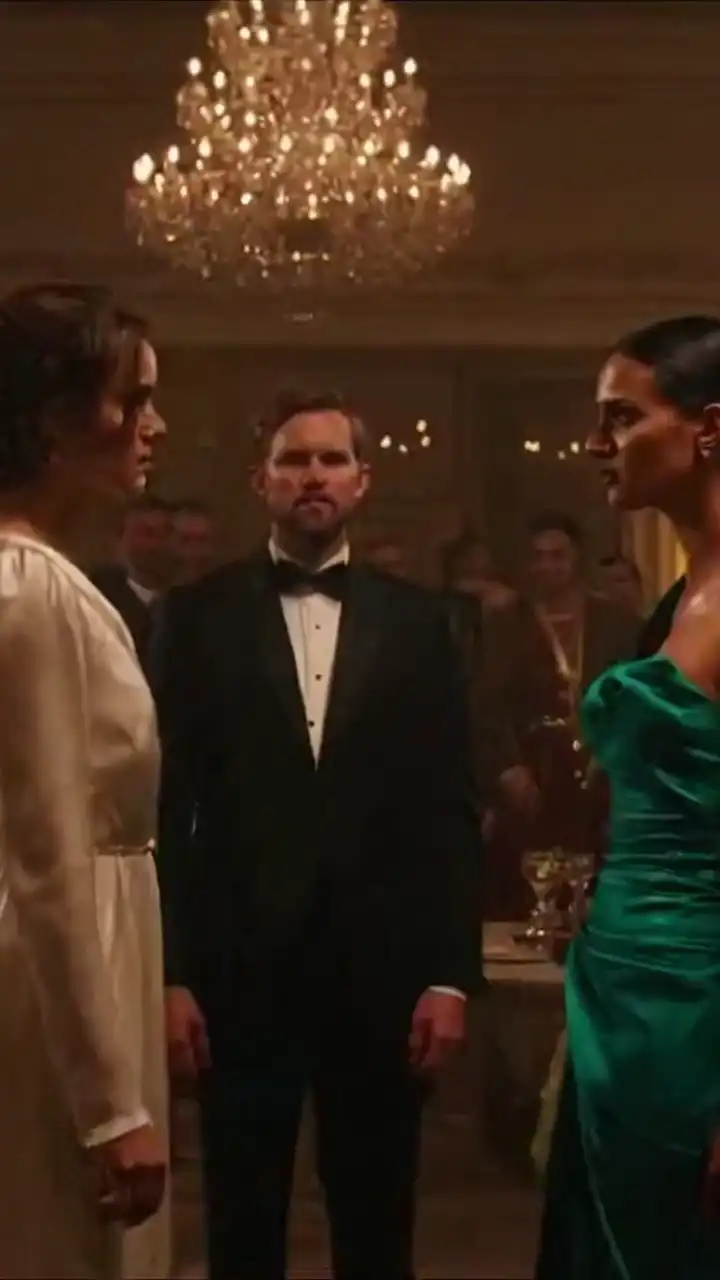
MY HUSBAND USED MY MONEY, GOT ENGAGED TO HIS MISTRESS, AND STOOD THERE WHILE SHE SLAPPED ME

THE MAID OF HONOR POURED WINE ON ME AT MY BRIDAL SHOWER AFTER STEALING MY FIANCÉ. SHE DIDN'T KNOW THE ROOM WAS ABOUT TO HEAR WHAT HE'D BEEN SAYING TO BOTH OF US.

THE MAID OF HONOR POURED WINE ON ME AT MY WEDDING AND CALLED ME CRAZY. SHE FORGOT I STILL HAD THE VOICE NOTE SHE SENT MY FIANCÉ.