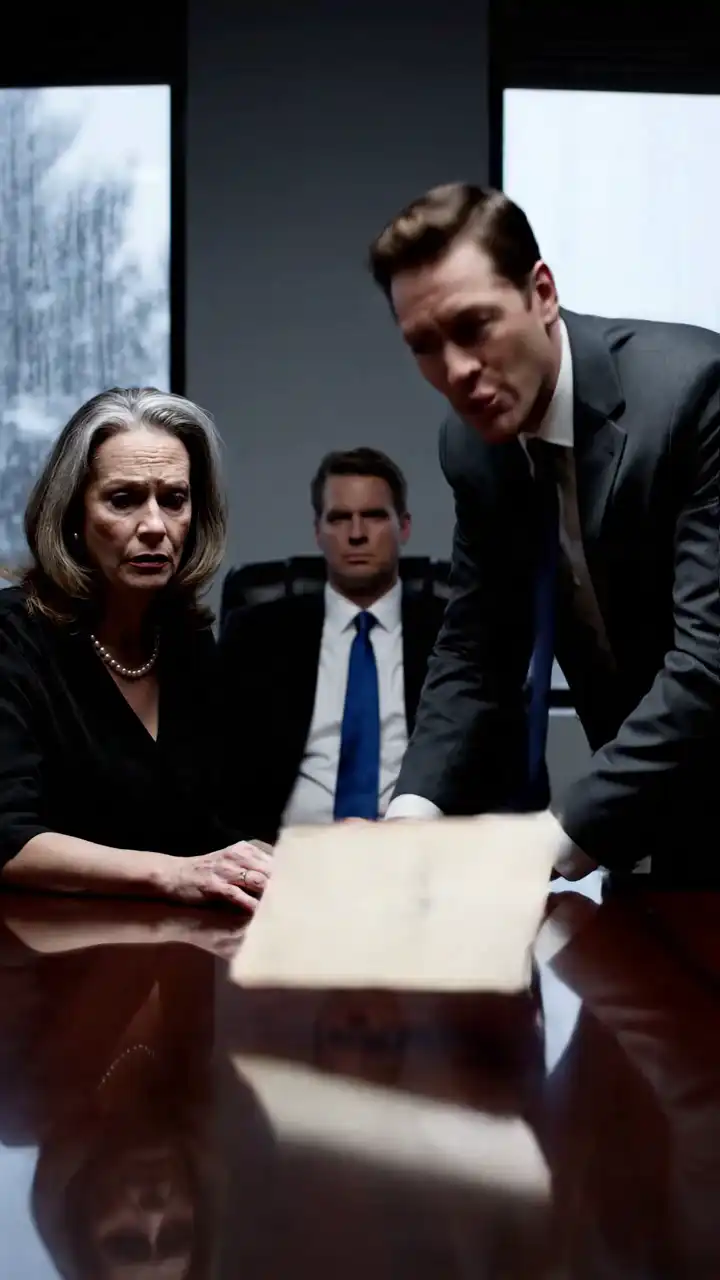
THEY THREW ME OUT OF MY HUSBANDS INHERITANCE UNTIL ONE PHOTOGRAPH STOPPED THE ROOM
Chapter 1
The photograph slid across the polished conference table and stopped in front of me like a slap.
Everyone saw it before I touched it.
A woman in a pale blue dress stood beside my husband, Dean Holloway, under a paper lantern arch. He was younger, darker-haired, laughing in that open way I had only seen in old pictures from before life hardened him. The woman had one hand over her small stomach. Dean’s hand was there too.
Across the table, my brother-in-law Nolan leaned back in his chair and said it softly enough to sound crueler.
“You want his estate, Vera? Then maybe start by explaining her.”
No one moved.
The office at Kessler Pike and Vann smelled like leather chairs, coffee gone cold, and rain drying on wool coats. Outside the windows, downtown Bellmere looked gray and wet. Inside, every eye landed on me with the same question: who was I, really, to claim anything from Dean Holloway?
I had buried my husband twelve days earlier.
I still had the black dress.
I still had the casserole dishes stacked untouched on my kitchen counter.
And now I had a room full of his family watching me as if grief itself had been a trick.
“I don’t know who that is,” I said.
Nolan let out a short laugh. “That’s convenient.”
At the end of the table, the attorney, Celia Pike, kept her expression flat, but I could see the alertness in her eyes. She was trying to keep control of the room and losing it inch by inch.
“Nolan,” she said, “if you have evidence relevant to the administration of your brother’s estate, present it properly.”
“It is relevant.” He tapped the photo with one finger. “Because if Dean had another wife, then this woman”—he looked at me, not even trying to hide his contempt—“might not be a widow at all.”
The word widow had been the only thing keeping me upright these past two weeks. It was ugly, heavy, final, but it was mine. Hearing him say might not be one made my chest go cold.
Across from me, Dean’s sister Marla pressed her lips together and looked down, but not before I caught the flicker in her face. Not shock. Fear.
That scared me more than Nolan.
I picked up the picture. It was old. Glossy. Slightly bent at one corner. On the back, in faded black ink, someone had written June at Lake Wister.
No last names. No date.
The woman did look close to Dean. Close enough to hurt.
Close enough to ruin things.
“I’ve never seen this before,” I said.
“Of course not,” Nolan said. “Because Dean never told you everything.”
There it was. The thing the whole family had been implying since the funeral. That I had married my husband late in his life for comfort, for his nice little brick house on Mercer Row, for his insurance, for whatever they thought a widow collected like coupons after a man died.
The truth was uglier and simpler. I had married Dean at forty-seven after years of working double shifts at Briar County Medical Center, years of helping my first husband through a cancer battle we both knew he would lose, years of living in apartments where pipes rattled and rent climbed. Dean was kind. Dean was steady. Dean fixed cabinet hinges without being asked and put gas in my car before winter storms. We did not have some fairy-tale marriage, but we had a good one. A grown one.
And now I was sitting in a law office while his own brother tried to erase it.
Celia folded her hands. “Mrs. Holloway has a legal marriage certificate on file. If your allegation is that Dean Holloway was previously married and never divorced, we need records, not a loose photograph.”
Nolan was ready for that.
He pulled a manila folder from his briefcase and set it down like a prosecutor in a movie. “Glad you asked.”
My stomach turned.
Marla looked up fast. “Nolan—”
“No, let him,” I said, though my voice came out thinner than I wanted. “If he wants to humiliate me, let him do it all at once.”
That made the room go still in a different way.
Celia opened the folder. I watched her eyes move across photocopied documents. Her face changed, but only slightly. It was enough.
“What is it?” I asked.
She looked at me carefully. “These appear to be records for a marriage license issued in Polk County twenty-nine years ago. Dean Holloway. And a woman named Lena Vale.”
Nolan sat back like the verdict had already come in.
“Say it,” he said. “Say she’s not the legal widow.”
My fingers tightened around the photograph so hard the edge bit my palm.
Celia lifted a hand. “I said appears. I haven’t verified anything.”
“But you think it’s possible,” Nolan pressed.
Marla whispered, “Please stop.”
He ignored her. “Dean always disappeared for chunks of time when we were younger. Dad covered for him. Mom cried over it. We all acted like Dean was the golden boy anyway. Then he comes back years later, marries Vera, and suddenly she thinks she gets everything?”
“I never said everything,” I shot back.
It was the first time I’d raised my voice all morning. The sound bounced off the glass walls and drew a glance from someone passing outside the conference room.
“I came here because your brother died without finishing his paperwork,” I said. “I came here because Ms. Pike said we had to review the will and the beneficiary disputes in person. I came here because I was trying to survive this with some dignity. You’re the one who brought a photograph and a rumor.”
“Not a rumor.”
He pointed at the copy in Celia’s hand.
Celia exhaled slowly. “The issue is not resolved by shouting. If this marriage record is valid and there was no divorce, then yes, the estate becomes more complicated. But right now, no one is being removed from anything.”
Nolan turned to me with that patient, false smile people use when they think they’ve finally trapped someone low enough to deserve it.
“Then tell us why Dean hid her.”
“I can’t tell you what I don’t know.”
“Or who she was,” he said, tapping the photograph again.
At that moment the conference room door opened a few inches and a timid voice came through.
“Mom?”
Every head turned.
My niece Tansy stood in the doorway, soaked at the hem from the rain, clutching the strap of her backpack. She was fifteen and always looked like she wanted to apologize for entering any room. Behind her was Marla’s husband, Brent, who gave an embarrassed shrug.
“School let out early,” he said. “I couldn’t keep her downstairs.”
Tansy looked from my face to the picture in my hand.
Then she said the sentence that made the back of my neck prickle.
“I know that photo.”
The room changed.
Nolan frowned. “What?”
Tansy took one careful step inside. “I’ve seen it before. At Grandma Iris’s house. In the cedar chest upstairs.”
Marla went pale. “Tansy—”
“No,” Celia said at once. “Let her speak.”
Tansy swallowed. “There were two copies. One had writing on it. Grandma called it the Lake Wister picture.”
I stared at her. “Who was the woman?”
Tansy hesitated. Her eyes moved to Nolan, then to Marla, then back to me.
“I thought it was you,” she said.
Chapter 2
For a second, I truly thought I might faint.
The room tilted, not because what Tansy said made sense, but because it didn’t. I was fifty-two years old. The woman in the photo looked maybe twenty-three. I had never been to any place called Lake Wister. I had no secret past tucked away in cedar chests.
Nolan recovered first. “That’s ridiculous.”
Tansy flinched at the sharpness in his voice.
Celia gestured to the empty chair near the wall. “Come in, sweetheart. Sit down if you want.”
Tansy did not sit. She stood with her backpack hanging from one shoulder, rain darkening the cuffs of her jeans, and looked at the picture again.
“I just mean,” she said quietly, “when I saw Aunt Vera at Uncle Dean’s cookout the first time, I thought she looked like the woman in the photo. Grandma said some faces circle back in families.”
“That doesn’t mean anything,” Nolan snapped.
“It might,” Celia said.
Marla closed her eyes. “Oh God.”
I turned to her. “What do you know?”
“Nothing you can use,” she whispered.
That sentence lodged in me harder than an accusation. Not nothing. Nothing you can use.
I had lived around families long enough to know the difference.
Celia straightened the stack of papers in front of her with deliberate care. “We are stopping this meeting for today.”
Nolan jerked forward. “No. Absolutely not. We have a challenge to standing and—”
“We have an unverified record, one old photograph, and an increasingly unstable family situation,” she said. “I won’t let this turn into a public brawl in my conference room.”
“It already is,” I said.
She met my eyes, and hers softened just slightly. “Mrs. Holloway, I recommend you go home. Do not sign anything. Do not remove items from the estate property. I’m going to verify the Polk County filing and request any dissolution records.”
“And if there aren’t any?”
She didn’t answer fast enough.
Nolan noticed. “Then she’s out.”
“No one is out today,” Celia said.
But he already had what he wanted. He had doubt. Inheritance fights didn’t need truth at first. They only needed enough ugliness to make the rightful person look suspicious.
I placed the photograph back on the table and stood. My knees felt strange under me. Tansy moved aside so I could pass, and as I did she caught my sleeve.
“Aunt Vera,” she said softly, “I didn’t mean to make it worse.”
I looked at her pale, frightened face and believed her.
“You didn’t,” I said. “You just said what you knew.”
Nolan muttered, “That’s debatable.”
Marla shot him a look that would have stopped a kinder man.
In the elevator down, no one spoke. The mirrored walls held all our faces too clearly. Mine looked older than it had that morning. Marla’s looked sick. Brent kept staring at the numbers above the door. Tansy wrapped both arms around her backpack like she could hide inside it.
When the doors opened to the lobby, Marla touched my elbow.
“Can we talk outside?”
Bellmere was all wet pavement and dripping awnings. A bus roared past and sprayed the curb. We stood under the narrow overhang of the office building while people in work shoes rushed by with their heads down.
Marla didn’t start right away. She watched Tansy and Brent head toward the parking garage, then let out a shaky breath.
“I should have said something years ago,” she said.
“About what?”
“I don’t know exactly what happened. That’s the truth.” She looked at me with red-rimmed eyes. “But our mother kept things. Letters. Pictures. One tiny gold baby bracelet. She was one of those women who hid pain in boxes.”
My throat tightened. “You’re saying Dean had a child?”
“I’m saying there was a woman once. Lena, maybe. Maybe not. I heard that name one time when I was a kid.” She rubbed her forehead. “Dean was nineteen. Our father was vicious about reputation. Whatever happened, it was buried.”
“Buried where?”
“In this family.”
I wanted to be angry at her for knowing even this much and leaving me to be blindsided in that room. But she looked like someone standing on the edge of a truth she had spent her whole life trying not to touch.
“Why did Nolan come prepared?” I asked.
“Because Nolan’s been going through Mom’s house since the funeral.”
That made me go cold again. Dean’s mother, Iris Holloway, had died four months before Dean. There had been no time to settle one grief before another one came down. Nolan had taken charge of cleaning out her old Victorian on Juniper Crest because, in his words, someone had to be practical. I had been too busy with Dean’s worsening heart condition to argue.
Now I understood what practical had really meant.
“Did he find this in her things?”
Marla nodded. “Probably. And if he did, he’ll use every scrap of it to push you aside.”
“For money?”
“For punishment.” Her mouth tightened. “Nolan always hated how Dean left Bellmere, then came back acting like he owed nobody an apology. He hates you too.”
“Why?”
“Because you made Dean happy after years Nolan thought should belong to family.”
That was the Holloways in one sentence. Their version of love had always come with a fence around it.
I folded my arms against the damp wind. “So what am I supposed to do? Sit at home while your brother proves I might not even be married?”
Marla looked toward the street. “Go to Mom’s house.”
I stared. “What?”
“The cedar chest upstairs. If Tansy saw two copies, there may be more. Nolan doesn’t notice what he doesn’t value. If there’s anything real, it might still be there.”
“You want me to break into your mother’s house?”
A sad, humorless smile touched her face. “The spare key is under the stone rabbit by the back hydrangeas. Mom never changed her hiding spots. In this family, the dead are never as private as people pretend.”
I searched her face. “Why are you helping me?”
She answered without looking at me. “Because when Nolan put that picture in front of you, Dean would have hated himself for not warning you.”
That was the first kind thing anyone in his family had said to me all day.
I drove through rain that had thinned into a cold mist and parked outside the Holloway house at dusk. Juniper Crest was one of those old streets where every porch had a swing and every house seemed to carry secrets in its walls. Iris’s place sat slightly crooked under two huge maples. The hydrangeas were bare this time of year, their stems like brittle hands.
The stone rabbit was exactly where Marla said.
Inside, the house smelled like dust, furniture polish, and the faint stale sweetness of old perfume. Plastic still covered one of the living room chairs. Family portraits crowded the walls, all of them formal enough to hide more than they showed.
I climbed the stairs with my heart beating harder than it should have.
The cedar chest sat at the foot of the upstairs guest bed, brass latch tarnished green. When I opened it, the smell rushed out—wood, old linen, time itself. There were afghans, baby clothes yellowed at the folds, Christmas cards tied with ribbon, and under those, several envelopes with no names on them.
I sat on the floor and opened the first.
Inside was a photograph of Dean at about twenty, standing beside a dark-haired woman holding an infant wrapped in a striped blanket. On the back, in Iris’s looping handwriting, was one line.
Dean with Lena and the baby before everything broke
My hands started shaking.
The baby’s face was turned away, no more than a round cheek and a tiny fist.
There were more photos. Dean holding the infant on a porch. The same woman laughing into the wind near a lake. Dean in a denim jacket looking at the baby with naked astonishment.
Not one wedding picture.
Not one clear proof.
But enough to tell me this was not random.
At the bottom of the chest was the photo Tansy must have remembered. The same Lake Wister shot Nolan had used. This copy had more writing on the back, faded almost beyond reading.
June at Lake Wister If anyone ever asks tell them she has her mothers eyes
My breath caught.
She.
Not wife. Not secret spouse. She.
The baby was a girl.
I read it again, kneeling on a dead woman’s bedroom rug while the house creaked around me.
If anyone ever asks tell them she has her mother’s eyes.
I knew those words were important before I knew why. I only knew my skin had gone cold and some invisible line had begun connecting itself in the dark.
Downstairs, a floorboard groaned.
I froze.
Then came the sound of a front door opening.
“Nolan?” a voice called.
Not Nolan.
Brent.
And Tansy with him.
Chapter 3
I came down the stairs clutching the photographs to my chest like stolen evidence and found Brent in the foyer, one hand still on the doorknob. Tansy stood half behind him, wide-eyed.
For one terrible second we all looked guilty.
Then Brent lifted both hands a little. “Marla sent us.”
I let out the breath I’d been holding. “She could have warned me.”
“She said if she called, Nolan might hear.” Brent shut the door behind them. “He went back to the office to harass Celia Pike. Marla thought you shouldn’t be alone here.”
I looked at Tansy. “And you?”
She gave a small shrug. “I know where Grandma hid the letters.”
That nearly undid me.
There are moments when a family reveals itself not through the loud people, but through the quiet one nobody asks. Tansy had spent years moving around adult tempers like furniture, watching where truth got put when nobody wanted it in the open.
“Show me,” I said.
She led us not upstairs, but into the dining room. Iris had a heavy mahogany sideboard with carved grapevines along the front. Tansy knelt, reached under the lowest shelf, and slid out a thin taped box that looked like it had once held stationery.
“She didn’t want Mom to find these,” she said.
“Why not your mom?”
“Because Mom cries and tells the truth at the same time.”
Brent closed his eyes briefly, as if that sounded exactly right.
Inside the box were letters bundled with fraying blue ribbon. Some were addressed to Iris Holloway. Some were never mailed. Two envelopes were water-stained beyond saving. One had a return address from a town I had never heard of—Marlow Bend, Tennessee.
I sat at the dining room table. Brent turned on the overhead light. Dust floated in the yellow glow.
The first letter I opened was from the dark-haired woman.
Mrs. Holloway, I am writing because Dean has not answered me and I do not know if that is his choice or yours. Junie is six months old and has had a fever three days. I am not asking your family for money. I am asking for acknowledgment. If he cannot be her father in public, then at least let him be one in private.
The letter was signed Lena Vale.
The room went still.
Tansy whispered, “Junie.”
The name meant nothing to Brent, but it did to me. Junie. June at Lake Wister. The note on the photo. She has her mother’s eyes.
I reached for another letter, this one in a different hand. Dean’s.
Mama, You told me to leave it alone or I would ruin all of us. I tried. I swear I tried. But every time I think of that baby, I feel sick. I sent money through Russell and he says she got it. If Daddy knows, he’ll kill me or her or both. I am not strong enough for this house.
No date. No envelope. Fold marks worn soft from handling.
Brent swore under his breath.
I read on, my heart pounding.
Dean had loved someone. Or maybe not loved her enough. He had fathered a child. His father had apparently threatened scandal, violence, or both. Iris had hidden the evidence, not destroyed it. That meant something too.
But it still didn’t explain why Tansy had once mistaken me for the woman in the photo.
I spread the pictures across the table. One by one. Dean with Lena. Dean with the baby. Lake Wister. Porch. Blanket. Sun glare. Half smiles.
Then Tansy leaned in and touched one picture lightly.
“Not her,” she said. “The baby.”
“What about her?”
She looked up at me, and the room seemed to tighten around her answer.
“She looks like you.”
I almost laughed, because it was impossible and because I was suddenly afraid it wasn’t.
I looked down at the tiny round-cheeked infant in the blanket. Babies resemble everybody and nobody. But there was something in the spacing of the eyes. Something in the shape of the mouth.
Brent pulled out a chair and sat. “Hold on. Are you saying—”
“No,” I said too quickly.
But my voice had changed.
My first husband, Ray Madsen, and I had no children. Before Ray, before nursing school, before the hard years that gave me the habit of bracing myself, there had been another story in my life. I was adopted as a baby through a church arrangement so informal it barely left paperwork. I knew only that I had been born in Tennessee and brought to Ohio at three months old. My adoptive parents, Darlene and Wes Givens, were decent, tired people who never lied to me exactly. They simply had very little to tell.
A girl from Tennessee.
A hidden baby.
A note about her mother’s eyes.
My hands went numb.
“This is crazy,” I said, but the words sounded weak even to me.
Tansy’s voice was small. “Aunt Vera?”
I pushed back from the table and stood too fast. “I need air.”
I made it to the screened side porch before the tears came, sudden and furious. Rain ticked off the gutters. Somewhere down the block a dog barked twice and stopped.
I gripped the porch railing and stared out at the dark yard, trying to force my breath into something steady.
Dean had known.
Or Dean had suspected.
Or Dean had married me without ever seeing it.
Each possibility was worse than the one before.
The screen door creaked behind me. Brent came out but kept his distance.
“You don’t have to jump to any conclusion,” he said.
I wiped my face. “Don’t say that unless you can give me another one.”
He was quiet a moment. “Can I ask something ugly?”
I gave a bitter laugh. “Seems like the day for it.”
“Did Dean ever… say strange things? About your face? Your age? Your past?”
I thought of small moments I had filed away as tenderness. Dean studying me in the kitchen when the morning light hit from the side. Dean asking once, very casually, whether I had ever searched for my birth mother. Dean taking too long with an old photo album at Iris’s funeral luncheon. Dean standing in the church parking lot after we got engaged, saying, “Some people come back into your life in ways you don’t understand at first.”
At the time I had thought he meant grief. Or God. Or timing.
Now I felt sick.
“He asked questions,” I said. “Not many. Enough.”
Brent leaned against the porch post. “Maybe he didn’t know.”
“Maybe he did.”
“And if he did, maybe he was trying to make sense of it.”
That should have comforted me. Instead it made me furious.
“By marrying me?”
He had no answer.
Inside, Tansy called softly, “I found another one.”
We went back in.
She held out a smaller envelope, brittle with age. There was no letter inside, only a copy of some kind of intake form from St. Brigid’s Home for Mothers and Infants in Marlow Bend. Most of it was blurred, but one line was still visible.
Female infant transferred through private church placement Receiving family name Givens
The room dropped away under me.
My legs gave out and I sat down hard in the nearest chair.
Brent read it over my shoulder. “Jesus.”
Tansy whispered, “Aunt Vera?”
I could barely hear her. My ears were ringing.
I had spent a lifetime feeling loosely attached to my own beginning, as if I had entered the world through a side door no one wanted to discuss. And here, in Dean’s mother’s dining room, that side door had opened straight into my marriage.
I was Dean’s daughter.
Or there was enough evidence to make the possibility unbearable.
I pressed my hand over my mouth.
“No,” I said into my palm. “No.”
But the photographs were there.
The letter was there.
The town name matched.
And the worst part of all was not what it meant for the estate.
It was what it meant for every tender memory I had of my husband.
The way he looked at me.
The gentleness.
The instinctive pull he’d had toward me from our first conversation in the waiting room at Briar County Medical Center, when his mother was there for a fall and I was sitting with Ray during one of his scans. We had spoken like strangers and then like old friends and then, years later, not like either.
If he had known, then my life had not merely been broken open in a lawyer’s office.
It had been built on a wrongness too deep for language.
I stood abruptly. “I need to see Celia.”
Brent checked his watch. “At this hour?”
“Tonight.”
Tansy reached for the Lake Wister photo. “Take this one.”
I looked at her.
“This is the one they all looked at,” she said. “Maybe this is the one that tells the truth.”
She was right.
The photo that humiliated me in public had become the one clue I could not leave behind.
Chapter 4
Celia Pike was still at her office when I arrived, though the receptionist had long since gone home and half the floor was dark. She opened the door herself, heels in one hand, legal pads under her arm, and when she saw my face she stepped back without a word.
Ten minutes later, I was in the same conference room where Nolan had tried to strip me of my place, except now the lights felt harsher and the silence had teeth.
I laid everything on the table.
The letters. The St. Brigid’s paper. The photographs. The Lake Wister copy with the faded note.
Celia read for a long time without interrupting. Rain rattled softly against the window. Somewhere in the building, an elevator chimed.
Finally she sat back and removed her glasses.
“This is,” she said carefully, “a disaster.”
I laughed once, a dry broken sound. “That’s the cleanest word for it.”
She folded her hands. “If this is authentic, then Dean likely fathered a child with Lena Vale around the same time referenced in these letters. If you are that child—”
“If.”
“Yes. If.” Her voice sharpened, kindly but firmly. “No life-changing conclusion gets built on resemblance and grief. We would need DNA. Records. A chain of custody on these documents if they’re to matter legally.”
“Legally,” I repeated.
She understood at once what I meant. Legally was not the worst layer here.
Celia looked down at the Lake Wister photo again. “Do you think he knew?”
The question landed like a bruise.
“I don’t know what I think. I keep replaying everything.” I stared at the tabletop. “He once asked me if I had ever wanted to know where I came from. Another time he asked what church handled my adoption. He said it casually. I thought it was curiosity.”
“It may have been.”
“Or guilt.”
Celia did not answer.
The office suddenly felt too small. “If Dean knew I was his daughter and still married me, then I don’t know what I do with the years I had with him. If he didn’t know, then he died before the truth reached him. I can’t decide which is worse.”
She spoke gently. “You do not need to decide tonight.”
“But Nolan will. He’ll decide by morning. He’ll tell everyone I’m a fraud, or a mistress, or insane, or all three.”
Celia leaned forward. “Then listen carefully. Until facts are established, he has no right to publicly defame you. If this matter goes where I think it may go, the inheritance question changes entirely. A spouse claim may be invalid if the marriage is prohibited by consanguinity, yes. But a biological child’s inheritance rights would be significant. The legal status may transform, not disappear.”
I stared at her.
The words were technical, but I heard the human thing inside them. Nolan might try to throw me out of the family line, only to discover I stood deeper inside it than he did.
It made me feel no triumph at all.
Celia tapped the St. Brigid’s paper. “We start with records. I want certified copies from Marlow Bend, Polk County, and the county court here. I also want a DNA sample from you and, if possible, from one of Dean’s close blood relatives. Marla would be best.”
“She might do it.”
“Nolan won’t.”
“No.”
Celia nodded. “Then we move fast before he spins this into something irreversible.”
As if summoned by his own malice, Nolan called thirty minutes later.
Celia put him on speaker without warning me. His voice filled the room, sharp and satisfied.
“Thought you should know,” he said, “I’m filing an emergency petition in the morning to freeze distribution and challenge Vera’s status.”
Celia’s face did not change. “On what verified basis?”
“Enough basis.”
“That’s not a legal term, Nolan.”
He ignored her. “I also spoke to Reverend Holt at Trinity Covenant. He remembers Dean asking questions years ago about old church placement records. Funny, isn’t it?”
My blood ran cold.
Dean had looked.
Not just wondered. Looked.
Celia glanced at me but kept her tone neutral. “Questions about what?”
“Oh, you know. Babies. Adoptions. Hidden mistakes.” Nolan sounded almost cheerful now. “Makes a man seem guilty of something.”
I whispered, “Did he say my name?”
Celia hit mute for one second. “He can’t hear you.”
Then she unmuted. “Did Reverend Holt mention Mrs. Holloway specifically?”
“No,” Nolan said. “But I think your widow has more explaining to do than I first realized.”
Widow.
He said it with a sneer now, as if the word itself were spoiled.
Celia ended the call.
I sat motionless.
“He searched for me,” I said.
“Possibly.”
“He searched.”
Celia did not soften it. “It sounds that way.”
I closed my eyes. Dean, in some church office years before we met or maybe after, asking for placement records. Dean carrying some old suspicion like a stone in his pocket. Dean saying nothing.
The room seemed to narrow around one horrible thought.
“What if he knew before he proposed?”
Celia’s silence was answer enough: we did not know.
I left her office after nine and drove not home, but to Trinity Covenant Church on West Alder, where I had been taken as a baby according to the only adoption papers my parents ever showed me. The building was dark except for a small side light near the fellowship hall. I sat in the parking lot with my hands on the steering wheel until they stopped shaking.
Memory is cruel when truth starts moving under it.
I remembered Dean standing with me in that very church two years earlier after a food pantry fundraiser. He had stared at the old stained-glass window of Saint Brigid carrying a child and said, “Funny how some places keep records longer than they keep mercy.”
I had laughed because I thought he was talking about church gossip.
Now I wondered if he had been talking to himself.
The next morning Bellmere was buzzing before I had coffee. Nolan had told people something. Not the truth, because he didn’t have it, but enough poison to get it moving. By ten, two cousins had texted me asking if there had been “some confusion” about Dean’s first marriage. By noon, a woman from church had left a voicemail saying she was praying for “clarity in all hidden things.” People never sound crueler than when they lace it with prayer.
Marla came to my house just after lunch.
She looked wrung out. “Nolan cornered me at Mom’s place. He knows someone’s been there.”
I moved aside to let her in. My kitchen still held condolence flowers turning brown at the edges. It made the whole room smell faintly sweet and spoiled.
“Did you tell him?”
“No.” She took off her coat. “But he told me something I should have said yesterday.”
I waited.
“When Dean got sick last fall, he asked me one question,” she said. “He asked if I remembered a baby.”
The air left my chest.
“What did you say?”
“I said yes.”
“And?”
“And he cried.”
Marla had probably never seen her brother cry in his adult life. Neither had I, not fully. I had seen wet eyes at his mother’s funeral, at Ray’s grave when he stood beside me though he barely knew me then, but not crying.
“What else?” I asked.
“He said, ‘I think I found her too late.’”
I had to grip the back of a chair.
Marla came closer. “Vera, I swear to you, I didn’t understand what he meant. I thought maybe he’d tracked down that woman, Lena. Or maybe there was some old debt. He was tired. He was on medication. Then the hospital got involved and everything became appointments and test results and denial.”
I looked at the sink window because I could not look at her.
“He knew,” I said.
She answered in a whisper. “I think he suspected.”
That distinction barely held.
Celia called an hour later. “I have something,” she said. “Come in.”
This time when I entered the conference room, Nolan was already there.
So were Marla, Brent, Tansy, and an older man in a brown suit I recognized vaguely from church archives. Reverend Amos Holt.
Nolan smiled when he saw me, too pleased with himself. “Perfect. Now maybe we can stop pretending.”
On the table sat a single file folder and, beside it, a sealed envelope.
Celia remained standing. “Before anyone speaks out of turn, let me make this clear. I have received preliminary records from Marlow Bend and Trinity Covenant indicating that an infant born to Lena Vale was placed privately through the church network and transferred to a family named Givens.”
Nolan’s smile flickered.
“That doesn’t make her Dean’s child,” he said.
“No,” Celia replied. “But this might.”
She lifted the sealed envelope.
“Yesterday, when I anticipated this issue escalating, I requested expedited comparison testing using stored pathology material from Dean’s recent medical file and a voluntary sample Mrs. Holloway provided last night.”
The room went silent except for the hum of the air vent.
My hands went cold again. I had almost forgotten how quickly Celia had moved.
Nolan stood. “You did what?”
“In anticipation of legal relevance.” She looked at me once. “Mrs. Holloway consented after being advised.”
I had, though I barely remembered signing.
Celia opened the envelope.
No one breathed.
She read for a moment, then set the paper down very carefully.
“The probability that Dean Holloway is Vera Holloway’s biological father is 99.998 percent.”
It felt like being pushed under deep water.
Marla made a sound in her throat and sat down. Tansy covered her mouth. Brent stared at me with naked pity. Reverend Holt lowered his head like a man arriving late to a funeral he helped create.
Nolan said the ugliest thing in the room.
“No.”
Not disbelief.
Refusal.
Then he looked at me as though I had done this to him.
Chapter 5
No one rushed to comfort me.
That sounds harsh, but it was the truth. The kind of truth that comes in rooms where law and blood crash into each other. People froze. They recalculated. They protected themselves first.
I sat in my chair and stared at the grain of the table until it blurred.
Dean was my father.
The man I had buried as my husband was my father.
No sentence in the English language can carry that without breaking something.
Nolan was the first to recover enough to turn vicious.
“This proves nothing about what she knew,” he said.
Celia’s head snapped toward him. “Be very careful.”
“I’m serious.” He pointed at me with a trembling finger. “For all we know, she found out years ago and married him anyway for the house, the accounts, all of it.”
I looked up then.
There are moments so cruel they burn away your instinct to appease. I had spent years being underestimated because I was polite, because widowhood made people mistake quiet for weakness, because I had worked my whole life in jobs where other people’s emergencies took precedence over my dignity.
That was gone now.
“If I had known,” I said, and my voice was low and steady enough to make him stop, “I would have run from him screaming.”
The words landed hard.
Marla began to cry.
Nolan’s face reddened. “That’s easy to say now.”
“Enough,” Celia said. “The test establishes paternity. The archive records align with the letters. Reverend Holt has also provided a statement that Dean approached him twice over the last three years requesting help tracing an infant placed through Trinity Covenant in the late nineteen-seventies.”
I turned to the minister. He looked older than I remembered, smaller too.
“Why didn’t you tell me?” I asked.
His voice shook. “Because I didn’t know it was you.”
That did not satisfy me, but it was honest.
He clasped his hands. “Dean came in the first time with only a town name and the surname Vale. He believed there had been a private placement connected to Saint Brigid’s and Trinity. We had limited records, badly stored, some sealed. He was… agitated. Ashamed. Determined. The second time he came, he had your adoptive parents’ names.”
The room spun again.
Marla whispered, “He found her.”
Reverend Holt nodded once. “He asked if I believed God ever returned the lost to each other after too much damage had been done.”
I could not speak.
“And what did you tell him?” Celia asked.
The old minister swallowed hard. “I told him truth without courage is just another form of hiding.”
I laughed then, sudden and broken. “Did he listen?”
No one answered.
Celia slid another document toward me. “This was found in Dean’s safe deposit inventory this morning. The bank released it under estate review. It was sealed and labeled for me if he died before updating his final documents.”
My fingers would not move.
“Read it,” Nolan said, with a kind of hungry cruelty that wanted the worst possible ending.
I looked at the envelope. My name was written on the front in Dean’s hand.
Vera
Just that.
Not my wife. Not darling. Not anything that claimed or explained.
I opened it carefully because some stupid part of me still respected his handwriting.
Inside was a letter.
If you are reading this, then I ran out of time or I lost my nerve. Maybe both. I have started this letter six times and each time I sound like a coward because I am one.
Years ago my mother told me that the baby Lena placed was safe and gone and that some mercies can only survive if they stay buried. I wanted to believe her because I was young and weak and afraid of my father. That fear became a habit, then a life.
When I met you at Briar County, I felt something I had no right to feel. Familiarity is too small a word. Peace is too noble. It was like grief standing up before I knew its name. I did not understand it then.
I began looking after we married. That is the unforgivable part. Not before. After. Because by then loving you was already the truest thing in my life and also the most dangerous.
I found enough to suspect. Then enough to fear. Then enough to know I had built my happiness on a sin I did not choose but failed to stop in time.
I wanted to tell you every day and could not bear to become a monster in your eyes.
I went to Celia to change the will. I meant to protect you. If the law stripped you as wife, I wanted my estate to recognize you as my child. I also meant to tell you in person. I waited too long.
There is no apology big enough for this.
You were innocent. You are innocent still.
Whatever anyone says after I am gone, do not let them put my silence on your back.
The photograph from Lake Wister is the first picture I ever loved because it held both of you before the world split apart.
Truth is heavier than shame. If it reaches you, let it.
Dean
By the time I finished, the paper was wet in my hands.
No one spoke.
Even Nolan had gone quiet, though whether from shock or thwarted greed I could not tell.
The room felt stripped bare. Every ugly little assumption from the first meeting lay dead on the table. Gold digger. Fraud. outsider. Widow trying to take more than she deserved.
I had not married into the Holloway family.
I had been cut out of it at birth and thrown back into it by accident and silence.
Marla covered her face and sobbed openly. Tansy moved to her side and put a hand on her shoulder with a tenderness beyond her years. Brent stared at the ceiling as if anger were the only way he could keep from falling apart.
I folded the letter very slowly.
“Nolan,” Celia said, and her voice carried the cold authority I had been waiting to hear all week, “you will withdraw your petition language suggesting fraud unless you want this matter to become a defamation suit on top of an inheritance contest you are unlikely to win.”
He blinked. “What?”
“Dean’s last valid estate intent, combined with paternity and the church placement evidence, creates substantial basis for Mrs. Holloway—” she paused, then corrected herself with careful respect, “for Vera Givens Holloway, as Dean Holloway’s biological issue, to inherit under both testamentary reformation arguments and intestate protections if necessary.”
Nolan sat down hard.
“It can’t go to her,” he said.
There it was. The child’s sentence under the grown man’s suit.
Not because the law said no.
Because he could not stand that the woman he had tried to humiliate belonged more deeply than he did.
I looked at him across the same table where he had shoved that photograph at me.
“You wanted me out,” I said. “But I was never outside.”
His eyes shifted away first.
Reverend Holt stood and came around the table with terrible caution, like approaching a wounded animal.
“I owe you repentance,” he said.
I almost said no, that he owed it to God or Dean or the dead women who hid girls in church systems and called it mercy. But I was too tired for false grace.
“You owe me records,” I said. “Every scrap.”
He bowed his head. “You’ll have them.”
Celia gathered the documents into neat piles. “There will be hearings. Questions. Probably press if Nolan keeps behaving like this in a small town.” She looked at me directly. “But the main truth is no longer in doubt.”
That should have felt like relief.
Instead it felt like a blade finally pulled free. The bleeding got clearer after that.
On my way out, Tansy caught up to me in the hallway.
She held the Lake Wister photo in both hands.
“Do you want this?” she asked.
I looked at it a long moment. Young Dean. Lena. The invisible future pressing toward them.
“Yes,” I said.
She gave it to me carefully.
Then, in that simple child way that cuts through all adult wreckage, she asked, “What do I call him now?”
I closed my hand around the photo.
“I don’t know,” I whispered. “I think I’ll spend the rest of my life not knowing.”
Chapter 6
The hearings took three months.
Bellmere talked the whole time.
Some people were kind in that nosy, casserole-bearing way small towns specialize in. Some avoided me in grocery aisles because scandal makes cowards of ordinary people. Some became sudden experts in law, bloodlines, and scripture without understanding any of the three.
I learned to keep my face still.
Celia did what good attorneys do: she took chaos and made it stand in numbered order. Polk County had no valid surviving marriage between Dean and Lena beyond the license application Nolan first found. Records showed the ceremony was never completed after Lena left town late in pregnancy. There had been no wife hidden in the shadows, no bigamy, no trick. There had been something sadder and more common in damaged families—a frightened young woman, a powerful father, a church network that prized discretion over honesty, and a baby handed away because adults mistook secrecy for protection.
That baby was me.
Dean’s will had indeed been in the process of revision. Celia produced drafts, appointment logs, and notes in his handwriting. He had intended to tell me. He had intended to change everything.
The court invalidated my marital inheritance claim. That part was clinical, blunt, and weirdly easy to hear compared with the rest. Then it recognized me as Dean’s biological daughter and primary heir under the corrected estate findings.
When the ruling came down, Nolan looked as if he had swallowed nails.
I felt nothing like victory.
You cannot win your way into a truth like that. You only survive it.
I sold Dean’s fishing boat because I could not bear the sight of it. I kept the house on Mercer Row for a while, then slowly changed things that had begun to feel haunted. I painted the bedroom. I donated the recliner where he spent his sickest afternoons. I moved the framed wedding picture into a drawer, not because I denied what happened, but because some images become too heavy for walls.
Marla came by often after that, usually with soup she over-salted and apologies I never fully let her finish. We were not sisters-in-law anymore, at least not by any clean language, but family terms had already failed us once. We became something harder and truer: two women left holding the consequences of a dead man’s fear.
One Sunday, months later, she brought over a small box from Iris’s house.
“I think these should be with you,” she said.
Inside was the tiny gold baby bracelet she had mentioned outside the law office, polished now, with one word engraved in script so shallow I had to tilt it toward the light.
June
Not Junie. June.
Maybe the nickname had come later. Maybe the note on the photo had started it. Maybe it was what Lena had meant to call me before everyone else started deciding things.
I sat at my kitchen table for a long time with that bracelet in my palm.
Then I drove to Lake Wister.
It was farther than I expected, a thin blue body of water outside Marlow Bend where the reeds bent in the wind and the docks looked older than memory. I had Celia track the location from one of the old envelopes. It took almost a full day to get there.
I brought the photograph.
I stood on the shore where I guessed the picture had been taken and looked out at the moving water. It was ordinary. That was the strangest part. Not sacred. Not cinematic. Just a lake under a pale sky, holding its own weather.
I tried to imagine Lena there—young, scared, laughing anyway for one second while someone raised a camera. I tried to imagine Dean before he became the man I knew. I tried to imagine a baby in the heat and light, not yet lost because she had not yet learned what loss was.
“I was here,” I said aloud.
The words blew away in the wind.
After a while I took the photograph from my coat pocket. On the back, the faded note still trembled at the edge of legibility.
If anyone ever asks tell them she has her mothers eyes
I had spent weeks angry at that line, then months haunted by it. But standing there, I understood something small and painful. The note was not a legal clue when it was written. It was love trying to survive in hiding. Weak love, compromised love, cowardly love maybe—but love still, scribbled in the only margin left.
I did not forgive Dean all at once. I don’t know that I ever will in the clean way people expect from stories. Some wounds do not close; they become part of your weather. But I stopped letting Nolan’s cruelty define the shape of what happened. Dean’s silence was his. The innocence was mine.
When I got back to Bellmere, I put the Lake Wister photograph and Dean’s letter in a fireproof box with the St. Brigid’s record and the baby bracelet. Not buried. Not displayed. Kept.
That felt right.
A week later Tansy came over after school and sat at my kitchen counter eating apple slices with peanut butter. She was taller already, or maybe grief had made me notice growth more sharply.
She looked at the bracelet, which I had left beside the fruit bowl, and then at me.
“Do you want me to call you Vera now?” she asked.
I smiled for the first time that day. “You can call me whatever still feels true.”
She thought about that with all the seriousness of fifteen.
Then she said, “Aunt Vera still feels true.”
I nodded because my throat had tightened.
Truth, I had learned, was not always neat enough to replace every old name. Sometimes it simply made the names heavier.
Outside, the late light settled over Mercer Row. Inside, the kitchen was warm, the apples were browning at the edges, and for once the silence did not feel like a trap.
It felt like a place where the truth could sit down at last.
And that was enough, because in the end truth weighed more than appearances, more than shame, more than the photograph thrown at me across a lawyer’s table. It weighed more than the lies meant to cut me out.
It was heavier.
It stayed.
Disclaimer: Mention of any brand or trademark is for identification only and does not imply partnership or endorsement
MY HUSBAND USED MY MONEY, GOT ENGAGED TO HIS MISTRESS, AND STOOD THERE WHILE SHE SLAPPED ME
THE MAID OF HONOR POURED WINE ON ME AT MY BRIDAL SHOWER AFTER STEALING MY FIANCÉ. SHE DIDN'T KNOW THE ROOM WAS ABOUT TO HEAR WHAT HE'D BEEN SAYING TO BOTH OF US.
THE MAID OF HONOR POURED WINE ON ME AT MY WEDDING AND CALLED ME CRAZY. SHE FORGOT I STILL HAD THE VOICE NOTE SHE SENT MY FIANCÉ.