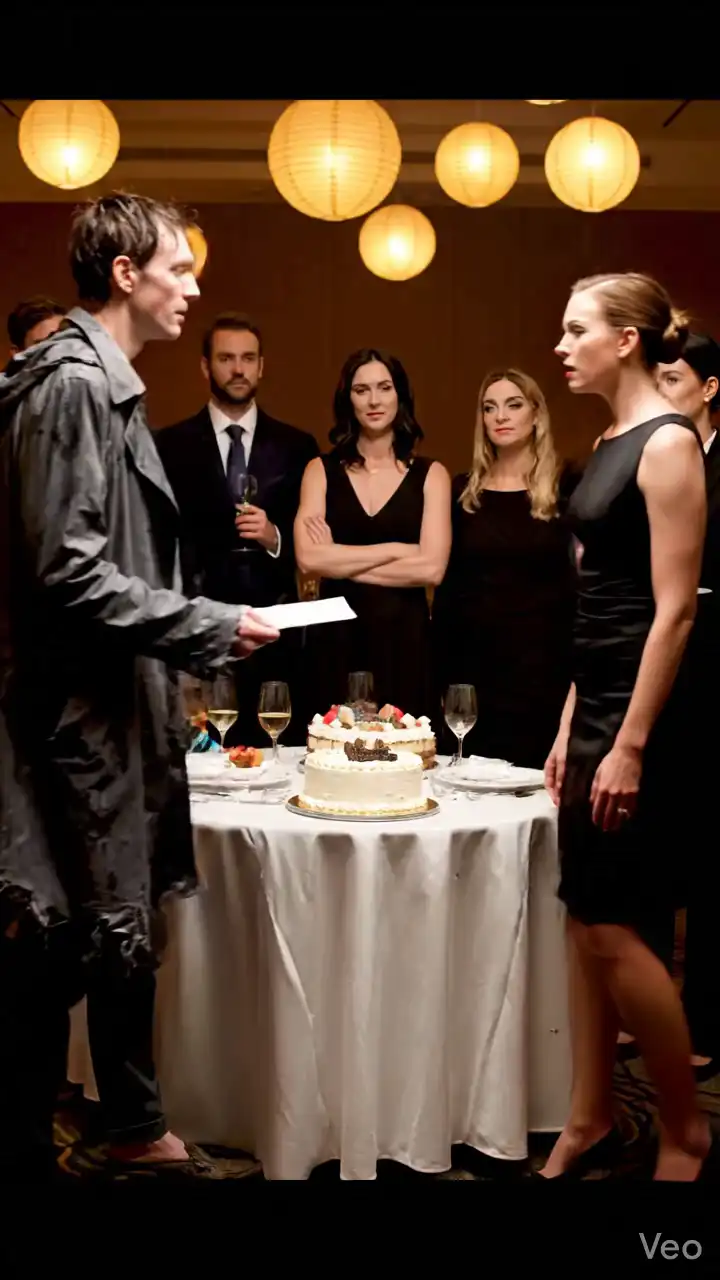
HE STOOD IN RAGS AT HER PARTY AND SHE LAUGHED BEFORE SHE SAW THE LETTER
Chapter 1
The first thing I saw was my husband’s hand shaking over the cake table.
Not because he was drunk. Not because he was angry. Because he was holding a folded white envelope like it weighed more than the whole room.
“Sir, you can’t be in here.”
The words came from a waiter in a black vest, soft at first, the way people talk when they think they’re being kind. But half the ballroom at the Marigold House in Bellmere had already turned to stare.
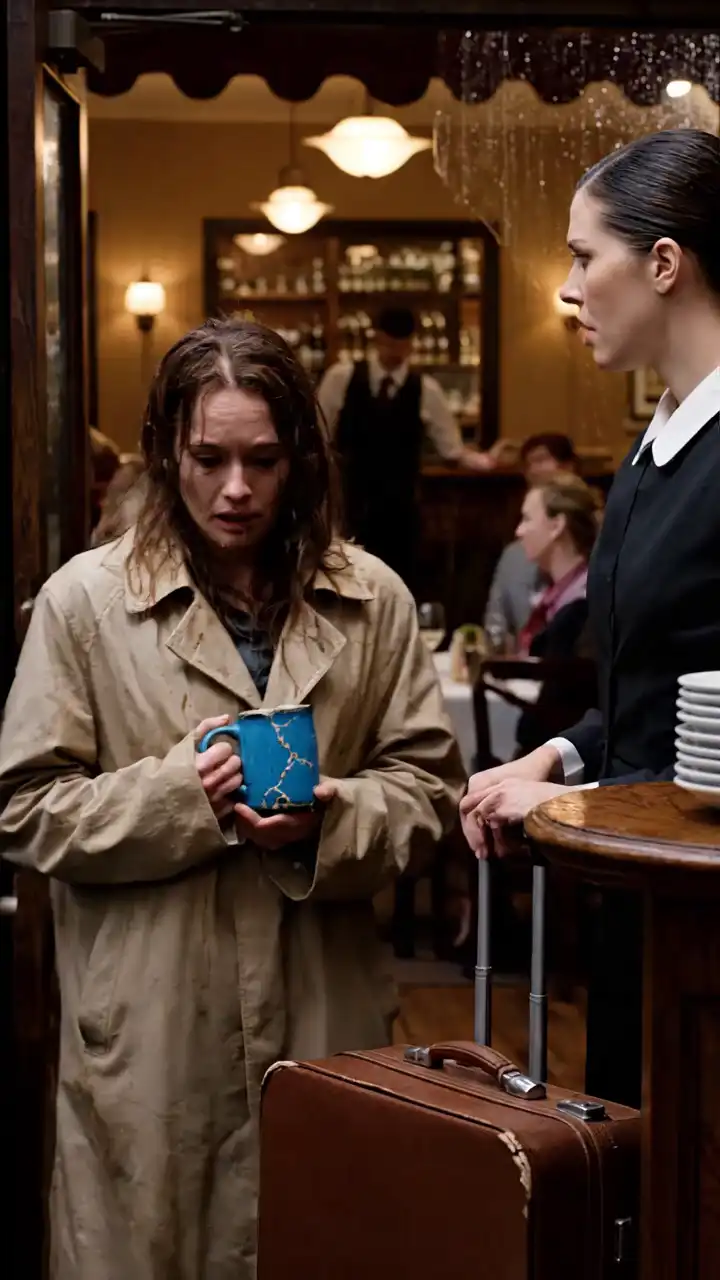
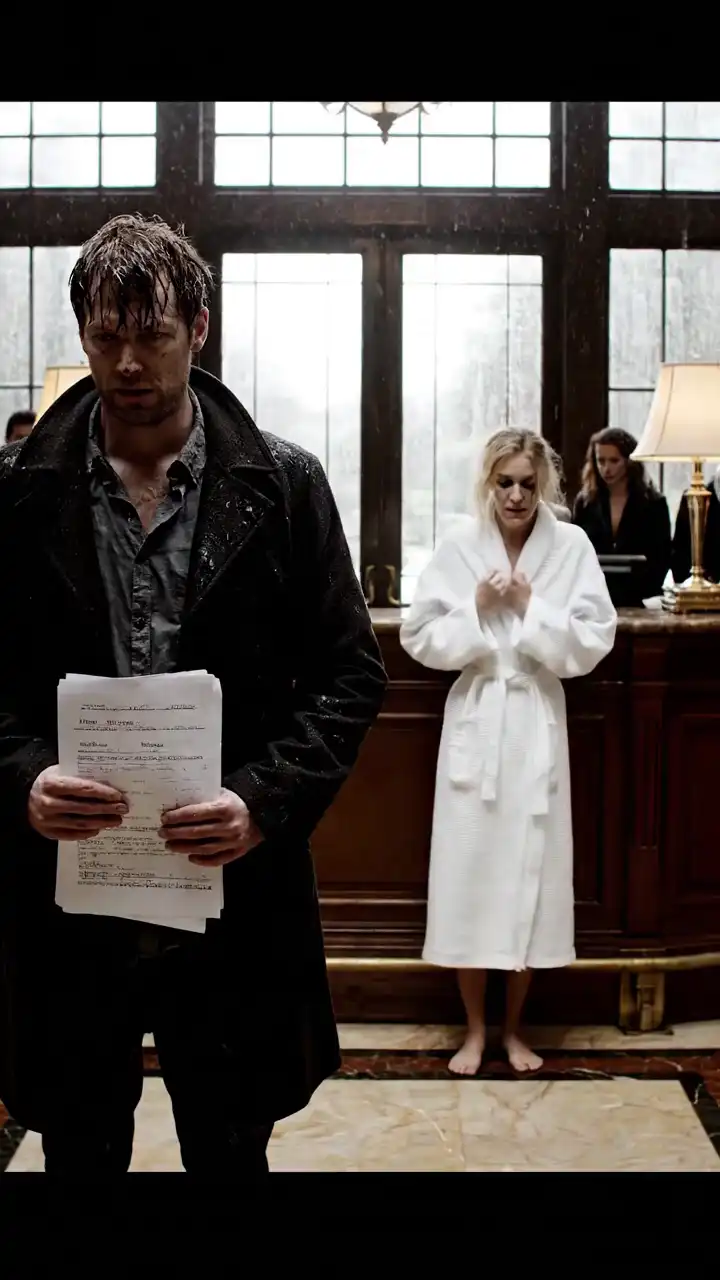
My husband, Nolan Pierce, stood under the gold paper lanterns in a torn gray coat that hung off his shoulders like wet cardboard. His beard had grown uneven. His shoes were split at the toes. Rain had dried in a dirty line across the cuffs of his pants. He looked exactly like what the room decided he was within two seconds.
A homeless man who had wandered into a private anniversary party.
My anniversary party.
My hand froze around my champagne flute. Around me, people from my office kept smiling that tight smile people wear when they’re not sure whether to be amused or embarrassed. My sister Talia leaned closer and whispered, “Bree… do you know him?”
I knew him better than anyone in the room. Better than I wanted to in that moment.
Nolan and I had been married nine years. Separated for eleven months. Not divorced, because every time the papers got close, something stalled. A missed signature. A changed mailing address. A message from his public defender after one of his trespassing charges. My own refusal to make the final appointment. I called it exhaustion. My friends called it weakness.
But there he was, standing in the middle of my company promotion party with an envelope in his hand and half the room looking at me.
I set my glass down before I dropped it.
“Yes,” I said. “I know him.”
The music didn’t stop, but it should have. It felt obscene that a saxophone track still drifted through the room while my past stood under the lights looking like he had slept in an alley.
Across the ballroom, Kendra Vale from corporate gave a little laugh she didn’t bother to hide. “Well,” she said loudly, “this just got interesting.”
That was Kendra. Every room was a stage if she could get one more person to look at her.
Nolan’s eyes found mine. They were the same eyes that used to study old houses as if he could hear their history through the walls. Same pale hazel, same quiet focus. But now they sat inside a face the world had punished.
“I just need one minute,” he said.
He didn’t raise his voice. That made it worse somehow. The room had to lean in.
I walked toward him on legs that didn’t feel attached to me. The hem of my navy dress brushed the floor. I was suddenly aware of everything cruel between us: my clean hair, his cracked hands, the silver candlelight reflecting in my earrings, the smell of roast chicken and butter, the smell of cold street rain still clinging to him.
“You shouldn’t have come,” I said.
“I know.”
“Then why are you here?”
He looked down at the envelope. “I needed to bring this myself.”
Kendra was closer now, balancing a drink in one manicured hand. “If he’s panhandling, somebody call security before he ruins the linens.”
A few people chuckled. Not because it was funny. Because laughter lets cowards hide in a group.
Nolan didn’t look at her. That should have shamed her, but it didn’t.
I felt heat rise up my throat. “This is not the place.”
“I know,” he said again. Then, quieter: “Please take it.”
He held out the envelope.
I didn’t reach for it.
Behind him, one of the catering staff—a middle-aged woman with a silver name tag that read DOREEN—stepped from the wall and quietly set a glass of water on the edge of the cake table within Nolan’s reach. It was such a small motion no one else seemed to notice. Her eyes flicked to his hands, to the tremor, then away, as if she understood that mercy works best when it doesn’t announce itself.
Nolan didn’t touch the water. He kept holding the envelope toward me.
“What is it?” I asked.
“Something that belongs to you.”
Kendra let out another laugh. “Maybe it’s a bill.”
More laughter this time, louder. A man from sales muttered, “Or an apology tour.”
My humiliation came in layers. First the sight of him. Then the pity on a few faces. Then the delight on others. Then my own anger that underneath all of it, beneath the ruin and shock and resentment, one ugly part of me was worried about him.
Nolan had not always looked like this. Two years earlier he had been a finish carpenter with his own tiny restoration business, the kind of man who could make a broken staircase feel solid again under your feet. Then came the warehouse accident that crushed his wrist, the painkillers, the debt, the jobs he lost, the lies, the theft from our own savings, the nights he disappeared, the shelter stays, the county jail holds, the calls I stopped answering. Love had not died all at once. It had thinned, frayed, then been soaked in disappointment until it could no longer hold shape.
And still he was here, holding out a stupid envelope in front of everyone I had worked so hard to impress.
“Give it to me later,” I whispered.
“It can’t be later.”
That sentence landed badly inside me.
Before I could answer, Kendra stepped closer, smiling with all her teeth. “You know, this is actually kind of touching. Maybe we should all chip in and get him a room for the night.”
A few people laughed again.
Nolan finally looked at her. Not with anger. Just a tired, level look. “I didn’t come for money.”
“Oh,” she said. “That makes it classier.”
I should have defended him then or sent him out or done something cleaner than just standing there while strangers used my marriage as party entertainment. Instead I said the coldest thing available.
“You need to leave.”
His face changed, but only a little. “Read it first.”
“I said leave.”
For one awful second, I thought he might argue.
Instead he lowered the envelope, nodded once, and set it on the table beside the untouched water. Then he reached into his pocket and pulled out something else: a small brass key on a faded blue tag.
My breath caught. I knew that key.
Unit 14. Bellmere Station lockers.
He placed the key on top of the envelope.
“Don’t throw that away,” he said.
Then he turned to go.
The room released a strange collective breath, like a theater audience when a scene ends.
But as Nolan moved toward the side exit, his knee buckled hard enough that he hit the edge of a chair. Doreen was there before anyone else, steadying him with one hand at his elbow and the other quietly pressing a wrapped dinner roll into his coat pocket as if she were returning something he had dropped.
He looked startled.
She said only, “Take your time.”
It was the gentlest thing anyone had said all night.
He gave the smallest nod, then walked out into the rain.
Kendra exhaled dramatically. “Well. That was dark.”
I stared at the envelope and key on the cake table while the candles flickered beside them.
Talia touched my arm. “Bree, honey, don’t open that in front of everyone.”
That made the room even stiller. Because now everybody wanted me to.
I picked up the envelope. The paper was damp and slightly warm from his hand. My name was written across the front in Nolan’s old careful block letters.
Bree Pierce.
Not Bree Mallory, which I’d gone back to using at work.
Pierce.
I should have hated that. Instead I felt a sudden thin line of fear.
“What’s in the locker?” Talia asked softly.
I looked toward the rain-streaked exit where Nolan had disappeared.
I had spent almost a year believing there was nothing left between us except paperwork and damage.
But he had come into a room full of people willing to laugh at him, and he had done it just to place that envelope and that key in my hand.
Something was wrong.
Something bigger than his timing. Something bigger than my embarrassment.
I slid my thumb under the flap.
Inside was one folded sheet, and one hospital wristband.
Chapter 2
I didn’t make it past the first line before the room tilted.
Bree—
If you’re reading this, I ran out of time to explain it right.
I folded the paper shut too fast, my fingers suddenly clumsy. The wristband had already told me enough to light up every nerve in my body. The plastic strip was creased and old, but the printed words were clear under the ballroom light.
ST AGNES MEDICAL CENTER INFANT FEMALE MOTHER HARTWELL JUNE
June Hartwell was Nolan’s mother.
Dead for six years.
“Bree?” Talia said. “What is it?”
I shoved the letter and wristband back into the envelope. “Nothing.”
It was a stupid answer. My face had gone cold. Talia knew it. So did everyone close enough to see.
Kendra leaned in shamelessly. “Don’t leave us hanging.”
I looked at her and found, with relief, that humiliation had burned clean through into anger.
“This isn’t your entertainment.”
Her smile faded by half a shade. “I was joking.”
“No,” I said. “You weren’t.”
That finally scattered a few people. Not because they cared about my dignity, but because public meanness gets less fun when someone names it. The music kept playing. A server crossed with a tray of mini crab cakes. Somebody at the bar restarted a conversation too loudly. The party tried to stitch itself back together around the rip.
Talia took my elbow and guided me toward the side hallway near the restrooms. “Talk to me.”
I looked down at the envelope. “He gave me a key to the train station lockers.”
“That’s not normal.”
“Nothing about Nolan has been normal for a long time.”
“Do you think he stole something?”
The words came fast, practical, almost protective. This was how my family loved me—by assuming the worst quickly enough that I wouldn’t get blindsided.
“I don’t know.”
“Is he using again?”
“I don’t know.”
“Are you in danger?”
I almost laughed at that. “From a man who can barely stand up?”
Talia folded her arms. “That doesn’t answer me.”
The hallway smelled like lemon cleaner and old flowers. Through the ballroom doors I could still hear scattered laughter, the clink of silverware, one woman saying, “I mean, who even let him in?” My cheeks burned all over again.
I pulled the letter back out and forced myself to read more.
Bree—
You remember my mother said I was born at home. That was never true. I found out three weeks ago at St Agnes outreach when a volunteer nurse recognized my last name from old records they were clearing. She should not have shown me, but she did. There was another baby on the paperwork that night. A girl. Same mother. No death certificate. No discharge record under my mother’s name after dawn.
I stopped breathing for a second.
Talia watched my face. “What?”
I kept reading.
I went to Bellmere Station locker 14 because of what my mother said once when she was sick and talking sideways. She said, Keep the blue-tag key if you ever want the first truth. I thought she meant tools. She did not mean tools.
In the locker there is a red file box. I did not open all of it. Some of it is yours to open first.
My knees felt weak enough that I sat down on the velvet bench under the hallway mirror.
Talia crouched in front of me now. “Bree, you’re scaring me.”
I looked up slowly. “Nolan thinks his mother hid a baby.”
“What?”
“A girl.”
“Whose girl?”
“I don’t know.”
Her mouth parted, then closed again. “That doesn’t make any sense.”
“No.”
“And why would any of that be yours?”
I stared at the wristband in my hand.
Infant female. Mother Hartwell June.
Because June Hartwell had worked for eighteen years as a maternity ward housekeeper at St Agnes. Because she knew corners and records and who to ask for favors. Because she had always watched me too closely, even before Nolan and I married. Because one drunken Thanksgiving, years ago, she had touched my hair and said, “I knew your face before you did.”
At the time I thought she was just mean.
Now I wasn’t sure.
The rest of the letter was shorter.
I came tonight because I think someone at your party knows part of it. I saw her name on the invitation board through the side door when I came in. Lenora Voss. She was at St Agnes in 1989. I know because her name is in the file. I needed to get this to you before she saw me.
If she tries to leave, don’t let her.
I folded the letter so sharply it nearly tore.
Lenora Voss.
My boss’s mother-in-law.
Eighty-two years old, silk scarf, pearls, and a reputation in Bellmere for fundraising hard enough to frighten city councilmen.
She was here tonight because Marigold Biotech liked to fill every event with local prestige. I’d shaken her hand an hour earlier near the photo wall.
Talia saw the change in my expression. “Who?”
“Lenora Voss.”
“The woman in green?”
“Yes.”
Talia turned to glance through the ballroom doors. “Bree, if this is some paranoid thing Nolan cooked up—”
“It might be.”
“But?”
“But he walked into a room where people could tear him apart just to hand me this.”
My sister looked back at me, and for the first time that night her face softened into something other than alarm. “You still trust him.”
“No,” I said, and hated how quickly I answered. “I just… I trust that he believed this mattered.”
That was truer.
A shadow moved at the end of the hallway. Doreen, the catering worker, stood holding a coffee urn by the service door. “Ma’am,” she said quietly, “I don’t mean to interrupt.”
I wiped at my face before I realized there were tears there. “It’s fine.”
She hesitated. “The man who came in? He left his scarf on the loading dock.”
I looked at her blankly. “He wasn’t wearing a scarf.”
She gave me a tiny glance that said she knew that too. Then she extended her hand. In it was a folded knit cap, not a scarf at all. Tucked under the fold was a small pharmacy receipt.
I took it.
The receipt was from Hawthorn Pharmacy on Kettle Street, dated that afternoon. One prescription: furosemide. Another: spironolactone.
Water pills.
For heart failure.
My stomach dropped.
Doreen kept her voice low. “He looked dizzy. I thought maybe you should know.”
Talia inhaled sharply. “Why would he leave this with you?”
Doreen’s eyes moved to me, then away. “He didn’t. It fell when he reached for the door.”
There was something careful in her tone. Protective. Like she was offering help without crossing into someone else’s story.
“Thank you,” I said.
She nodded. “The lady in green is asking for her car.”
I stood so fast the bench legs scraped. “What?”
“I heard her tell the valet captain to bring it around to the east drive.”
Talia grabbed my wrist. “Bree.”
I looked from the receipt to the ballroom doors. If Nolan was wrong, I would look unhinged. If he was right and I let Lenora leave, I might lose the only person who knew what that wristband meant.
I shoved the cap, receipt, letter, and wristband into my purse.
“Stay here,” Talia said.
“No.”
“You can’t chase some old woman into the parking lot over a maybe.”
“Watch me.”
I pushed through the ballroom doors.
The party hit me all over again—warm lights, voices, perfume, polished glass. Near the bar, Kendra was telling a cluster of people something with animated hands. I caught the words “her husband” and “train station” and kept moving.
At the far end of the room, Lenora Voss was slipping on cream gloves while a young man in valet black held her shawl. She turned slightly, and in that moment I saw something I had missed before: when Nolan had entered, she had not looked amused or confused.
She had looked afraid.
“Mrs. Voss,” I called.
She paused but did not smile. “Yes, dear?”
“I need a word.”
“I’m just leaving.”
“That’s exactly why.”
People near the entrance stopped pretending not to watch.
Lenora’s chin lifted. “I beg your pardon.”
I walked until I stood directly in front of her. “Did you work at St Agnes in 1989?”
The valet’s eyes flickered between us.
Lenora’s face changed so slightly most people would have missed it. I didn’t. Her fingers tightened once on her glove.
“I sat on a fundraising board,” she said.
“Did you know June Hartwell?”
“No more than any hospital volunteer knows staff.”
I opened my purse and took out the wristband.
Her breath caught.
Just once. Just enough.
Talia was suddenly at my side. Behind us, conversation had thinned into a strange hush. Even Kendra had stopped speaking.
Lenora looked at the band, then at me. “This is not a conversation for a party.”
“Then stop trying to leave.”
Her eyes sharpened. “Did he bring you that?”
“Yes.”
“Where is he?”
“I don’t know.”
For the first time, real urgency cracked through her poise. “Find him.”
That was the moment my fear changed shape.
Until then I had thought the worst thing in the room was public humiliation.
Now I understood there was something older here. Buried. Protected.
And everybody who had laughed a few minutes ago was about to learn they had laughed at the wrong man.
Chapter 3
Lenora Voss did not want the conversation in the ballroom, but she also did not want me out of her sight.
That told me enough to follow her.
We ended up in the library lounge off the main corridor, a little showcase room Marigold House rented for “private donor moments.” Mahogany shelves. Fake fireplace. Oil portraits of dead people who had probably once called women like me “dear” while destroying them politely.
Talia came with me. So did my boss, Reed Solson, because Lenora was his wife’s mother and no scandal in Bellmere was allowed to occur without somebody trying to manage it. He shut the door behind us while the party noise turned muffled and distant.
Lenora remained standing. “Show me the letter.”
“No.”
“You don’t know what you’re holding.”
“That’s exactly the problem.”
Reed looked tired already. “Bree, maybe we should all take a breath.”
I almost laughed. “I did that for eleven months. It got me nowhere.”
He winced. “Fair.”
Lenora’s gaze stayed fixed on my purse. “If Nolan found the station locker, then he found material that can hurt people who are already old enough to be buried by it.”
“Did you help steal a baby?” I asked.
Talia made a sound under her breath.
Reed said, “Jesus, Bree.”
But Lenora did not flinch. She looked at me with a kind of exhausted fury. “Nothing in those years was as simple as one person stealing anything.”
“That is not a no.”
Her shoulders lowered a fraction. “No. It is not.”
The room went very still.
I thought of the wristband, of June Hartwell’s rough hands folding napkins at our wedding, of how she’d once watched a stranger’s baby cry in the grocery store with an expression I could never place.
“Who was the baby?” I asked.
Lenora’s face hardened again. “That depends on which record survived.”
I took out Nolan’s letter and unfolded it. “He said your name was in the file.”
“He shouldn’t have come here.”
“He came because he thought you’d run.”
“And was he wrong?”
No. She had been halfway to her car.
Reed rubbed his forehead. “Lenora, for God’s sake, just say what this is.”
She ignored him. “Did he read everything?”
“I don’t think so.”
A knock sounded softly at the side service door. Before anyone could answer, Doreen slipped inside with a fresh tray of water glasses as if she had simply mistaken the room. Her eyes took in all four of us with one quick sweep.
“Sorry,” she said. “I was told this room needed service.”
“No,” Reed snapped. “Not now.”
But Doreen had already set the tray down. She placed one glass near me, one near Talia, one near Lenora. Last, she set a glass in front of the empty chair nearest the door, then quietly slid a cloth napkin beside it. On top of the napkin lay a small wrapped peppermint and a hotel pen.
It was such an odd, neat little arrangement that even in the middle of everything, I noticed it.
Then I saw what else she had done.
Under the glass nearest me, half-hidden, was a folded valet claim ticket.
She did not look at it. She did not look at me. “Again, I’m sorry.”
She left.
Talia frowned. “What was that?”
I picked up the glass and slid out the ticket.
EAST DRIVE SECURITY HOLD SUBJECT WAITING Dock Camera 3
My pulse jumped.
Lenora noticed. “What is it?”
“Nothing for you,” I said.
I stood. Reed moved instinctively to block the door. “Bree.”
“My husband came here half-collapsing with heart meds in his pocket and now somebody from staff is telling me he’s being held at security.”
Talia stared. “Held?”
I pocketed the ticket. “Apparently.”
Lenora’s voice sharpened. “Take me to him.”
“No.”
“Listen to me, child, if he has the file and he panics—”
“He didn’t panic,” I snapped. “He walked into a room where people laughed at him, and he still tried to hand me the truth.”
That finally cut through her composure. She looked at me for a long second and said, almost to herself, “He really is June’s son.”
I hated that sentence instantly. “Don’t talk about him like he’s one of your old records.”
Reed stepped back from the door. “Fine. We all go.”
We crossed the service hallway toward the east drive entrance, my heels slipping on old tile, my heart beating too hard. On the way, we passed two bartenders whispering near an ice bin. One of them looked up, recognized me, and looked away too fast. News spread through parties like spilled wine—quiet and unstoppable.
At the security station by the loading area, we found Nolan sitting in a metal chair under a flickering light. He looked grayer than before, one hand pressed to his side. A young security guard named Mateo stood awkwardly nearby with a clipboard, clearly unsure whether he was guarding a threat or an illness.
Nolan looked up when he saw us. First me. Then Lenora.
His jaw tightened.
Mateo spoke quickly. “He didn’t do anything violent. He just almost passed out by the dock and refused an ambulance.”
“Because I can’t afford one,” Nolan muttered.
I moved toward him before I remembered I was still angry. “Why didn’t you tell me you were sick?”
A tired smile touched one corner of his mouth. “We had bigger material.”
That stupid, dry line almost broke me.
Talia folded her arms. “You have heart failure?”
He looked embarrassed, which somehow made it worse. “Congestive. They caught it after the pneumonia in January.”
“You never called,” I said.
“You changed numbers.”
“You could have emailed.”
“I was living under the Baxter overpass for part of February, Bree.”
The words landed between us, stripped clean of drama. Just fact. Just weather.
Lenora stepped forward. “Do you still have the box?”
Nolan’s eyes turned to her, flat and guarded. “No.”
“Where is it?”
“Safe.”
“You don’t understand what’s in it.”
“Then explain.”
She looked at Mateo, then at Reed, then back at Nolan. “Not here.”
Nolan gave a brittle laugh that turned into a cough. “Funny. That’s what everybody keeps saying.”
I saw then that his hand was clenched around something. Not the envelope now, but a photo, edges bent from pressure.
“What is that?” I asked.
He hesitated, then passed it to me.
It was an old Polaroid of a hospital nursery window. Behind the glass, three bassinets. The center one had a card clipped to it, blurry but readable if you looked hard enough.
Baby Girl Hartwell.
And at the edge of the frame, reflected faintly in the nursery glass, stood a younger Lenora Voss.
Talia whispered, “Oh my God.”
Lenora closed her eyes for one beat. “There should have been four bassinets.”
The loading bay seemed to contract around us.
Nolan said, “That’s what the missing chart notes suggest.”
Reed looked physically ill. “Lenora.”
She opened her eyes and met mine. “Your mother’s name was Celeste Mallory, yes?”
Everything in me went rigid.
“Yes.”
“She delivered at St Agnes on the same night June Hartwell brought in a stillborn infant.”
My voice came out thin. “My mother never said anything about that.”
Lenora’s expression shifted into something close to grief. “Your mother was sedated and hemorrhaging. The attending physician signed papers he never should have signed. June’s baby had been born alive but weak. Your mother’s healthy daughter…” She stopped.
“No,” I said.
No because I understood. No because I didn’t. No because some truths arrive like a hand around the throat.
Lenora swallowed. “June had lost two babies before. She was not stable. The doctor owed people favors. There was money. Panic. Terrible judgment. They switched the infants before sunrise.”
Mateo, the security guard, stared openly now.
Talia took a step back until she hit the cinderblock wall.
I looked at Nolan. His face had gone still in that dangerous way people do when they have known a fact alone for too long and are waiting to see whether anyone else can survive hearing it.
“You’re saying,” I whispered, “I was born to Celeste Mallory.”
“Yes,” Lenora said.
“And Nolan—”
“Was not.”
Nolan looked at the concrete floor. “June stole me into her grief, or bought the chance to. Depends how kind you want to be.”
I couldn’t feel my fingers.
All those years. Me and Nolan meeting as adults at a city preservation fundraiser. Falling in love over rotten floorboards and coffee in paper cups. Marrying in front of eighty guests and a string quartet. Fighting over rent, over lies, over painkillers, over every small cruel thing married people can become.
And underneath it, something impossible.
I thought I might vomit.
“We’re not blood,” Nolan said quickly, reading my face. “That’s not what this is.”
I looked up.
He held my eyes. “June’s baby was a girl.”
The room tipped again.
The baby.
The missing girl.
The wristband.
Lenora nodded slowly. “The records suggest the living female infant born to June Hartwell disappeared from the chart before noon. No death filing. No adoption trail. Just gone.”
I heard my own voice as if from a distance. “You think that baby is still alive.”
Nolan answered. “I think that baby is why my mother kept that locker key for thirty-seven years.”
Nobody spoke for several seconds.
Then Doreen’s voice came softly from behind us.
“Excuse me.”
We all turned. She stood in the doorway holding a cardboard cake box against her apron.
“I know this is not my place,” she said. “But the woman from valet asked me to bring this to the gentleman.”
She held out the box.
Nolan frowned. “I didn’t order anything.”
“No,” Doreen said. “But you should eat.”
Again, that small quiet mercy. Cake box in hand, as if food were the most ordinary answer to catastrophe.
He took it, looking almost ashamed.
Then Doreen glanced at Lenora and said, “Mrs. Voss, your driver is gone.”
Lenora blinked. “What?”
Doreen’s face remained calm. “I called him off when I heard you were waiting on family.”
Reed stared. “You what?”
She shrugged once. “Some people need a chance to finish the truth before they can flee from it.”
For the first time that night, I almost smiled.
Chapter 4
We moved from the loading bay to a closed conference room near the kitchen because there was nowhere else left to go. The party kept glowing two hallways away, absurdly alive, while my marriage and maybe my whole history sat under fluorescent lights with a cake box between us.
Nolan finally ate half a dinner roll from his pocket and a forkful of buttercream from the box Doreen had brought. I watched him do it and had to look away. There was too much shame in a hungry person trying not to look hungry.
Talia sat beside me, silent now, one hand on my forearm.
Lenora began at the beginning because there was no clean middle.
In 1989, St Agnes Medical Center had been under financial pressure and public scrutiny after a string of malpractice claims. The maternity ward was short-staffed. Records were partly paper, partly manual logbooks. A wealthy donor family was covering a construction wing. The attending physician that night, Dr. Emil Voss—Lenora’s late husband—was brilliant, proud, and already compromised by debts no one outside the family knew.
June Hartwell arrived in labor early, frightened and alone. A few hours later, Celeste Mallory came in with a difficult delivery. June’s baby girl survived birth but struggled. Celeste’s baby girl was healthy.
Then June hemorrhaged and was told her baby had died.
“She screamed so hard they sedated her,” Lenora said. Her hands were folded too neatly on the table, as if she were holding herself together by force. “Emil told me later he only meant to buy time. To spare her until morning.”
Nolan spoke without looking at her. “That’s a pretty phrase for a theft.”
“Yes,” Lenora said. “It is.”
She told us Dr. Voss had altered a chart. He moved one wristband. One bassinet card. One notation. By dawn, he had convinced himself he could reverse it quietly after June stabilized.
But by noon, panic had turned ugly.
June woke demanding her daughter. Celeste hemorrhaged again and nearly died. An administrator pressed everyone to avoid another scandal. Emil made a decision that Lenora said had haunted him until the day he died.
He finalized the switch.
Not between June and Celeste.
Between records.
He documented Celeste’s healthy child under Celeste’s name—that was me. But he also allowed June’s living daughter to vanish from the chart altogether when an outside intermediary offered to “place” the sick infant privately. Cash changed hands. Silence followed.
“You’re telling me my mother kept me,” I said slowly, “but June’s actual daughter disappeared?”
Lenora nodded.
“Then why did June raise Nolan?”
“Because three days later,” Lenora said, “a male infant was surrendered through emergency protective intake after a drug raid in Kersey County. No immediate family claim. Emil arranged for June to foster him off record for a short period. Then he turned that into permanent placement.”
Nolan let out one sharp breath through his nose. “Off record. That sounds right.”
I looked at him. “So June knew?”
“Not all of it,” Lenora said. “She knew enough to understand Emil had given her a child to fill the hole. Whether she understood he wasn’t hers by blood, I can’t prove. But over time she must have.”
Nolan stared at the table. “She used to say, ‘You’re the child I got after God was done explaining Himself.’”
No one answered that.
I thought of June’s moods, her strange cling to Nolan, the way she drank, the way she watched babies, the way she hated hospitals. I thought of my own mother, Celeste, who died when I was twenty-four without ever telling me anything unusual about my birth. Maybe she never knew. Maybe she suspected and buried it. Maybe some secrets rot so long they become part of the walls.
Reed stood near the door as if he could still somehow control the shape of events. “This is all monstrous, but legally, what are we talking about? Are there records? DNA? Anything that survives more than memory?”
Nolan reached for his coat and pulled out a thin bundle of photocopies held with a rusted clip. “Some.”
He pushed them toward me. Logbook entries. Old nursery sheets. A note in Dr. Voss’s handwriting with one line crossed out so hard the paper had nearly torn. A duplicate station receipt from a storage locker first rented in June 1998.
And one small note in June Hartwell’s hand.
Blue key for first truth Green ribbon for second If the girl comes back let her choose
My chest tightened.
“The girl,” Talia whispered.
Lenora closed her eyes briefly. “June came to my house four months before she died. Drunk. Furious. She said she wanted names. She knew Emil had lied to her for years. She said she had hidden one thing he couldn’t erase.”
“The locker,” Nolan said.
Lenora nodded. “I thought she was bluffing.”
He gave a humorless smile. “So did I until I found the key sewn into the lining of one of her old coats.”
There it was. The thing that had dragged him through rain and shame and back into my life.
Not money. Not manipulation. A key.
I looked at the copies again. “What’s the green ribbon?”
Nolan’s jaw tightened. “I haven’t found that yet.”
Silence spread across the table. Then another thought hit me.
“Why tonight?” I asked. “Why come tonight, of all nights?”
He looked at me carefully. “Because your invitation was posted in the lobby window.”
“My invitation?”
“The one from Marigold House. Gold script, your full name, list of special guests.” He glanced at Lenora. “When I saw hers, I knew I couldn’t wait.”
“You could have called.”
“From where?”
Anger rose in me again, mixed with guilt so sharp it almost felt like nausea. “I still would’ve answered if you said it was serious.”
His eyes stayed on mine. “Would you?”
I couldn’t answer.
Because maybe I wouldn’t have. Because maybe I had trained myself not to. Because survival had made us both cruel in practical ways.
A sudden commotion sounded in the hall outside—voices, quick footsteps, a burst of laughter. The party was reaching cake-cutting. I remembered, absurdly, that the giant white cake in the ballroom still had our company logo piped in navy icing and my promotion spelled in sugar script.
Life had split down the middle, and the other half was still serving dessert.
Doreen appeared again, this time without pretense. “Sorry. But people are asking questions.”
Reed straightened. “Handle them.”
She looked unimpressed. “I’m catering captain, not a magician.”
Even in the middle of all that pain, Talia made a startled sound that might have been a laugh.
Doreen stepped inside and set down a plain paper folder. “One more thing. The station called back.”
Nolan frowned. “Station?”
“I called Bellmere Transit after I heard enough to understand the locker mattered,” she said. “My brother works maintenance.”
All of us stared at her.
She shrugged lightly. “People in service hear everything. Sometimes we can help.”
“Help how?” I asked.
“They checked old unclaimed property records tied to locker fourteen and nearby units. One entry from 1998 mentions ‘green ribbon packet transferred to St Agnes Chapel archive by request of JH.’”
My heart kicked.
“Chapel archive?” Lenora repeated.
Doreen nodded. “Basement storage under the old chapel annex. Most of it flooded years ago, but some boxes were moved.”
Nolan was already trying to stand.
He made it halfway, then braced hard on the table, breath catching.
I moved before thinking and put a hand to his arm. It was the first time I had touched him all night. His coat sleeve felt damp and rough. Under it, his body was frighteningly thin.
“Sit down,” I said.
“I’m going.”
“You can barely stand.”
“I’m still going.”
Talia said, “Bree, if he drops in a church basement, this gets even weirder.”
Nolan managed a crooked, exhausted smile. “Nice to know that’s the threshold.”
I kept my hand on his arm. “I’ll go.”
His head turned toward me. “No.”
“Why not?”
“Because if the file is what I think it is, then whatever’s in that ribbon packet belongs to you more than me.”
“That’s exactly why I should see it first.”
“No,” he said softly. “It’s exactly why you shouldn’t see it alone.”
Something old and bruised moved between us then. Not romance. Not forgiveness. A habit of standing in the same storm even after we had forgotten why.
Lenora rose slowly from her chair. “I’m coming too.”
Talia muttered, “Absolutely not, old lady crime committee.”
Lenora gave her a brief, almost offended look. “If there is a record in that chapel, I may be the only one who knows where flood salvage boxes were moved.”
Reed opened his mouth to object and then closed it again, perhaps realizing he had already lost all authority over the night.
So an hour after my husband was laughed out of my promotion party, the six of us left through the service exit—me in heels, Nolan in torn shoes, Lenora in pearls, Doreen still in her catering apron, Talia carrying my purse like it contained a live grenade, and Reed cursing under his breath into the cold Bellmere rain.
Anyone who saw us would have thought the wrong people had escaped the wrong building.
Maybe they would have been right.
Chapter 5
St Agnes Chapel Annex stood three miles away on Willow Crest Road, shuttered and half-forgotten behind the newer hospital tower. The old stone building had a boarded side entrance and a brass cross gone green at the edges. Rain slicked the steps black. The security lights buzzed weakly over the basement stairwell.
Doreen’s brother, a maintenance supervisor named Curtis Bell, met us with a ring of keys and the dazed expression of a man who had been told, at 10:40 p.m., that his sister needed him to open a church basement for strangers carrying a medical conspiracy.
He looked at Nolan, then at me, then at Lenora. “Dorie, you owe me dinner for a month.”
“Done,” she said.
The basement smelled like mildew, dust, and old paper. Metal shelves lined the cinderblock walls. Archive boxes were stacked in warped rows, some marked CHAPEL LINENS, some PASTORAL FILES, some FLOOD HOLD. Curtis led us to a back alcove where a hand-lettered sign read SALVAGE UNKNOWN.
“Anything with ribbons or personal effects from ward transfers ended up here after the flood,” he said. “Nobody wanted to throw out church-connected donations without review.”
Lenora lifted a flashlight from a shelf and moved slowly down the aisle, her breath shallow. “There was a volunteer chaplain in those years, Sister Maureen Hale. She used green ribbon to bind anything she thought had spiritual significance.”
“Why?” Talia asked.
Lenora gave a sad little smile. “Because she thought office labels were too cold for sorrow.”
Nolan had one hand on the shelf, conserving strength. I wanted to tell him to sit, to leave, to let this wait until morning, but the truth had already waited thirty-seven years. It was not going to be polite now.
We searched.
Curtis opened damp boxes. Reed used his phone flashlight. Doreen, somehow still practical, found a pair of rubber gloves and distributed them like we were doing ordinary work. Talia muttered under her breath every time a spiderweb brushed her face.
At the back of the third shelf, behind a box of warped hymnals, I found a smaller carton with no label at all.
Around it was a faded green ribbon.
My hands stopped moving.
“Nolan.”
He looked up, and something passed over his face so quickly I barely caught it—fear, hope, and the kind of grief that has waited too long to be named.
I lifted the box carefully and set it on a folding table. The ribbon was stiff with age. When I pulled it loose, dust rose into the flashlight beams.
Inside were four items.
A sealed envelope addressed in shaky handwriting: FOR THE GIRL IF TRUTH EVER CATCHES UP
A baby bracelet with no name, only a date.
A photograph.
And a small cloth doll with one button eye missing.
No one spoke.
I reached for the envelope, but Nolan touched my wrist lightly. “Wait.”
His hand was cold. So light it barely held me.
I looked at him.
“You open it,” he said.
So I did.
Inside was a letter written by Sister Maureen Hale.
If this reaches the rightful hands, then God has finally tired of silence.
Tonight I was asked to witness a transfer I did not trust. Infant female, weak but living. No family name entered. Dr. Voss said placement was arranged. June Hartwell was in no condition to consent to anything. I tied this packet in green because wrong should not travel unmarked.
At 2:10 p.m. the baby was taken by a woman called Evelyn Rusk from the Mercer House on county route records. She said the child would be cared for privately. I copied the car tag and address because the baby cried when they lifted her and nobody else seemed willing to remember her.
There was more. A plate number. A county address outside Bellmere. A note that the child had a small crescent-shaped birthmark under her left shoulder blade.
Talia covered her mouth.
I read that last line twice before my mind accepted it.
Nolan slowly pulled aside the collar of his shirt and turned awkwardly, enough for all of us to see the pale crescent birthmark under his left shoulder blade.
The room went silent in a way I had never heard before.
Even Nolan looked confused for half a second, as if his own body had spoken before he could.
“That’s impossible,” Reed said.
Lenora gripped the table so hard her knuckles whitened. “No.”
I looked between the letter and Nolan’s shoulder and then back again.
Infant female. Crescent-shaped birthmark. The baby cried when they lifted her.
My thoughts scattered, then slammed together.
“No,” I said, but for the opposite reason now. “The bracelet.”
I picked up the tiny hospital bracelet. The old ink had bled, but under the flashlight Curtis held steady, one notation could still be made out.
SEX: M
Everyone stared.
Talia whispered, “Male.”
Nolan slowly turned back around.
Lenora took the bracelet from my hand with trembling fingers. “This was from the surrendered infant. The boy.”
Then she looked at Nolan’s shoulder again and began to cry without sound.
Doreen spoke first. Of course she did. The only one calm enough to see what others missed.
“The birthmark note belongs to the wrong baby,” she said quietly.
We all turned to her.
She pointed at the photograph. “Look.”
I picked it up. It showed Sister Maureen holding a swaddled infant beside a bassinet. On the back, in pencil, two words:
Rusk pickup
The infant’s blanket had a card tucked near the edge. The handwriting was hard to see, but Curtis zoomed his phone camera in.
Baby Boy Temp placement
Doreen nodded. “The packet was tied by a witness who thought she was marking the wrong transfer. She wrote ‘for the girl’ because that was the story she was trying to save. But the photo and bracelet show the child taken by Evelyn Rusk was the surrendered boy.”
Nolan.
Nolan stared at the photo as if it might strike him.
Lenora sank into the folding chair. “Emil moved more than one child.”
Nobody answered because it was true. The room was full of proof now.
I forced myself back through the sequence. “Then June’s baby girl wasn’t given to Mercer House.”
“No,” Nolan said slowly. “I was.”
The words seemed to shock even him.
“Then where did the girl go?” Talia asked.
Lenora looked up, her face wrecked. “With Celeste Mallory.”
I turned toward her so sharply the chair legs scraped.
“What?”
“She kept the healthy girl she delivered under her own name. That was you. But after the chart alteration and the panic, Emil may have believed leaving one child in place would hide the rest. June’s daughter—if she survived the night—could have been recorded under another emergency maternal file, then folded into county foster or private adoption. The point wasn’t care. It was concealment.”
“Say it plain,” I said.
Lenora did. “Your mother did not steal you. June did not raise her own son. My husband and that hospital erased one child and misplaced another.”
The truth hit in layers.
Nolan had spent his life in a house built from somebody else’s grief. I had spent mine never knowing the crime touched me at all. And June’s real daughter—somewhere, if alive—had grown up without either truth.
Nolan sat down hard on a crate. His eyes were fixed on nothing.
I crouched in front of him before I knew I was doing it. “Nolan.”
He didn’t answer.
“Nolan, look at me.”
He did.
For the first time all night, all the performance had fallen off him. No defensive wit. No stubborn pride. Just a man who had been laughed at in a ballroom while carrying proof that his whole life had been arranged by strangers.
“I thought,” he said hoarsely, “if I could just bring you the letter, maybe one thing in this mess would belong to the right person.”
My throat tightened. “You brought me more than that.”
He gave a tiny shake of the head. “I brought you shame at your own party.”
“No.” I swallowed. “You brought me the truth.”
His eyes reddened instantly, though no tears fell.
Behind me, Lenora reached into her handbag and took out a thin leather checkbook case. Reed stared at her, appalled. “If you think money—”
“It is not payment,” she said sharply. “There is no payment.” She looked at Nolan. “But there was a charitable trust established by Emil Voss before he died. Anonymous. I always believed it was guilt money meant for records lawsuits. Now I know he left instructions tied to June Hartwell and any surviving child from that night.”
Nolan’s expression changed from numbness to suspicion. “I’m not taking a bribe.”
“It isn’t a bribe,” Lenora said. “It is restitution delayed by cowardice.”
She placed a folded document on the table.
Trust beneficiary amendment Pending identification of affected parties
There was enough there to change a life. Housing assistance. Medical access through a private clinic network. Legal funds to reopen sealed county files and locate surviving records on the missing girl.
Talia whispered, “My God.”
I looked at Lenora. “Why didn’t you ever say anything?”
Her answer came out broken. “Because I loved a man who asked me to guard his worst sin until he could fix it, and then he died before he was brave.”
No one could answer that either.
Doreen, who had started this night by setting down a glass of water no one else thought to offer, reached into the box and picked up the one-eyed cloth doll. She brushed dust from its face and handed it to Nolan.
“Maybe this was with you,” she said. “Or maybe with the child who should have had you.”
He took it in both hands like it was alive.
A broken doll. A rain-soaked letter. A hidden file. A quiet kindness no one announced.
The whole night had turned on small things people almost missed.
Chapter 6
By sunrise, Bellmere looked washed out and honest.
Rain had cleared. The streets near St Agnes steamed faintly in the early light. Reed took Lenora home. Curtis locked the annex behind us. Talia, wrung hollow by everything, left only after making me promise twice to call her when I got home and once more to call if I did not.
That left me, Nolan, and Doreen standing by the hospital parking lot with a coffee carrier between us.
Doreen pressed one cup into Nolan’s hand, one into mine. “I’m off shift in twelve minutes,” she said. “And I don’t want either of you pretending caffeine is breakfast.”
Even exhausted, I smiled. “Do you do this for all family disasters?”
“Only the organized ones.”
Nolan let out a weak laugh. It was the first laugh from him that night without bitterness in it.
Doreen looked at him. “There’s a room above my cousin’s garage on Bramlett Street. Nothing fancy. But it’s warm, and he owes me three favors.”
Nolan started to refuse on instinct. I saw it happen in his face.
Then Doreen raised one hand. “Don’t be proud before you’re fed.”
He looked down at the coffee. “I’m not proud.”
“Good,” she said. “Makes this easier.”
After she left, there was a long quiet between me and Nolan. Morning traffic hissed on the avenue. Somewhere nearby, a delivery truck backed up with soft electronic beeps.
He still held the little cloth doll in one coat pocket and the coffee in the other hand.
“You can take the room,” I said.
He nodded once. “For a few days.”
“For longer if you need.”
He studied my face. “That sounds dangerous.”
“It probably is.”
“You don’t owe me rescue, Bree.”
“I know.”
That mattered. Maybe more than anything.
I looked at him in the flat morning light and saw the whole impossible man at once—the carpenter I married, the addict I could not save, the stranger laughed at under party lights, the child handed from one lie to another, the man who still walked into humiliation to put truth in my hand.
“We need to open the county records,” I said. “Find June’s daughter.”
He nodded. “Yes.”
“We need legal help.”
“Yes.”
“You need a doctor.”
At that, he looked away. “I know.”
I waited until he looked back. “No disappearing.”
A small line formed between his brows. Then he said the simplest thing he could have said.
“I’ll try.”
Years ago, that answer would have infuriated me. Try was what people said when they wanted credit before effort. But now I heard the honesty in it. He did not promise what he could not guarantee.
So I answered with equal honesty.
“Then I’ll try too.”
He looked at me for a long moment. “At what?”
I thought about the party. The laughter. Kendra’s voice. My own voice telling him to leave. Doreen slipping him bread when no one watched. Lenora finally telling the truth after decades. The green ribbon around the box. Every life in that night bent by one cruel act and one small mercy after another.
“At not mistaking ruin for worthlessness,” I said.
His eyes filled then, finally. He looked down before the tears could fall.
We walked slowly to the curb where Doreen’s cousin was coming to pick him up. He moved carefully, one hand near his side. I matched his pace without commenting on it.
At the car, he stopped and reached into his coat. For one blind second I thought there was another letter.
Instead he held out the brass key with the faded blue tag.
“Keep it,” he said.
“You found the truth with this.”
He gave a tired little shrug. “And then I brought it where it belonged.”
I closed my fingers around the key.
A week later, Marigold House sent me a formal apology after several guests complained about how security had treated “the distressed man at the event.” Kendra sent no apology at all, which was somehow fitting. Two weeks later, Lenora transferred the first trust documents to an attorney in Corven Falls who specialized in sealed family records. Three weeks later, Nolan moved into the room above the garage and started treatment through the clinic the trust covered. It wasn’t a miracle. He was still sick. Still thin. Still carrying more damage than any paper could fix.
But he was indoors. He was answering his phone. He was showing up.
And that mattered.
Months later, when the county finally opened the first box of archived foster intake files, we found a name that might have belonged to June’s daughter. Not certainty. Not yet. But a line to follow.
That morning, after the lawyer called, I drove to Bramlett Street with coffee and copies and found Nolan on the back steps, sanding an old cedar chair for Doreen’s cousin. Sawdust clung to his sleeves. The one-eyed cloth doll sat on the windowsill inside, propped beside a jar of screws.
He looked up when he heard my car door.
“Well?” he asked.
I held up the file.
He stood too fast, then steadied himself on the railing. I crossed the yard and handed it over.
His hands shook again, just like they had over the cake table that night.
Only now no one was laughing.
He looked at the papers, then at me.
“You came back,” he said.
It was barely above a whisper.
I thought of the question underneath it, the one bigger than marriage, bigger than scandal, bigger even than blood.
I reached for the chair rail beside him and answered the only way that was true.
“So did you.”
Sometimes fate changes with a courtroom order or a medical test or a name pulled from a dead file.
And sometimes it changes because one broken person chooses to carry a letter through a room full of mockery, and one unnoticed woman sets down a glass of water, and the truth survives long enough for kindness to find it.
That was the part I understood at last.
Not all redemption arrives loudly.
Sometimes it comes in rags, with a shaking hand and nowhere left to hide.
And if someone is brave enough to meet it with mercy, it can still change a life.
Disclaimer: Mention of any brand or trademark is for identification only and does not imply partnership or endorsement
MY HUSBAND USED MY MONEY, GOT ENGAGED TO HIS MISTRESS, AND STOOD THERE WHILE SHE SLAPPED ME
THE MAID OF HONOR POURED WINE ON ME AT MY BRIDAL SHOWER AFTER STEALING MY FIANCÉ. SHE DIDN'T KNOW THE ROOM WAS ABOUT TO HEAR WHAT HE'D BEEN SAYING TO BOTH OF US.
THE MAID OF HONOR POURED WINE ON ME AT MY WEDDING AND CALLED ME CRAZY. SHE FORGOT I STILL HAD THE VOICE NOTE SHE SENT MY FIANCÉ.