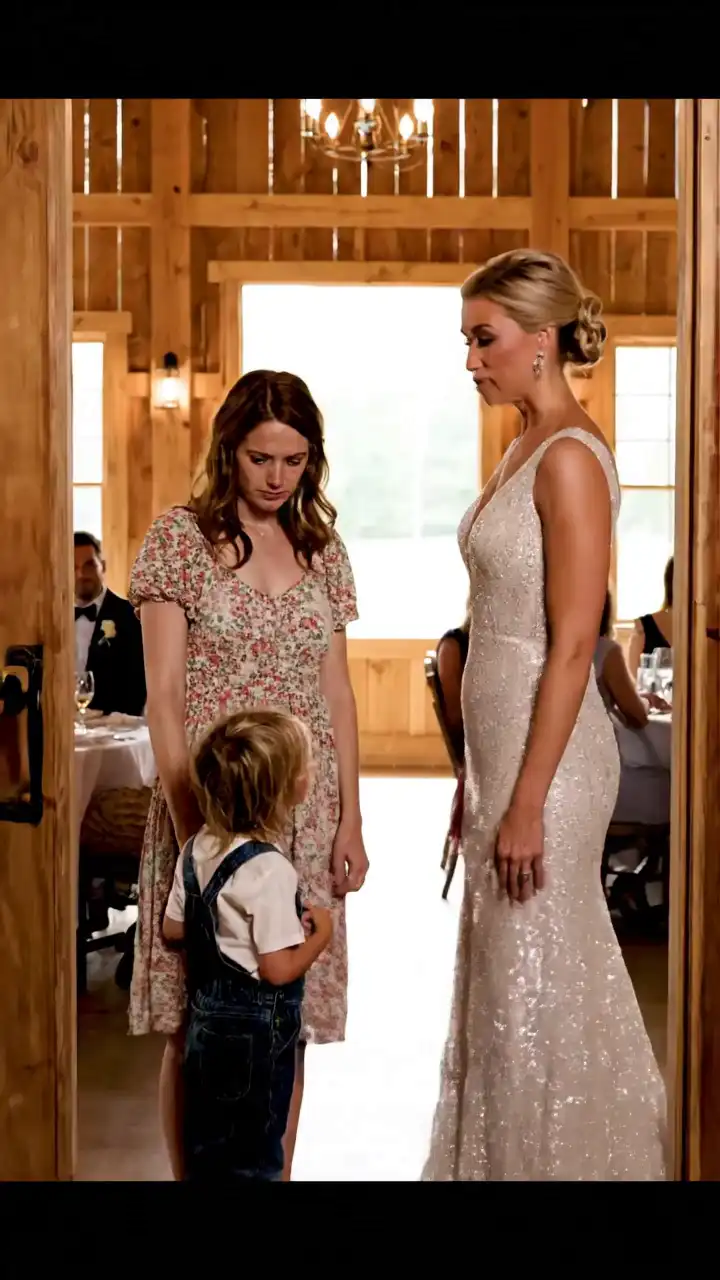
THEY LAUGHED AT MY THRIFT STORE DRESS UNTIL GRANDMA SAW THE SCAR ON MY ARM
Chapter 1
The first thing my cousin Brinley said when she saw me was loud enough to stop the music.
“Lark, honey, this is a formal engagement party, not a yard sale.”
A few people laughed before they could catch themselves. A few didn’t even try.
I stood just inside the reception hall of the Willow Creek Event Barn with my hand still on the door, feeling the April wind at my back and the heat of a hundred eyes in front of me. My dress was navy blue and simple, with a tiny loose stitch near the hem where I had fixed it by hand the night before. I had bought it from a thrift shop in Darlow, and if nobody looked too hard, it almost passed for new.
But Brinley always looked hard.
The lights hanging from the rafters were soft and golden, the tables were covered in ivory linen, and there were towers of roses arranged in crystal vases so expensive I was afraid to breathe near them. My shoes were old. My purse had a cracked strap. My son’s hand was warm and small in mine.
Milo pressed closer to my leg.
“Mom,” he whispered, staring at the dessert table, “is that real chocolate?”
“It is,” I said.
“Can we have some?”
“Later.”
He nodded in the serious way eight-year-olds do when they know later might mean no.
My older brother Kent walked over with a half smile that never reached his eyes. He was wearing a charcoal suit that fit him like it had been poured on. Beside him, Brinley touched the diamond on her finger every few seconds, making sure the room remembered why we were all there.
“You made it,” Kent said.
I almost laughed at that. He had sent the invitation three weeks late and only after our aunt called him twice.
“Wouldn’t miss it,” I said.
Brinley tilted her head at Milo. “And you brought him. Cute.”
Her voice did that thing where a single word held a whole insult.
“He’s family,” I said.
“Of course.” She looked Milo up and down. “There’s a kids’ table near the bathrooms. That might be more comfortable.”
Milo lowered his eyes. He had on his church shirt, the white one with the cuffs slightly too short now because he was growing. I had ironed it on a towel over the kitchen table in our apartment because the ironing board had broken last month.
“He stays with me,” I said.
Kent gave the room a quick glance, already embarrassed by the possibility of conflict. He had always been that way. Even as a kid, he would let somebody kick me under the table and then ask if we could all just move on.
Brinley stepped closer, smiling the way people smile when they want to draw blood without staining their own hands.
“You could’ve told me if money was tight. I had a box of leftover centerpieces in the garage. You might’ve made something out of them.”
More laughter. A sharper kind this time.
I felt Milo’s grip tighten.
“Mom,” he said softly, “can we go home?”
That should have been the moment I turned around. It should have been simple. But family humiliation has hooks in it. It tells you if you leave, you prove them right. If you stay, you bleed slower.
So I stayed.
“I’m here for Kent,” I said.
Brinley’s gaze dropped to my bare wrist, then to my dress, then to the faded coat I was still holding over my arm. “That’s generous.”
As I shifted the coat, the sleeve of my dress pulled back. The old scar on my left forearm showed for a second—thick, pale, and twisted from wrist to elbow, a shiny rope under the skin.
I covered it quickly, but not before somebody near the champagne tower noticed.
“Oh,” one of Brinley’s bridesmaids said, wrinkling her nose. “What happened there?”
I said the same thing I always said.
“Kitchen accident.”
Brinley laughed softly. “You really do collect hardships, don’t you?”
The barn had gone oddly quiet around us, not because anyone planned to help, but because public humiliation was free entertainment. Forks paused in midair. A woman I didn’t know pretended to rearrange silverware so she could stare longer. My aunt Geneva looked at the floor. My uncle Ross coughed into his napkin and said nothing.
Then from the far side of the room, a wavering voice cut through the hush.
“Lark?”
Everyone turned.
At the corner table nearest the windows sat Grandma Odelle, small and folded into her wheelchair under a lavender shawl. She had been left there with a sweating glass of iced tea, half melted, while the rest of the family clustered around the photographer and the bar. She was ninety if a day, and for the last year everyone had begun speaking around her as if she were already halfway gone.
But her eyes were clear.
“Come here,” she said.
Brinley forced a laugh. “Grandma, we’re greeting guests.”
Odelle didn’t even look at her. “I said come here.”
I walked Milo across the room, feeling every stare follow me. My cheeks burned. Milo stayed pressed to my side like he was trying to disappear into my dress.
When I reached Grandma, she lifted one trembling hand and touched my arm, right where the scar hid under my sleeve.
Her fingers stopped.
Then she looked up at me with a strange, searching expression I had not seen in years.
“Let me see.”
“It’s nothing,” I said quietly.
“Let me see.”
I don’t know why I obeyed. Maybe because in that room full of polished cruelty, her voice was the first one that sounded like home.
I pushed the sleeve up.
The scar showed in the warm light, white and ridged and impossible to make pretty. Around us, chairs scraped. People leaned in openly now.
Grandma Odelle traced the edge of it with one finger and went very still.
Then she whispered, not to the room, not even to me, but to herself.
“That fire.”
I felt the floor shift under me.
Kent frowned. “What fire?”
Grandma looked from my arm to my brother’s face.
And for one impossible second, she seemed more awake than all of us.
“The nursery,” she said. “Oh Lord.”
Chapter 2
Nobody moved after she said it.
The music kept playing, some soft country love song about forever, but it sounded wrong in the silence that had opened around our table. I could hear the fountain in the drink station trickling into a silver bowl. I could hear Milo breathing. I could hear my own heartbeat in my throat.
Kent gave a short laugh. “Grandma’s confused.”
Grandma Odelle turned her head slowly and fixed him with a look that would have flattened stronger men than my brother.
“I am old,” she said. “I am not confused.”
Brinley stepped in at once, smooth and smiling. “Maybe we should get Grandma back to her room for a rest.”
“This is not a room,” Grandma snapped. “This is a barn with fake roses and cold chicken.”
A few people looked away to hide their smiles.
Brinley’s face tightened. Kent rubbed the back of his neck. He hated scenes unless he was protected from them.
I pulled my sleeve down. “It’s fine. She’s remembering something wrong.”
But Grandma caught my wrist with surprising strength.
“No.” Her fingertips pressed the scar again. “You burned this saving him.”
The him landed in the center of the room like dropped glass.
Kent stared at her. “Saving who?”
She looked at him as if the answer were obvious. “You.”
I felt Milo’s hand slip into mine again. He was looking up at me with that worried little line between his eyebrows that made him look too much like his father.
“No,” I said quickly. “Grandma, please.”
Because I knew exactly what memory she was reaching for. I had spent fifteen years keeping it buried where nobody could use it, nobody could pity me for it, and nobody could call it debt.
Brinley gave a thin laugh. “Well, if we’re doing family legends now, somebody get another cake.”
Nobody laughed with her this time.
Aunt Geneva finally approached, carrying a plate she’d forgotten she was holding. “Odelle, maybe sit back, sweetheart.”
Grandma ignored her. “He was three,” she said, still looking at Kent. “Lark was nine. The space heater tipped over in the nursery at the old house on Bellmere Road. Curtains went up first. Then the crib blanket.”
Kent’s face changed, but only a little. Not recognition. Resistance.
“That’s not how I remember it,” he said.
“Because you were three,” Grandma replied.
A hush moved through the room in waves. Somebody lowered their phone. Someone else set a champagne flute down too quickly and spilled it over their hand.
Milo looked at me. “Mom?”
I knelt beside him. “It’s okay.”
But it wasn’t okay. The old panic was rising in me, the one that always came with smoke memories and hospital smells and the feeling of being trapped in a story I never wanted told.
I stood again. “Grandma, enough.”
Her eyes came to mine, softening.
“You never told him,” she said.
“No.”
“Why not?”
Because after the fire came everything else.
Because sacrifices are easier to survive than to explain.
Because people who owe you often grow to resent you.
Because I had spent years watching Kent become a man who measured people by what they wore, drove, served, and earned, and I could not bear to stand in front of him with my old hurt held out like proof of worth.
So I said the smallest part of the truth.
“It was a long time ago.”
Kent looked from me to Grandma, then back again. “Why would nobody tell me that?”
Aunt Geneva spoke without meeting anyone’s eyes. “Your father didn’t want you burdened by it.”
That made me laugh once, a dry little sound. Burdened. Such a clean word for the way our father handled guilt—by locking it in someone else’s closet.
Brinley touched Kent’s arm. “This is not the time.”
But Grandma Odelle had spent a year being treated like furniture, and now she had found a door back into the room.
“It is exactly the time,” she said. “You all sit her at the far tables. You call her brave for coming when what you mean is poor. You look at that child like he spoils your pictures. And all night I’ve watched it.”
Her voice shook, but it carried.
Nobody interrupted.
Milo leaned against me. I smoothed his hair, trying to steady both of us.
Uncle Ross cleared his throat. “Odelle, maybe there are details we all remember differently.”
Grandma gave him a stare sharp enough to cut bone. “Were you there when she jumped into the smoke?”
He looked down.
No one answered.
There was a ringing in my ears now. Not from sound. From the strain of holding myself together in public.
Kent’s face had gone pale under the barn lights. “Lark,” he said, and for the first time that night he sounded unsure. “Is that true?”
I could have said yes.
I could have let the room swing toward me and watched every expression rearrange itself.
Instead I said, “Can we not do this here?”
Brinley seized on that at once. “Exactly. Thank you. We have vendors, guests, a timeline—”
“Timeline?” Grandma said. “This girl has carried your family on her skin for fifteen years and you’re worried about a timeline?”
A nervous laugh skittered and died.
Then, from the dessert table, a little voice said, “Why didn’t anybody help her?”
It was my niece Hallie, Geneva’s granddaughter, seven years old and still young enough to ask the question nobody else dared ask plainly.
The room had no answer.
I looked toward the windows. Outside, dusk had thickened over the pasture. Cars lined the gravel lot in neat polished rows. Mine was the oldest one there by twenty years, with a door that only opened from the outside and a check-engine light that no longer even frightened me.
I wanted to take Milo and leave. I wanted my tiny apartment over Marla’s Hardware, my mismatched mugs, my quiet.
But Kent was still staring at my arm.
He said, “I don’t remember.”
“I know,” I replied.
And that, somehow, seemed to hurt him more.
Chapter 3
The party didn’t stop. That was the cruelest part.
The catering staff kept clearing plates. The DJ lowered the music and then raised it again once he decided no actual disaster was unfolding. Guests drifted into little pockets of whispering speculation. Brinley’s mother, Celeste Varden, marched over to the planner and started speaking in the clipped voice of a woman trying to tape dignity back together.
Meanwhile, my son hadn’t eaten dinner.
That was how these nights always went for people like me. Wealthy families can make humiliation look elegant, but underneath it there is still a mother trying to find a chicken tender for her child while everyone else circles scandal.
I took a plate from a tray and led Milo toward an emptier corner near the coat rack. He sat on a folding chair too tall for him, legs swinging, and ate in quick embarrassed bites.
“Am I in trouble?” he asked.
“No.”
“Did I do something wrong?”
My throat tightened. “No, baby.”
He nodded and kept eating, but he watched the room as if danger might come back wearing a nicer jacket.
Across the barn, I could see Kent in a hard conversation with Aunt Geneva and Uncle Ross. Brinley stood beside them, one hand pressed flat over her midsection, not because she was upset, I thought, but because she needed to hold herself in the center of the picture. Every few seconds someone came up to whisper to her. The event planner. A cousin from Tulsa. Her maid of honor, still holding her phone.
And over by the windows sat Grandma Odelle, alone again.
That sight hit me harder than the laughing had.
No one wanted to mock an old woman to her face, but they could punish her by neglect. They could let her sit with an empty tea glass and pretend they were simply busy. It was cleaner that way.
“Milo,” I said, “stay where I can see you.”
He pointed at the plate. “Can I take one more brownie?”
“Yes.”
That made him smile, just a little.
I crossed the room and knelt beside Grandma. “You shouldn’t have said that.”
She didn’t look sorry. “I should have said it years ago.”
Her wheelchair blanket had slipped to the floor. I picked it up and tucked it over her knees.
“They’ll blame you for the scene,” I said.
“Let them. They’ve been blaming the wrong people for years.”
I glanced at her sweating glass. “Have you had dinner?”
She looked at the distant buffet and sniffed. “They gave me green beans and called it supper.”
I almost smiled. “I’ll get you something else.”
As I stood, I noticed the skin of her hands, paper-thin and veined blue. This was the woman who used to bake seven pies for Thanksgiving before dawn. The woman who once split wood at sixty-eight because my father’s back was “acting up.” The woman who remembered everything and had been punished for outliving the uses people had for her.
I returned with a plate of sliced ham, mashed potatoes, and two dinner rolls wrapped in a napkin for later. She accepted it like a queen receiving tribute.
“Bless you,” she said, then added in a low voice, “Watch your brother.”
I followed her gaze.
Kent was walking toward me.
He stopped a few feet away, hands in his pockets like a man trying to appear casual while drowning.
“Can we talk outside?” he asked.
Brinley, who had shadowed him halfway over, spoke before I could answer. “Maybe not right now.”
Kent didn’t look at her. “I’m asking my sister.”
The word sister sounded awkward in his mouth, like a thing he had not used enough.
I looked at Milo. He had finished eating and was showing Hallie how to stack sugar packets into a tiny tower. Hallie’s mother was too deep in gossip to notice.
“Two minutes,” I said.
Outside, the air was cold enough to sting. String lights glowed along the fence, and somewhere beyond the pasture a dog barked. The gravel crunched under our shoes as we moved away from the doors.
For a few seconds, Kent said nothing.
Then, “Is it true?”
I shoved my hands into my coat pockets. “Why does it matter now?”
“Because if I’ve spent my whole life not knowing—”
“You’ve spent your whole life not asking.”
That landed. He looked away.
The truth was, there had always been clues. The scar. My refusal to celebrate the anniversary of the fire. The way Grandma stiffened whenever space heaters clicked on in winter. But Kent had lived in a world designed to cushion him from uncomfortable details. Our father saw to that.
“I was a kid,” Kent said.
“So was I.”
He swallowed. “What happened?”
The barn doors opened briefly behind us, spilling music and laughter and perfume into the cold, then shut again.
I closed my eyes for a moment. I didn’t want to tell it. Not because I was ashamed. Because the memory still had heat in it.
“The heater tipped,” I said. “I smelled smoke. You were asleep. Mom was at the late shift at County General. Dad was outside in the garage, passed out or close to it. I tried to wake you, but the crib sheet had caught. I pulled you out. The curtain fell. I put my arm over your face and ran.”
Kent’s breathing changed.
“That’s it?” he said.
I looked at him. “That was enough.”
He rubbed his mouth with one hand. “Why didn’t Dad ever tell me?”
Because our father had been many things, and honest was rarely one of them.
“Maybe because admitting I saved you meant admitting he didn’t.”
Kent stared at the dark pasture. “I don’t know what to say.”
“You don’t have to say anything.”
“I mocked you.”
“Yes.”
He flinched, but I was too tired to soften it.
Before he could answer, the barn door slammed open again. Brinley came out, heels sinking into the gravel, anger bright on her face.
“This is ridiculous,” she said. “Guests are asking questions. Grandma is upsetting people. And now my engagement party is turning into some kind of rescue-hero family drama.”
Kent stared at her. “Brinley, not now.”
“When then? After everyone leaves talking about your sister’s thrift dress and tragic scar?”
The words hung in the cold between us.
I saw Kent’s expression change. Not into goodness. Not yet. Just into shock that the ugliness sounded uglier when stripped of charm.
Brinley crossed her arms. “Look, I’m sorry if something happened when you were kids. But we cannot let one old story hijack tonight.”
I said nothing.
She turned to me. “And honestly, Lark, you could have handled this privately.”
Something in me went still.
“Privately?” I asked.
“Yes. Instead of standing there making everyone uncomfortable.”
I laughed then. Not because it was funny. Because it was so perfectly cruel.
“You humiliated me in front of a room full of strangers,” I said, “and I’m the one who made everyone uncomfortable?”
Her jaw tightened. “You know what I mean.”
“No,” I said. “I know exactly what you mean.”
The barn door opened a third time, more slowly now.
Grandma Odelle sat in the doorway in her wheelchair, a dinner roll in her lap like a forgotten prop, and behind her stood Hallie.
Hallie had one small hand on the handle, trying to help.
“I found her,” Hallie said.
Grandma looked at Brinley with open contempt. “You forgot me again.”
Brinley’s face flushed scarlet. “Nobody forgot you.”
Hallie said, “She was asking for water.”
No adult can survive a child’s plain truth with their dignity intact.
Grandma lifted her chin toward me and Kent. “If we’re speaking honestly tonight, let’s speak honestly all the way.”
Chapter 4
By then people were no longer pretending not to watch.
Clusters of guests had gathered near the doors, coats half on, drinks in hand, pulled by the kind of family rupture that makes everyone feel both ashamed and alive. The string lights above us flickered in the wind. Hallie stood behind Grandma’s chair in pink patent shoes, solemn as a witness.
Kent moved toward Grandma. “You shouldn’t be out here in the cold.”
She batted his hand away. “Then perhaps one of you should have thought of that before parking me by a window like a plant.”
Even in that moment, a few people smiled.
Brinley looked ready to shatter. “This is insane.”
“No,” Grandma said. “Insane was watching that girl limp through high school after skin grafts and never once hearing your father say thank you.”
The word skin grafts made several people recoil. The story was becoming too physical now, too impossible to keep tidy.
Kent turned to me slowly. “You had surgery?”
I nodded once.
“How many?”
“I don’t remember. Four, maybe five.”
He stared as if he was trying to place me in a family album and finding all the pages missing.
What I remembered wasn’t the number of surgeries. It was the smell of antiseptic. The itch under bandages. The way my mother cried only when she thought I was asleep. The way my father avoided my hospital room the first two days, then came in angry because guilt always made him mean.
And after the burns healed badly, there were bills. Missed shifts. The old house sold in a rush. Then Mom’s stroke three years later. Then her funeral. Then Dad drinking the rest of what was left. Poverty doesn’t usually arrive as one dramatic fall. It comes as a line of hands pushing on the same weak spot until something gives.
Brinley looked around at the guests, calculating. “Can we stop saying all this outside? People are staring.”
“They were staring when you mocked her dress too,” Grandma replied.
That shut her up for a beat.
Then Aunt Geneva came out with Uncle Ross behind her. Geneva’s lipstick had faded into the fine lines around her mouth. She looked older than she had an hour earlier.
“Odelle,” she said quietly, “you don’t know the full story.”
Grandma let out a sound halfway between a scoff and a laugh. “Then tell it.”
Geneva hesitated. Ross put a hand on her back.
That was when I knew there was more.
I looked at my aunt. “Tell what?”
She rubbed her palms over her skirt as if trying to smooth wrinkles that weren’t there. “Your mother asked us not to.”
My stomach dropped.
“Asked you not to what?”
Kent stepped closer. “Aunt Geneva.”
She looked at me with wet eyes. “Lark, after the fire, there was an insurance settlement. Not huge. Enough to cover treatment and help your mother move somewhere safer.”
Cold moved through me so suddenly it felt like illness.
I knew there had been paperwork. I knew adults whispered over forms and envelopes. But I had been nine. Then ten. Then a teenager trying not to become another bill.
“And?” I asked.
Geneva looked at Ross, then at Kent.
“Your father used part of it on debts,” she said. “Then more. Your mother fought him. There were terrible fights. By the time she understood how much was gone, there wasn’t enough left for everything.”
The night around us seemed to narrow.
Kent said, “What are you talking about?”
Geneva closed her eyes. “The private burn clinic in Wichita. The one with the reconstructive specialist. Your mother wanted Lark treated there. But you had already been admitted to Crestview Academy that fall.”
Kent went still.
I heard the name before I understood it. Crestview Academy. His boarding school. The place he still talked about like a launchpad to his whole life. The place with rowing photos in the hall and tuition we were never supposed to wonder about.
Ross said softly, “Your mother had to choose what was left could cover.”
“No,” Kent said immediately. “That’s not true.”
Geneva looked broken. “It is.”
I felt like I was watching someone else’s life from a few steps away.
“She chose him?” I asked.
Geneva’s face crumpled. “No. She chose the future she thought would lift the family. She believed you were stronger. She believed you’d survive what he couldn’t.”
That was somehow worse.
Brinley whispered, “Oh my God.”
Grandma Odelle said, “I told her it would haunt her.”
Nobody answered that.
Kent’s voice came out rough. “My school was paid for with her treatment?”
Ross nodded once.
“Not all of it. But enough. And when there wasn’t money later for the revision surgeries, your mother…” He stopped.
“My mother what?” I asked.
Geneva’s eyes met mine. “She took a second job. Nights at the laundry plant. That’s where she collapsed.”
I grabbed the back of Grandma’s wheelchair to steady myself.
My mother’s stroke. I had always been told it was stress, exhaustion, blood pressure. But the shape of it changed in front of me now. The hidden arithmetic of what had been traded for what.
Milo had come outside without me noticing. He stood in the doorway, brownie still in one hand, eyes huge.
“Mom?”
I straightened at once. “Go back inside, sweetheart.”
He didn’t move.
Kent looked at him, then at me. His face was wrecked open now, years of easy certainty splitting down the middle.
“I didn’t know,” he said.
And for the first time, I believed him.
That didn’t make it hurt less. But it changed the angle of the pain.
Brinley put a hand over her mouth. She was crying now, though I couldn’t tell whether for me, for Kent, or for the collapse of the beautiful night she had arranged so carefully. Maybe all three. People are rarely one clean thing.
A gust of wind lifted the edge of my coat, and my sleeve slid back again. The scar caught the string light above us, white against the dark.
Hallie stared at it, then up at me.
“Did it hurt?”
Children ask the truest questions.
“Yes,” I said.
She nodded, considering that with the grave seriousness of the young. Then she asked, “Did you still save him anyway?”
My eyes burned.
“Yes.”
Hallie’s small face twisted, not in fear, but in a child’s furious sense of unfairness.
Behind us, one of the guests quietly said, “Jesus.”
And the whole night turned.
Chapter 5
News travels through a family faster than fire if shame is carrying it.
By the time we went back inside, the atmosphere in the barn had changed completely. It wasn’t kindness exactly—not at first. It was the stunned rearranging of people who realize they have been standing on the wrong side of a story.
The bridesmaid who had wrinkled her nose at my arm wouldn’t meet my eyes. Celeste Varden, who had been so proud of the floral wall and imported macarons, suddenly became deeply interested in whether Grandma had enough ice water. Uncle Ross pulled out a chair for Milo at a proper table. Aunt Geneva disappeared and came back with a little plate piled high with the best things from the buffet, like ham and potatoes could mend fifteen years.
They couldn’t. But I saw the trying.
Kent stood in the middle of the room as if he no longer understood where to put his body. The easy authority he wore in every family space had vanished. He looked younger and older at once.
Brinley touched his arm. “Kent.”
He stepped away from her without thinking.
That hurt her. I saw it plainly. Again, people are not one clean thing.
The DJ, reading the room at last, turned the music down to nearly nothing. The party planner approached Brinley with a desperate whisper about cake photos. Brinley looked at the towering white cake under its sugar flowers and then at me.
For the first time all evening, she seemed stripped of performance.
“I’m sorry,” she said.
It was not dramatic. Not tearful. Not enough to erase what she had done. But it was real.
I nodded once because I did not have more to give her than that.
Then Kent crossed the room and stopped in front of me.
Everyone watched. Even the caterer with the coffee urn paused.
He said my name once. “Lark.”
I waited.
“I need you to tell me what I can do.”
There it was. The line people reach when regret finally meets helplessness.
My first impulse was anger. My second was to say nothing at all. But Milo was beside me, and Hallie was still hovering near Grandma, and all these younger eyes were learning something from us whether we meant to teach it or not.
So I answered honestly.
“You can stop letting people talk to me like that.”
Kent swallowed.
“You can stop treating my son like an inconvenience.”
His gaze went to Milo at once. Milo held his plate with both hands and looked back, wary and silent.
“And,” I said, “you can ask what happened before you decide who someone is.”
Kent nodded, once, hard. “I can do that.”
Then he did something I never expected.
He turned toward the room.
Not in a speech-making way. Kent was too rattled for that. But he faced the guests, the relatives, the polished people from Brinley’s side, and said in a voice that carried clean and plain:
“I was wrong.”
The barn went still again.
He looked at Milo. “And so was anyone who made this little guy feel unwelcome tonight.”
Milo blinked.
Then Kent looked back at me. “My sister saved my life. She paid for it in ways I didn’t even know to ask about. And I let her stand here and be humiliated. That ends now.”
No one moved.
Brinley closed her eyes briefly, as if accepting the public cost of all private cruelty.
Grandma Odelle dabbed at one eye with a dinner napkin and muttered, “About time.”
A tiny snort of laughter moved through the room, breaking the tension just enough for people to breathe.
Then the most unexpected person stepped forward: Celeste Varden.
Brinley’s mother was the last person I would have expected to cross a room without calculating the optics first. But she did.
She looked at my dress, my purse, my old shoes, my scar, and then at my face.
“My father worked in a feed mill,” she said quietly. “My mother hemmed dresses for cash. I taught my daughter polish and forgot to teach her mercy. That’s on me too.”
Brinley stared at her mother in shock.
Celeste took a breath. “Mrs. Odelle should not have been left alone. Your son should have been seated with the family. And you should never have been mocked in this room.”
She turned to the planner. “Move the place cards.”
The planner blinked. “Tonight?”
“Yes, tonight.”
Within minutes, chairs scraped across the floor. Table settings shifted. People who had watched me from a distance now made room. Not because all of them had changed inside. Some simply followed the loudest current in the room, and tonight the current had turned. I knew that. Poverty teaches you to read sincerity in thin slices.
But some had changed.
Hallie carried Milo’s brownie plate to the new table with ceremonial seriousness. Aunt Geneva personally wheeled Grandma Odelle to the center. Uncle Ross fetched fresh coffee. Even the bridesmaid with the cruel little wrinkle at her nose came to me and said, “I’m sorry about before.” She looked seventeen suddenly, and frightened of the kind of woman she might become.
I sat down slowly, as if the chair might vanish.
Milo climbed into the seat beside me and whispered, “Do we get cake now?”
I laughed, and it came out wet.
“Yes,” I said. “We get cake now.”
Kent remained standing for a long moment. Then he reached into his inside jacket pocket and pulled out a folded envelope, thick cream paper with my name written on it in his neat accountant’s hand.
“I was going to wait until later,” he said, “because I thought giving it quietly would make me look generous.”
I looked at him without taking it.
He held it out anyway. “It’s a cashier’s check. I sold the lake lot last month. I was planning to put it into an investment account, but—” His voice broke. “It should have been yours years ago.”
The room seemed to lean in.
I didn’t reach for the envelope.
“This won’t fix it,” I said.
“I know.”
“It won’t bring Mom back.”
His eyes filled. “I know.”
“It won’t undo being the family cautionary tale. Or the poor sister people invite out of obligation.”
His hand shook. “I know.”
I looked at the envelope for a long time.
Then Grandma Odelle spoke from my left, blunt as ever.
“Take it,” she said. “Pride won’t pay rent.”
Several people laughed through tears.
And because she was right, because Milo needed shoes and our car needed brakes and because refusing help simply to protect the dignity people had already trampled was another way of staying trapped, I took the envelope.
My hand trembled around it.
Kent let out a breath like a man who had been underwater.
“I’m sorry,” he said again.
This time I believed more than the words. I believed the damage in him.
Then Milo tugged on my sleeve. “Mom.”
“What is it?”
He pointed toward the cake table where a server was cutting huge white slices with raspberry filling.
“That one has extra frosting.”
In that moment, with my dead mother’s history hanging in the air and my family rearranging itself in real time, my son was still a child.
Thank God for that.
I brushed my fingers under my eyes. “Then that’s the one you get.”
Chapter 6
The party never became what it had been meant to be.
There were no more easy toasts after that, no glossy stream of engagement photos untouched by truth. But in a strange way, it became something better than polished.
It became honest.
Grandma Odelle ate two full slices of cake and informed the table that the frosting was too sweet and the coffee was weak. Hallie asked if scars always looked shiny. Milo, after finishing his first piece, finally smiled wide enough to show the gap where he had lost a tooth in March. Aunt Geneva cried in the ladies’ room and came back with her face washed clean. Brinley sat very straight through most of it, speaking less than usual, which may have been the first useful silence of her adult life.
Later, when people began gathering purses and coats, she found me by the coat rack.
The barn was quieter then. The string lights glowed low, and the floor was sticky with spilled punch. Milo had fallen asleep with his head on Grandma’s lap while Kent and Ross loaded gifts into cars.
Brinley stood with her heels in one hand and said, “I’ve been awful to you.”
I was too tired to pretend otherwise. “Yes.”
She nodded. “I kept thinking if I made you small, nobody would notice how hard I work to seem big.”
I looked at her more carefully then. Under the makeup and the practiced brightness, she looked frightened. Not of me. Of herself.
“That’s still a choice,” I said.
“I know.” She swallowed. “I don’t expect you to forgive me tonight.”
“Good.”
To her credit, she accepted that.
Then she glanced at Milo asleep in Grandma’s lap and asked, almost shyly, “What’s his favorite kind of birthday cake?”
The question was so ordinary it nearly undid me.
“Yellow,” I said. “With chocolate frosting.”
She nodded like she was committing a fact to memory that might matter later.
Maybe it would. Maybe it wouldn’t. Families do not heal in one dramatic scene any more than they break in one. But a true question is a beginning.
When it was time to go, Kent walked us to my car.
The gravel lot was damp with dew. My old sedan looked even sadder parked between polished SUVs and a black Mercedes. Kent carried the leftover cake box and the envelope had been tucked deep into my purse where I could not feel its weight too directly.
He stood while I buckled Milo into the backseat.
“I want to help more,” he said quietly.
I closed the door and turned to face him. “Then help right. Not as charity. Not as guilt.”
He nodded. “Tell me how.”
“Start with Grandma. She shouldn’t have to ask for water in a room full of relatives.”
He looked down at the gravel. “Okay.”
“Call Hallie’s mother and ask why a seven-year-old noticed what adults didn’t.”
His mouth twitched despite everything. “Okay.”
“And don’t rewrite tonight into a story where you were noble in the end.”
That one made him wince.
“Okay,” he said again.
I opened my driver’s door. Before I got in, I looked at him—really looked. The brother I had carried from smoke. The man built partly on a sacrifice he had never been told to see. He looked fragile in a way expensive clothes cannot hide.
“I didn’t save you so you could become cruel,” I said.
His eyes filled. “I know.”
For a second I thought he might hug me, but we weren’t there yet. Maybe one day. Maybe not. Truth does not always lead to closeness. Sometimes it just clears the fog.
I got into the car. The engine coughed twice before it caught. Kent stepped back.
As I pulled toward the exit, I saw Grandma Odelle through the barn window, her lavender shawl bright under the lights, one hand lifted in a queenly wave. Hallie stood beside her. Brinley was behind them carrying two cups of coffee, one careful step at a time.
I drove slowly down the gravel road toward Darlow, with Milo sleeping in the back and the smell of cake filling the car.
At a red light near Mercer Street, I took one hand off the wheel and touched the old scar on my arm. For years I had hidden it under sleeves, under jokes, under silence, as if what had been taken from me would shrink if nobody named it.
But some truths rot in the dark.
And some, once brought into the light, stop being shame and become witness.
I wasn’t rich when I left that party. I wasn’t suddenly healed. My rent was still due. My job at Hensley Cleaners still started at seven on Monday. My grief for my mother was still old and sharp in the places that mattered.
But something had changed.
My son had seen a room full of people turn after truth. My grandmother had been heard. My brother had finally looked at me and seen the cost written on my skin. And the family story had been forced to make room for the person it had asked to stand quietly at the edges.
When we reached home, I carried Milo upstairs without waking him. In the kitchen, under the weak yellow light over the sink, I set the cake box down beside our chipped sugar bowl and my purse on the chair.
Then I rolled up my sleeve.
The scar shone pale in the light, ugly to some eyes, impossible to miss now that I was really looking at it.
I traced it once and said out loud to the empty room, to my mother, to the girl I had been, to anyone who had ever mistaken worn clothes for a small life:
“You don’t get to measure people by what they wear.”
Then I turned off the kitchen light and went to bed, carrying that truth with me like something finally returned.
Disclaimer: Mention of any brand or trademark is for identification only and does not imply partnership or endorsement
MY HUSBAND USED MY MONEY, GOT ENGAGED TO HIS MISTRESS, AND STOOD THERE WHILE SHE SLAPPED ME
THE MAID OF HONOR POURED WINE ON ME AT MY BRIDAL SHOWER AFTER STEALING MY FIANCÉ. SHE DIDN'T KNOW THE ROOM WAS ABOUT TO HEAR WHAT HE'D BEEN SAYING TO BOTH OF US.
THE MAID OF HONOR POURED WINE ON ME AT MY WEDDING AND CALLED ME CRAZY. SHE FORGOT I STILL HAD THE VOICE NOTE SHE SENT MY FIANCÉ.