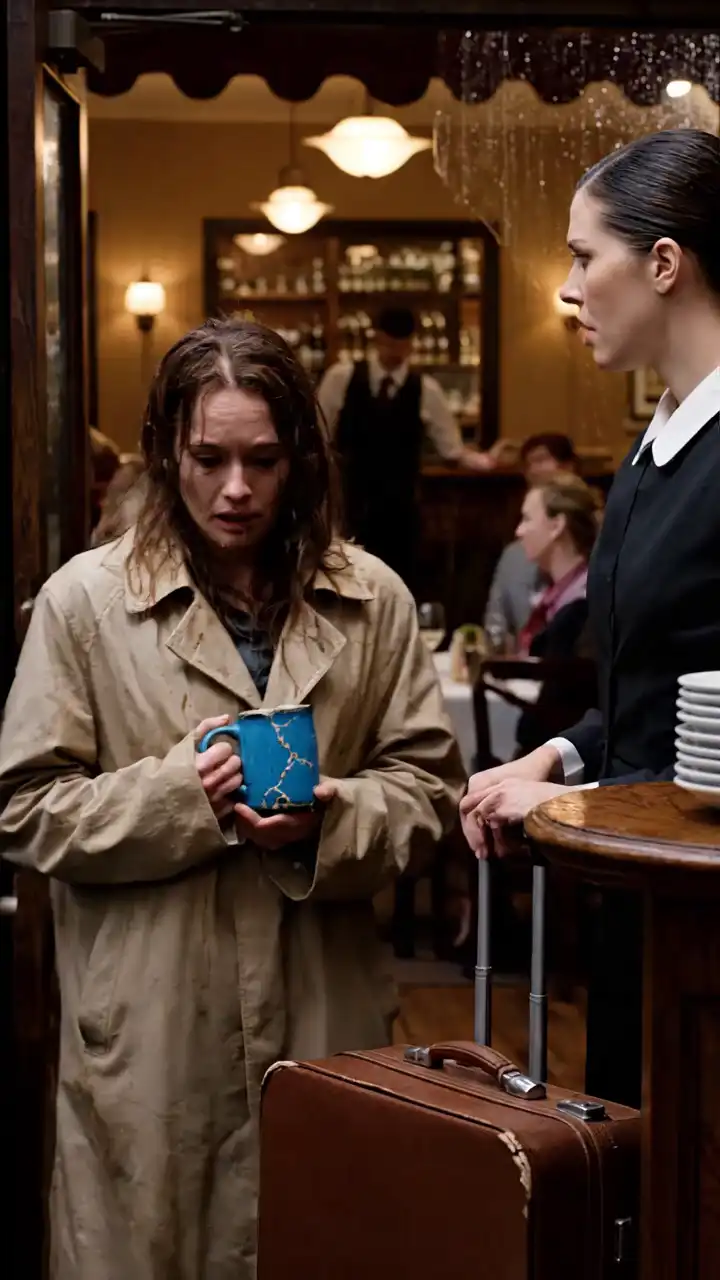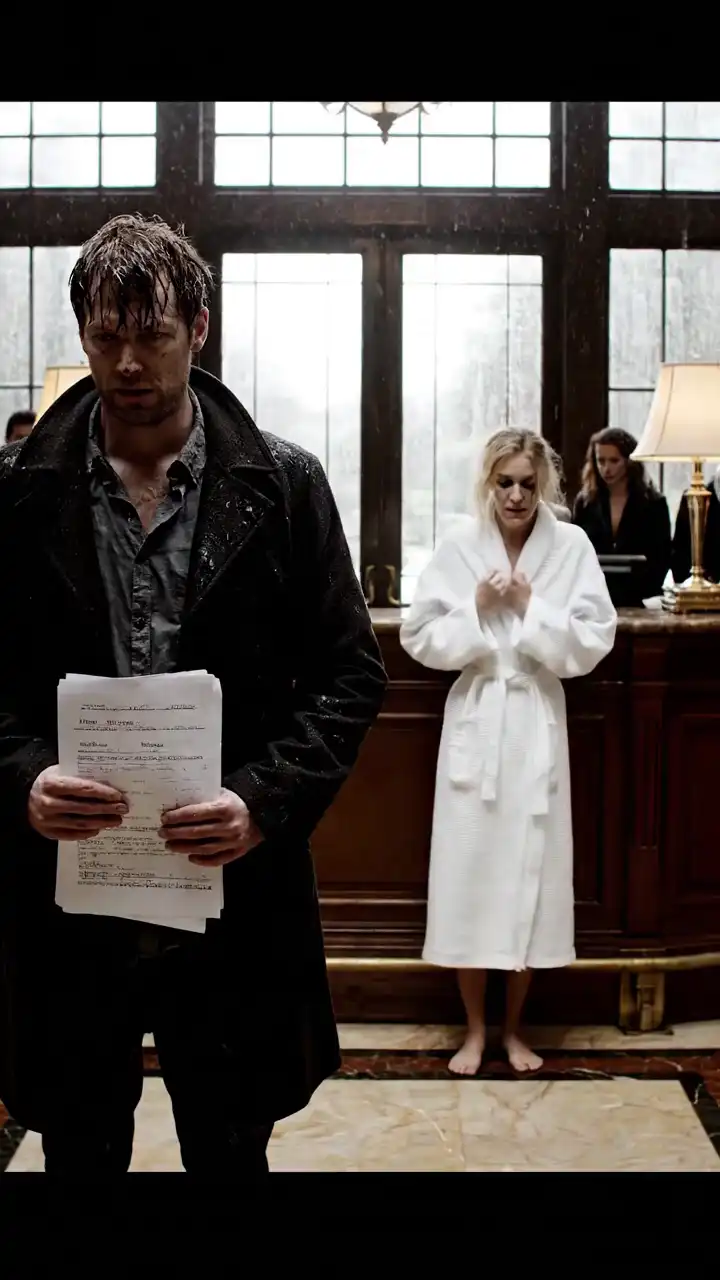

HE HELD UP MY PHONE IN THE MEETING ROOM ON OUR WEDDING MORNING
Chapter 1
When my phone lit up in Trevor Dane’s hand, the whole conference room went silent.
I was still wearing my wedding dress under a cream wool coat because the courthouse ceremony was less than an hour away. My veil was folded in a white bakery box beside the refreshments, next to a tray of stale mini muffins and a silver coffee urn that hissed every few seconds. On the glass wall behind me, gold vinyl letters spelled out DANE FAMILY HOLDINGS in a clean, expensive font that made everything feel official and cold.
Trevor stood at the head of the table with my phone raised shoulder-high, like evidence.
“Do you want to explain this before I do?” he asked.
His voice was calm, and that was the cruelest part. Calm meant practiced. Calm meant he had decided how this was going to look before I even walked in.
Every seat around the long walnut table was filled. His mother, Lenora, had one hand over her pearl necklace. His uncle, the family attorney Gordon Pike, sat with a legal pad open in front of him. Two board members I barely knew stared at me with the hungry stiffness people get when they sense scandal and want the right to feel superior about it.
And then there was Reese Halden.
My ex.
He was standing near the back wall beside the credenza, one hand in his coat pocket, looking at me like he wished the floor would split open and swallow both of us.
I stopped just inside the door. “Why do you have my phone?”
Trevor gave a humorless smile. “You left it in the bridal suite upstairs.”
That was a lie. I had left it in the ladies’ room down the hall when Lenora came in asking me to join this “quick family paperwork review” before the ceremony. I had not left it with him.
My maid of honor, Sable Ortiz, sat near the corner of the table, half-risen from her chair. She had come with me to help pin my veil after the meeting. Now her face was pale and hard at the same time.
“Trevor,” she said, “put her phone down.”
He ignored her and tapped the screen. “A deleted message thread restored from the cloud. Funny thing about deleting messages, Nora. They don’t always leave clean.”
My stomach dropped so fast I had to grip the back of the nearest chair.
The room heard the name before I could breathe.
Reese.
A message preview flashed across the screen in blue and gray bubbles.
I miss you too
Another line below it.
We can’t keep doing this
Someone at the table sucked in a breath. Lenora did not look at her son. She looked at me, and in her eyes I watched myself become a type of woman she had always expected me to be.
Trevor set the phone on the table and slid it toward Gordon Pike like an exhibit in court.
“So,” Trevor said, “is there anything you’d like to tell the room before I cancel a wedding and a trust transfer?”
The words hit harder than the messages.
Trust transfer.
That was why we were in the conference room on my wedding morning. Trevor’s late grandfather had left a property and voting shares in the company to be transferred upon Trevor’s legal marriage. It had been framed to me as routine paperwork, dry and procedural, one last administrative errand before vows and champagne and pretending I belonged in this polished family.
Now I understood. This was not paperwork. This was a stage.
I looked at Reese. He looked away first.
That hurt almost as much as seeing my own phone in Trevor’s hand.
“It’s not what you think,” I said, and I hated myself for saying the oldest, weakest sentence in the world.
Trevor laughed once, short and sharp. “Then please. Help us think better.”
I wanted to say that grief made people text old people. That confusion made people weak. That missing someone once did not mean betraying someone now. I wanted to explain that the message he was showing had been from three months ago, after my father’s stroke, when I had panicked and reached for the person who had known me before I learned how to hold my face still.
But I also knew how it looked. Young bride. Ex-boyfriend in the room. Groom holding up deleted messages.
No one was waiting for the truth. They were waiting for me to crack.
Sable stood up fully this time. “This is disgusting.”
Lenora turned to her. “If Ms. Weller has done nothing wrong, she can answer for herself.”
My throat burned.
I had spent the last year trying not to be expensive trouble. That was the silent rule around the Dane family. Don’t need too much. Don’t say too much. Don’t bring your messy old life into their sleek new rooms. Trevor never said it directly, but his mother wore the message like perfume.
I came from Penn Hollow, a river town forty miles south, where people still talked through open screen doors and funeral casseroles arrived before the obituary. Trevor came from Norwick Heights, where every building had tinted glass and every conversation sounded billable.
I had met him at the Morrow Gallery fundraiser where I worked part-time after leaving community college to help care for my dad. He liked to say I was “refreshingly real.” I used to think that was admiration. Later I understood it was a kind of ownership.
Gordon cleared his throat. “Nora, for the sake of the record, were you or were you not in contact with Mr. Halden during your engagement?”
I stared at him. “The record?”
Trevor spread his hands. “You should have read the prenuptial addendum more carefully.”
A pulse started pounding behind my eyes. “You invited my ex to a family meeting on our wedding day and dug through my phone?”
Trevor’s jaw tightened. “Answer the question.”
Reese finally spoke, too quietly at first. “Trevor, don’t do this.”
Every head turned.
Trevor smiled without warmth. “Interesting. Now he’s worried about dignity.”
I looked at Reese, and for one reckless second I wanted him to save me, even if I didn’t deserve saving. He had once been the person who knew when I was about to cry before I did. But he only stood there with his face drawn and ashamed.
That was when I realized he hadn’t been surprised to see me in this room.
He had been called here.
Used here.
Maybe willingly.
The humiliation turned physical. My ears rang. The wool coat felt too heavy over the satin dress. The room smelled like burnt coffee and expensive cologne and the faint powdery scent of roses from my bouquet waiting somewhere upstairs.
“Say it,” Lenora said softly. “Were you carrying on with your ex while planning to marry my son?”
The phrase carrying on floated over the table like something sticky and old-fashioned and filthy.
“No,” I said.
Trevor leaned down, braced both hands on the polished wood, and spoke to me as if I were the only person in the room.
“Then why did you text him at midnight that you missed him?”
I swallowed. “Because my father was in the ICU and I was scared.”
“Scared enough to crawl backward?”
The room stayed still.
“I didn’t sleep with Reese,” I said.
Trevor’s eyes flicked toward my phone. “Did you love him?”
That one landed deeper because it was not a legal question. It was a humiliation question, designed to make everyone watch me bleed.
My hands were trembling now. “This is not how decent people behave.”
Trevor straightened. “Decent people don’t marry for access while texting their ex.”
That was the moment the room changed. Not because people believed him more. Because he had finally said the dirty thing under all the cleaner words.
Access.
The shares. The property. The Dane family name. The polished life.
To them I was suddenly not a bride under attack. I was a girl from the wrong town in white satin, caught reaching above herself.
Sable grabbed her bag and marched around the table. “We’re leaving.”
But before I could move, Gordon Pike lifted one finger.
“I’m afraid no one should leave yet,” he said. “Not until we address the matter tied to the Harrow Street transfer clause.”
I frowned. “What does Harrow Street have to do with this?”
The attorney looked surprised that I knew the address.
Because Harrow Street had been my grandmother’s street once. A narrow old block in Penn Hollow with peeling porches and stubborn rosebushes. I had not heard that name from anyone in Trevor’s family before.
Trevor’s expression shifted for a split second, almost annoyance, almost worry.
Then Sable said the sentence that made my blood run cold.
“Nora,” she whispered, “why is Reese getting messages from Trevor too?”
Chapter 2
For half a second no one moved.
Then Trevor turned to Sable so quickly his chair legs scraped against the floor.
“What are you talking about?”
Sable was holding her own phone now, not mine. Her thumb trembled over the screen, but her voice came out steady.
“I texted Reese this morning from Nora’s phone when she was in the restroom. I just wanted to tell him to stay away from the courthouse if he was planning to make some dramatic last-minute appearance.” She looked at Reese with disgust. “I thought you were the problem.”
Reese flinched but didn’t interrupt.
Sable continued, “He never answered me there. But five minutes later, I got a message from an unknown number saying, Don’t warn him. I need him in the room.”
The conference room seemed to pull inward around us.
Trevor gave a short laugh. “That proves nothing.”
“It might if I show the number,” Sable said.
She crossed the room and held her phone toward me first, as if asking permission. On the screen was the unknown text. Beneath it, another one had come in a minute later.
She’ll deny it
Trevor’s face did not change, but something in his eyes hardened into calculation.
“Coincidence,” he said.
“No,” Reese said.
That one word came out flat and final.
Everyone turned to him again. He pulled his phone from his pocket with the slow reluctance of a man stepping into traffic because he can no longer stand still.
“I got texts too,” he said. “From a blocked number at first. Then from a second number after midnight.”
He looked at me only once before placing his phone on the table.
Trevor didn’t move, but I saw a muscle jump in his cheek.
Reese spoke to the room, not to me. “I was told Nora wanted to see me before the wedding. Then I was told there were legal questions about a property in Penn Hollow and my name might matter. I came because I thought...” He stopped.
“What?” Lenora snapped.
Reese swallowed. “I thought she might be in trouble.”
Trevor scoffed. “How noble.”
But Gordon Pike had leaned forward now. He was reading Reese’s screen with the focused silence of someone who recognized liability when he saw it.
The messages were short.
Be at Dane Holdings at 10 sharp
Don’t tell Nora I called
You may want to hear what she says before she marries me
Bring anything you still have from Harrow Street
My heartbeat stumbled.
Harrow Street again.
I stared at Trevor. “Why would Reese have anything from Harrow Street?”
Trevor looked almost bored. “How would I know?”
But Reese answered before anyone else could.
“Because your grandmother, Edith Weller, left a metal lockbox with me four years ago,” he said.
The room tilted.
I had to set both palms on the table.
“My grandmother died eight years ago.”
Reese nodded once. “She gave it to me before she died.”
“You’re lying,” Lenora said.
“No,” Reese said. “She did.”
I turned fully toward him. “Why would my grandmother leave you anything?”
His face changed then. Not defensive. Not proud. Just old regret resurfacing.
“Because I was helping her after church on Tuesdays,” he said. “She trusted me. She knew your dad was drinking hard back then and she didn’t want the box disappearing before the right time.”
I could barely hear through the rush in my ears.
My grandmother Edith had raised me after my mother left when I was six. She had lived on Harrow Street in a narrow blue house with a porch swing and two cracked concrete steps. She hid emergency money in flour tins and wrote reminders on the backs of utility bills. She had also believed in papers. Keep your papers, she used to say. People can steal your words if you don’t keep your papers.
Trevor had never met her.
So why was he using her street like bait?
Gordon Pike removed his glasses. “Mr. Halden, if such a box exists, why bring it now?”
Reese let out a breath. “Because the texts said the transfer connected to Harrow Street. I didn’t know if it was real. But I still had the box.”
Trevor smiled thinly. “This is ridiculous.”
Sable folded her arms. “Then why are you sweating through your shirt?”
He shot her a look that would have silenced most people. Sable stared right back.
I looked at Gordon. “What transfer clause were you talking about?”
He hesitated, and that hesitation said more than any answer.
Lenora noticed too. “Gordon?”
The attorney cleared his throat. “The late Hollis Dane’s amended estate instrument included a contingent acquisition provision tied to marriage and occupancy. It concerns a Penn Hollow parcel identified as 214 Harrow Street.”
I felt my face go cold.
That was my grandmother’s address.
I heard my own voice as if someone else were using it. “Why is my grandmother’s house in your family papers?”
No one answered fast enough.
Trevor reached for control again. “This is getting off track. The issue is still whether my fiancée was conducting an emotional affair with her ex.”
“No,” I said, louder than before. “The issue is why my dead grandmother’s house is sitting inside your grandfather’s estate.”
The board members shifted uncomfortably. This was no longer delicious private scandal. This was messier. Legal. Historical. Public in the wrong way.
Gordon pressed his lips together. “Perhaps we should continue this in confidence.”
“Absolutely not,” I said.
For the first time that morning, my voice felt like mine.
I took off my coat and draped it over a chair. The white dress beneath it glowed too brightly under the recessed lights. I felt absurd and exposed and stronger than I had five minutes ago.
“Explain it now.”
Lenora turned toward Gordon with open anger. “I was told this was a standard execution review.”
Gordon looked at Trevor.
That was answer enough.
Trevor lifted his chin. “My grandfather made investments in distressed properties. We all know that.”
“Distressed?” I said. “A widow’s house in Penn Hollow was a distressed property?”
His eyes narrowed. “Don’t get melodramatic.”
Sable made a sound under her breath. Reese stared at Trevor with open contempt now.
Gordon spoke carefully. “Years ago, title to 214 Harrow Street transferred during a debt action involving your father, Ms. Weller.”
“My father had no authority over that house,” I said. “It belonged to my grandmother.”
“After a lien and probate confusion—”
“Confusion for who?”
He stopped.
I knew then that whatever this was, it had not begun with me. It had begun long before I ever put on a white dress or answered one of Trevor’s polished texts or stepped into this building trying to become acceptable.
Trevor spread his hands again as if he were the only practical person in a room full of hysteria. “Nora, no one stole your house. If there’s some ancient paperwork issue, that has nothing to do with the fact that you’ve been talking to your ex behind my back.”
There it was again. That frantic return to the affair. The simpler shame. The shame that kept the larger questions buried.
My eyes dropped to my phone on the table.
Deleted messages. Restored from the cloud.
I knew exactly which thread Trevor had shown. I also knew I had deleted more than one kind of message in the past month—not because I was cheating, but because some texts had made no sense and left me uneasy. Messages from Trevor arriving at strange hours, then disappearing from our thread. Quick phrases. Wrong names. Fragments that felt like they belonged to another conversation.
At the time I thought he was drunk, distracted, careless.
Now a memory flashed so sharply I almost swayed.
Two weeks earlier, Trevor had handed me his phone at dinner and said, “Can you read that to me?” A message had appeared at the top of the screen before he snatched it back.
Miss you too
For one stupid second I had thought it was my old message reflected in my guilty mind. Then he laughed and said it was for a client named Theresa and changed the subject.
I lifted my head.
“Sable,” I said quietly, “do you still have the screenshots I sent you from the weird messages Trevor deleted?”
Her brows drew together. “Yeah. I always keep screenshots.”
Trevor’s face finally changed. Only a little. But enough.
“What screenshots?” Lenora asked.
Sable was already scrolling.
Chapter 3
If you want to know how fast a room can turn against a woman, get accused in white.
If you want to know how fast it can hesitate, let one fact refuse to stay buried.
Sable connected her phone to the conference room screen before anyone could stop her. She had done freelance event work for enough hotels and venues to know every cable, every adapter, every little humiliating way technology could make private things public. The big monitor at the far end of the room blinked blue, then filled with her photo roll.
“Take that down,” Trevor said.
“No,” Sable replied.
She opened a folder labeled JUST IN CASE.
The first screenshot appeared on the screen, oversized and brutal.
It was from a month ago. I had sent it to Sable late at night with the message, Does this seem weird to you?
The screenshot showed a text thread with Trevor.
Trevor: I shouldn’t have stayed that long
Trevor: She thinks I was with Gordon
Trevor: Delete that
Then, three minutes later:
Trevor: Sorry wrong person
At the time he had laughed it off. Said he was texting a board member about a donor dinner and dictating too quickly. I had wanted so badly to be the kind of woman who didn’t make trouble that I let it pass.
The conference room went still in a different way now. Not the clean silence of accusation. The rawer silence of people recalculating.
“That could be anything,” Trevor said.
Sable swiped.
Another screenshot.
Trevor: Don’t wear the blue one around her
Trevor: I mean around my mother
Then another.
Trevor: If she asks tell her you were at Lake Mercer
Trevor: Sorry not for you
Lenora made a small sound in her throat.
Gordon Pike looked like a man trying to decide whether to stay a lawyer or become a witness.
Trevor put both hands flat on the table. “These are incomplete.”
“Of course they are,” Sable snapped. “Because he kept deleting them.”
My humiliation was still there, hot and alive, but something else had entered the room with it now. Recognition. All the small moments I had folded up and hidden from myself were unfolding at once.
The nights Trevor turned his phone face down the second I walked in.
The shower he took before hugging me after “late meetings.”
The strange tenderness on the mornings after he’d been distant, as if guilt made him generous.
The way he kept asking if I had heard from Reese, not casually, not jealous exactly, but probing, as if he needed a shape to pin me into.
I remembered one more thing. Three days earlier, I had stepped into his office to drop off seating cards for the reception. He had been on the phone with someone and said, very softly, “She still doesn’t know.”
He had smiled when he saw me and changed his voice immediately.
I thought he meant a surprise.
Now I wondered who the she had been.
Lenora rose from her chair in one stiff motion. “Trevor, tell me what these are.”
He did not look at her. He looked at me.
And in that look I saw it clearly for the first time: he had never been afraid I would betray him. He had needed me to look capable of it.
A bride with an ex in the shadows was useful.
A wife who could be discredited on day one was useful.
A woman from the wrong side of money, entering a marriage that triggered a property transfer, was useful if she could be painted greedy, unstable, unfaithful.
My skin went cold all over.
“Gordon,” I said, “what happens to the Harrow Street transfer if the marriage fails before execution?”
The attorney took too long.
Lenora swung toward him. “Answer her.”
He removed a document from his leather folder but did not hand it over yet. “The contingent acquisition would remain under Dane family control pending spousal review and waiver.”
“Waiver by whom?” I asked.
“By the incoming spouse.”
I stared. “Me.”
Gordon said nothing.
Trevor finally moved away from the table and began pacing near the glass wall. He looked angry now, but not blindsided. Cornered, yes. Exposed, maybe. But not surprised.
That terrified me more than if he had shouted.
“This is absurd,” he said. “Nora, I was trying to protect myself. You were talking to your ex. You’ve been evasive for months. We had every right to clarify what kind of marriage I was stepping into.”
Reese laughed once, bitter and low. “You lured me here to make her look guilty.”
Trevor whirled toward him. “You came running.”
“Because I thought she needed help.”
“You always think she needs help.”
The words hung there with too much history in them.
My face burned. Every old triangle is humiliating because everyone can assign roles to you before you open your mouth. Fragile woman. Better man. Rich man. Old flame. Gold-digger. Emotional fool.
I was tired of all of it.
“What is the lockbox?” I asked Reese.
He hesitated, then reached under the credenza where he had apparently tucked a worn metal box wrapped in a grocery bag. It was smaller than I expected. Rust flecked the corners. A faded strip of masking tape across the top had my grandmother’s handwriting on it.
FOR NORA IF HARROW STREET IS EVER CONTESTED
My knees almost gave out.
I moved toward it, but Trevor got there first and put one hand on the lid.
“Don’t,” he said.
That single word told the room everything.
Reese knocked his hand away.
“Don’t touch what isn’t yours.”
Trevor stepped back, and for the first time his polished self-control cracked into something ugly. “You have no idea what you’re talking about.”
“I know enough,” Reese said. “Edith said if anybody from the Dane side ever got interested in that house, Nora needed to see what was inside.”
“Why didn’t you give it to her years ago?” I asked.
His eyes met mine with visible shame. “Because she said only if it was contested. And because after we broke up, I thought staying away was the least selfish thing I could do.”
That hurt, but it also felt true.
Sable came to stand beside me. “Open it.”
Lenora sat back down very slowly, as if her bones had gone weak. “Trevor,” she said, “what have you done?”
He didn’t answer.
I lifted the lid.
Inside were folded documents in plastic sleeves, a brass key, a small church envelope, and a cassette-sized digital recorder so old it looked almost comic in the sleek conference room. The top document was a property deed. Beneath it was a notarized letter from my grandmother Edith Weller dated six months before her death.
My hands shook so badly Sable took the letter and read it aloud when I couldn’t.
“If this house is ever claimed by anyone outside my blood,” she began, “know this was done against my understanding and under false papers brought during my son’s illness. I was told I was signing temporary debt protection. I later learned the deed had been altered under a holding company connected to Hollis Dane.”
Gordon Pike closed his eyes.
Sable kept reading.
“I was not of clear sight the day those papers came. I had taken medicine after my fall. The young man who carried them said the matter was urgent and legal and that my granddaughter Nora would be protected if I cooperated. I did not understand till later. I write this now with Pastor Eli Baines as witness.”
There was a second signature at the bottom. Pastor Eli Baines, Riverlight Baptist Church, Penn Hollow.
My vision blurred.
Trevor moved toward us. “That proves nothing. Elderly people get confused.”
Then Lenora slapped him.
The sound cracked through the conference room so sharply that everyone froze.
She wasn’t a dramatic woman. She was a surgical woman. Controlled. Groomed. Socially exact. The fact that her hand was shaking afterward made the slap feel even louder.
“Do not insult that woman to save yourself,” she said.
Trevor touched his cheek, stunned.
No one spoke for several seconds.
Then Gordon said, quietly, “There may be criminal exposure.”
Trevor’s head snapped toward him. “You work for us.”
“I work for the law,” Gordon said, though he sounded like a man only now remembering that distinction.
I looked deeper into the box.
There were photocopies of loan notices sent to the wrong address. A note in my grandmother’s handwriting listing dates and names. And one thing that made my chest tighten so fast I had to sit down.
A photo.
Trevor, much younger, standing beside a woman in a blue dress near a lakeside railing.
The back was dated by my grandmother in pen from three years earlier.
Lake Mercer fundraiser night the same night he met Nora at gallery
Under the photo, tucked into the sleeve, was a folded printout of text messages.
I opened it.
The number at the top was not saved, but I knew those fragments.
Don’t wear the blue one around her
If she asks tell her you were at Lake Mercer
I stared at the screen captures, then at the woman in the blue dress.
It wasn’t random.
It was one person.
One hidden line running under everything.
Lenora saw the photo and went completely pale.
“No,” she whispered.
Sable looked over my shoulder. “Who is she?”
Lenora’s answer came out like something torn.
“Celeste.”
Trevor said nothing.
Gordon looked up sharply. “Celeste Rainer?”
Lenora laughed once, and there was no warmth in it at all. “My God.”
I turned to her. “Who is Celeste?”
She pressed her fingers to her mouth, then lowered them.
“Hollis Dane’s probate mediator,” she said. “And Trevor’s former girlfriend.”
Reese stared at Trevor. “Former?”
Lenora looked at the screenshots, the photo, then her son.
“Apparently not.”
Chapter 4
Once Celeste Rainer had a name, the room began to organize itself around the truth whether Trevor liked it or not.
Secrets are strongest when they stay abstract. They weaken the moment people can point and say, Her.
Gordon used the conference room speakerphone to call his office and have a junior associate pull every estate amendment involving Hollis Dane, Harrow Street, and Celeste Rainer’s firm. He did it right in front of us. Trevor kept objecting, but his objections sounded smaller each time, like he was shouting from the bottom of a stairwell.
I sat with the metal lockbox in front of me and my wedding skirt spread around the conference chair, a ridiculous white circle under fluorescent lights. Every so often someone looked at the dress and then away again, because even after the legal pieces started shifting, the visual insult remained. A bride in a boardroom learning she might have been selected not for love but for leverage.
Sable put a cup of water in my hand.
“Drink,” she said.
I did.
Reese stood near the wall, close enough to step in if needed, far enough not to presume. I was grateful and angry at him for existing in the same room at all.
Lenora called for all nonessential staff to leave. The two board members escaped first, relieved to become invisible. But trouble has gravity. Even through the glass wall, I could see assistants pretending not to look over as they passed.
Trevor tried again to reclaim the narrative.
“Even if Celeste and I had contact,” he said, “that doesn’t change what Nora did.”
I let the cup down carefully. “What I did was text someone from my past when my father nearly died.”
“You said you missed him.”
“I did once. I missed a version of my life where I wasn’t constantly being managed.”
That shut him up for a beat.
Then Reese said, “We didn’t sleep together.”
Trevor barked out a laugh. “How convenient.”
Reese’s jaw tightened. “You want timestamps? Hotel receipts? Witnesses to the fact that nothing happened? I can give you a full accounting of every time she spoke to me if that helps you sleep.”
The bitterness in his voice carried old pain, but it also carried truth.
I turned to Reese. “How many times did we speak?”
He answered immediately. “Four calls after your dad’s stroke. Two texts after Christmas. One coffee in public when you told me you were engaged and asked me not to make it harder.”
Silence.
That last part stung because it was accurate. I had met Reese for coffee at Broadfield Diner six months earlier specifically to close a door. We had broken up not because he was cruel but because he was drifting, and I was tired of loving someone who treated the future like weather. Trevor, by contrast, had seemed solid. Certain. Chosen.
But certainty is dangerous in the wrong hands.
Sable, who had known all this, muttered, “And she cried the whole drive home after that coffee because she said she was doing the responsible thing.”
Lenora looked at me. Not kindly yet. But differently.
Gordon’s phone buzzed on the table. He answered, listened, then slowly sat down.
“Well,” he said.
No one rushed him. It was the kind of well that only precedes damage.
“What?” Lenora asked.
He put the call on speaker. A young woman’s voice from his office began summarizing what she had found.
Celeste Rainer had served as outside probate consultant on three late-stage amendments to Hollis Dane’s estate. One of those amendments inserted a conditional marriage-triggered transfer clause concerning 214 Harrow Street, categorized as an “ancillary distressed asset.” Two document signatures appeared irregular compared to known exemplars. Payment records showed Celeste’s firm had received undeclared side compensation through a shell entity linked to one of Trevor’s personal LLCs.
No one breathed for a moment.
Then the associate added, “There are also repeated call logs between Mr. Trevor Dane and Ms. Rainer over the past fourteen months, including late-night traffic during the period leading to his engagement.”
Lenora shut her eyes.
Trevor slammed his palm against the table. “Enough.”
But the associate wasn’t finished.
“One more thing. There’s a draft waiver prepared for execution after marriage. It would have transferred any claim by Ms. Nora Weller to Harrow Street and related title disputes as a condition of trust disbursement.”
My body went cold in a way I had never experienced before, not even at my grandmother’s funeral.
I had almost signed away my own bloodline in satin and borrowed earrings.
“Send everything,” Gordon said hoarsely, then ended the call.
Trevor pointed at him. “You have no right.”
Gordon looked back with open disgust. “You forged a marital path to launder an estate claim.”
“I did not forge anything.”
“Then you can explain the shell payments.”
Lenora turned to her son. “Were you sleeping with her?”
He didn’t answer.
She asked again, quieter this time. “Trevor. Were you sleeping with Celeste?”
He looked toward the glass wall, toward the city, anywhere but at his mother.
That was answer enough.
I felt the room constrict, then open, like a fist unclenching.
All morning I had been the woman under suspicion. Now Trevor was simply a man too cowardly to say yes in front of his own mother.
Lenora sank back in her chair. “How long?”
He rubbed his forehead. “It was on and off.”
“How long?”
“Before the engagement.”
“Did it stop?”
He said nothing.
Sable’s voice cut through the quiet. “That means no.”
Reese took one step forward. “You framed her because you needed her compromised.”
Trevor shot back, “I needed protection.”
“From what?” I asked. “From me asking questions after the wedding? From me seeing paperwork? From me learning why my grandmother’s house was trapped inside your family estate?”
His eyes found mine then, and something frighteningly candid slipped out.
“You were never supposed to know about Harrow Street before the transfer.”
No one moved.
There it was. Stripped bare.
The room had wanted scandal. Instead it got intention.
I stood up so quickly my chair rolled backward.
“You chose me.”
“Nora—”
“You chose me because I was connected to the claim.”
“It wasn’t like that at first.”
I laughed, and the sound hurt. “There should never be an at first in that sentence.”
He stepped toward me. “I cared about you.”
“Did Celeste know you were marrying me?”
His face darkened. “This is between us.”
“Did she know?”
Again, no answer.
Sable looked at Gordon. “Can we subpoena her?”
He answered automatically, lawyer first. “Potentially.”
Lenora stood. “Call her now.”
Trevor snapped, “Mother—”
“Call her.”
He didn’t.
So Lenora picked up his phone where it had been left on the table during all the movement and held it out.
“Unlock it.”
He stared at her like he no longer recognized the woman who raised him.
“Unlock it,” she repeated.
Slowly, under every eye in the room, he took the phone and entered the code.
Lenora snatched it back before he could grab it away. She opened his recent calls. Celeste’s name sat there three times from the previous night.
Not old. Not ended. Not misunderstood.
Last night.
The night before our wedding.
A sound left me then, not a sob exactly, not a gasp. Something lower. The body’s voice when it finally catches up to what the mind has been resisting.
Sable put a hand on my arm.
Lenora pressed call.
It rang once. Twice.
Then a woman answered, breathless and annoyed. “Trevor, I told you not to call till after—”
She stopped.
Lenora’s voice was ice. “After what?”
The line went silent.
Then Celeste said, “Mrs. Dane?”
Everyone in the room heard the fear.
Lenora switched the call to speaker.
“After what?” she repeated.
Celeste inhaled shakily. “I think this is a conversation for counsel.”
“No,” I said, stepping closer to the phone. “It’s a conversation for the woman whose wedding dress is still on because you and he thought she would sign away her own grandmother’s house before lunch.”
Silence again.
Then, very softly, Celeste said, “You weren’t supposed to be in the room for the review.”
Trevor lunged for the phone. Gordon intercepted him.
That sentence was enough. Maybe not enough for court on its own. But enough for the room.
Enough for me.
Lenora looked at her son with a kind of horror that had gone past embarrassment and landed in moral recognition.
“I raised this,” she whispered.
“No,” I said before I could stop myself. “You protected this.”
She flinched as if I had struck her.
And the worst part was that I meant it.
Because women like me do not walk into rooms like this by accident. We are admitted conditionally. Smiled at cautiously. Assessed constantly. If something was wrong around Trevor before now, many people had chosen comfort over curiosity.
Gordon cleared his throat. “Ms. Rainer, I strongly advise you to retain independent counsel and preserve all communications.”
Celeste hung up.
No goodbye. No denial. Just the click of a line collapsing.
Trevor yanked free of Gordon’s grip. “Fine. Fine. It got complicated.”
“Complicated?” Reese said.
Trevor ran both hands through his hair, finally looking less like a groom and more like what he was: a man caught mid-construction of a lie.
“My grandfather promised Harrow Street to a redevelopment block years ago. Then title problems surfaced. Celeste said if the claim came through marriage, it could be cleaned up quietly.”
“Through marriage to me,” I said.
He looked at me with tired irritation, as if I were making this personal. “You were already in the picture.”
The disgust that moved through the room was visible.
I took off my engagement ring.
It had felt heavy for months. In that moment it felt weightless.
I set it on the conference table beside the wedding waiver draft Gordon had finally slid across to me.
“I was in the picture,” I said. “But I was never the plan.”
Chapter 5
You would think the moment a woman removes a ring would feel dramatic.
For me it felt precise.
The metal made a tiny sound when it touched the wood. Not thunder. Not cinema. Just a small hard click, like the truth locking into place.
No one spoke right away.
Then Trevor said, “Don’t be theatrical.”
Sable actually laughed. “She’s in a wedding dress in a boardroom because you tried to ambush her with her own phone. If anyone here is theatrical, it’s you.”
I should have felt broken. Part of me did. But another part had gone strangely still, as if all the panic had burned itself out and left behind only decision.
“Gordon,” I said, “I want copies of everything. The estate amendments, the waiver draft, payment records, all of it.”
Trevor stepped in. “Those documents are privileged.”
Gordon looked at him with open contempt now. “Not against her if she is an intended signatory and potential injured party.”
Trevor turned to his mother. “Say something.”
Lenora looked at the ring on the table and then at me. “What is there to say?”
“You’re just going to let her—”
“She?” Lenora’s voice sharpened. “You are still trying to make this woman the event.”
That shut him down for a moment.
I sat again and sorted the contents of the lockbox with trembling fingers. There were more notes tucked under the deed packet, written by my grandmother in the stiff all-caps she used when she wanted to make sure no one misread her meaning.
HOLLIS SENT A YOUNG WOMAN FIRST THEN A YOUNG MAN WITH CLEAN SHOES
THEY SAID NORA WOULD BE PROVIDED FOR
NEVER TRUST PEOPLE WHO TALK FAST WHEN YOU ARE SICK
I could see her as I read it. Her small kitchen. The yellowed curtains. The tea towel hanging from the oven handle. The way she would straighten papers three times before letting anyone touch them.
The church envelope contained a key tag with one word in black marker.
BASEMENT
I frowned. “What basement?”
Reese answered carefully. “Edith told me there was an old records cabinet in the church annex. Pastor Baines let neighbors store things there after the flood year.”
I looked at Gordon. “If there are originals there—”
“It would matter,” he said. “A lot.”
Sable leaned in. “Then we go now.”
Trevor scoffed. “You think some moldy church cabinet is going to save your melodrama?”
I stood so fast again the hem of my dress brushed the chair wheels.
“My melodrama?” I said. “You cheated on me, set up my ex, dug through my phone, used deleted messages to humiliate me in front of your family, and planned to slip a legal waiver under my wedding papers so you could bury what was done to my grandmother.”
Trevor opened his mouth, but I kept going.
“And somehow I am still the one expected to answer elegantly.”
The room went dead quiet.
Those were the truest words I had spoken all year.
Lenora drew in a long breath. “She’s right.”
Trevor looked at her as if betrayal had only just arrived in the room. Men like him never notice betrayal when they are spending it. Only when they are charged for it.
Gordon began packing documents into two folders. “I recommend immediate suspension of all transfer actions, notification to the probate court, and preservation orders on both Mr. Dane’s and Ms. Rainer’s communications.”
“I recommend,” Sable said, “that somebody tell the courthouse there won’t be a bride arriving.”
That sentence landed with a strange tenderness inside me. Not because I cared about the courthouse anymore, but because it acknowledged what had just died.
There would be no vows. No photos on the steps. No little dinner with champagne and lemon cake. No careful smile stretched over my instincts.
I looked at Reese. “Did you know any of this before today?”
“No.” His answer came instantly. “I knew Trevor was reaching out. I knew something felt wrong. I did not know about Celeste or the property waiver.”
“Why didn’t you tell me he texted you?”
His face tightened. “Because I thought if I showed you, I’d look like I was trying to break up your wedding.”
That was fair. And stupid. And human.
Sable muttered, “Men are exhausting.”
For the first time all morning, I almost smiled.
We left the conference room in a fractured group. Gordon carrying folders. Sable carrying my veil box and the lockbox. Reese walking one step behind me, as if he knew better than to crowd my grief. Lenora stayed behind with Trevor.
At the elevator, she called my name.
I turned.
The corridor outside the conference suite was lined with abstract art and too-bright sconces. People in suits moved around us pretending not to hear, but their eyes kept darting over. Public humiliation had brought me to the room. Public recognition would now escort me out.
Lenora stood several feet away, no pearls now, just a tired woman in a pale gray suit.
“I did not know the extent of this,” she said.
I believed her on the extent. Not on the atmosphere that allowed it.
“You knew enough to trust your son over me before I said a word.”
Her eyes lowered. “Yes.”
I nodded. “That mattered.”
She swallowed. “If there is anything I can do—”
“There is,” I said. “Tell the truth when it becomes inconvenient.”
The elevator doors opened.
That should have been the end of that exchange, but she said one more thing before I stepped inside.
“You deserved to walk into a marriage clean.”
I looked down at the dress, at the bodice I had altered myself to save money, at the satin now wrinkled from hours in a conference chair.
“No,” I said. “I deserved not to be used.”
Then the doors closed.
We drove straight to Penn Hollow in Sable’s old green hatchback because my own car was still at the hotel and none of us wanted to go back there first. I sat in the passenger seat in my wedding dress with my bouquet still absent, my makeup half-worn, the lockbox on my lap. Reese followed in his truck because some distances still needed their own vehicle.
The closer we got to the river, the easier I could breathe.
Penn Hollow in early spring smelled like wet earth, fryer oil from Minta’s Deli, and the faint mineral scent that rose off the water by the railroad bridge. Church bells from Riverlight Baptist were ringing noon when we pulled up.
Pastor Eli Baines was older than I remembered, broad-shouldered and gentle-faced, with silver hair around a polished brown scalp. He took one look at me in the dress and didn’t ask the obvious question.
He simply said, “Come in, baby.”
That nearly undid me.
In the church annex basement, behind stacked folding chairs and old nativity boxes, was a dented gray file cabinet with a rusted lock. The brass key from the envelope fit on the second try.
Inside were labeled folders wrapped in plastic against dampness.
WELLER HOUSE DEED COPIES FLOOD TAX LETTERS PASTOR WITNESS
And one folder that made Gordon, who had followed us in his own car by then, go utterly still.
SIGNATURE COMPARISONS
There they were. Original deeds. My grandmother’s earlier will. Notes from Pastor Baines about the day she came to him crying over papers she didn’t understand. A statement from a notary who later questioned whether the signature pages she had witnessed were attached to the same documents afterward. Hollis Dane’s intermediary names. Dates. Parcel maps.
And, tucked into the back, a printed email from Celeste Rainer to a title clerk, accidentally copied years ago to a church volunteer who had helped Edith fax documents.
If Weller kin can be brought into family through marriage, litigation risk drops to near zero
I read it twice.
Then once more.
The wording was colder than I expected. Not lust. Not romance. Strategy. My life reduced to kin, marriage, risk.
I handed it to Sable because suddenly my fingers wouldn’t work.
She read it and whispered, “Oh my God.”
Reese said nothing at all.
Pastor Baines placed one large hand on my shoulder. “Your grandmother knew men with money moved quietly,” he said. “That’s why she left noise behind.”
I cried then.
Not the pretty tears I had held back in the conference room. Not the controlled tears of a woman trying not to give a rich family a spectacle. These were ugly, shaking tears from somewhere old and exhausted.
Sable held me from one side. Pastor Baines from the other. Reese stood a respectful distance away, eyes red, hands useless at his sides.
When I could finally breathe again, Gordon closed the folder.
“This is enough,” he said quietly. “Enough to stop them. Maybe enough to unwind everything.”
I wiped my face. “Do it.”
He nodded.
“And the wedding?” Sable asked softly.
I looked at the white skirt pooled around my shoes on the basement floor of the church where my grandmother used to sing alto every Sunday.
Then I looked at the email that had turned me into a legal solution.
“The wedding was over before I entered that conference room,” I said. “I just didn’t know it yet.”
Chapter 6
Three months later, Harrow Street smelled like fresh paint and old roses.
The house looked smaller than it had in my childhood memory, but safer. The porch had been reinforced. The blue siding was scraped and primed, waiting for its final coat. The stubborn rosebushes my grandmother once talked to as if they were moody children had survived another season and were beginning to leaf.
I stood on the front walk with a stack of mail in one hand and a cold glass of sweet tea in the other. Across the street, Mrs. Kett from number 209 pretended to water petunias while openly tracking every tool and visitor on my property. Some forms of neighborhood surveillance are really just love in orthopedic shoes.
The legal process was still moving, but the important part had already happened. Emergency injunction. Suspension of the Dane transfer. Probate review reopened. Celeste Rainer resigned from two firms and hired her own attorney. Trevor issued a public statement full of words like regrettable and misunderstanding and private matters. It convinced no one who had seen the filings.
Lenora testified.
That mattered.
Not because it made her noble, but because she finally did what I asked. She told the truth when it became inconvenient. She admitted Trevor had orchestrated the conference room confrontation, accessed my phone without permission, and prepared for me to sign documents under wedding pressure. She looked ten years older on the courthouse steps afterward.
Trevor never called me directly again.
He sent one letter through counsel asking for “a path toward personal resolution.” My attorney advised me not to respond. Sable suggested I frame it and hang it in the downstairs bathroom.
I considered it.
Instead I used it to level a wobbly table while sorting old kitchen tiles.
People asked about Reese, of course. In a town like Penn Hollow, the fact that my ex had walked into my ruined wedding morning and walked out carrying part of the truth was too tempting for gossip to ignore.
The answer was simple.
We were not back together.
Pain is not proof of destiny. Rescue is not romance. History is not a shortcut.
Reese came by sometimes to help with the porch rail or carry lumber or eat takeout on the steps while we talked more honestly than we ever had in our twenties. He had changed. So had I. That did not mean we owed the old story a sequel.
One evening he asked, “Do you ever wish none of it had happened?”
We were sitting on the front porch under a bare bulb, sharing fried catfish from a paper carton. The air smelled like river damp and cut grass.
I thought about the conference room. My phone in Trevor’s hand. The eyes around the table. The slap. The ring on polished wood. The sentence from Celeste: You weren’t supposed to be in the room.
Then I thought about the lockbox, my grandmother’s careful handwriting, Pastor Baines’s basement cabinet, and this house behind me breathing back to life one repair at a time.
“I wish I had been spared the humiliation,” I said.
Reese nodded.
“But not the truth.”
He looked out at the street for a while. “That seems fair.”
Inside the house, Sable was singing badly while she painted the dining room trim. She had moved into the spare room “for one month max” and was still there seven weeks later with two houseplants and a deep emotional commitment to my toolbox organization. Her laugh drifted through the screen door.
That sound, more than anything, told me I had survived.
Not beautifully. Not gracefully. But cleanly.
On a warm Saturday in June, I found my wedding dress folded in the back of the hall closet where Sable had hidden it after the courthouse cancellation. I carried it to the porch and sat with it across my lap. The satin had a faint crease from the conference chair. One bead near the shoulder was missing.
For a long time I just touched the fabric.
Then Sable came out with a paint-speckled cheek and said, “You okay?”
I looked at the dress and surprised myself by smiling.
“Yeah,” I said. “I think so.”
“What are you going to do with it?”
I thought about bonfires, donation bins, scissors, all the dramatic options people like to suggest when a woman survives a betrayal. But drama had already taken enough from me.
Across the yard, the rosebushes moved in the breeze.
“I’m going to have it cut down,” I said. “Not into something fancy. Just something honest.”
Sable leaned against the porch post. “A revenge dress?”
“No,” I said. “A dress that doesn’t lie.”
She grinned. “That’s better.”
Later that week, I took the gown to Maribel Cho, the best seamstress in Penn Hollow, who worked out of a tiny storefront beside a bait shop and a tax office. She ran the satin through her fingers and asked no foolish questions.
“What do you want it to become?” she said.
I looked out at the river road and knew the answer before I spoke.
“Something I can walk in.”
She nodded as if that was the most sensible request in the world.
And maybe it was.
Because that was the lesson underneath everything that had happened in the meeting room and after it. Love that needs deceit, pressure, humiliation, and paperwork tricks is not love you build a life on. It is a trap dressed for photographs.
Marriage cannot stand on betrayal and still call itself sacred.
I learned that in a conference room with my own phone turned against me.
I learned it again in a church basement with my grandmother’s handwriting in my shaking hands.
And I live it now every morning I unlock the front door of Harrow Street with a key that was always meant for me.
Disclaimer: Mention of any brand or trademark is for identification only and does not imply partnership or endorsement
MY HUSBAND USED MY MONEY, GOT ENGAGED TO HIS MISTRESS, AND STOOD THERE WHILE SHE SLAPPED ME

THE MAID OF HONOR POURED WINE ON ME AT MY BRIDAL SHOWER AFTER STEALING MY FIANCÉ. SHE DIDN'T KNOW THE ROOM WAS ABOUT TO HEAR WHAT HE'D BEEN SAYING TO BOTH OF US.

THE MAID OF HONOR POURED WINE ON ME AT MY WEDDING AND CALLED ME CRAZY. SHE FORGOT I STILL HAD THE VOICE NOTE SHE SENT MY FIANCÉ.