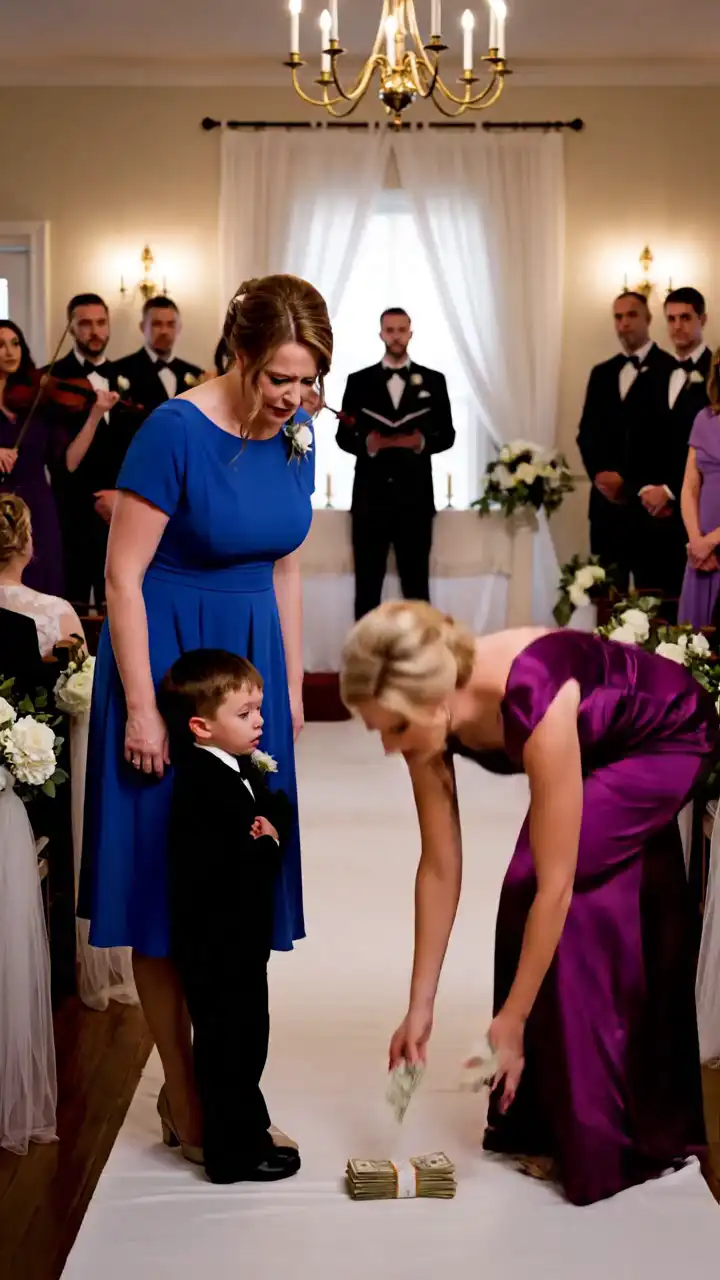
THEY SAW CASH FALL FROM HER PURSE AT THE WEDDING AND THOUGHT THEY KNEW HER
Chapter 1
The first bill slipped out when I bent to fix my son’s collar.
A twenty drifted to the white aisle runner like a leaf, then another, then a folded stack thick enough to make three women near the front table stop talking at once.
For one hard second, the whole wedding at Bramble Hall seemed to go silent except for the violin and the soft rip of my six-year-old, Milo, pulling at the stiff sleeve of his little gray jacket.
“Mom,” he whispered, looking down at the money by my heels, “did we drop that?”
I straightened too fast. My face went hot. I grabbed for my purse, but by then my cousin Darlene had already stepped in front of me in her plum satin dress, one hand on her chest like she’d just witnessed something obscene.
“Oh my God,” she said, not quietly. “At my daughter’s wedding?”
Heads turned in rows. My aunt Sissy stopped fanning herself. The groom’s uncle lowered his phone. Even the minister glanced over before pretending he hadn’t.
“I can explain,” I said, but hearing it out loud made it sound like I was guilty of something.
Darlene stooped, pinched one of the twenties between two fingers, and held it up. “Can you? Because my bridal purse went missing from the suite ten minutes ago.”
The violin screeched into a wrong note. People shifted. Somebody near the back murmured, “Lord.”
I should tell you I had known this was possible before I even parked my old blue Civic in the gravel lot.
Not the money part. The blaming part.
I’m Nora Bellamy, thirty-four, single mother, receptionist at Givens Tire and Auto in the town of Alder Creek, the branch of the Bellamy family no one introduces with much pride. My son’s father disappeared before Milo learned to say his own name. I learned young that if a room full of people had to choose between believing me and judging me, judgment was faster.
Still, I came to the wedding because my younger cousin Wren had called me herself.
“Please come,” she said three weeks earlier. “I want Milo there. He makes everything feel human.”
That was Wren. She always said the soft thing in a hard family.
So I came. I spent two evenings hemming the blue dress I bought off clearance at Halsey’s Department Store. I polished Milo’s shoes with a wet paper towel and a prayer. I tucked a card in my purse with forty dollars inside, all I could manage, and I promised myself I would not feel small just because the Bellamys had become experts at making me feel that way.
Now here I was, standing near the front of the garden room with cash at my feet and every eye on me.
“Darlene,” I said carefully, “that money is mine.”
“Yours?” Her eyebrows lifted. “You carrying around a loose wad of cash to a wedding?”
“It’s not loose.”
She gave a bitter little laugh and looked around, gathering the room to her side. “Well, it sure looked loose from here.”
Milo pressed into my leg. I could feel his hand through the fabric of my dress. He hated loud rooms and angry voices, and our family was excellent at both.
“Please,” I said. “Not in front of him.”
That only sharpened her.
“In front of him?” Darlene repeated. “Nora, my daughter is getting married. Her envelope box is in the reception hall. My purse vanishes from the bridal suite. Then money starts raining out of your bag. Tell me how this looks.”
Wrong, I wanted to say. It looks wrong because families can decide who you are years before you arrive.
But before I could answer, another voice came in from my right.
“Maybe we should step aside,” said Grant Bellamy, my older brother, already wearing the expression he used when he was embarrassed to share blood with me. He worked in commercial real estate in Greenport and had spent the last decade smoothing his accent and acting like our childhood happened to someone else. “Don’t make a scene.”
“I’m not making a scene,” I said. “I was standing here.”
Darlene folded her arms. “Then where did this come from?”
I looked down. The stack wasn’t even neat enough to look stolen. Several twenties and tens were folded around a strip of white paper like someone had wrapped it in a hurry. I didn’t recognize it. That was the first thing that frightened me. The second was that it really had come out of my purse.
Milo stared at it and then up at me. “Mom?”
“It’s okay,” I lied.
It wasn’t.
Two groomsmen had stopped moving chairs. The wedding coordinator, a brittle woman named Elise with a headset and a smile she only used when things were under control, was walking toward us from the gift table. Across the room, Wren had appeared in the doorway in her lace dress, one hand clutching the frame, her face changing as she took in the circle around me.
“What happened?” she asked.
Darlene answered before I could. “Your purse is missing, sweetheart, and cash just fell out of Nora’s bag.”
Wren looked at me. Not accusing, not trusting either. Just stunned. That somehow hurt more.
I crouched to pick up the money, but Darlene’s heel came down lightly on one bill.
“No,” she said. “Leave it.”
The room tightened.
“Take your foot off it,” I said.
Her chin lifted. “Then tell the truth.”
A child cried somewhere near the dessert table. Glasses clinked. The smell of peonies and hot catering trays turned sour in my throat.
“I didn’t take your purse.”
“Then why is that in your bag?”
“I don’t know.”
That sentence did me no favors.
Grant exhaled through his nose. “Nora.”
“What?” I snapped, then lowered my voice because Milo flinched. “What do you want me to say?”
Elise finally reached us. “Ladies, let’s move this into the Magnolia Suite.”
“No,” Darlene said immediately. “If there’s a problem, it should be handled now.”
Of course she wanted witnesses. Shame is a kind of sport to people who never think they’ll be the one holding the wrong end of it.
Wren stepped closer, pale under her makeup. “Mom, stop.”
“Your purse is gone.”
“That doesn’t mean—”
“Someone needs to check her bag,” Darlene said.
I laughed once because it was either that or cry. “Absolutely not.”
“Nora,” Grant said, “if you didn’t do anything, then just let them look.”
That was the moment I saw exactly how alone I was. Not because strangers doubted me. Because family did it so easily.
Milo’s fingers dug into my dress. “Mom, I want to go home.”
I put a hand over his hair. “Not yet, baby.”
Darlene held out her palm. “Open the purse.”
I looked around at faces I’d eaten casseroles with after funerals, hugged at Christmas, stood beside in church pews. No one stepped in front of me. No one said this had gone far enough.
Then, from near the side wall, a man in a dark suit I vaguely recognized from the rehearsal dinner lifted his hand.
“Before anybody touches that bag,” he said, “someone should ask who put the money there.”
He was thin, maybe late forties, with a tired face and the kind of voice that made people listen by not trying too hard. I remembered Wren mentioning him the night before. Colin Reeve. The family attorney who had come because he was handling some paperwork for my grandmother’s estate.
Darlene turned sharply. “What are you talking about?”
He looked not at her, but at the white strip wrapped around the bills.
“I’m talking,” he said, “about the note attached to that cash.”
Chapter 2
Nobody had seen the note because nobody had wanted to.
That is one thing I think about now whenever I remember that day at Bramble Hall. People will look straight at an object and still miss the part that asks them to slow down.
Colin Reeve stepped forward, careful, like he was walking into a field where anything might catch fire. He wasn’t family, which made him easier to hear and easier to hate.
Darlene bent first and snatched up the stack before I could reach it. “There is no note.”
“There is,” he said. “Wrapped around the middle.”
The room leaned in. Darlene’s fingers picked at the folded white strip. It was narrow, almost like receipt paper. She uncurled it with a frown.
“What is that?” Wren whispered.
Darlene read silently, and for the first time all day, her certainty shifted. Not gone. Just interrupted.
“Well?” Grant asked.
She did not answer right away. Instead she held the note away from herself, as if the paper had become dangerous.
“Read it,” Colin said.
Her jaw tightened. Then she read aloud, clipped and cold.
“For flowers balance and tipping the kitchen staff. Please don’t mention it. She would refuse.”
Silence again.
Wren blinked. “What?”
Darlene turned the note over like another explanation might be hiding there. “That proves nothing.”
But I had felt something move in the room. A pause. A tiny crack.
Colin looked at me then. “Ms. Bellamy, may I ask when you last opened your purse?”
I swallowed. “In the parking lot. I got out gum for Milo.”
“And after that?”
“I put the wedding card in there before we walked in.”
He nodded slowly, more to himself than to me.
Elise, the coordinator, stepped in with that same strained smile. “This is getting us nowhere. We’re on a schedule. Mrs. Whitaker, if your purse is missing, we should contact venue security.”
“I know that,” Darlene said. “But this note could have been written by anyone.”
“Why would I write a note saying I’d refuse money?” I asked.
She looked me dead in the face. “To make yourself look generous.”
That would have been absurd if it hadn’t been so cruel.
A little sound escaped Wren, somewhere between a gasp and a groan. “Mom, please stop.”
“You stop,” Darlene snapped. “You are too trusting.”
Grant rubbed his forehead. “Colin, with respect, are you saying you know something?”
Colin didn’t answer immediately. His gaze moved around the room, measuring people. “I’m saying I may have seen who approached Nora’s chair in the bridal suite hallway.”
That made every head turn.
I stared at him. “You did?”
“I was on a call near the service corridor,” he said. “I wasn’t paying close attention then. I wish I had. But I remember someone setting something down.”
“Who?” Darlene demanded.
He hesitated. “I’d rather be certain before I say a name.”
“That’s convenient.”
He didn’t react. “No. It’s careful.”
That only irritated her more.
The trouble with wealthy family anger is that it often passes for authority. Darlene had spent twenty years becoming the kind of woman venues called ma’am and salespeople remembered by first name. She had opinions on table linens, imported candles, and the proper way to display devotion. Her husband, Ted, had made a fortune in commercial roofing before his heart gave out three summers ago. Since then, grief had sharpened every edge she already had.
I knew some of that. I also knew she had never forgiven me for refusing her offer to “temporarily place” Milo with relatives when I was struggling after my rent went up. Her exact words had been, “You need stability before you can mother properly.” Mine had been, “He’s not furniture.”
Now she looked at me like she’d been waiting years for public proof that I was exactly what she feared.
Elise clasped her clipboard harder. “The bride needs to be hidden before guests start arriving from the chapel lawn. Wren, let’s get you back to the suite.”
“I’m not leaving her,” Wren said quietly.
My throat tightened. It was the first thing anyone in the family had said that sounded like standing beside me.
Darlene sighed sharply. “This is your wedding day, not a rescue project.”
That landed hard. Wren looked away, humiliated in her own turn.
Milo tugged my hand. “Can we sit down?”
I nodded and led him to a nearby cane-backed chair by the wall. He climbed into it and swung his legs once, then curled them up under himself the way he did when he wanted to disappear. I crouched in front of him.
“Are you mad?” he asked.
“No.”
“Are they?”
“Yes,” I said, because children know when adults lie to them for comfort. “But not at you.”
He leaned close. “I didn’t take anything.”
I had to close my eyes for one second. “I know.”
When I stood again, I saw Colin speaking softly to Elise. She glanced toward the service door, then toward the hallway leading to the bridal suite.
A server in a black vest passed carrying a silver tray and slowed just enough to listen. The gossip had started. It spreads faster than music in places like that.
Grant came near me but not too near. “You always make things harder than they need to be.”
I stared at him. “How am I making this harder?”
“You get defensive.”
“Because I’m being accused.”
“You could just cooperate.”
The word cooperate rang in my skull. Like I was difficult because I did not hand over my dignity on command.
“Did you ever think,” I said, low and even, “that some of us get defensive because no one gives us the benefit of anything?”
His face changed for an instant, but not enough.
“What’s that supposed to mean?”
“It means you walked over here already embarrassed by me.”
He glanced around, checking who might hear. “This is exactly what I’m talking about.”
“No,” I said. “This is what happens after.”
Before he could answer, Wren crossed the floor and took my hand so fast it surprised both of us.
“I’m sorry,” she said. Her eyes were glassy. “I should have come sooner.”
“It’s not your fault.”
But she was looking at the money now, at the note, at her mother’s stiff spine, and I could see a newer fear entering her face. Not just that I had been accused. That something under her wedding day was off-center in a way she hadn’t understood before.
“Mom,” she said carefully, “did you ask anyone to pay the florist today?”
“No.”
“The kitchen staff?”
“No.”
“Then who would write that?”
Darlene folded the note again. “A manipulator.”
Colin walked back toward us. “There’s one more thing.”
Nobody breathed.
“I recognize the handwriting.”
Darlene scoffed. “From one line?”
“Yes.”
“Whose?”
He looked at Wren first, not at me, and I did not miss that. “I believe it belongs to your grandmother, June Bellamy.”
That name struck the room in a completely different place.
My grandmother had not come to the wedding. At eighty-two, with failing lungs and a stubborn heart, she hadn’t left the Willow Marsh Rehabilitation Center in two months. Most of the family spoke of her now in lowered voices, as if she were already partly gone.
But I knew her handwriting. Everyone did. Slanted. Tight. No nonsense, even on paper.
Darlene’s laugh sounded forced now. “That is impossible.”
Colin held her gaze. “Not impossible. Uncomfortable.”
Wren whispered, “Nana sent money?”
“For what?” Grant said.
No one answered, because no one knew. And suddenly the stack of cash on the chair between us looked less like stolen money and more like a message we had interrupted before understanding.
Still, suspicion did not leave the room. It simply changed shape.
Darlene put the note in her clutch and said, “Fine. Then let’s ask June. After the ceremony. But until then, Nora stays out of the bridal rooms.”
I should have objected. I should have demanded an apology on the spot. But Milo was pale, and the room was pulsing, and every second in that family circle felt like trying to breathe through cloth.
So I only said, “I was never trying to be in your rooms.”
Her expression did not soften.
Wren squeezed my hand once. “Please stay,” she said. “Please.”
That was the problem with love inside a difficult family. It asks endurance from the wrong people.
So I stayed.
And that was how the pattern began. One note. One stack of cash. One accusation that should have ended there, but didn’t. Because over the next few hours, more things would surface. A missing handbag. A whispered claim. A second envelope. And every one of them would point toward me until the truth finally had nowhere else to stand.
Chapter 3
The wedding still happened.
That might sound strange after a scene like that, but families with money and photographers can push almost anything to the edge of a frame and pretend it doesn’t belong in the picture. By four o’clock, guests had filled the white garden chairs on the lawn behind Bramble Hall. The hydrangeas glowed blue in the sinking light. The string quartet had recovered. The champagne was cold. If you arrived late, you would have thought the Bellamys were blessed and polished and whole.
Only the people closest to the center knew the day had split open.
I sat near the back with Milo, where children and divorced cousins and people without assigned importance often end up. He leaned against me, rubbing the satin edge of the program between his fingers.
“Is Wren okay?” he whispered.
I looked down the aisle where she stood at last under the arbor, all cream lace and trembling smile. “I think so.”
Darlene sat in the front row rigid as carved wood. Grant stood on the groom’s side, jaw set. Nobody looked back at me.
Nobody except Colin Reeve.
He had taken a seat at the far end of the second row, not quite with the family, not quite apart. Once, during the vows, he turned and gave me the smallest nod, as if to say hold on. It was a strange kindness from a near stranger, and because I had so little kindness that day, I held onto it more than I should have had to.
After the ceremony, guests streamed into the reception hall while staff moved like dark fish through candlelight and tall centerpieces. The hall smelled of butter, roses, and sugar icing. At the entrance stood an antique white card box with a brass slot on top and a sign in gold script that read WREN AND LUKE.
I saw it, and immediately my stomach tightened.
It wasn’t because I wanted what was inside. It was because I knew now how quickly any object in that room could become evidence if someone wanted it to.
“Stay by me,” I told Milo.
He nodded. “Can I have the little crackers?”
“In a minute.”
I handed our card to the attendant at the guest book table instead of putting it in the box myself. I wanted witnesses for even the smallest thing.
The attendant, a college-aged girl with a braid and pearl earrings, smiled nervously. “I can place it for you.”
“Thank you,” I said.
Maybe she had heard. Maybe everyone had.
At our table, the place cards had me at Table Twelve with an elderly great-aunt who never remembered my name, two teenage second cousins glued to their phones, and the groom’s former youth pastor. Milo had no seat, though I had RSVP’d for him six weeks ago. A catering captain dragged over a folding chair from storage and covered it with a white slip in a gesture so fast and embarrassed it made me want to disappear.
I heard one of the teenage girls whisper, “Wasn’t she the one?”
The other whispered back, “My mom said not to stare.”
So of course they stared.
Across the room, Darlene moved from table to table receiving praise with the bright, exhausted smile of a woman determined not to let the day leave fingerprints on her. She did not come near me.
Wren did, once.
During salad, she slipped away from the head table and crouched beside Milo. “You look very handsome,” she said.
He touched his collar. “It’s itchy.”
She laughed softly, then looked at me. Up close, I could see the strain under her makeup. “I’m sorry about your seat. I didn’t do the chart myself.”
“I know.”
“I’ll fix it.”
“You don’t have to fix everything today.”
Her eyes flicked toward her mother. “It feels like I do.”
Before I could answer, Luke’s sister called her back for photos. Wren squeezed my wrist and rose.
Then Darlene appeared behind her like a storm front.
“Wren,” she said, all sweetness for the room, “the videographer needs you.”
Wren hesitated. “I was just—”
“I know.”
There was no scene. No raised voice. But the message was clear enough. The bride was not to be seen lingering beside me.
Milo watched them go. “Why is everybody acting weird?”
Because adults can smell weakness and call it concern, I thought. Because families protect image before they protect truth. Because one accusation stains everything around it.
Instead I said, “Sometimes people get scared and mean at the same time.”
He considered that. “That’s dumb.”
“Yes,” I said. “It is.”
The reception gathered speed. Toasts. Clinking glasses. The first dance. Laughter rising and falling in pockets around us while I sat in a ring of invisible caution. People were not openly rude. In some ways that was worse. They were polite in the manner of those who have already decided where to place you.
At one point I went to the ladies’ room and two women fell silent when I entered. One was my cousin Janice by marriage. The other was a family friend from church.
Janice looked at my reflection instead of my eyes. “There’s a lot going on today.”
“Yes.”
The church friend dabbed lipstick and murmured, “We should all pray before making assumptions.”
It sounded generous, but she said it in the tone people use when they are absolutely making assumptions.
Back in the hall, Milo was gone from his chair.
Every mother’s body has a private alarm. Mine went off so hard the room blurred.
“Milo?” I called, too quickly.
The youth pastor stood. “I think he went toward the dessert bar.”
I crossed the room, scanning shoes, chair legs, white tablecloths. The band was louder now, a slow Motown song under amber lights. My heart was pounding.
Then I saw him.
He was standing beside the card box.
Beside him stood Darlene.
And in her hand was my son’s wrist.
Not hurting him. But holding him there as if he had been caught.
The world narrowed.
I reached them in seconds. “Let go of him.”
Darlene released him, but slowly, making sure everyone nearby could see she had been the calm one.
“He was touching the box,” she said.
Milo’s face had gone stiff, the way it did when he was trying not to cry. “I just wanted to see the brass thing.”
“He lifted the lid.”
“It has a lid?” I looked at it. The box did have a small hinged panel at the back for staff to remove cards. It was shut.
“He was fiddling with it,” Darlene said. “And after earlier—”
I moved in front of Milo. “Don’t.”
“Then control your child.”
There are sentences that hit old bruises under the skin. That was one of mine. Social workers had asked versions of it. Teachers had asked versions of it. Landlords, doctors, my own brother. Control your child, as if motherhood were proof of your worth only when your child took up no complicated space.
“He’s six,” I said.
“And old enough to know better.”
“He wasn’t stealing anything,” I said.
People were watching. Again. A semicircle of reception silence, that awful public hush where music continues but attention collects like heat.
Milo clutched the side of my dress. “I didn’t do bad.”
I bent and put both hands on his cheeks. “No, baby. You didn’t.”
Darlene’s voice was low and sharp. “This cannot keep happening.”
I stood up. “What keeps happening is you deciding what things mean before asking.”
“What does it mean, then? First the money, now this?”
“He’s a child.”
“He’s your child,” she said, and there it was, the sentence beneath all the others.
Something flashed behind my eyes. If Colin had not appeared then, I don’t know what I would have said.
“What’s going on?” he asked.
Darlene turned to him. “The boy was handling the gift box.”
“Milo,” Colin said gently, “did you put anything in it?”
Milo shook his head hard. “No.”
“Take anything out?”
“No.”
“Why were you there?”
He looked at me first, then answered in a tiny voice. “There was an envelope on the floor.”
That changed the air.
“What envelope?” I asked.
He pointed under the linen skirt of the card table.
Elise, the coordinator, dropped to one knee and reached beneath. Her arm disappeared up to the elbow. When she pulled back, she was holding a cream envelope bent at one corner.
The front had no name.
Darlene held out her hand. “Give me that.”
But Colin spoke first. “Maybe don’t.”
Elise froze.
“Why?” Darlene said.
“Because if there’s been confusion already,” he said, “it would be smart to have neutral hands.”
This time even Grant, who had come over at the commotion, seemed to hesitate.
“Open it,” he said to Elise.
She did, with visible reluctance.
Inside was cash. Hundreds, not twenties. And a folded note.
The whole room seemed to inhale.
Elise unfolded it. Her eyes flicked over the words, then she looked up, startled.
“What does it say?” Wren asked from behind us. She and Luke had come off the dance floor. Her veil had been removed, and a pin had slipped from her hair.
Elise swallowed. “It says, ‘For the honeymoon account. Don’t tell Darlene until after the band is paid.’”
No one moved.
Then Wren said the quiet thing that broke the surface.
“That’s Nana’s handwriting too.”
Chapter 4
After the second note, people could no longer pretend the problem was simple.
That did not mean they stopped blaming me.
It just meant blame had to get more creative.
The reception was quietly redirected the way people redirect a river with sandbags and prayer. Luke’s college friend started an impromptu dance circle near the band. The photographer pulled the bride’s cousins into the courtyard for sparklers. Staff refreshed drinks with extra speed. From a distance, the evening might still have looked magical.
Up close, the family had split into little islands of panic.
Elise took the second envelope to her office. Colin went with her. Darlene insisted on following. Grant trailed after them with the heavy-footed look of a man who hates scandal unless it benefits him. Wren stood in the middle of the reception hall in her wedding gown and looked, for one terrible second, like a child left in a store.
I stayed with Milo near the coffee station because every instinct told me not to be in any room where decisions about me were being made. But then Wren came over and said, “Please come. If this is about Nana, you should hear it too.”
That surprised me enough that I almost said no.
“Why me?” I asked.
“Because she loved you.”
The words landed in a place I had kept armored for years.
My grandmother June Bellamy was the only person in the family who had never spoken to me in the careful voice people use when they’re already disappointed. She was hard in plenty of ways. She liked her tea scalding and her opinions sharper than kitchen shears. But she never confused hardship with failure. After Milo was born, when everybody else had advice, she had practical things. Diapers. Soup. Gas money pressed into my hand in the church parking lot. Once, during my worst winter, she had said, “Being broke is not a character flaw, Nora. Don’t borrow shame from people who’ve never earned the right to give it.”
I had carried that line through years she never even saw.
So yes, I followed Wren.
We ended up in the venue office off the side corridor, where a fake ficus sat beside a filing cabinet and a security monitor showed four camera angles in grainy black and white. Milo sat in a swivel chair eating pretzels from his pocket because apparently children remain children even in the middle of adult ruin.
Elise locked the door.
On the desk lay both envelopes, the loose bills from my purse, and the two notes.
Colin stood beside them, glasses low on his nose now, studying the paper with a patience that seemed to annoy everyone. Darlene stood near the wall with her arms crossed so tight I wondered if breathing hurt. Grant checked his watch. Wren sat on the edge of a chair, her wedding skirt spilling around her like she had melted into the room.
Luke arrived a minute later, still smiling from whatever version of the evening he had been protecting until now. The smile vanished when he saw our faces.
“Can someone tell me what’s happening?” he asked.
Darlene answered first. “Your wife’s grandmother has apparently decided to leave cash all over the premises like breadcrumbs.”
“That’s not funny,” Wren said.
“I’m not joking.”
Colin picked up the note from the second envelope. “These are definitely June Bellamy’s.” He looked at Luke. “I’ve handled her estate documents for eight years.”
Luke frowned. “Then why not just say that from the start?”
“Because certainty matters.”
Darlene gave a short, humorless laugh. “How noble.”
He ignored her. “More importantly, the cash from Nora’s purse was not stolen from you.”
Darlene lifted her chin. “I’m aware of what the note claims.”
“No,” he said. “You are not yet aware of what it means.”
That finally shut the room for a second.
Grant stepped closer. “Then say it.”
Colin looked at me. “June asked me a week ago whether there was a discreet way to cover a few wedding expenses without Darlene knowing.”
Wren blinked. “Why wouldn’t she want Mom to know?”
No one answered because the answer was standing there in silk shoes and offended silence.
Colin continued, “Your grandmother said she didn’t want praise, and she didn’t want a fight. She specifically said if Darlene found out too early, she would either refuse the help or become angry about the form.”
“That sounds like Nana,” Wren whispered.
Darlene snapped, “She had no reason to go behind my back.”
“Maybe she thought she did,” Colin said.
Wren looked at him. “Then why give the money to Nora?”
“Because June didn’t trust the rest of you to receive it quietly.”
My chest tightened.
Darlene stared. “Excuse me?”
Colin folded his hands. “I’m not trying to be rude. I’m being accurate. June believed Nora would take care of practical matters without turning them into theater.”
It was so close to an insult, and yet it was the first true respect anyone in that room had spoken over me all day.
Grant gave a disbelieving shake of his head. “So we’re supposed to accept that our grandmother sent thousands of dollars through Nora without telling anyone?”
“Not accept,” Colin said. “Verify.”
He turned to the security monitor and pointed to the upper-left screen. The image showed the service hallway outside the bridal suite, timestamped from an hour before the ceremony.
“Bramble Hall keeps rolling hall footage with no audio,” he said. “Elise helped me pull this.”
Elise hit play.
The grainy video showed staff crossing with flower buckets, groomsmen in half-buttoned shirts, Wren disappearing into the suite with her makeup artist, me passing through the hallway holding Milo’s hand. We stopped by a chair while I adjusted his jacket. I set my purse down on the seat for maybe ten seconds.
Then the image changed everything.
My grandmother’s private nurse, Tanya Velez, entered the frame.
I knew her on sight from Willow Marsh. Mid-fifties, curly dark hair always pinned up, sneakers that squeaked in polished hallways. She was supposed to be off duty that day. In the video, she carried a tote bag and looked around once, quickly. Then she took an envelope from the tote, slid something into my open purse, and placed another packet beneath the chair cushion.
She was gone in seconds.
No one spoke.
Milo looked up from his pretzels. “That lady gave us a paper.”
Wren put a hand over her mouth.
Darlene’s expression changed so rapidly I almost pitied her. Almost. First shock. Then relief that it hadn’t been theft. Then a flicker of shame. Then, because some people would rather grip anger than fall into shame, a fresh hardening.
“So Nora knew Tanya would be here.”
I actually laughed. “What?”
“You know Nana best lately. You visit her.”
“I visit her because the rest of you are busy.”
“I am not busy,” she said, offended by the word itself.
“No,” I said. “You’re selective.”
Wren’s eyes filled. “Mom.”
Luke stepped between us a little, palms out. “Okay. Everybody stop.”
But Colin had not finished.
“There’s more,” he said.
I was almost afraid to hear it.
He took a folded sheet from his leather briefcase and set it on the desk. “June gave me this to hold until after the ceremony unless she changed her mind.”
Darlene’s voice dropped. “What is it?”
“A letter.”
“For who?”
He looked at Wren. “For the family. But I suspect especially for today.”
Darlene shook her head. “She cannot orchestrate my daughter’s wedding from a rehab facility.”
Colin met her gaze evenly. “And yet here we are.”
Wren whispered, “Read it.”
He unfolded the page. The paper itself looked ordinary. The room did not.
“‘If this letter is being read,’” Colin began, “‘then either I have lost my nerve, or my family has once again mistaken noise for truth.’”
Even in his voice, June’s words sounded like her.
Milo stopped crunching.
Colin read on. “‘The cash is mine. I asked Tanya to place it where Nora would find it because Nora understands errands, discretion, and how to do a kind thing without making a parade of it. I did not ask Darlene because she hears help as criticism. I did not ask Grant because he hears family matters as inconvenience. I did not ask Wren because brides should be brides for one day if the world allows it.’”
Wren began to cry silently.
Grant looked down.
Darlene was no longer moving.
Colin continued, and now his voice softened.
“‘I asked Nora because she has carried more than this family ever gave her credit for. She carries her boy, her bills, her fear, and still arrives with pressed collars and good manners while people with easier lives discuss her as if she is a cautionary tale. That will be enough of that.’”
Something in me gave way so suddenly I had to grip the back of the chair.
No one looked at me. They looked at the desk, the floor, the walls. Anywhere but me.
“‘The money is for flowers, kitchen tips, and a little private honeymoon gift because joy deserves backing, not just speeches. If Darlene is angry, she may be angry after the cake is cut. If Nora is embarrassed, tell her I’m sorry for making use of family blindness. But sometimes blindness is the only cover kindness gets.’”
Colin lowered the page.
The room was so still I could hear the refrigeration hum beneath the sink cabinet.
Wren crossed the room in one sweep of white fabric and threw her arms around me. She didn’t say anything at first. Her face was wet against my shoulder.
I held her because that was easier than holding myself together.
Behind her, Darlene stared at the notes on the desk like they had become a mirror she had not agreed to look into.
Then she said the only thing a person says when truth leaves no more room.
“I didn’t know.”
That was when I finally looked at her and said, “That didn’t stop you.”
Chapter 5
The reveal should have ended it.
In cleaner stories, it would have. The note would be read, the guilty would lower their heads, the misunderstood woman would be embraced, and the wedding would continue in a softer light.
Real families are messier than that.
Truth lands unevenly. It humiliates one person, frees another, and leaves everyone else scrambling to revise themselves without admitting how quickly they chose the worst.
After Colin read June’s letter, nobody knew what to do with their hands.
Luke was the first to move. He took the page from Colin and read it himself, slower, lips tightening as he went. Then he looked up at me with an expression that was almost apology and almost awe.
“I’m so sorry,” he said.
Three simple words. Clean. Adult. They mattered.
Grant did not say them. Not yet.
He stood near the office door with one hand on his belt, his face gone flat in the way men’s faces go flat when feeling anything would cost them public shape. “If Nana planned all this,” he said, “why didn’t she tell anyone directly?”
Wren let out a sad little laugh through tears. “Did you hear any of that, or just the part that still lets you be right?”
Grant colored. “I’m asking a practical question.”
“No,” I said. “You’re asking the question that gets you out of the real one.”
He looked at me. “Which is?”
“Why did you believe it so fast?”
That sat between us like another document nobody wanted to read.
Darlene finally moved toward the desk. Her mascara had not run, because women like her learn early what they can control. But her face had changed. It looked older, stripped of performance.
“She used Tanya,” she said. “Without telling me.”
Colin’s voice was gentler now. “June told me she tried to discuss helping with expenses. You said no every time.”
“I was paying for my daughter’s wedding.”
“You were trying to own it,” Wren said before she could stop herself.
Her mother turned. “Wren.”
“You were.” Wren wiped her eyes with the side of her hand. “The flowers had to be yours. The linens had to be yours. Even the honeymoon was your gift if anyone gave one. Nana knew that.”
Darlene stared at her daughter as if she had been slapped in church.
Milo, who had quietly slid off the swivel chair, came to my side and wrapped both arms around my waist. He looked up at the adults with open dislike.
“Nana June was helping,” he said. “You were mean.”
No one corrected him.
Sometimes children save everyone time.
Elise cleared her throat awkwardly. “The band leader is asking whether we are doing the father-daughter tribute video in five minutes.”
A broken laugh escaped Wren. “My father is dead, my mother accused my cousin of theft, and there’s secret wedding cash from a rehab center. I don’t think the video is the emergency.”
Luke put a hand on her back. “We can cut it.”
Darlene stiffened. “No. Ted would have wanted—”
“Dad would have wanted one peaceful day,” Wren said, not loudly, but with enough force to stop her mother cold. “And if we are finally being honest, you wanted control because grief is easier when everything obeys you.”
I had never heard anyone in the family speak to Darlene like that. Neither, I think, had Darlene.
Her face crumpled then, not gracefully, not privately. Just cracked.
“He should have been here,” she said.
There it was. Under all the satin and accusation and perfection. A widow terrified of losing one more structure. A mother trying to force order onto sorrow until anything outside the plan looked like attack.
It did not excuse what she had done. But it changed the temperature of the room.
Wren softened first, because daughters often do, even when they should not have to. “I know.”
Darlene looked at me then. Really looked. Not as a category. As a person she had just publicly shamed.
“I was wrong,” she said.
It was not dramatic. No big speech. Just raw and difficult and late.
I stood there with Milo attached to me and the whole day pressing against my ribs, and I found that forgiveness was not a door I could open because someone knocked once.
“You were cruel,” I said.
Her eyes filled at last. “Yes.”
“You wanted everyone watching.”
“Yes.”
“You used my child.”
That one she absorbed like a blow. “I know.”
For a second I thought she might say something defensive, something about stress or fear or misunderstanding. Instead she nodded once, helplessly.
“I know.”
Colin intervened before the moment could sour again. “There is one last practical issue.”
Everyone turned.
“Tanya Velez texted me forty minutes ago,” he said, holding up his phone. “She’s downstairs in the parking lot. She panicked when she heard there was a scene and didn’t know whether to come in.”
“Bring her in,” Wren said.
Tanya entered two minutes later still wearing hospital scrubs under a cardigan, as if she had come straight from a shift. She looked mortified.
“I am so sorry,” she said the second the door shut. “Ms. June thought it would be simple.”
I almost laughed from exhaustion. “Nothing with my family is simple.”
Tanya pressed a hand to her chest. “She told me, ‘Put the florist money where Nora will find it, and put the honeymoon envelope near the card table after guests settle. Do not under any circumstance hand anything to my daughter, because she will make a war out of gratitude.’” Tanya winced. “Her words, not mine.”
Even Darlene let out one short, pained breath that might have been a laugh if the day had been kinder.
Tanya looked at me. “She said you’d know what to do.”
“I would have,” I said quietly. “If anyone had let me.”
That nearly undid me.
Tanya dug into her tote and pulled out a small lavender envelope. “She also said if things got messy, I should give this only to Nora.”
The room fell silent again.
I took it with shaking fingers. My name, NORA, was written across the front in June’s hard slanted hand.
Inside was a card and five crisp hundred-dollar bills.
The card was short.
For the emergency that always arrives after a public humiliation Use it for rent or tires or take the boy somewhere with a lake You do not owe this family your shrinking Love June
I had to look away.
No one spoke because there was nothing left to hide behind now. Not after that sentence. You do not owe this family your shrinking.
Wren reached for my hand again. Luke stepped to the side and put his arm around her shoulders. Grant sat down abruptly in the desk chair and stared at the floor, all his polished confidence gone.
Then he said, so quietly I almost missed it, “I’m sorry too.”
I looked at him.
He swallowed. “I should have stood beside you.”
“Yes,” I said.
No punishment I could invent would have stung him more than my not softening.
We returned to the reception hall changed, all of us. Word spread in fragments. Not the whole truth at first, because families still ration honesty. But enough. Enough that the glances shifted from suspicion to embarrassment. Enough that Janice by marriage came over to offer me coffee she didn’t need to offer. Enough that the elderly great-aunt at Table Twelve suddenly remembered my name.
Most telling of all, Darlene crossed the room, tapped a spoon against her champagne glass, and asked for everyone’s attention.
The room turned.
She stood under the hanging Edison lights, shoulders squared, one hand trembling around the stem of her glass.
“I need to correct something,” she said. “Earlier today, I made a false assumption about my cousin Nora in front of several of you. I was wrong. Completely wrong. The money involved was a private gift from my mother, and Nora did nothing except become the target of my bad judgment.”
The hall went still enough to hear ice settle in drinks.
Darlene went on, voice rougher now. “I owe her an apology. Publicly. Because the harm was public.”
She looked at me across all those round white tables.
“Nora,” she said, “I am sorry.”
For once, nobody looked away.
I stood because sitting would have made me smaller than I was willing to be.
“Thank you,” I said.
That was all. Not because it was enough. Because it was what I had.
Then, from beside me, Milo raised one hand and said in a clear child voice, “And I didn’t steal the box.”
A ripple of startled laughter moved through the room. Even the band smiled.
Darlene nodded with tears in her eyes. “No, honey. You didn’t.”
And somehow that was the moment the air finally broke.
Chapter 6
Later, after the cake was cut and the dance floor filled again and people decided they preferred redemption to discomfort, I stepped outside with Milo.
Night had settled over Bramble Hall in a soft black sheet. The parking lot lights glowed over gravel and oak trees. Inside, bass from the band thumped faintly through the brick walls. Fireflies blinked near the hedge line like tiny thoughts trying to form.
Milo sat on the curb in his wrinkled little suit and leaned against my arm.
“Are we in trouble anymore?” he asked.
“No.”
“Forever?”
I smiled despite everything. “Probably not forever. But not tonight.”
He thought about that. “Can we still have cake later?”
“Yes.”
“Good.”
Children know exactly how much healing a body can manage at once.
The door opened behind us. Wren stepped out barefoot, carrying the train of her dress over one arm and two slices of cake on a plate. Luke followed with a folded cardigan for her shoulders.
“I thought you might disappear without dessert,” Wren said.
“I considered it.”
She sat beside me anyway, uncaring that the curb might stain her gown. Luke handed Milo a plastic fork and perched on the low stone planter nearby.
For a while, we ate in the night air and said nothing. It felt holy in its own small way.
Then Wren spoke.
“Nana called me this morning,” she said. “I missed it because I was getting my hair done.”
I turned toward her.
“She left a voicemail.” Wren swallowed. “I listened after the ceremony, before all of this. I thought she was just blessing the day.” Her voice shook. “She said, ‘If there is a mess, don’t waste your wedding trying to look elegant inside it. Just find the truth and stand next to it.’”
I closed my eyes for a moment. That sounded exactly like June.
Luke looked toward the parking lot. “She knew this family better than any of us.”
“She survived all of us,” I said.
Wren laughed softly. “That too.”
The door opened again. This time it was Darlene.
She paused when she saw us, like she understood she had approached a place she had not yet earned. Her shoes were in her hand. Her hair had loosened. Without the room inside to support her, she looked smaller.
“Milo,” she said gently, “may I talk to your mom for a minute?”
He looked at me. I nodded.
Luke stood. “We’ll show him the fountain.”
Wren took Milo’s hand and led him a few yards away, where the courtyard fountain spilled silver under the lights. His excited voice rose almost immediately. “Can I throw a penny?”
When we were alone, Darlene stayed standing.
“I won’t keep you,” she said. “I just…” She looked down at the shoes in her hand and then up at me. “I want to do better than a microphone apology.”
I waited.
She let out a long breath. “After Ted died, I got mean in ways I called efficient. I managed everything. I controlled everything. People praised me for being strong, and I let that become permission.” She shook her head once. “That’s not your burden, and it’s not an excuse.”
No. It wasn’t.
“But it is the truth,” she said. “And another truth is that I have judged you for years because your life frightened me. Not because it was lesser. Because it was fragile in ways mine never had to be, and I told myself that meant you had done something wrong.” Her eyes shone. “I see now what that says about me.”
There are apologies that ask to be comforted. This one did not. That mattered.
I looked toward the fountain where Milo was trying to lean too far over the water while Wren held his jacket.
“People have been doing that to me a long time,” I said. “Turning struggle into character evidence.”
“I know.”
“No,” I said. “You know now.”
She nodded.
Then she reached into her clutch and pulled out the small note from the first bundle of cash. She had smoothed its wrinkles flat.
“I think this belongs to you,” she said.
I took it.
“For flowers balance and tipping the kitchen staff. Please don’t mention it. She would refuse.”
I smiled in spite of myself. “She knew you.”
Darlene gave a wet half-laugh. “Unfortunately.”
Then her face folded again, quieter this time. “I didn’t visit her enough.”
That grief I understood. Not because it was the same as mine. Because regret sounds alike in every income bracket.
“There’s still time,” I said.
She looked startled. “For what?”
“To go tomorrow.”
A tear slipped free before she could stop it. She nodded.
“Will you be there?”
“Yes.”
She absorbed that, and maybe it was the first acceptance we had ever exchanged that was not stiff with old family roles.
“Thank you,” she said.
I almost told her she didn’t have to thank me. But maybe she did. Maybe gratitude was part of the new order too.
When she went back inside, I stayed on the curb and unfolded June’s card again under the parking lot light.
You do not owe this family your shrinking.
I read it twice. Then I folded it carefully and tucked it into my purse, not loose this time, but safe.
A minute later Milo ran back toward me, cheeks flushed, one tie end flapping free.
“Mom,” he said, breathless, “Aunt Wren says they’re doing one more dance and kids can come.”
“She’s not your aunt exactly.”
“She is tonight.”
I looked at Wren standing by the fountain, barefoot and smiling at us through the tired wreckage of her wedding day. I looked at Luke beside her, steady and quiet. Through the open door behind them, I could see Darlene at the edge of the dance floor, not in the center, just watching.
Maybe family was not the people most qualified to judge you.
Maybe it was the people willing to learn after they had done it wrong.
“Okay,” I said to Milo. “One more dance.”
He grabbed my hand and pulled.
So I went back inside to the music and the lights and the faces that looked different now that truth had passed through them. Not perfect. Not healed all at once. But changed.
And for the first time in a very long while, I did not walk into my family already making myself smaller.
Disclaimer: Mention of any brand or trademark is for identification only and does not imply partnership or endorsement
MY HUSBAND USED MY MONEY, GOT ENGAGED TO HIS MISTRESS, AND STOOD THERE WHILE SHE SLAPPED ME
THE MAID OF HONOR POURED WINE ON ME AT MY BRIDAL SHOWER AFTER STEALING MY FIANCÉ. SHE DIDN'T KNOW THE ROOM WAS ABOUT TO HEAR WHAT HE'D BEEN SAYING TO BOTH OF US.
THE MAID OF HONOR POURED WINE ON ME AT MY WEDDING AND CALLED ME CRAZY. SHE FORGOT I STILL HAD THE VOICE NOTE SHE SENT MY FIANCÉ.