THEY SAID A CLEAN MOTHER WOULD NEVER BE HERE WITH THAT MAN
Chapter 1
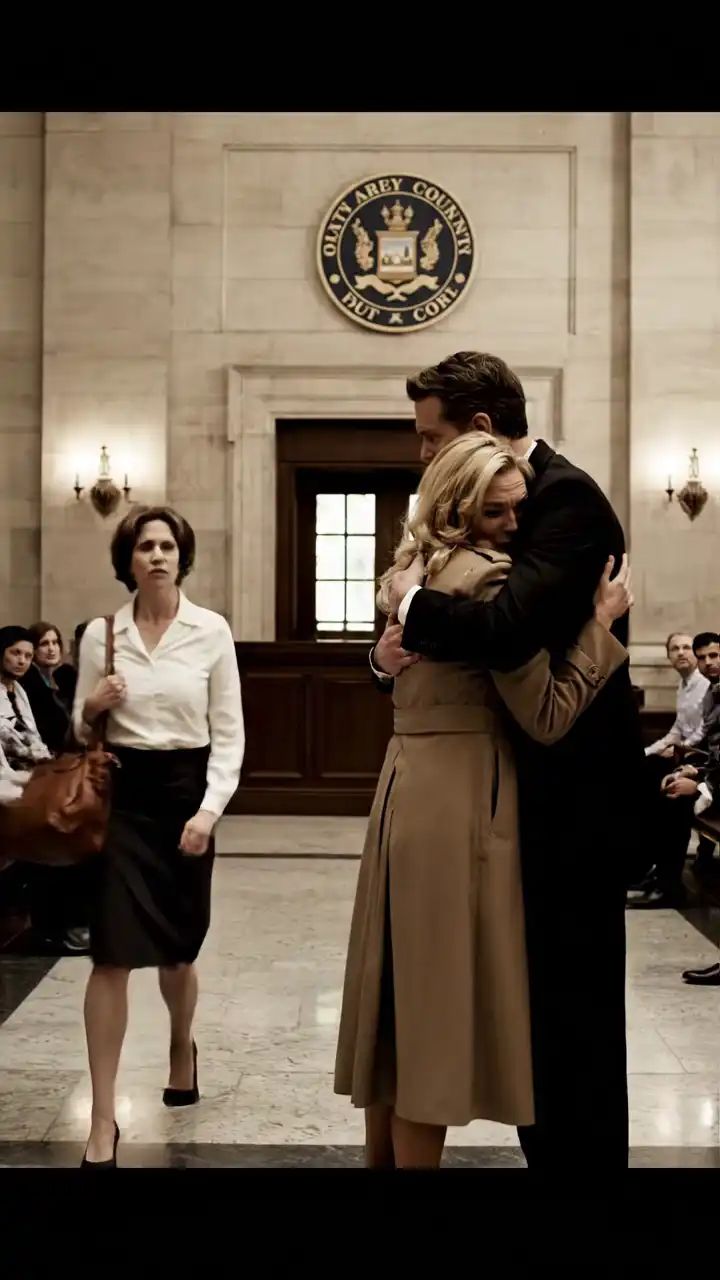
The first thing I saw was my son gripping another woman’s elbow while she cried into his suit jacket in the middle of the county courthouse.
People stopped walking.
A bailiff near the metal detector turned his head. Two women waiting for traffic tickets leaned closer to each other. Someone behind me muttered, “That must be his wife.”
Then the woman looked up, saw me, and said it loud enough for half the lobby to hear.
“She’s the one. She’s the mother.”
I froze under the seal of Bracken County Civil Court with my drugstore heels squeaking on the polished floor and my handbag clutched so tightly my fingers had gone numb. My son, Nolan, turned so fast his face drained of color.
“Mom,” he said.
Just that. One word. Thin and wrong.
The woman still held his sleeve. She was younger than me by maybe fifteen years, wearing a camel coat over a pale blue dress that looked expensive enough to have its own soft light. Her mascara had run. A diamond ring flashed on her hand when she pointed at me.
“You knew,” she said. “Didn’t you?”
Every eye in that lobby landed on me.
“No,” I said, because it was the truth and because it was all I had.
Nolan stepped away from her, but not enough. “Evelyn, not here.”
“Not here?” she asked, almost laughing. “You brought me to court.”
That got another turn of heads. Court. Brought. Me. It sounded filthy even though we were standing under fluorescent lights and a framed portrait of a judge who looked dead before I was born.
I wanted to disappear. I wanted to grab Nolan by his arm and drag him out to the parking lot like I used to when he was sixteen and stupid and thought speeding made him a man. Instead I stood there in my sensible navy skirt and cream blouse and felt every cheap seam on me.
I am fifty-two years old. I raised Nolan alone in a duplex on Merrow Street over a barber shop that smelled like talc and aftershave. I worked twelve years at Dwyer Linen Supply folding hotel sheets until my wrists started aching at night. Then I took bookkeeping work for Stant & Vale Auto Glass because numbers stayed where you put them, even if people didn’t.
I came to court that morning because Nolan had called me the night before and said, “Mom, I need you there. Please don’t ask on the phone.”
Those words had sat in my chest all night.
Now here he was, holding a woman in a courthouse lobby while strangers watched me become part of something ugly.
A sharp voice cut through the crowd. “Counsel and parties for Courtroom B, please move inside.”
The woman—Evelyn—wiped her face and stared at me like I had raised a snake and released him into her house.
Nolan lowered his voice. “Mom, I can explain.”
“Then explain,” I said.
His mouth opened, then shut. He glanced at Evelyn, then toward the hallway that led to Courtroom B.
That was my first real fear. Not that he had done something wrong. Nolan had done wrong before and survived it. No, what scared me was the look on his face—the look of a man trying to decide which lie would hurt less.
Evelyn gave a small, bitter nod, as if confirming something to herself. “Of course. He can’t.”
She started toward the courtroom. Nolan went after her. I stood in place for one breath too long, then followed because if a mother leaves in that moment, she loses the right to ask anything afterward.
Courtroom B was colder than the lobby. The benches were half full already with landlord-tenant cases and people who looked exhausted by money. The wood had been polished so many times it reflected the overhead lights in long dull stripes. I slid onto the back bench. Nolan and Evelyn sat at the front with their attorneys.
I should have known then this wasn’t one bad choice. Bad choices show up messy. This had paperwork.
A woman in a fitted charcoal suit turned around to look at me. Her hair was pinned into a perfect low twist, and even seated she carried herself like the room had been built to flatter her. She leaned into the aisle.
“You’re Ms. Lorna Vance?”
I nodded.
“I’m Celia Wren. I represent Ms. Halberd.” She smiled, but there was no warmth in it. “I hope you understand your son’s personal history may become relevant today.”
“Personal history?” I repeated.
Her eyes moved over my blouse, my worn handbag, my shoes. I had seen that look before. Bank office. School fundraiser. Fancy restaurant where Nolan once took me and I could tell from the hostess’s face she thought I’d wandered in looking for the restroom.
“Background matters,” she said softly. “When people build trust on false appearances, the court deserves context.”
“What does that mean?”
“It means,” she said, lowering her voice further, “some men know exactly what kind of family they come from.”
The judge entered before I could answer. Everyone stood.
By the time we sat again, my heartbeat was so hard I could hear it in my ears.
The case was called as a petition concerning marital fraud, financial concealment, and emergency injunctive relief regarding estate transfers. The words landed around me like cold metal tools. Nolan sat straight-backed at the respondent’s table. Evelyn looked ahead, pale and furious.
Marital fraud.
The room tilted.
My son had not told me he was married.
The judge, Honorable Miriam Sloane, adjusted her glasses. “Counsel, I understand there are allegations of concealment before and during marriage, as well as disputed authority involving property instruments. We will proceed carefully.”
Celia Wren stood. “Your Honor, my client married Mr. Nolan Vance believing him to be a man of stability, transparency, and good character. Instead she discovered hidden transfers, secret meetings, and continuing involvement by a mother who”—she glanced back at me with practiced regret—“was never an appropriate influence in these matters.”
Several heads turned again.
My face burned.
Nolan’s attorney, a tired man named Ron Beatty with a loose tie and kind eyes, rose next. “Your Honor, we object to irrelevant character smears against family members.”
“Family members become relevant,” Celia said, “when they are used as vessels.”
Vessels.
The word hit me so strangely I almost missed the next line.
“We also have reason to believe a notarized document was moved through the respondent’s maternal household without disclosure.”
I gripped the bench.
A notarized document.
I didn’t know what she meant. But at the sound of it, something flickered in my memory: a thick cream envelope Nolan had once asked me to hold “for a few days” because he was changing apartments downtown. I had put it in the bottom drawer of my sewing cabinet and forgotten it there after he never mentioned it again.
My throat tightened.
Judge Sloane looked toward the front. “Ms. Vance, you may be called later. Please remain available.”
I could barely nod.
Then Evelyn turned in her seat and looked straight at me. Her lips trembled before she spoke.
“Did you help him hide me,” she asked, “or did he hide me from you too?”
The whole room seemed to lean in.
And for the first time that morning, I understood I might not know my son at all.
Chapter 2
I did not answer Evelyn in the courtroom. Judge Sloane wouldn’t have allowed it anyway, and I was grateful for that small mercy. If I had spoken in that moment, I might have said something wild and motherly and useless, like He was a good boy once, as if childhood could testify for a grown man.
The hearing began with bank records projected on a monitor. Numbers, transfers, account names. One trust. Two wire payments. A condo lease in Nolan’s name. Another account that had been closed six weeks before the wedding.
Wedding.
Even in my own head, I kept tripping over it. Nolan married this woman without telling me. No courthouse photo. No phone call. No invitation. No “Mom, I met someone.” Just a stranger in a blue dress crying into his shoulder beneath a county seal.
The judge asked measured questions. Celia Wren gave measured answers sharpened like pins. Ron Beatty objected when he could, but he was fighting uphill and knew it. Evelyn sat with one hand over her mouth, staring at the screen as if numbers could still surprise her.
Then Celia called Nolan as an adverse witness.
He was sworn in and sat with his hands folded. He looked exactly like his father around the eyes when cornered, and that was not a resemblance I had ever wanted.
“Mr. Vance,” Celia said, “did you or did you not tell my client that you had no surviving close family involved in your financial affairs?”
Nolan swallowed. “I told her my family situation was complicated.”
“That is not my question.”
“No,” he said. “I didn’t say it like that.”
“Did you present yourself as socially unattached?”
Ron objected. The judge narrowed the question. Celia tried again.
“Did you allow my client to believe your background was different from what it is?”
A long pause.
“Yes,” Nolan said.
There it was. A simple yes. It slid into me like ice water.
I remembered standing over the stove on Merrow Street when Nolan was twelve and asking him who broke the neighbor’s mailbox with a baseball bat. He had stared at the peas on his plate and said, “I just didn’t say it was me.” Even then he had known the shape of an omission.
Celia paced one step. “And what exactly is your background, Mr. Vance?”
Ron was on his feet immediately. “Your Honor—”
But Nolan answered before the judge ruled.
“My mother raised me alone,” he said. “We didn’t have much.”
Celia waited.
“That’s all?” she asked.
His jaw tightened. “What else do you want me to say?”
She looked toward the bench. “Perhaps that your mother cleaned office suites at night, that you changed schools twice after eviction, that your father spent time in county lockup, that you built a false biography because you believed my client’s family would never accept you.”
My pulse hammered. Not because all of it was false. Some of it was true. I did clean offices at night when Nolan was in high school, after Dwyer cut my hours. We did get evicted once, from the place before Merrow Street. His father, Dean Vance, had spent three months in lockup for check fraud before disappearing into another state and another woman’s mess.
But hearing those facts spoken in that room, turned into proof of contamination, made me sit straighter out of pure humiliation.
Judge Sloane cut in. “Counsel, mind the line.”
Celia bowed her head. “Yes, Your Honor. Mr. Vance, did you ask your mother to retain sealed legal papers on your behalf?”
Nolan looked, just for a second, toward the back where I sat.
“Yes.”
The room changed.
It was small, almost physical, the way attention gathers. Even the people waiting on unrelated cases started watching like this was the only matter in the building.
“When?” Celia asked.
“Last fall.”
“What papers?”
“I’m not sure.”
“You’re not sure?”
“They were legal papers.”
“Prepared by whom?”
“I don’t know.”
“Not true,” Evelyn said suddenly, her voice cracking. “You told me there was nothing. You said there was nothing with my name on it.”
The judge held up a hand. “Ms. Halberd, let counsel proceed.”
But the line had landed. Nolan didn’t deny it.
Celia turned. “Your Honor, this goes directly to our concern. Mr. Vance concealed his marriage while facilitating the movement of property instruments. We believe the respondent’s mother retained a notarized document relevant to estate diversion.”
Estate diversion.
I had no idea what that meant, but I knew enough to know it sounded criminal.
Ron Beatty stood. “There has been no showing that Ms. Vance knew the contents of any envelope.”
“Then let her say so under oath,” Celia replied.
Judge Sloane looked at me. “Ms. Vance, approach.”
My knees nearly failed me. Still, I stood and walked to the witness stand, aware of my own body in the room in a new and terrible way. My skirt tugged at the back of my knees. My blouse was damp at the underarms. The clerk held out the Bible. I was sworn in.
I sat and kept my hands flat because if I clasped them, they would shake.
Celia Wren approached with a yellow legal pad. “Ms. Vance, are you a notary?”
“No.”
“Have you ever worked in a law office?”
“No.”
“Have you ever been entrusted with legal or financial documents by your son?”
“Yes. Once or twice.”
“Did he ask you to keep an envelope for him last fall?”
“Yes.”
“Where is that envelope now?”
“I don’t know.”
That part was true, and it wasn’t. I didn’t know where it was at that exact second. But as soon as she asked, I saw my sewing cabinet drawer clear as day, with the tin box of buttons, the old tax returns, the hem tape, and under them all that cream envelope with the unbroken seal.
“Did you open it?” she asked.
“No.”
“Did you ask what was in it?”
“He said it was paperwork.”
“And you simply accepted that?”
“Yes.”
A tiny murmur moved through the room. Not loud enough to be a sound, just enough to feel.
Celia tilted her head. “Ms. Vance, did you know your son was married?”
The answer came out before pride could touch it. “No.”
That made Evelyn look at me for the first time with something other than disgust.
Celia noticed it too and adjusted. “Did you know he represented himself differently to my client’s family?”
“No.”
“Did you ever encourage him to conceal his origins because you believed a woman of means would reject him?”
“No.”
“Did you ever say he deserved a better life than the one you gave him?”
That question made me blink.
Because I had.
Not those exact words. But close enough. After every setback. After every late bill. After every school event where I stood in the back in my work shoes while other mothers smelled like perfume and confidence. I had told him, “You’re meant for more than this.”
I looked at Nolan. His eyes dropped.
“Yes,” I said quietly. “I probably did.”
Celia stepped back as if that answered everything.
Ron Beatty rose for redirect, but before he could speak, the rear courtroom door opened with a scrape. Everyone turned.
My younger sister, Tessa Harlan, stood there in a rust-colored coat with her windblown gray curls and a grocery tote hanging from one hand. She was late, breathing hard, and looked exactly like what she was: a woman who had run from a bus stop because family trouble moved faster than public transit.
“I’m sorry,” she said to no one and everyone. Then she squinted toward me, saw where I sat, and lifted something from the tote.
A large cream envelope.
My blood turned cold.
“I found this in your sewing cabinet,” she said. “Is this what everybody’s shouting about?”
Chapter 3
If shame made a sound, it would be the noise that moved through Courtroom B when my sister held up that envelope like a church bulletin she’d almost forgotten to bring.
Judge Sloane rapped once for order. “Ma’am, approach the clerk. Do not display documents in the gallery.”
Tessa obeyed, though not quickly. She had never moved quickly for authority. At sixty, my sister still looked like the kind of woman who would argue with a parking meter and win. She was not elegant. She was not quiet. She had raised foster teenagers for twenty years and believed no polished person was more trustworthy than a tired one.
Unfortunately, she also had the timing of a thunderclap.
The clerk took the envelope. Celia’s eyes lit with the cold satisfaction of a person whose guess had just been confirmed in public.
Ron Beatty asked for a brief recess. The judge denied it. “We will establish chain and relevance now.”
Tessa was sworn in from the side witness chair. She gave her name and address—Juniper Flats on North Kellan, apartment 3C—and then looked over at me with a worried frown.
“You look sick, Lorna.”
“I’m fine,” I whispered.
“No, you’re not.”
A few people in the gallery almost smiled. It was a human moment in a room trying very hard not to be human.
Celia took control immediately. “Ms. Harlan, how did you come into possession of this envelope?”
“I did not come into possession of it,” Tessa said. “I found it where my sister keeps old patterns and the Christmas ribbon nobody likes.”
Celia blinked. “Why were you in her sewing cabinet?”
“Because she called me from the courthouse sounding like somebody had kicked her heart in, and I knew she’d be too rattled to remember where she put anything. So I let myself in with the spare key and looked.”
“Did you open the envelope?”
“No.”
“Did you know what it contained?”
“No, ma’am.”
“Did your sister ever tell you she was holding legal papers for her son?”
Tessa glanced at me. “She mentioned he dropped off an envelope months ago and forgot about it. She didn’t say legal. She said boring.”
The room gave a tiny, ugly laugh.
Celia turned toward the bench. “Your Honor, we request permission to inspect the document.”
Ron objected, then limited his objection to scope and immediate assumptions. The judge allowed the envelope to be opened under the clerk’s handling.
I watched that seal split.
There are moments when your body knows before your mind does that life is about to divide itself into before and after. My shoulders tightened. My teeth pressed together. My lungs forgot rhythm.
The clerk removed several stapled pages, a notarized signature page, and what looked like a certified copy of something older beneath it.
Judge Sloane reviewed the top page first, then the notarization. Her face changed only slightly, but in a courtroom slight changes matter.
“Counsel, approach.”
Both attorneys went to the bench. They spoke in low voices while the rest of us were left to drown in our own guesses.
Nolan sat very still.
Evelyn looked from him to the judge to the papers and back again. Her anger had shifted shape. It was no longer the clean anger of betrayal. It was becoming fear.
I leaned toward the side rail. “Nolan,” I whispered.
He didn’t turn.
“Nolan.”
Finally he looked at me, and I saw tears in his eyes for the first time since he was eighteen and came home after his father died in a motel outside Shreveport. He had cried then in the kitchen without sound, one hand over his face, not because Dean had been a good father but because death closes doors even bad men leave cracked.
“Mom,” he said very softly, “I’m sorry.”
“For what?”
He shut his mouth.
That silence did more damage than shouting ever could.
The judge and counsel returned to their places. Judge Sloane looked directly at Nolan.
“Mr. Vance, these documents appear to include a postnuptial property acknowledgment, not recorded, as well as a certified copy of a paternity adjudication from twenty-eight years ago. I am going to ask you some careful questions, and I strongly advise honest answers.”
The room changed again.
Paternity adjudication.
The words were so specific, so old, so out of place in a marriage fraud hearing, that everyone seemed briefly unable to attach them to any person in front of us.
Celia recovered first. “Your Honor, if I may—”
“You may not until I establish foundational facts,” Judge Sloane said.
She turned to Nolan. “Did you know this older document was attached?”
“Yes.”
Evelyn made a sound beside him, very small and hurt. “Attached to what?”
The judge ignored the interruption for the moment. “Did you intentionally retain this packet outside normal disclosure?”
“Yes.”
“Why?”
Nolan swallowed. “Because if it came out the wrong way, it would destroy everything.”
“Everything for whom?”
He looked at Evelyn, then at me.
“For all of us.”
Celia stood. “Your Honor, my client has a right to know whether her husband fabricated his identity, concealed inheritances, or committed fraud to gain access to her family’s assets.”
“There will be no speculation,” the judge said.
But speculation was already running wild in the room. I could feel it around me. People thought what I thought for one awful second: another family, another child, another woman hidden somewhere in a paper trail.
A courthouse is the worst place to be misunderstood because misunderstanding there arrives dressed like fact.
The judge called for a ten-minute recess so counsel could review the documents fully. We spilled into the hallway in stunned fragments.
Evelyn stepped away from Nolan at once. “Don’t touch me.”
He dropped his hand.
I moved toward him, but Celia intercepted me with the skill of a woman who had done so many times before.
“Ms. Vance, I suggest you do not discuss testimony.”
“You think I know what this is?” I asked.
“I think mothers often know more than they admit.”
“Not this time.”
She held my gaze for a beat, maybe deciding whether I was lying badly or telling the truth too late.
Across the hall, Tessa stood with her tote pressed to her side and looked more upset than I had ever seen her.
“What?” I asked when I reached her.
She lowered her voice. “Lorna, I remember that notary stamp.”
“You what?”
“I’ve seen it before.”
“Where?”
“In Mama’s lockbox after she died.”
I stared at her.
Our mother, Jean Harlan, had been dead eleven years. She left us a Bible with pressed lilies in it, a set of chipped serving bowls, and more confusion than money. We had spent one weekend sorting documents at her kitchen table in Briar Glen, throwing out receipts and recipes and clipping coupons from magazines older than Nolan.
“There was an old court paper,” Tessa said. “I didn’t understand it. Mama cried over it one night when she thought I was asleep. I only remember because she kept saying, ‘That poor boy never had a fair start.’”
“What boy?”
“I thought she meant you-know-who.” She jerked her chin toward Nolan. “But now I’m not sure.”
A chill moved over my skin.
Nolan joined us then, his attorney at his shoulder. His face had gone gray around the mouth.
“Mom, listen to me.”
“No,” I said. “You listen. Are you in debt? Are you hiding some other woman? Is there a child? What paper is that?”
He looked like a man standing at the edge of a bridge trying to judge the drop.
“There isn’t another woman,” he said.
Evelyn, hearing that from across the hall, gave one sharp laugh. “That is your best line right now?”
He flinched.
Ron Beatty leaned in. “Nolan. You need to decide if you are going to tell the full truth before we go back in.”
“I was trying to protect her.”
Evelyn’s voice was flat. “From what. Your mother.”
That hit harder because it sounded plausible.
Nolan looked at me then, and I saw something I had not seen since he was a child—fear that he might not be believed even if he finally told the truth.
“Mom,” he said, “I need you to hear this without walking away.”
I folded my arms so he wouldn’t see my hands shake. “Try me.”
But before he could speak, the bailiff opened the courtroom doors and called us back inside.
The truth sat ten feet away on the judge’s bench in a stack of paper, and still none of us knew which life it belonged to.
Chapter 4
Back in Courtroom B, no one settled easily. Even the ordinary sounds changed. The scrape of benches was sharper. Papers snapped. A cough in the gallery seemed rude. We were all waiting for a name, a date, a sentence that would make the whole ugly morning line up into something understandable.
Judge Sloane resumed with unusual slowness, as if she were placing glass on a table.
“The court has reviewed the envelope contents sufficiently for present purposes. This hearing began as a petition concerning concealment within a marriage and disputed transfer-related documents. It now includes an older adjudication whose relevance is disputed but potentially central.”
Celia rose. “Your Honor, my client was induced into marriage by a man who falsified essential facts about himself and concealed legal documents touching identity and property. Whether those documents also contain family irregularities only heightens our concern.”
Ron stood too. “The respondent concedes concealment, but not for the reasons alleged. The old adjudication directly bears on identity, lineage, and the assumptions being made in this courtroom.”
Lineage.
I felt Tessa’s eyes on me from the second row.
The judge nodded once. “Then we will stop circling. Mr. Vance, did you know before your marriage that the man listed as your legal father on your birth certificate was not your biological father?”
The air left my body.
I heard myself make a small sound, almost nothing.
Nolan answered, “Yes.”
My vision narrowed at the edges.
No.
No. That was impossible.
Dean Vance had signed Nolan’s birth certificate. Dean had held him in one hospital photo, looking annoyed and trapped. Dean had left when Nolan was four, returned twice, vanished for years, then resurfaced in phone calls asking for money. He was many bad things. But he was Nolan’s father. He had to be. That was the fixed point under every other mess.
Judge Sloane continued. “When did you learn otherwise?”
“Last year.”
“How?”
“My grandmother’s papers.”
Tessa turned toward me at once.
Our mother’s lockbox.
I could not feel my fingertips.
Evelyn stared at Nolan as if she no longer recognized the language of his face. “What are they talking about?”
No one answered her quickly enough, so she stood. “What are they talking about?”
Judge Sloane’s tone softened by one degree. “Ms. Halberd, sit down. You are about to hear it.”
Evelyn sat.
Nolan looked straight ahead. “After Grandma Jean died, there were boxes from her garage that got left in Aunt Tessa’s storage unit for years. Last summer she finally made me take some of them. In one box there was a packet wrapped in dish towels. Court papers. Letters. A notarized acknowledgment. A paternity order.”
I turned to Tessa. “You never told me.”
She looked sick. “I didn’t know what it meant, Lorna. Nolan said he needed time.”
Needed time. The phrase burned.
Judge Sloane asked, “What did the documents show?”
Nolan’s voice thinned. “They showed that before my mother married Dean Vance, there was a paternity action filed privately and sealed after acknowledgment. The biological father was not Dean.”
I gripped the bench rail so hard the wood bit my palm.
This was impossible. More than impossible. It was obscene. It rewrote the years.
“I would have known,” I said before I meant to speak.
Every head turned.
Judge Sloane studied me. “Ms. Vance, are you saying you had no prior knowledge?”
“I gave birth to him,” I said. “I think I would know who his father is.”
A ripple moved across the room—disbelief, sympathy, maybe both.
Nolan looked at me with unbearable tenderness, the kind a child has when a grown-up is standing too close to a cliff.
“Mom,” he said, “the dates are from before you were born.”
For one stunned second, the words had no place to land.
Before I was born.
I blinked.
The room remained exactly where it was—the flag, the bench, the fluorescent lights, Evelyn’s blue dress—but I was no longer standing in the same life.
Judge Sloane spoke with careful precision. “The adjudication concerns the paternity of the minor child later known as Dean Vance, not the respondent.”
I stared at her.
Tessa covered her mouth.
Nolan’s voice nearly broke. “Dean wasn’t my father’s blood child. He was adopted informally inside the marriage and then legally papered over later. Grandma Jean knew. She kept the order sealed. Dean found out when he was older and lost his mind over it. That’s part of why he was the way he was.”
I could not breathe right.
Dean. Not blood.
Then whose blood?
And why would that matter now?
Celia Wren was no longer triumphant. She looked irritated, as if the story had become both messier and less useful to her.
Judge Sloane continued. “The respondent also retained a postnuptial acknowledgment. Mr. Vance, explain its relation to this older paternity order.”
Nolan looked at Evelyn finally. “Because after I learned the truth about Dean, I hired a genealogist. I found out who Dean’s biological father was.”
Evelyn shook her head once. “No.”
No one had said the thing yet, but somehow she knew before I did.
Nolan said it anyway.
“It was Charles Halberd.”
Silence hit the room like impact.
Charles Halberd. Evelyn’s father.
The founder of Halberd Farm & Timber. The man whose portrait hung in the lobby of the regional hospital wing his donations built. The man who had died eight months before Evelyn married Nolan.
I heard Tessa whisper, “Lord.”
Evelyn stood so abruptly her chair legs screamed against the floor. “Stop.”
Nolan stood too. “Evelyn—”
“Stop talking.”
Her face had gone white in a way I had only seen once before, on a young mother at St. Agnes urgent care when a doctor came out still wearing gloves.
Judge Sloane said, “Sit down, both of you.”
Neither moved.
Nolan swallowed. “I found letters. Your grandfather had an affair with Jean before she married. When the baby came, the family handled it quietly. Your father grew up never knowing. Dean learned years later from a slip in one of your grandfather’s old business men, then found the sealed order. He hated being lied to. He hated rich people. He hated what he thought had been stolen from him. But he never pursued anything.”
My mind was shattering and rearranging itself in pieces too fast to hold.
Jean. Our mother.
Charles Halberd.
Dean had been Jean’s husband’s legal son but Charles Halberd’s biological son.
Which made Dean and Evelyn’s father half-brothers.
Which made Evelyn—
I sat down hard before my knees failed.
Evelyn whispered it first. “We’re related.”
Nolan closed his eyes. “By blood, yes. Not closely enough that we would have known. But yes.”
The words moved through the gallery like cold wind through a church.
The humiliation of the morning, the whispers about my blouse and my shoes, the assumption that I had raised a climber trying to steal into a wealthy family—all of it suddenly looked cheap beside the real horror.
Evelyn put one hand over her stomach though she had not mentioned being pregnant and might not have been. It was simply where fear went.
“No,” she said again, softer this time. “No.”
Celia was on her feet at once. “Your Honor, my client requests immediate sealing of all related personal details and an emergency order preserving all genealogical and estate materials.”
The judge nodded. “That will be considered.”
But Evelyn wasn’t looking at the judge. She was looking at me.
And for the first time, there was no accusation in it. Only devastation.
“I thought you knew,” she whispered.
“I didn’t,” I said.
That answer, at last, she believed.
Chapter 5
Once the truth was spoken aloud, the hearing stopped being a spectacle and became what courtrooms are supposed to be: a place where facts are pinned down before they can run wild and ruin more lives than they already have.
The judge cleared the gallery of all nonessential observers. The landlord-tenant cases were moved. The traffic ticket people were sent elsewhere. Doors closed. What had been public humiliation narrowed into private wreckage under law.
I should have felt relief, but relief is too clean a word for what came next.
I felt stripped.
Judge Sloane ordered the records provisionally sealed pending formal motions. Then she heard testimony in a slower, more surgical way. Nolan stayed on the stand first.
He told it in pieces.
Last July, while helping Tessa clear old storage boxes from Willow Run Mini Storage, he found one marked JEAN H. Inside were crocheted baby blankets, receipts from a furniture store long gone, and the wrapped packet. He opened it because Dean’s name was visible on one folded page.
There was a certified paternity order from 1971 establishing that Charles Halberd was Dean’s biological father. There were signed affidavits from two men—one lawyer, one physician—stating the matter had been privately resolved to preserve all families involved. There was also one letter from Jean, undated, saying she agreed to let her husband, Earl Harlan, raise Dean as his own after the boy’s legal status was regularized, and another letter from Charles promising quiet support through intermediaries.
Quiet support.
Tessa gave a short, broken laugh at that. “If he gave support, it never made it to our kitchen.”
No one corrected her.
Nolan said he had stared at those papers for hours. He knew what the Halberd name meant in Bracken County. He knew Evelyn socially before he dated her. She served on the board of the Bracken Arts Conservancy and attended fundraisers he sometimes photographed for a local magazine on freelance jobs. He had not approached her for money or strategy. At least that was what he said under oath, and I believed him because he told the ugliest parts too.
He admitted he was stunned by the connection and should have walked away then.
“Why didn’t you?” Judge Sloane asked.
“Because I liked her before I knew,” he said.
Evelyn looked down.
“And after I knew,” he continued, “I thought maybe I was wrong. Maybe it was a coincidence. Maybe the old paper had some other Charles Halberd. So I hired a genealogist in Lexington using cash and a friend’s recommendation because I didn’t want the local gossip machine on it.”
The genealogist confirmed the identity through archival records, old correspondence, and eventually DNA from one of Charles Halberd’s acknowledged sons’ descendants in a public database. The connection was real.
“Did you tell Ms. Halberd immediately?” the judge asked.
“No.”
“Why not?”
His answer was quiet. “Because by then I loved her.”
That should have sounded romantic. Instead it sounded like the beginning of every disaster.
He testified that he tried to end the relationship twice without explanation. Evelyn contradicted him only partly, saying he pulled away, then came back, then proposed in what she had thought was panic over grief after her father’s death. They married quietly at the courthouse in Varden City because, in her words, “he said simpler was safer.”
Safer. God.
Then came the postnuptial document from the envelope. Nolan had drafted it through Ron Beatty three months after the wedding but never filed it. It stated that if a blood relationship within prohibited or morally significant degrees were substantiated, he would assert no claim against any Halberd estate, trust, or marital property beyond what the court found equitable for fraud or emotional harm. He had signed it before a notary. Evelyn had never seen it.
Celia pounced on that. “So you prepared a legal paper anticipating catastrophic truth and still said nothing to your wife.”
“Yes,” he said.
“Because you were protecting her?”
“Yes.”
“That is not protection. That is theft of consent.”
He lowered his head. “I know.”
I had wanted all morning to hear a clean defense of him, some misunderstanding so complete I could stand taller again. Instead truth came as something rougher. Nolan was not innocent. He had not seduced Evelyn for money, and he had not used me as some scheming vessel. But he had let a woman bind her life to his while holding a knife-edge fact behind his back.
That was betrayal, even if his hands shook while he did it.
When it was my turn again, Ron Beatty asked me only a few questions.
Did I know of the Halberd connection? No.
Did I know my late mother had concealed paternity documents concerning Dean? No.
Did I know my son had married Evelyn Halberd? No.
Did I knowingly retain the envelope to hide it from anyone? No.
Then Celia cross-examined me, and this was where the final humiliation came.
“Ms. Vance,” she said, “isn’t it true you repeatedly impressed upon your son that he was meant to escape his station?”
I wanted to hate her for the question. But hatred is easy when a question is false. Harder when it has a bruise of truth.
“Yes,” I said.
“Did you admire wealthy families from a distance?”
“I admired people who didn’t count quarters for groceries.”
“Did you ever express resentment that life had not given your son more?”
“Yes.”
“Did you ever suggest that respectable women would judge him by where he came from?”
“Yes.”
She nodded slowly, like a seamstress finding the weak spot in cloth. “So the shame was already planted.”
Ron objected to characterization. The judge sustained it. But the line stayed in the air.
Because it was true in the way that matters most: Nolan learned from me that class can enter a room before you do. He learned to iron his shirts too sharply, to edit his childhood when people asked where he grew up, to laugh off old neighborhoods with a tone that meant he was already above them. I had taught him dignity. I had also taught him concealment and called it survival.
By the time Tessa testified, the room was exhausted. Yet she, who seemed so peripheral when she entered with that grocery tote, gave the line that finally cut the story open.
She held the edge of the witness stand and said, “Everybody keeps talking about who belonged where. But my mother hid that paper because rich men could buy silence and poor women had to carry it. Then Lorna spent thirty years trying to look respectable enough nobody could spit on her kid. And that boy grew up thinking the worst thing on earth was to be known all the way through.”
No one objected.
No one could.
Even Judge Sloane sat very still.
Evelyn cried without covering her face now. Not dramatic crying. The kind that happens when the body stops defending pride because it has bigger work to do.
When the judge finally spoke, her voice had lost its edge.
“This court is not here to punish origins,” she said. “It is here to address concealment, legal consequences, and protection of the parties. What has emerged is painful and extraordinary, but the central principle remains simple: truth withheld in intimate life causes real harm.”
She granted Evelyn temporary relief, ordered no dissipation of assets, directed immediate sealed review for annulment-related issues, and instructed counsel to prepare filings under confidential status because of the newly established family connection.
Then she looked directly at me.
“Ms. Vance, the record reflects no evidence that you knowingly participated in fraud or concealment of these facts.”
A small sentence. Barely more than administrative.
But after the morning I had endured, it felt like someone unstrapped a stone from my chest.
I looked at Evelyn. She met my eyes.
“I’m sorry,” I said.
She wiped her face. “For what part?”
I thought of answering too quickly. For my son. For the envelope. For not knowing. For raising him with so much fear of being looked down on that he mistook silence for love.
Instead I told the truth.
“For all the ways we helped him think hiding was safer than being known.”
Evelyn closed her eyes once, then opened them.
“Yes,” she said. “That part too.”
Chapter 6
When we stepped out of Bracken County Civil Court, the sky had turned the color of wet newspaper. Reporters had not gotten the full story—thank God for sealed records and the judge’s speed—but courthouse gossip moved fast enough that a few people with phones were already hanging near the front steps pretending not to wait.
Ron Beatty steered Nolan toward the side exit. Celia led Evelyn the other way. Tessa and I stood under the stone awning for a moment, neither of us ready for the parking lot, the cars, the ordinary world that expected us to continue as if our family had not just cracked open in public.
Tessa touched my sleeve. “You want me to drive you home?”
“In a minute.”
She nodded and gave me the kindest thing a sister can give: space without distance.
I watched Nolan emerge from the side corridor anyway. He had escaped his lawyer for one last minute. His tie was crooked now. His shoulders looked older than mine.
“Mom.”
I turned.
For a second he looked like the little boy who used to wait up on the stairs when I worked late, trying to stay awake until he heard my key in the door.
Then I remembered the courtroom. The hidden marriage. The sealed papers. The woman he had loved badly enough to wound.
He stopped three feet away.
“I never wanted you shamed like that,” he said.
I almost laughed at the uselessness of that sentence.
“No one wants the consequences,” I said. “They only want the hiding.”
His eyes filled. “I know.”
“Do you?”
He looked down at the courthouse steps. “I thought if I could fix it first, then tell it clean, nobody would get destroyed.”
“That’s not how truth works.”
“I know.”
This time I believed he might.
We stood in the cold wind with traffic hissing by on Maple Annex and the flag above us snapping hard enough to sound angry.
“Did you love her?” I asked.
“Yes.”
“Did you tell her everything before today?”
“No.”
“Then whatever else is true, remember that.”
He nodded once, the way people do when they accept a wound they earned.
Behind us, the glass door opened. Evelyn came out alone. Celia had gone to fetch the car. Evelyn saw us and paused. She looked wrung out, but she was standing straight.
Nolan took one step toward her, then stopped himself.
She spoke to me first.
“I misjudged you.”
I swallowed. “You had reason.”
“I had pieces.” She looked at Nolan without softness. “That’s not the same as truth.”
Then she turned back to me. “I’m sorry for what I said in the lobby.”
“You were hurt.”
“Yes,” she said. “But I was cruel on top of it.”
The honesty of that almost undid me.
I nodded. “I’m sorry too.”
Nolan’s voice was barely there. “Evelyn—”
She raised one hand. A soft refusal. Nothing theatrical.
“No.”
He stopped.
Then she said the line I knew would stay with me longer than the judge’s orders, longer than the documents, longer than the shame.
“You don’t get to love me in secret and call that protection.”
He closed his eyes.
A black sedan pulled up to the curb. Celia stepped out, opened the rear door, and pretended not to hear any of it.
Evelyn looked at me one last time. “Take care of yourself, Ms. Vance.”
“You too.”
She got into the car and was gone.
Nolan didn’t move until the sedan disappeared past the courthouse annex. Then he wiped his face with both hands, like a tired man at a sink, and walked down the steps alone.
Tessa came back to my side. “You ready?”
I looked up at the stone building, at the windows reflecting a sky that never once cared what we were hiding inside.
“All those years,” I said quietly. “My mother kept the paper. Dean carried the damage. Nolan carried the shame. And still it came out.”
Tessa slipped her arm through mine. “That’s the thing about truth.”
I nodded.
We started toward her old Subaru in the side lot, past puddles and cigarette butts and a windblown receipt plastered to the curb. Nothing looked dramatic anymore. Just cold, ordinary, real.
I thought of my sewing cabinet at home on Merrow Street. The drawer with the button tin. The hem tape. The empty place where the envelope had sat all those months like a sleeping animal in my house while I folded dish towels and paid utility bills and believed silence meant safety.
It never had.
By evening, people in town would have versions of the story. By tomorrow, some would be wrong, some vicious, some almost kind. None of that could change what had happened in that courtroom.
A woman I never met before this morning had believed I helped my son deceive her.
My son had believed he could outrun blood, class, and law with one sealed packet and enough silence.
My mother had hidden a truth so long it survived two generations and still found air.
And me—I had spent half my life trying to look respectable enough that no one could use where I came from against me. But truth does not rise for the polished. It rises for everyone.
In the car, Tessa started the engine and turned the heat on high. I held my handbag in my lap and watched the courthouse shrink in the side mirror.
At last I said the only thing that felt solid.
“The truth comes up eventually.”
Tessa squeezed the wheel and gave a tired little nod.
“Always,” she said.
And this time, I knew it was enough.
Disclaimer: Mention of any brand or trademark is for identification only and does not imply partnership or endorsement
MY HUSBAND USED MY MONEY, GOT ENGAGED TO HIS MISTRESS, AND STOOD THERE WHILE SHE SLAPPED ME

THE MAID OF HONOR POURED WINE ON ME AT MY BRIDAL SHOWER AFTER STEALING MY FIANCÉ. SHE DIDN'T KNOW THE ROOM WAS ABOUT TO HEAR WHAT HE'D BEEN SAYING TO BOTH OF US.
THE MAID OF HONOR POURED WINE ON ME AT MY WEDDING AND CALLED ME CRAZY. SHE FORGOT I STILL HAD THE VOICE NOTE SHE SENT MY FIANCÉ.