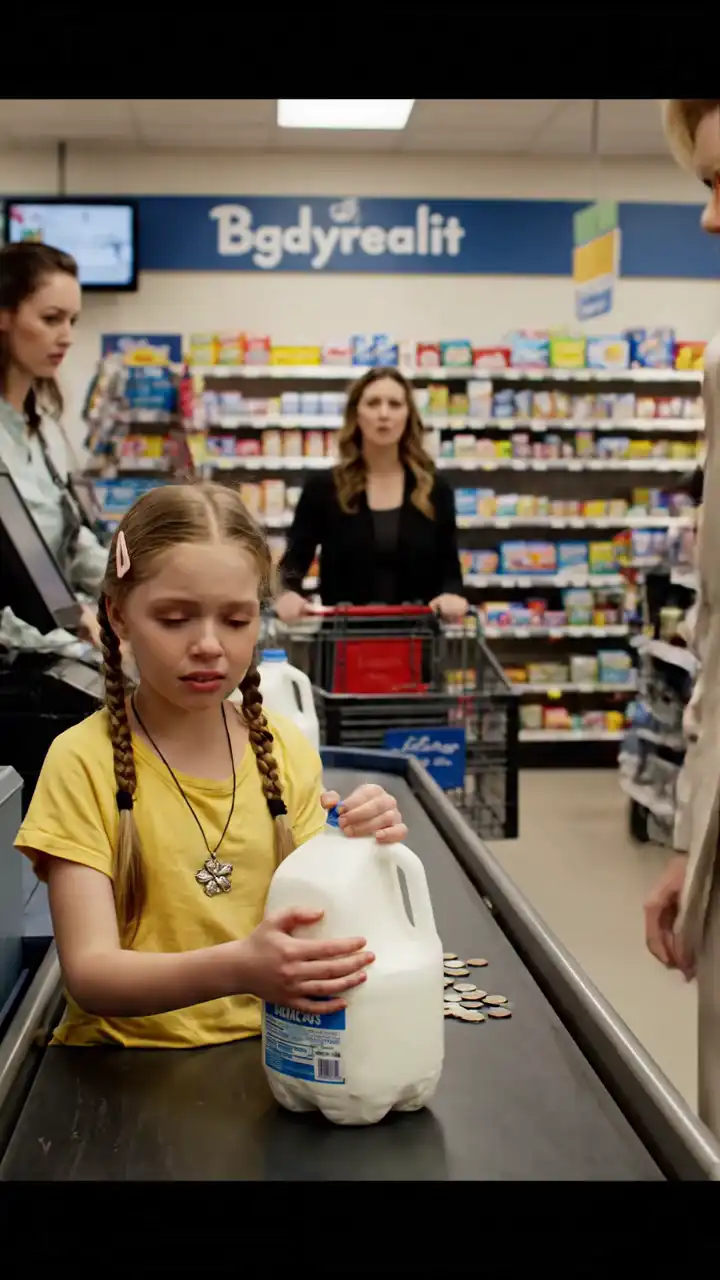
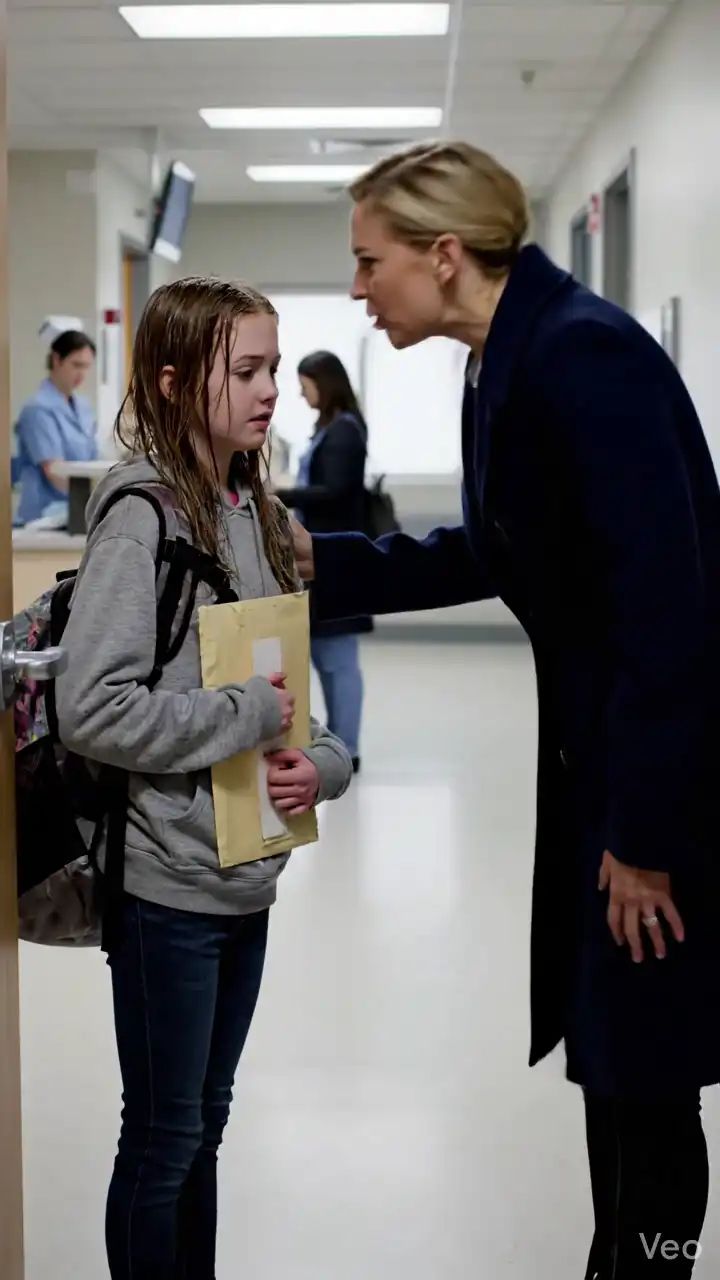
THEY LAUGHED WHEN THE LITTLE GIRL HELD THE LAWYERS LETTER OUTSIDE HER FATHERS HOSPITAL ROOM
Chapter 1
The envelope looked too big in Wren Halbrook’s hands.
She stood in the fourth-floor cardiac wing of St. Brigid Medical Center with her backpack sliding off one shoulder, her sneakers damp from the rain, and a sealed cream-colored envelope pressed against her chest like it might stop her heart from kicking so hard. Her father’s room was ten feet away. So was the woman who hated seeing her there.
“Are you lost again?” Celeste Varlan asked loudly.
The waiting area went quiet in the worst way. Not silent, exactly. Just thin. The TV over the coffee station still murmured about weather. A vending machine hummed. Someone coughed behind a magazine. But every face turned.
Wren was twelve, old enough to know when adults wanted a scene.
She tightened her fingers on the envelope. “I’m here to see my dad.”
Celeste gave a soft laugh and looked at the people around her like they were already on her side. She had one hand on the handle of a rolling suitcase and the other wrapped around a hospital coffee cup with pink lipstick on the lid. Her blond hair was neat. Her coat still had the fold lines from a dry cleaner. She looked like she belonged in places where people lowered their voices for her.
“You don’t just wander in whenever you feel like it,” Celeste said. “Not after three years.”
A man in a Ravens cap looked away fast. A nurse at the station lifted her head, then dropped it again.
Wren felt heat rise into her face. She hated that part most. Not the words. The burning.
“I didn’t wander,” she said. “Mrs. Kettle at the desk called up.”
Celeste stepped closer. “You mean after you stood downstairs crying until someone felt sorry for you?”
A few people shifted in their seats.
Wren wished her mother were there. But her mother was working the morning shift at Dunlee Farm Supply, and the school office had called too late and too vaguely—family medical issue, possible emergency, child requesting release. So Wren had taken the county bus alone with her coat half-zipped and algebra homework still in her bag.
She had not cried downstairs. She had only asked twice where to find Martin Halbrook.
Her father.
The word still felt strange in her mouth, because most days she used it only in her head.
Celeste tipped her chin toward the envelope. “And what exactly is that?”
Before Wren could answer, the elevator doors opened behind her with a ding. A narrow man in a dark suit stepped out carrying a leather briefcase. He scanned the hall, saw the room number, and walked toward them with the careful look of someone entering a family fight he had been paid to witness.
“Ms. Varlan?” he asked.
Celeste straightened at once. “Yes?”
“I’m Edwin Pike, with Pike and Renshaw.” He lifted another envelope from his briefcase, then noticed the one in Wren’s hands. “Ah. Good. The second delivery made it up here.”
Celeste frowned. “Second delivery?”
Mr. Pike looked from Celeste to Wren, then back again. “One sealed notice for you, one sealed notice for Miss Wren Halbrook.”
The whole hallway seemed to lean.
Celeste blinked, then laughed outright. “That can’t be right.”
Mr. Pike checked the label. “It is.”
Wren stared at him. Her name was written on the front in black ink. Full name. Not Wrennie like her mother called her. Not kiddo. Not sweetheart. Wren Elise Halbrook.
Celeste held out her hand sharply. “Let me see.”
Wren pulled the envelope back against her chest.
“Don’t be ridiculous,” Celeste snapped. “You’re a child.”
Mr. Pike cleared his throat. “The document is addressed to her. I can’t release it to anyone else.”
That was when Celeste’s face changed. Not all at once. First disbelief. Then offense. Then something colder.
“Do you know who I am?” she asked him.
“Yes, ma’am,” he said. “My instructions remain the same.”
She laughed again, but this time there was no warmth in it. “This is absurd. Martin is sedated. I’m the one handling his affairs. This girl has no place in that.”
Wren swallowed. “I’m his daughter.”
The sentence landed and stayed there.
A volunteer in a blue vest paused with a mop bucket. Two visitors near room 417 stopped pretending to read their phones.
Celeste looked directly at Wren, smiling with only her mouth. “You are the child he visited twice a year when it was convenient. Let’s not make things bigger than they are.”
The shame came so fast Wren almost couldn’t breathe. Because the worst humiliations were always the ones with a little truth inside them.
Her father had sent birthday checks some years and nothing on others. He missed two school plays, a tonsil surgery, and every parent conference she could remember. He lived forty minutes away in Briar Glen and acted as if county roads were an ocean. Still, when the school secretary said your father has been admitted after a cardiac event, Wren had gone cold from scalp to ankle.
Something might happen before I get there, she had thought.
Something might happen and I’ll never know why he stayed away.
Celeste took a step toward room 418. “You need to leave.”
“I just want to see him.”
“He doesn’t need stress.”
“I’m not stress.”
A little boy across the hall looked up from a puzzle book and asked, “Why’s she crying?”
Wren lifted her hand to her face. She hadn’t noticed the tears.
Celeste exhaled through her nose as if Wren had proved her point. “Because she’s making this into a performance.”
“I’m not,” Wren whispered.
Mr. Pike spoke carefully. “Perhaps it would be best if we all moved this discussion somewhere private.”
“No,” Celeste said. “Actually, let’s be perfectly clear right here. Martin has made his choices. He has a life. He has responsibilities. And he does not need a child turning up with a dramatic envelope and a school backpack to create confusion.”
The nurse at the station looked up again. Her badge said T. Cordero.
Wren’s fingers dug into the sealed paper. “Then why did a lawyer send me this?”
No one answered.
For one strange second, even Celeste looked unsure.
Then the door to room 418 opened.
A pale, broad-shouldered man in a hospital gown stood there with one hand braced against the frame and telemetry wires loose against his chest.
Martin Halbrook looked older than Wren remembered. His hair had gone mostly silver at the temples. His face was puffy from medication. But his eyes found her immediately, and all the sound in the hallway seemed to drain away.
“Wren,” he said.
It was not loud. It was barely steady.
But it was the first time he had ever said her name like it mattered in front of other people.
Celeste spun around. “Martin, get back in bed.”
He kept looking at Wren. Then he saw the envelope in her hands and closed his eyes for one hard second.
“Oh no,” Celeste said softly. “What is that?”
Martin opened his eyes again. “Let her in.”
Celeste’s voice sharpened. “Absolutely not.”
“Let her in.”
The nurse had already started walking toward them. “Sir, you need to sit down.”
Wren stood frozen in the middle of the hall, small and wet and burning with embarrassment, while strangers stared and her father gripped the doorframe like he might collapse.
Then Mr. Pike said the sentence that changed the air in the entire corridor.
“Mrs. Varlan,” he said, “if Mr. Halbrook loses capacity before these documents are acknowledged, there may be immediate consequences regarding the estate.”
Estate.
The word hit like broken glass.
Celeste turned slowly. “What estate?”
And in that sharp hospital light, with everyone watching and the sealed envelope crushed in a little girl’s hands, Wren realized she had walked into something much bigger than a sick father and a cruel woman.
She had walked into a secret no one wanted spoken out loud.
Chapter 2
Nurse Talia Cordero took control before anybody else could.
“Everybody breathe,” she said in the voice of someone who had seen people faint, scream, fight, and still make it to lunch on time. She put a steady hand under Martin’s elbow and guided him back toward the bed. “Only two visitors. No arguing in the doorway. And if anyone raises their voice again, security can finish this conversation for you.”
Celeste opened her mouth, but Talia gave her one look and that was enough for the moment.
Wren stepped into the room as if crossing into a place she had imagined for years but never thought she would really see.
Her father’s room smelled like bleach, stale coffee, and the rubbery heat of hospital machines. Rain pressed dimly against the window. A half-finished cup of ice chips sat on the tray table beside a pair of reading glasses. There were flowers on the windowsill, already drooping. The card on them said Get Well Soon Love C.
Wren stayed near the door.
Martin lowered himself onto the bed and winced. He looked as if he wanted to reach for her, but he didn’t. Maybe he knew he hadn’t earned that right. Maybe he was too tired to pretend otherwise.
Celeste came in after them, angry and graceful at once. Mr. Pike stayed just outside the door, speaking in low tones with Talia.
For a few seconds no one said anything.
Then Martin looked at the envelope in Wren’s hands.
“You opened it?” he asked.
She shook her head.
“Good.”
Celeste turned on him. “Good? Martin, tell me what this is.”
He rubbed a hand over his face. “Not now.”
“You had a lawyer send a child legal papers to a hospital hallway.”
His jaw tightened. “I had papers delivered if something happened to me.”
“If something happened to you?” Her voice rose. “You told me everything was already arranged.”
He looked at Wren then, not at Celeste. “I arranged what should have been arranged a long time ago.”
Wren’s throat tightened. “What does that mean?”
Martin’s eyes moved over her face as if searching for a younger version of someone else. Her mother, maybe. Himself, maybe. “It means I was a coward.”
Celeste gave a short, disbelieving laugh. “Now you want honesty? In front of her?”
“In front of everybody, apparently,” he said.
That startled Wren. She had never heard that edge in his voice before. In her life, Martin Halbrook had always been careful around discomfort. He sent gifts instead of apologies. Paid for things instead of showing up. Avoided direct statements the way other people avoided ice.
Celeste crossed her arms. “Then say it plainly.”
He looked sick in more ways than one. “The will in your safe is not the final one.”
Silence.
Even from the doorway, Wren could feel Mr. Pike become very still.
Celeste blinked. “What?”
Martin nodded toward the envelope. “The final documents were filed six months ago. Edwin has copies. So does the court.”
“You changed your will without telling me?”
“Yes.”
“To include her?” Celeste asked, and this time she didn’t bother hiding the contempt.
Wren wanted to disappear. The room felt too white, too bright, too full of things adults had built without asking where she might stand in them.
Martin answered anyway. “She was always supposed to be included.”
Celeste stared at him as if she had never seen him clearly until that second. “You said the trust for Nolan covered your obligations.”
At the sound of another child’s name, Wren finally understood a piece she had been missing. Nolan. Celeste’s son. Older than her by maybe three years. The boy with the expensive soccer cleats and braces her father had once shown in a photo, smiling too brightly, calling him “the kid.” Wren had looked at that picture for days without understanding why it made her chest hurt.
Martin said quietly, “My obligations are not the same as my child.”
Celeste’s face lost color. “I stood beside you while you built everything after your father died. I managed the clinic property sale. I handled your tax mess. I moved into your house. I put my son in schools based on where you said we were headed. And now you’re telling me you rewrote your estate behind my back because of guilt?”
“No,” he said. “Because of the truth.”
The words frightened Wren more than if they’d started shouting again.
Talia leaned in through the doorway. “Five minutes, then he rests.”
Celeste pointed toward Wren without looking at her. “Ask her where she’s been all this time.”
Wren flinched.
Martin closed his eyes. “Stop.”
“No, ask her,” Celeste said. “Ask your daughter why she only appears when there’s money in the room.”
Wren felt the tears rise again, hot and humiliating. “I didn’t know there was money.”
“That’s convenient.”
“I came because the school called.”
Celeste smiled thinly. “Children learn very early where doors open.”
Martin’s voice cracked across the room. “Enough.”
It was weak, but it was real.
Celeste turned to him. “Then tell her. Tell her how many birthdays you missed. Tell her how little she knows about your life. Tell her she is standing in a hospital room with legal papers she cannot even understand, and the only reason anyone handed them to her is because you’re trying to repair your conscience before you die.”
Wren’s whole body went cold.
Before Martin could answer, there was a soft knock on the frame.
Not Talia this time.
It was an older man in maintenance gray, with a plastic badge clipped crookedly to his chest and a folded wheelchair in his hands. Wren had passed him downstairs. He had held the elevator for her when she was trying not to cry.
“Sorry,” he said. “Need this room?”
Talia called from the station, “Not yet, Len.”
He nodded, but his eyes flicked to the envelope in Wren’s hands and then to Mr. Pike by the door. Something small and knowing passed over his face.
“Ma’am,” Len said to Wren, in the gentle automatic way hospital workers often called everyone ma’am or sir no matter their age, “you dropped this downstairs.”
He reached into his pocket and held out a tiny silver key on a paper tag.
Wren stared. “That’s not mine.”
Mr. Pike stepped in fast. “Let me see that.”
Len handed it over. The tag read DEPOSIT BOX B 14 HARBOR STATE.
Celeste turned sharply. “What is that?”
Mr. Pike looked at Martin. Martin looked exhausted.
“It’s where the original letter is,” he said.
Wren frowned. “What letter?”
No one answered immediately.
And that, more than the shouting, more than the shame in the hallway, told Wren the truth had been living somewhere sealed for a very long time.
Celeste took one slow step back. “What original letter?”
Martin leaned his head against the pillow and looked straight at the ceiling. “The one my father left for Wren.”
Wren’s mouth fell open.
“My grandfather?” she whispered.
Martin did not look at her. “Yes.”
Celeste gave a low, stunned laugh. “This just gets better.”
But Wren barely heard her anymore.
Because she had met Warren Halbrook only once, when she was six. He had smelled like cedar and peppermint and called her “little bird” because of her name. Two months later he died, and nobody from that side of the family came to the funeral service her mother held in the church basement after the cremation. Wren remembered her mother standing by a folding table with potato salad and ham rolls no one touched, saying only, “Some people keep score with love.”
Now her dead grandfather had left her a letter in a deposit box.
And her father had hidden it.
Talia stepped into the room again. “Time’s up.”
Celeste looked at Martin as if he had become a stranger in his own bed. “We’re not done.”
“No,” he said, eyes finally finding Wren’s. “We’re not.”
As Talia guided Wren back into the hallway, Mr. Pike kept the silver key in his palm. Len the maintenance man wheeled the chair away without another word. Celeste stood at the room window with her back to everyone, shoulders rigid.
Wren paused outside the door and looked once more at her father.
He seemed smaller now, all the force gone out of him, but there was one thing she could not ignore.
For the first time in her life, Martin Halbrook looked less afraid of losing money than of losing the chance to tell the truth.
Chapter 3
By evening, the cardiac wing had become a small courtroom with worse lighting.
Wren’s mother arrived just before six, still in her work boots, with hay chaff clinging to the cuff of her jeans and a red mark across one wrist where feed twine had rubbed the skin raw. Her name was Delia Mercer, though Wren’s school forms still had the old last name crossed out and rewritten in blue ink from years back. Delia did not move through rich spaces like she belonged there, but she had a way of standing that made people regret underestimating her.
She hugged Wren once, hard, then held her at arm’s length. “You okay?”
Wren nodded even though she wasn’t.
“Did anybody put hands on you?”
“No.”
“Did anybody make you cry on purpose?”
Wren looked away.
Delia’s mouth flattened. “All right.”
Celeste was waiting near the windows with her phone in one hand and a leather handbag hanging from her elbow like armor. Beside her stood a tall boy in a prep school jacket, all knees and expensive sulk. Nolan, then. He looked at Wren with bored curiosity, as if she were some strange volunteer activity his mother had dragged him into.
Mr. Pike had returned with a second woman from his office, sandy-haired and brisk, named Mara Dobbins. She spread papers across a side table with the neat focus of someone who knew paper could hit harder than fists.
And drifting between them all was Len, the maintenance worker, emptying trash bins no one had asked him to empty, replacing liners that did not need replacing, hearing far more than people noticed.
Wren sat in a vinyl chair with the sealed envelope on her lap and watched the adults assemble themselves into factions.
The wrongness of it all kept growing.
Her father was in a hospital bed twenty feet away after his heart had nearly stopped, and somehow the loudest thing in the building was not fear. It was entitlement.
Celeste spoke first, because people like her usually did.
“I think we can all agree this is not the time for chaos.”
Delia gave a dry laugh. “That sentence usually means chaos has already been useful to somebody.”
Celeste turned. “You must be Delia.”
“And you must be the woman who humiliated my daughter in a hallway.”
Nolan shifted uncomfortably. Mr. Pike looked at the ceiling.
Celeste drew herself taller. “I protected a recovering patient from emotional manipulation.”
Wren whispered, “I didn’t manipulate anyone.”
Delia put a hand on Wren’s shoulder without looking away from Celeste. “I know, baby.”
Baby.
The word should have embarrassed Wren at twelve, but in that moment it made her want to cry all over again.
Celeste’s tone cooled further. “This girl has barely been part of Martin’s daily life. That is unfortunate, but it is also true. For legal decisions to now orbit around her is reckless.”
Delia said, “Her not being in his daily life says something about him, not her.”
That struck home. Even Nolan looked down.
Mara Dobbins slid a page from her folder. “To be precise, the current issue is not whether Miss Halbrook visited enough. Minors are not required to earn blood relation through attendance.”
Celeste laughed once. “What a pretty phrase.”
“It’s a correct phrase,” Mara said.
Wren looked from face to face, trying to understand what all these adults had known before she did. She thought of scraped-together birthdays, the one pair of tap shoes her father had mailed after hearing by chance that she’d started lessons, the checks with no notes, the long silences after promises. She had spent years feeling half-invited into her own life.
Now people were speaking about her as if she were central to something enormous.
It felt wrong. It also felt overdue.
Around seven, Talia let Delia and Wren into Martin’s room together.
The monitor beeped steadily. The room was darker now, the window reflecting their faces back at them.
Martin looked at Delia first. “You came.”
Delia didn’t sit. “The school called.”
He accepted that. “Fair.”
Wren stayed near the wall.
Martin looked at the envelope in her hands again. “You can open it.”
She hesitated. “Now?”
“Yes.”
Delia gave a slight nod.
Wren slipped her thumb under the flap and pulled out a formal notice on thick paper. Most of it was lawyer language she barely understood, but some words rose clear enough.
Named beneficiary.
Issue of Martin Halbrook.
Specific protected share.
Contingent transfer of residential property proceeds and investment holdings.
Her vision blurred.
“I don’t understand,” she said.
Martin swallowed. “My father left instructions that if I ever acknowledged you formally, you were to receive the same standing he intended for any grandchild of mine. Equal standing.”
Delia’s face changed. “Acknowledged her formally?”
Wren looked up. “You never did?”
Martin shut his eyes.
And then the ugliest truth so far entered the room.
Delia said, very quietly, “You told him not to put her on the record.”
Wren looked between them. “What?”
Martin didn’t answer.
Delia stepped closer to the bed. “Say it.”
He opened his eyes. Shame made him look older than illness had. “My father knew about Wren before she was born. He told me that if I wanted to be a man, I needed to claim my daughter publicly, not privately. He had documents prepared. Not just support. Name recognition. A trust clause. He said secrecy rots people.”
Wren felt suddenly cold all the way down her back.
Delia whispered, “And you chose rot.”
Martin stared at his blanket. “I was engaged then. My father threatened to cut me out if I tried to hide her. I thought he was controlling me. I thought I could handle things my own way.”
Delia laughed once, sharp as broken glass. “By handling nothing.”
He did not defend himself.
Wren’s voice came out small. “You didn’t want me to have your last name?”
His face crumpled in a way she had never seen from him. “I wanted you. I just wanted that without consequences.”
The room went still.
A person could live years on half-truths, Wren realized. She had done it. He had too. But every half-truth still had a shape, and now she could see the whole ugly outline.
Outside the room, voices rose.
Celeste.
Mara.
A deeper male voice Wren didn’t know.
Delia opened the door and found a man in a navy suit arguing with Mr. Pike near the station. He introduced himself as Graham Varlan, Celeste’s brother, there “to advise on financial exposure.” He said it like Wren was a lawsuit, not a girl.
Things turned uglier from there.
By eight o’clock, everyone in that hallway knew some version of the story, and most of those versions made Wren sound like an intruder.
She heard fragments while sitting by the vending machine with a pack of crackers she wasn’t hungry enough to open.
“Out of nowhere—”
“Convenient timing—”
“Old family money—”
“Unstable paperwork—”
“Sentimental last-minute change—”
“Minor child through a previous relationship—”
Nothing cuts quite like hearing yourself reduced to a phrase.
Len passed with a linen cart and paused beside her. “Saltines are bad when you’re scared,” he said softly.
Wren looked up. “What?”
He nodded at the crackers. “Too dry. Makes your throat feel closed.” He dug in his pocket and held out a butterscotch candy in a twisted wrapper. “This works better.”
She took it. “Thanks.”
He glanced down the hall. “You know what most people do when they think a child doesn’t understand? They tell the truth right in front of her, just in the meanest possible language.”
Wren turned the candy in her fingers. “Do you know what’s going on?”
“Enough.” He gave a tiny shrug. “Hospitals hear every version of a family before the family hears itself.”
“You’re just maintenance.”
He smiled a little. “Just.”
Then he wheeled the cart away.
At nine, Celeste made her biggest mistake.
It happened in the family consult room, a cramped space with two armchairs, a fake plant, and a framed lighthouse print so faded the sky had gone white. Talia had allowed a brief meeting so the fighting would move away from other patients.
Wren sat between Delia and the wall.
Celeste stood.
That said everything.
She looked at Wren and spoke with crisp restraint, which somehow made it crueler.
“Let’s be practical. Even if Martin intended some adjustment, no judge is going to let a middle-school child disrupt years of planning because a sick man panicked.”
Delia said, “Watch your mouth.”
Celeste ignored her. “You don’t know what maintaining his life has cost. The properties, the debts, the liabilities, the business cleanup after his father’s estate. You think an envelope makes you equal?”
Wren stared at the carpet.
Celeste took that for weakness and kept going.
“You appeared with wet shoes and a backpack, and now people are supposed to rearrange reality around you.”
Wren looked up at her then.
Not because she had a good answer.
Because there are moments when shame becomes so full it turns into stillness.
“I didn’t ask for your reality,” Wren said softly. “I asked why my dad kept me outside it.”
The room fell silent.
Even Celeste paused.
Martin, pale in the doorway with Talia just behind him, had heard every word.
He stepped inside slowly. “Because I was weak.”
Talia started to protest, but he lifted a hand.
Celeste turned on him. “Get back to bed.”
“No.”
He looked at Wren, not anyone else.
“No more making her stand in hallways while adults decide whether she counts.”
And for the first time all day, people did not seem to know where to place the little girl in the room.
Not because she had become powerful.
Because the man who had failed her was finally saying the failure out loud.
Chapter 4
The next morning, the hospital no longer felt like neutral ground.
News had not gone public, exactly, but gossip had done what gossip does best: it spread without leaving fingerprints. By breakfast, the receptionist on the first floor gave Wren a look that was too curious to be polite. A volunteer offered her extra pudding with the pity reserved for children from complicated families. Two men in sport coats came up asking for Martin and left when they saw lawyers already there.
Whatever Martin Halbrook owned, enough people cared.
Rain had cleared overnight. Sunlight laid hard rectangles across the waiting room floor, making every scuff mark visible.
Wren sat by the window with Delia’s old denim jacket around her shoulders while her mother argued quietly on the phone with someone from work for another unpaid day off. Inside room 418, Martin was being evaluated for discharge against medical advice if he insisted on participating in legal decisions before resting. He insisted.
Celeste had changed tactics.
She was no longer openly sneering in public. That had backfired once people started noticing how small Wren really looked in that hallway, how little she had done besides hold paper and try not to cry. Now Celeste moved through the wing in lowered tones and wounded expressions, as if she were the reasonable one carrying everyone else’s chaos.
That was somehow more dangerous.
At ten-thirty, she approached Wren alone.
“May I sit?” she asked.
Wren didn’t answer.
Celeste sat anyway, smoothing her coat under her before lowering herself into the chair beside her. Up close, she smelled faintly of expensive perfume and hospital sanitizer.
For a moment she said nothing. Then, “You should know I never hated you.”
Wren kept staring at the parking lot.
Celeste folded her hands. “I hated what your existence did.”
That made Wren look at her.
Celeste’s eyes were ringed with tiredness. “There’s a difference.”
Wren’s voice was flat. “I don’t think there is.”
Celeste almost smiled. “There is when you’ve built your life around promises someone else made.”
Wren thought of her mother waking before dawn to thaw pipes in winter, clipping coupons, counting prescription copays at the kitchen table, saying, We can do without that. She thought of Martin’s checks arriving at random like weather. She thought of birthdays spent waiting for headlights that never turned into the driveway.
“Did he promise you I didn’t matter?” Wren asked.
Celeste looked away first.
“No,” she said. “He promised me the past was settled.”
That was the closest thing to honesty Wren had heard from her.
Before either of them could say more, Len appeared pushing a mop bucket with no actual mop in it. “Need this corner dry,” he said cheerfully, though the floor was already dry as bone.
Celeste stood at once. “Of course.”
As she walked away, Len watched her go, then sat the bucket down and leaned slightly toward Wren.
“Your lawyer friend’s looking for the old deposit records,” he said.
Wren frowned. “Why are you telling me?”
“Because people keep acting like you’re furniture.” He lowered his voice. “And because yesterday your father asked me a question while I was fixing the bathroom rail in his room.”
“What question?”
“He asked if I still remembered where his father used to hide papers when family came around.”
Wren stared at him. “You knew my grandfather?”
Len gave a small nod. “Leonard Sutter. I worked maintenance at Halbrook Surgical for twenty-two years before they sold the building. Your granddad was the kind who noticed the janitor’s birthday and the surgeon’s lies.”
Wren’s heart thudded. “What did he hide?”
Len glanced toward the nurse’s station. “Not here.”
An hour later, while Delia was in the cafeteria and the lawyers were in conference with Martin, Len took Wren to the old chapel on the first floor. It was nearly empty except for a battery candle rack and a bowl of hard mints by a guest book.
He sat on the back pew, cap in his hands.
“Your grandfather came to this hospital near the end,” he said. “Not as a patient. To visit his sister. He’d bring files in a leather case and complain about everyone in his family except you. Said you had the only honest face among them, and you were still in kindergarten.”
Wren didn’t know what to do with that.
Len looked at the stained glass panel of a shepherd carrying a lamb over his shoulders. “He knew Martin was trying to split his life into separate rooms. One for business. One for appearances. One for your mama. One for you. Men like that think if they keep doors closed long enough, truth won’t walk.”
“What letter did he leave me?”
“I never read it.” Len shook his head. “But I watched him seal it. He told me if anything happened before Martin did right by you, I was to remember two things.”
Wren leaned forward.
“First, the bank box. Second, the witness card.”
“The what?”
Len reached into his shirt pocket and pulled out a folded index card, yellowed at the corners. On the front, in neat block letters, was written LEONARD SUTTER. Witness copy. He handed it to her.
On the back was a note in different handwriting, older and shakier.
If Martin delays her name again open the clinic ledger file and call Pike
Wren read it twice.
“Why didn’t you give this to anyone yesterday?”
Len’s face tightened. “Because I wasn’t sure who still deserved it. And because old family money makes honest men act slippery.” He looked straight at her. “But then I watched a grown woman shame a child in front of strangers, and I decided I had seen enough.”
Wren held the card carefully, as if it might crumble. “What’s the clinic ledger file?”
“I think,” Len said, “it’s the thing proving this wasn’t a deathbed impulse.”
That afternoon, Mara Dobbins nearly dropped her pen when Wren showed her the card.
Within an hour, Mr. Pike had someone retrieving archived files from a records warehouse in North Vale. Celeste noticed the shift at once. She stopped whispering and started pacing. Graham Varlan arrived again, looking less certain than he had the night before. Talia kept having to tell everyone to lower their voices.
By five, Martin was pale with fatigue but stubbornly upright in bed when Mara placed a thick copied ledger on the tray table.
“Clinic records from the year your father died,” she said. “And an attached memorandum from Warren Halbrook’s counsel.”
Celeste stood at the foot of the bed. “This is ridiculous.”
Mara ignored her and opened to a marked page.
There it was.
Not a sentimental late change. Not a panicked revision from six months ago. A formal allocation line drafted twelve years earlier: one protected inheritance share reserved for any biological child of Martin Halbrook, specifically including then-unborn issue from a documented private affidavit signed by Martin and witnessed by Leonard Sutter.
Wren didn’t understand every word, but she understood enough.
Unborn issue.
That was her.
Twelve years earlier.
Before she was even born, somebody had written her into the future.
Delia put a hand over her mouth.
Martin looked like he might be sick.
Celeste stared at the page in disbelief. “No.”
Mara turned another page. “There is also correspondence indicating Mr. Halbrook the elder reduced Martin’s immediate control over portions of the estate until public acknowledgment occurred.”
Graham took the document from her, scanned it, and went still.
“What does that mean?” Wren asked.
Mr. Pike answered carefully. “It means your grandfather believed hiding you was serious enough that he tied part of the estate to whether your father eventually did the right thing.”
“Did he?”
No one spoke.
That was the answer.
Martin covered his eyes with one hand. “Not soon enough.”
Celeste looked at him as if all the years between them had just been relabeled. “So when your father died, you let me believe the restructuring was tax strategy.”
He didn’t deny it.
“And all this time,” she said, voice thinning, “all this time part of everything was frozen because of her.”
Wren hated the way her sounded in Celeste’s mouth. Not a name. A cost.
Delia straightened. “No. Because of him.”
Celeste took a step back from the bed as if Martin had physically struck her.
What changed then was not just the paperwork.
It was the room.
Until that moment, people had treated Wren like a disruption to a stable system. But the ledger proved the system had never been stable. It had been built on concealment from the start. The adults who mocked her presence were not defending order.
They were standing on a lie old enough to vote.
Celeste gave one soft, breathless laugh. “Do you know what he made me look like?”
“No,” Delia said. “He made you choose what to do once you knew.”
That landed harder than shouting.
For the first time since Wren arrived, Celeste had no quick answer.
She left the room without another word.
And everyone watched her go.
Chapter 5
The final unraveling came the next morning with a sealed packet, a notary, and a room too small for the truth inside it.
Martin had refused transfer to a private facility. Maybe because leaving St. Brigid would have let everyone scatter back into their old versions of themselves. In the hospital, under fluorescent lights and public rules, he had fewer places to hide.
Talia arranged for the consult room again, though this time she stood near the door with her arms folded, making it clear the staff had grown personally invested in seeing the adults behave.
Present were Martin, pale and tired but lucid; Delia and Wren; Mr. Pike and Mara; Celeste and Graham; and, at Mr. Pike’s request, Leonard Sutter in a freshly pressed work shirt instead of maintenance gray.
Celeste noticed that last detail immediately. “Why is he here?”
Mr. Pike answered, “Because Mr. Sutter was a witness to two key instruments and custodian of a directive note from Warren Halbrook.”
Len sat without fuss, hands folded over his cap.
Wren took the chair closest to her mother.
Mr. Pike opened the packet and removed a handwritten letter in a protective sleeve.
“The original from the deposit box,” he said.
Wren’s heartbeat thudded in her ears.
The paper was cream, heavy, and old enough that the fold lines looked soft. At the top, in dark ink gone brown with age, were the words For my granddaughter Wren if foolishness continues past my death.
Even Graham let out a breath at that.
Mr. Pike looked at Wren. “Would you like me to read it?”
She nodded.
He began.
Little Bird
If this reaches you late then men have delayed what should have been simple
You belong where the truth belongs in daylight
Your father was born with charm enough to make excuses look gentle and fear enough to mistake secrecy for peace
Do not learn that habit from him
What is yours is not only property though there is property and I have set my hand to that because money is the only language some cowards respect when love fails
What is yours first is your name your place and your equal standing among the living and the dead of this family
If anyone tells you it is greedy to stand where you were always meant to stand they are asking you to help them continue a lie
Take nothing by begging
Take only what is already true
And if the day comes when dignity costs you more than staying quiet pay it and walk upright
Love Warren Halbrook
By the middle of the letter, Delia was crying silently. By the end, Wren was too.
Not loud tears. Just the kind that fell because some part of you had been recognized too late and too exactly.
Martin was openly weeping.
Celeste sat perfectly still, jaw tight, eyes fixed on the table.
No one rushed to speak. The letter had done what no argument had managed. It gave the secret a moral shape. This was no longer only a fight over percentages and documents. It was a record of what had been denied.
Mr. Pike set down the letter and slid forward a second document.
“This is the acknowledgment affidavit Martin should have filed years ago. It was drafted and witnessed but never submitted. Under the elder Mr. Halbrook’s estate structure, the protected share remained reserved pending formal recognition or legal proof after death.”
Wren stared at the line where her father’s younger signature looped across the page. He had signed. He had known. He had still hidden her.
Martin’s voice was rough. “I thought I had time.”
Delia turned to him with such tired sadness that it hurt to watch. “Time for what?”
“To make it cleaner.”
“There is no clean way to hide a child.”
He bowed his head.
Celeste finally spoke. “How much?”
Mr. Pike named the amount and property terms plainly.
Even Wren, who had never cared much about money because there was never enough to imagine in big numbers, understood from the room’s reaction that it was substantial. A share of proceeds from the sale of the original clinic property, accumulated investments held in reserve, and a future portion of the Briar Glen house sale if Martin died before executing new settlement terms.
Celeste went white.
“So my son loses because yours lied,” she said to Delia.
Delia’s answer came sharp and clean. “My daughter was not born taking from yours.”
“No,” Celeste said, eyes shining now, anger cracking into something uglier. “She was born into a mess and now all of us pay for his guilt.”
Wren looked at Nolan’s empty chair in her mind, though he wasn’t present this morning. She thought of his school jacket, his awkward silence, how children inherited storms they never made. For one brief second she even pitied Celeste.
Then Celeste made her last and worst mistake.
She turned to Wren directly.
“Do you even want this house?” she asked. “These accounts? This name? Or do you just want the satisfaction of watching everything break?”
The room froze.
Wren had spent two days being spoken around, over, and through. She had been treated like evidence, threat, inconvenience, pity object, late invoice. Something inside her settled.
She wiped her face with the heel of her hand and answered in a voice so quiet people had to lean in.
“I wanted my dad to know my birthday without my mom reminding him.”
No one moved.
“I wanted him to come to my choir concert once,” she said. “I wanted him to stop saying next weekend and then sending money instead. I wanted to know if he stayed away because of me or because he was scared.”
Celeste looked down.
Wren kept going.
“I didn’t come here for your house.”
Then she looked at her father.
“I came because I thought he might die before telling the truth.”
Martin made a sound like something inside him had given way.
Len took off his glasses and pressed his fingers to his eyes.
Mr. Pike cleared his throat, then didn’t speak after all.
It was Martin who finally did.
“Everything she receives stays,” he said, voice shaking. “Not because I’m dying. Because it was always hers. But the house in Briar Glen will be sold whether I live or not.”
Celeste looked up sharply.
He met her eyes. “And your son’s educational trust will be honored in full from my personal accounts, outside this dispute. That was my promise to him, and he is not responsible for me.”
Some of the rigidity left Graham’s shoulders.
Celeste whispered, “So that’s it?”
Martin took a long breath. “No. That’s the legal part.”
He turned to Wren.
“The rest is yours to refuse.”
The room became very still.
He looked terrible. Weak. Ashen. Human in a way she had never seen. Not a father from a distance. Not a name on envelopes. Just a man who had let cowardice shape a child’s life and could finally see the shape it had made.
“I am sorry,” he said. “I do not expect forgiveness because I finally got sick enough to stop lying.”
Wren’s eyes burned.
He went on, each word seeming to cost him.
“I should have put your name where it belonged when you were born. I should have stood beside your mother when it got hard. I should have let my father be angry instead of letting you carry the price. I cannot ask you to trust me quickly. Maybe not ever. But I will not hide you again.”
Delia looked at Wren and let the decision stay where it belonged.
That mattered.
Not one adult grabbed the moment and turned it for her. Not one spoke on her behalf.
Wren sat with the ache of everything she had wanted and everything she no longer believed could be repaired by wanting it. She realized then that justice and closeness were not the same thing. A name on paper could be corrected. A childhood could not.
She took a breath.
“I don’t want to fight you for a place,” she said. “I want you to stop making me stand outside rooms.”
Martin closed his eyes, tears slipping under his lashes. “I will.”
It was not a miracle. It was only a promise. But it was the first one he had made in front of witnesses.
Mr. Pike began explaining next steps, signatures, court notifications, trustee revisions. Most of it blurred.
The thing Wren remembered was smaller.
As everyone started moving paper, Celeste rose from her chair, picked up her handbag, and paused by the door. She looked at Wren for a long moment.
“I was cruel to you,” she said.
Wren said nothing.
Celeste swallowed. “I thought if I made you feel small, this would become small. It didn’t.”
Then she walked out with her back straight and did not ask anyone to stop her.
And somehow that was the first decent thing Wren had seen her do.
Chapter 6
Martin stayed in the hospital three more days.
No one turned those days into a movie ending. There was no sudden perfect fatherhood, no magical healing of old damage. Cardiac rehab was arranged. Legal notices were filed. Delia took calls on the chapel steps and read every page before signing anything. Mr. Pike moved with the solemn efficiency of a man cleaning up after generations of expensive avoidance.
Celeste did not come back after the final meeting, though Nolan sent a note through Graham two days later. It was folded from a sheet of notebook paper and written in cramped teenage print.
I didn’t know either Sorry my mom was awful I hope your dad doesn’t die
Wren read it twice, then tucked it into her backpack.
On Martin’s last afternoon at St. Brigid, sunlight filled the room so fully it made the machines look almost domestic. The flowers on the windowsill had been thrown out. In their place stood a paper cup with three crayons in it because a pediatric patient down the hall had insisted all recovering people needed color nearby.
Wren sat by the window while Martin signed discharge papers.
His hand shook.
When the nurse left, he looked at her. “Your choir concert is in May, right?”
Wren nodded cautiously.
“Will you tell me the date?”
She studied him for a second. “I’ll text it to you.”
The answer was small, but he smiled like he understood what it cost.
“Okay,” he said.
Not Dad will definitely be there. Not We’ll make up for everything. Just okay.
That was better.
Delia came in with a pharmacy bag and car keys. “Ready?”
Martin looked at her. “Thank you for bringing her.”
Delia’s expression was calm, almost kind, which was not the same as soft. “I brought her for her. Not for you.”
“I know.”
She nodded once. “Good.”
Len appeared in the doorway in his gray work shirt, carrying a trash bag he clearly did not need as an excuse anymore.
“Checkout parade?” he asked.
Wren smiled for the first time in days. “Something like that.”
He tipped his head toward her. “Your granddad was right about one thing.”
“What?”
“You do stand upright.”
Wren looked down, embarrassed, but pleased in a shy painful way.
Mr. Pike met them in the hall with copies of the filed acknowledgment, the trust summary, and a certified copy of Warren’s letter placed in a slim blue folder.
“This belongs to you,” he told Wren.
She took it carefully.
The hallway outside room 418 looked almost ordinary now. People passed with balloons, coffee trays, overnight bags. A janitor buffed the far corner of the floor. The TV still talked to no one.
It was strange how the place of her biggest humiliation could look so normal.
Wren stopped near the exact spot where she had stood with the sealed envelope against her chest while strangers watched her be made to feel like a mistake.
She could still hear Celeste’s voice if she let herself.
You appeared with wet shoes and a backpack.
Maybe she had.
But she had also walked in carrying the truth adults were too polished to hold.
Martin came out slowly with Delia on one side and a discharge aide on the other. He looked at the hallway too, and Wren knew he remembered.
“I’m sorry about that day,” he said quietly.
Wren adjusted her backpack strap. “That day showed everything.”
He nodded. “Yes.”
They rode the elevator down together. In the lobby, where it had all begun, they stopped by the front doors. Outside, the rain had finally broken for good. The parking lot shone under clear spring light. Delia’s truck waited at the curb, rust along the wheel well, feed sacks in the back under a tarp.
Martin’s ride had not yet arrived.
For a moment they all stood there with nowhere to hide.
Wren looked up at him. He seemed uncertain, which she suspected was new for him.
“Do you want me to call you when I get home?” he asked.
She thought about it.
This was the place where stories usually lied, where children ran into arms and everybody used the right word at last and the hurt somehow shrank to fit the page.
But Wren had learned something in that hospital.
Dignity was not the same as reunion.
You could accept what was yours without pretending what was broken had never broken.
“You can call,” she said. “I might not answer right away.”
Martin took that in, and to his credit, he did not bargain.
“All right.”
Delia opened the truck door for Wren.
As she climbed in, she looked back once. Her father stood in the hospital entrance with discharge papers in one hand and the weight of his own choices finally visible on his face. He looked like a man who wanted to be asked not to leave.
No one asked.
And that, Wren understood now, was not cruelty.
It was consequence.
Delia started the engine. The truck rattled, coughed, then steadied. As they pulled away from St. Brigid, Wren held the blue folder on her lap and watched her father grow smaller in the side mirror.
Not erased.
Not reclaimed.
Just seen clearly at last.
Delia rested one hand briefly over Wren’s on the folder. “You okay?”
Wren looked out at the bright road ahead.
“I think so,” she said.
And for the first time, the answer felt honest.
Disclaimer: Mention of any brand or trademark is for identification only and does not imply partnership or endorsement
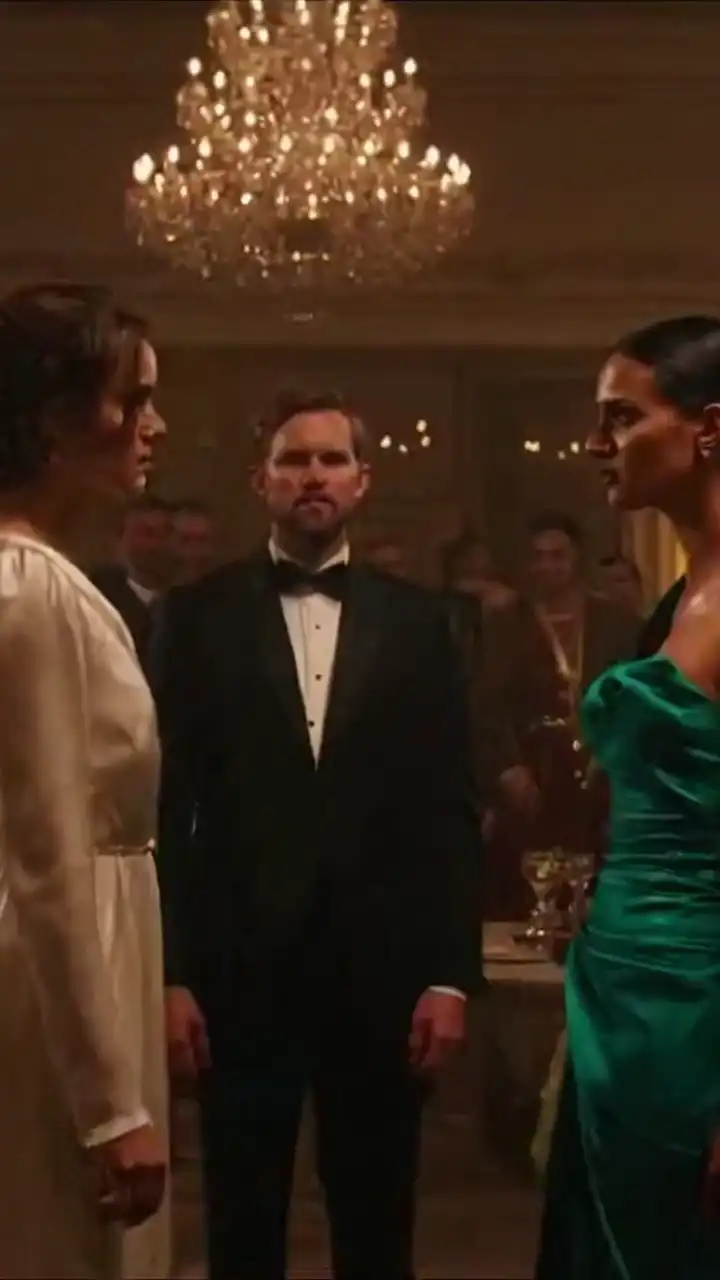
MY HUSBAND USED MY MONEY, GOT ENGAGED TO HIS MISTRESS, AND STOOD THERE WHILE SHE SLAPPED ME
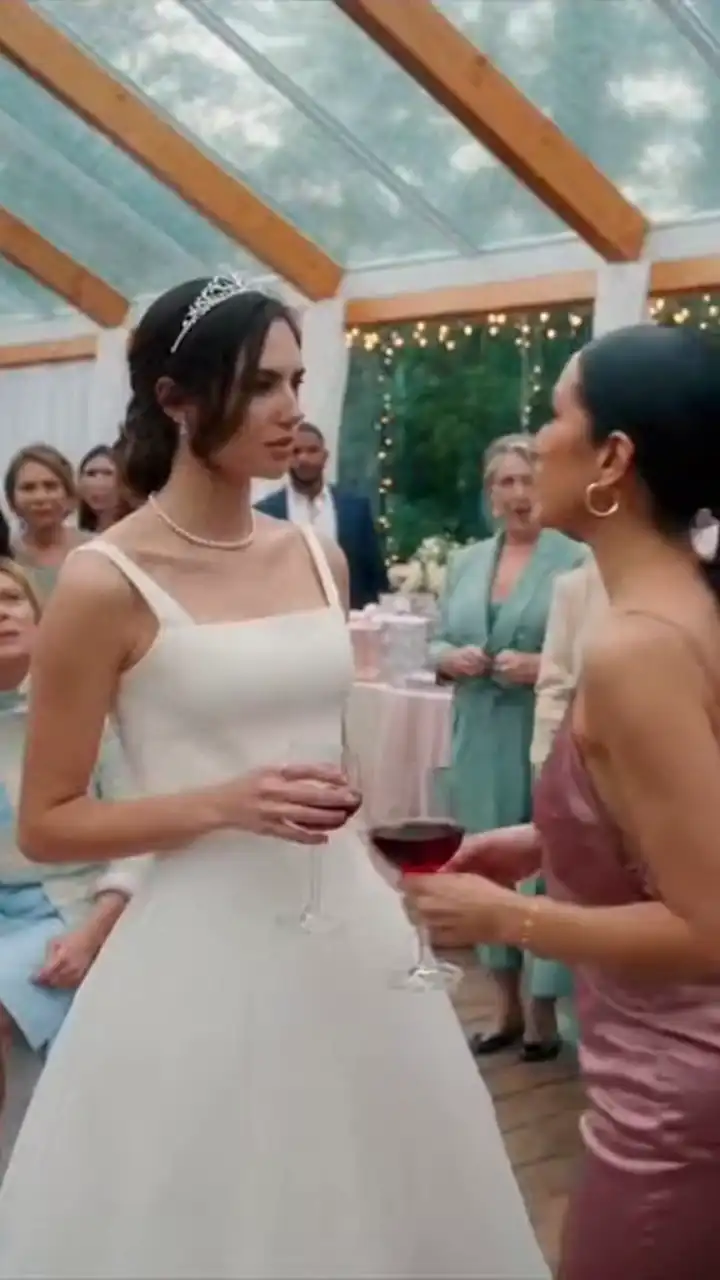
THE MAID OF HONOR POURED WINE ON ME AT MY BRIDAL SHOWER AFTER STEALING MY FIANCÉ. SHE DIDN'T KNOW THE ROOM WAS ABOUT TO HEAR WHAT HE'D BEEN SAYING TO BOTH OF US.
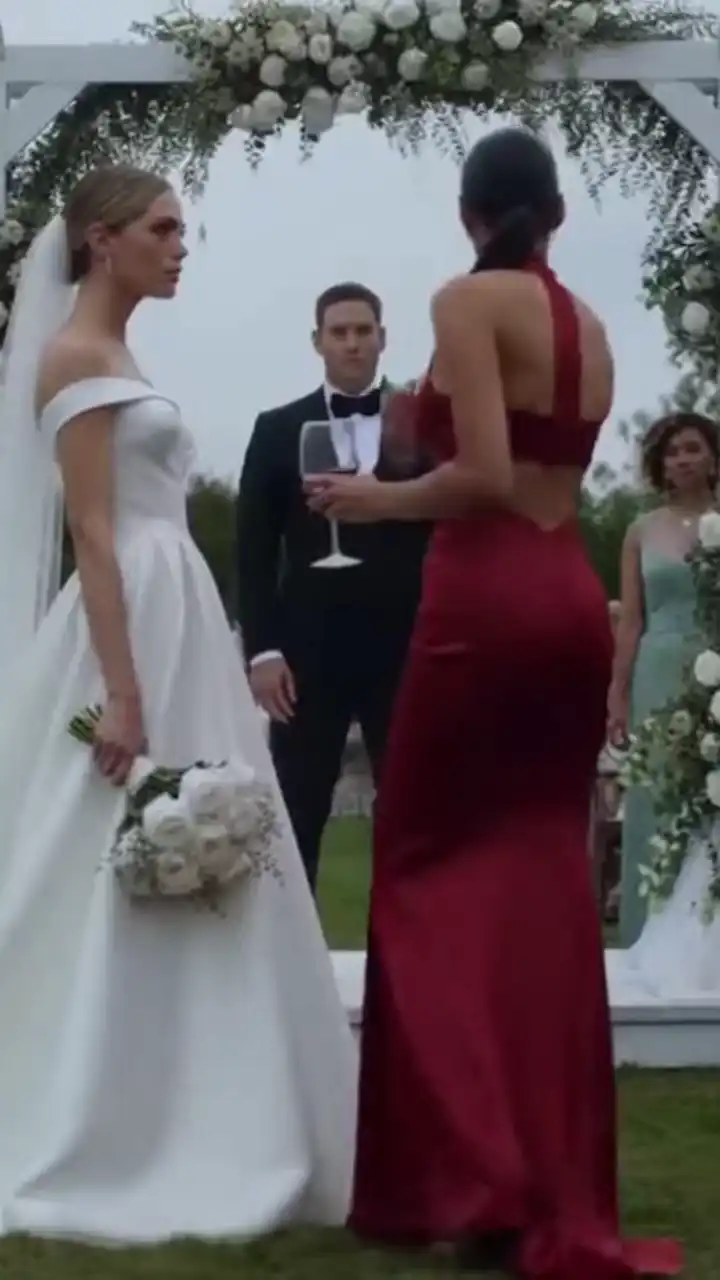
THE MAID OF HONOR POURED WINE ON ME AT MY WEDDING AND CALLED ME CRAZY. SHE FORGOT I STILL HAD THE VOICE NOTE SHE SENT MY FIANCÉ.