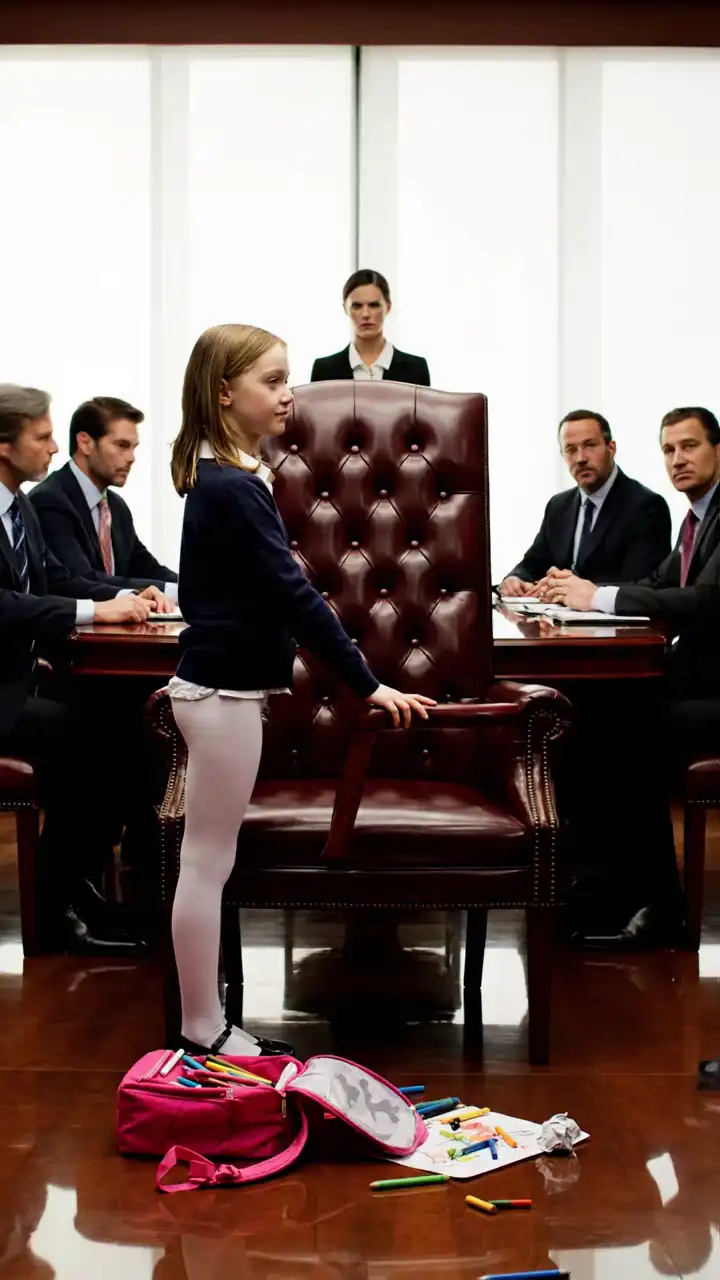
THEY LAUGHED WHEN THE LITTLE GIRL OPENED THE WILL AND SAID THAT CHAIR IS MINE
Chapter 1
The first thing everyone saw was the pink backpack.
It slid off the leather chair and hit the polished conference room floor with a soft thud, spilling a crumpled drawing, two broken crayons, and a folded paper covered in childish handwriting. Ten pairs of adult eyes dropped to it at once.
Then they looked at the little girl standing beside the long walnut table.
She was trying so hard not to cry that her chin trembled before the rest of her face did.
“Lila,” Grant said under his breath, sharp enough to hurt. “Pick that up.”
His hand touched her shoulder like he was helping, but I knew better. He was steering her backward, away from the head of the table, away from the stack of legal folders, away from the seat her grandfather used to take in this room every Monday morning.
Lila didn’t move.
She was eight years old, in white tights, a navy cardigan, and a pair of patent shoes that had been polished so carefully they still caught the overhead light. She had dressed for this day like children dress for church or funerals—trying to look good enough to survive what adults were about to do.
“That chair is mine,” she said.
The room went very still.
Someone near the window let out a tiny laugh, the kind people make when they think a child has said something cute and inconvenient.
Grant’s fiancée, Vanessa Corbin, didn’t laugh. She looked annoyed.
“No, sweetheart,” she said, too softly, too prettily. “That’s not how any of this works.”
Lila bent down, scooped up the folded paper from the floor, and hugged it to her chest. “Papa said when he was gone, I sit there if it gets ugly.”
Now nobody laughed.
I was standing near the side credenza with a yellow legal pad and a coffee I had forgotten to drink. My name is Mara Bell, and technically I was only there to assist counsel, which was a fancy way of saying I did the quiet work nobody noticed until something fell apart. I worked for Baines Legal Group in Dunleigh, Missouri, and I had been told that morning this would be routine: a reading of estate directives for the late Russell Vale, founder of Vale Industrial Supply, attended by family, senior staff, and one very uncomfortable child.
Routine lasted about fifteen seconds.
Grant Vale, Russell’s only surviving son, straightened his tie. “Mara,” he said without looking at me, “would you ask someone to take Lila outside?”
Lila turned at once, those huge gray eyes landing on me like a plea she was too proud to voice.
“Please don’t make me go,” she whispered.
It was one of those lines that enters a room and changes the air. No drama in it. No performance. Just a small, breaking truth.
The official attorney leading the meeting, Wallace Baines, cleared his throat. “We should begin.”
Vanessa was already gathering the fallen crayons with two fingers, like they were dirty. “This is exactly why children shouldn’t be involved in probate proceedings.”
Lila looked at the crumpled drawing she still held. “I was involved before he died.”
That landed harder than it should have, maybe because it was true.
Russell Vale had brought Lila everywhere the last year of his life. Factory tours, charity lunches, site visits, and, yes, more than one board briefing in this very room at Vale Tower on Mercer Street. People had called it indulgent. Sentimental. Sad, maybe, because the old man’s health had gone fast after his second surgery. But I had seen the way he looked at the child, not as a toy or mascot but as if she was the last honest person left in a building full of polished liars.
Lila wasn’t Grant’s daughter. She was his late sister’s child. Nora Vale had died in a car accident three years earlier, and since then Lila had been moved around the edges of the family like fragile furniture. First with a cousin in Ashby Ridge, then with a nanny, then at St. Brigid’s House for Children for two months while lawyers sorted out “guardianship logistics.” The phrase still made me sick.
Then Grant had stepped in. Publicly, nobly. He had taken her in.
And six months later, he had gotten engaged to Vanessa.
Everybody in Dunleigh knew Vanessa. She chaired galas, posted devotionals online, and wore compassion the way some women wore diamonds: where everyone could see it. She spoke often about “building a family.” She never once said Lila’s name in public unless someone else said it first.
Wallace opened the top folder. “As counsel for the estate, I am here to review the decedent’s will, codicils, trust allocations, and governance instructions for Vale Industrial Supply.”
Grant pulled out the chair one seat down from the head. “Lila. Sit here.”
She stayed where she was.
“That chair is mine,” she repeated, quieter now.
Vanessa gave a tired smile to the room. “She’s been saying odd things all week. It’s just grief.”
Lila stared at the shiny tabletop. “No. It’s memory.”
I saw Wallace shift. He didn’t like surprises. Rich families paid firms like ours to package grief into signatures and schedule it between lunch and market close. A child with a sentence like that was dangerous.
“Let’s proceed,” he said.
Papers moved. Chairs creaked. Rain tapped the long windows overlooking downtown. Lila remained standing beside the head chair, one hand pressed to the leather as if it were a person she didn’t want strangers touching.
Wallace began listing assets: the house on Briar Glen, the lake property near Hollis Point, liquid accounts, minority holdings, charitable obligations. Grant nodded at the right places. Vanessa lowered her lashes in solemn sympathy whenever anyone looked over.
Then Wallace reached the section on temporary trusteeship and executive oversight, and that was when the meeting cracked open.
“Pending the child beneficiary reaching majority,” he read, “interim stewardship of the personal legacy archive and instructional materials shall be assigned in accordance with the attached memorandum.”
Grant frowned. “What archive?”
Wallace turned a page. “A sealed file set. Referenced here.”
Vanessa’s expression tightened. “Sealed from whom?”
Wallace did not answer immediately. He adjusted his glasses. “From all parties until this meeting.”
Grant gave a short laugh. “My father sealed something from me?”
Lila lifted the folded paper in her hand. “He didn’t seal it from me.”
Every head turned.
“Lila,” Grant said, and now the warning in his voice was naked. “What is that?”
She looked at him, and for the first time I saw something in her face that wasn’t just fear. It was hurt hardening into will.
“My paper.”
Vanessa stood. “Give it here.”
Lila stepped back so fast her shoe squeaked on the floor. “No.”
“Lila,” Grant snapped, “don’t embarrass yourself.”
The word embarrass hung there, ugly and adult and far too practiced.
The little girl flinched like she had heard it before.
And that was the exact moment I understood this meeting was not about orderly inheritance. It was about control—who got to define reality in front of witnesses, who got to call a child unstable, sentimental, confused, dramatic. Who got the head chair, and who got removed before the real decisions started.
Wallace extended his hand. “Perhaps I should see the paper.”
Lila clutched it tighter. “Papa said only if they start lying.”
Nobody breathed.
Grant’s jaw locked. Vanessa folded her arms. Around the table, executives, accountants, and one family pastor suddenly looked very interested in the grain of the wood.
I set my coffee down.
Because when a child says adults are lying, one of two things is happening.
Either she is frightened and confused.
Or she is the only honest person in the room.
Chapter 2
Wallace tried to recover the room with the calm, measured tone expensive lawyers practice in mirrors.
“Lila,” he said, “why don’t you sit down and let the adults finish reviewing the estate documents?”
She shook her head.
That simple refusal irritated Vanessa more than any tantrum would have. You could see it. A crying child could be managed, soothed, dismissed. A silent one who held her ground was harder to erase.
Grant exhaled through his nose. “She’s exhausted. We’ve had a very difficult week.”
The pastor, Reverend Cloy, murmured, “Understandable.”
It would have worked too, maybe, if I hadn’t noticed the dark crescent marks pressed into Lila’s wrist. Not bruises exactly. Finger pressure. Recent.
She saw me looking and tugged her sleeve down.
Wallace placed one palm on the file. “The memorandum will be reviewed in due course.”
Lila lifted her chin. “Read the part about me.”
Vanessa gave a strained laugh. “Honey, everything is not about you.”
The child’s mouth quivered. “It was to him.”
The rain outside grew heavier, streaking the glass and turning downtown Dunleigh into a blur of silver and charcoal. In that room, under recessed lights and framed photographs of Russell breaking ground on warehouses and ribbon-cutting charities, the little girl looked absurdly small.
But nobody could get her to move.
Wallace finally turned another page. “There is, ah, a letter of intent concerning Miss Lila Vale’s living arrangement, education, and personal representation.”
Grant leaned forward. “Good. Read that.”
Wallace did.
Russell’s words were direct even on paper. If his granddaughter, Lila Vale, remained a minor at the time of his death, all guardianship decisions affecting her residence, schooling, therapy, and public image were to be reviewed by an independent advocate appointed from outside the family before any long-term custody arrangement became permanent.
Vanessa blinked. “Public image?”
Grant sat back. “What does that even mean?”
Wallace kept reading. “Further, no engagement, marriage, merger, relocation, or media event involving the household may use the child’s presence or likeness without said advocate’s written consent.”
That made the room colder.
Vanessa’s cheeks lost color first. “Media event?”
I thought of the photographs. Her fall charity launch at the Elmont Hotel, where she had posed in cream silk beside Grant while Lila stood between them holding a basket of raffle tickets. Her church family campaign where she had posted a picture captioned Blessed to be building a home out of brokenness. The local magazine spread in which Lila had been described as a “quiet little angel healing two wounded adults through love.”
Grant’s voice flattened. “This is ridiculous.”
“Maybe he knew you,” Lila said.
She hadn’t raised her voice. She didn’t need to.
Vanessa turned to her so quickly her chair scraped. “That is enough.”
Lila stepped back into the head chair and held the leather top rail with both hands. Her folded paper was crumpling under her grip.
I saw Wallace glance at me. It wasn’t a command, exactly. More like a question. Do something.
Before I could move, the conference room door opened.
A woman I had seen only once before stood there in a rain-dark coat, carrying a slim briefcase and a dripping umbrella. She was in her fifties, with a plain silver cross at her throat and the tired alertness of someone who had spent her life entering rooms too late and still having to fix them.
“Sorry to interrupt,” she said. “Traffic on Birch Hollow was blocked by an accident.”
Wallace stared. “Ms. Kitt.”
Grant looked annoyed. “Who is this?”
The woman closed the door behind her and set down her umbrella. “Eleanor Kitt. Independent counsel.”
Vanessa frowned. “For whom?”
Eleanor looked directly at Lila. “For her, apparently.”
A pulse moved through the room.
Wallace regained his footing first. “Ms. Kitt was named in a secondary advisory capacity.”
“Secondary?” Eleanor said. “Interesting choice of adjective.”
She walked to the table, opened her briefcase, and removed a thin folder held together with a rust-colored clip. It looked unimpressive next to Wallace’s stacked binders and embossed tabs. Cheap paper. Old edges. The kind of thing people overlook.
Which was probably why it mattered.
“Mr. Vale,” Eleanor said to Grant, “before we proceed, I’d like clarity on why the child beneficiary was instructed to wait outside when the memorandum specifically protects her right to representation at any meeting that defines her home.”
Grant’s face darkened. “No one instructed her to wait outside.”
Lila whispered, “You said I’d ruin it.”
Grant turned so fast his cuff brushed a water glass. “That is not what I said.”
“It is,” she replied.
Vanessa’s voice sharpened. “She twists things when she’s upset.”
The sentence made my stomach turn because it carried the smoothness of repetition. Not a reaction. A method.
Eleanor placed the clipped folder on the table but did not open it yet. “Then perhaps we should proceed carefully. Children who are repeatedly told their memory is unreliable often stop speaking at all.”
Nobody answered that.
Wallace cleared his throat. “We are getting off track.”
“No,” Eleanor said. “We are finding it.”
Lila slowly sat down in Russell’s chair.
I think half the room expected someone to drag her out of it. But nobody did. Maybe because of Eleanor. Maybe because of Russell’s letter. Maybe because even the people who had rolled their eyes a moment before could now feel the old man’s hand in the room, still directing traffic after death.
Wallace resumed the reading, more carefully now. There were distributions to charity, bequests to long-time employees, scholarship funds, maintenance instructions for the lake property, and a long section on corporate governance that made the executives sit straighter.
Then came the line that changed Grant’s expression.
“Control of the Vale Voting Block shall not automatically transfer to my son, Grant Vale, upon my death.”
Silence.
Grant actually laughed from shock. “Excuse me?”
Wallace read it again, slower this time.
Vanessa whispered, “That can’t be right.”
“It appears to be,” Wallace said.
Grant planted both palms on the table. “Then who gets it?”
Wallace looked down. “The trust retains control pending activation criteria.”
“What criteria?”
Wallace hesitated. Eleanor did not. “There’s an instructional appendix,” she said.
Lila touched the folded paper in her lap. “I know.”
Grant stared at her. “How?”
She looked at him with wet, furious eyes. “Because he showed me.”
This time several people did laugh, but nervously, because what else do adults do when a child says something impossible with perfect certainty?
“Your father explained trust activation to an eight-year-old?” Grant said.
“She was seven then,” Eleanor said quietly. “And Russell was not a fool.”
Vanessa threw up her hands. “This is insane. We are treating bedtime stories like legal authority.”
Lila flinched at bedtime stories as if the phrase contained some private wound. Then she reached into her backpack and took out what I had first assumed was another child’s paper.
It wasn’t.
It was a résumé.
One page, folded in thirds, smudged at the corners, with coffee rings ghosting the bottom edge. The name at the top was mostly hidden by her thumb. Beneath it were dates, institutions, and a list of achievements typed in plain black ink.
It looked absurd in her small hands.
“What is that?” Grant asked.
Lila swallowed. “The one he said you’d miss.”
Eleanor’s eyes sharpened. Wallace looked confused. Vanessa looked offended by the paper itself, as if it had violated the room by existing in less expensive font.
“Give it to me,” Grant said.
Lila hugged it to her chest. “No. Not till someone tells the truth.”
The little résumé, bent and ordinary, had suddenly become the heaviest object in the room.
Chapter 3
The next hour was the ugliest kind of polite.
No one shouted at first. Instead they used the voices adults save for humiliating children in public—the careful voices, the reasonable ones, the tones designed to make resistance look irrational.
“Lila, sweetheart, we’re trying to help you.”
“Maybe you’re remembering wrong.”
“You don’t understand what those papers are.”
“Let the grown-ups handle it.”
Each sentence pressed on her from a different side, and I watched her pull inward with every one. She kept one hand inside the open flap of her backpack as if touching something hidden there gave her courage.
Eleanor asked for a recess. Grant refused. Wallace suggested the child be escorted to the adjoining waiting room with juice and coloring pages. Vanessa said that might be “best for everyone.”
Lila whispered, “I don’t want juice.”
It was such a small sentence, but it cracked me open. Because nobody had offered care. They had offered removal dressed up as kindness.
“I’ll stay with her,” I said before I had fully decided to speak.
Every head turned to me.
Wallace frowned. “Mara—”
“She doesn’t need to leave,” Eleanor said.
Vanessa gave me a chilly smile. “And you are?”
“Associate support,” Wallace answered for me, as if my name were optional.
“Mara Bell,” I said.
Lila looked over her shoulder at me, and for the first time all morning, some of the panic in her face loosened.
Grant sat back down, irritated. “Fine. Continue.”
Wallace turned to the appendix materials and began reviewing governance conditions. Russell had tied the future control of his voting block to a competency review board, a fiduciary performance audit, and what he called a values continuity finding. Even dead, he had a flair for making people earn what they expected.
Grant was livid.
“So my father built a maze to keep his own son from running his own company?”
“Not a maze,” Eleanor said. “A test.”
Vanessa scoffed. “For what? Sentiment?”
“No,” Eleanor replied. “Judgment.”
One of the executives, Del Shore, finally spoke. “If the trust keeps control too long, suppliers panic.”
The chief financial officer added, “And lenders start asking whether succession is unstable.”
Grant seized on that. “Exactly. We need a clean transition.”
Lila looked at the table. “He said clean people can still lie.”
Vanessa’s restraint broke a little. “Does anybody else think it is wildly inappropriate to let a child keep repeating lines she barely understands?”
“I understand enough,” Lila said.
“Do you?” Vanessa asked. “Do you understand how much pressure your uncle is under? How much he has done for you?”
Lila went still.
That stillness frightened me more than tears.
Because children often cry when they’re hurt. They go quiet when they’re trapped.
Eleanor opened the thin clipped folder she had brought in. Inside were photocopies of school reports, therapy notes, court summaries, and one page with handwritten annotations in blue ink.
Wallace looked irritated. “What is this?”
“A timeline,” Eleanor said. “Of the child’s placements, care recommendations, educational needs, and all requests made on her behalf since Nora Vale’s death.”
Grant rubbed his temple. “This has nothing to do with the company.”
“Everything in this room has to do with the company,” Eleanor said. “That’s the problem.”
Vanessa leaned forward. “Are you accusing us of something?”
Eleanor’s expression did not change. “I’m noticing patterns.”
She slid one page across the table.
I leaned to see. It was a recommendation from St. Brigid’s House, dated fourteen months earlier, advising stability, trauma-informed schooling, limited public exposure, and continuation of art-based therapy due to grief-linked panic episodes. At the bottom, in bold, it said: Child startles under raised voices. Avoid environments where she feels watched or corrected.
The conference room itself seemed to blush.
Vanessa folded her arms. “That place had a political agenda.”
“It’s a children’s residence,” Eleanor said.
“They judged us from day one.”
Lila spoke so softly we nearly missed it. “They gave me a night-light.”
Nobody answered.
Eleanor continued turning pages. There were canceled appointments. Switched schools. A delayed counseling intake at Meadow Row Child Wellness Center. Notes about “presentation conflicts.” A line from a household manager who had resigned after six weeks citing “constant photo scheduling” and “instability around the child’s routine.”
Grant slammed his hand on the table. “This is character assassination.”
“No,” Eleanor said. “This is paperwork.”
Then Vanessa reached for the résumé in Lila’s lap.
It happened quickly.
One second her manicured hand was on the edge of the page, the next Lila recoiled so violently that her chair rolled back and struck the wall. The résumé tore halfway down the center with a dry ripping sound that made everyone freeze.
“No!” Lila cried.
She fell sideways, one knee hitting the carpet, both hands trying to gather the torn halves like they were a living thing she had failed to protect.
I was beside her before I knew I had moved.
“It’s okay,” I said, though it clearly wasn’t.
“It’s not okay,” she gasped. “He said they’d do that.”
Vanessa stood with one half still in her hand, horror and defensiveness colliding on her face. “I was only trying to see it.”
“Give it back,” Lila said.
That was the teaser moment people would talk about later, though none of us knew it yet: the little girl on the conference room floor, clutching a torn résumé while adults stared from leather chairs under a dead man’s portrait.
“Give it back,” she said again.
Vanessa slowly lowered the torn half.
Eleanor took it from her and handed it to me. “Mara.”
I fit the two pieces together on the table.
At the top, finally visible, was a name none of the family members seemed to recognize.
JONAH QUILLEN
Below it:
Former Staff Counsel, Midstate Guardianship Project
Adjunct Lecturer, University of Wexler School of Law
Author, Child Witness Memory in Probate Conflict
Recipient, Missouri Bar Public Service Honor
Special Appointment, Juvenile Advocacy Review Panel
There was more. Enough more to make the room bend.
Grant frowned. “Who the hell is Jonah Quillen?”
Wallace looked at the page and went pale.
Eleanor answered. “The attorney Russell Vale requested two years ago.”
“For what?”
“To evaluate minor-beneficiary protections in high-conflict estates.”
Vanessa gave a disbelieving laugh. “That résumé is old.”
“Yes,” Eleanor said. “And undervalued, apparently.”
I looked closer. Coffee stain. Fold marks. One corner softened by being carried often. On the back, in a child’s crooked printing, were the words:
DONOT THROW AWAY PAPA SAID THIS MAN SEES KIDS
My throat tightened.
Grant looked from the paper to Wallace. “Why wasn’t I told about this?”
Wallace spoke carefully. “Mr. Quillen did preliminary consulting. The file did not proceed.”
“Why not?”
This time Wallace didn’t answer quickly enough.
Eleanor did. “Because Jonah Quillen advised Russell that if Lila’s guardianship remained tied to image management or business convenience, litigation could become necessary.”
The executives shifted. The pastor looked stricken. Del Shore stared at his folded hands.
Grant’s face went hard. “So my father hired an activist lawyer behind my back and buried it in estate paperwork?”
“Your father listened to someone you underestimated,” Eleanor said.
Vanessa pointed at Lila. “And now this child has been coached to weaponize it.”
Lila, still kneeling, looked up with tears on her lashes. “No one coached me.”
Grant said, “Then how did you get this?”
Lila’s answer was immediate.
“He put it in my spelling folder because he said pretty people throw away the plain papers first.”
Silence.
Even Wallace closed his eyes for a second.
Because everybody in that room knew Russell Vale had said exactly that kind of thing when he was alive. Crude, sharp, unembarrassed by truth.
Vanessa drew herself up. “This is grotesque. We are taking the word of a grieving child over responsible adults.”
The line might have worked if not for the résumé itself. Facts had a way of making polished people look suddenly slippery.
Eleanor asked the question nobody wanted to hear.
“Where is Jonah Quillen now?”
Wallace stared at the torn page.
“I don’t know,” he said.
And for the first time all morning, I believed the room was afraid.
Chapter 4
Fear changes posture before it changes language.
Grant stopped leaning back. Vanessa stopped smiling for effect. Wallace began checking his phone under the table, then openly, then with the tense impatience of a man trying to find a missing staircase in a burning house.
Outside the conference room, assistants moved through the hallway carrying trays and boxes as if it were a normal business day. Through the glass wall by reception, I could see the Vale Tower logo in brushed steel. Inside, the dead man’s instructions were slowly stripping the polish off everyone.
Eleanor asked for access to the full advisory files.
Wallace said some archives had been moved.
“Moved where?”
“Storage.”
“Which storage?”
He named a records facility near the rail yard.
Grant stared at him. “You sent my father’s legal review to storage?”
“It was inactive.”
Lila, now back in Russell’s chair, whispered, “No, it was waiting.”
Nobody corrected her.
A maintenance cart rattled past the hallway. The sound made Lila jump. She tried to hide it by tucking a strand of hair behind her ear, an adult little gesture that hurt to watch.
I leaned close. “Do you want water?”
She nodded once.
When I brought it, she took the cup with both hands. “Thank you, Mara.”
The use of my name nearly undid me. Children notice kindness with a precision adults lose.
Wallace finally reached someone at the storage facility and stepped out to take the call. The room immediately loosened into side conversations.
Del Shore muttered to the CFO, “If this gets into the press, the board will demand delay.”
The pastor asked Grant if perhaps “a more pastoral approach” to Lila might be wise. Grant ignored him.
Vanessa crouched beside Lila’s chair and pitched her voice low and sweet. I was close enough to hear.
“You don’t have to keep doing this.”
Lila gripped the cup. “Doing what?”
“Making a scene.”
Lila looked at her lap.
Vanessa went on, “We were going to keep you with us. We were going to make sure you had everything.”
Lila’s voice was so small it was almost only breath. “Everything except quiet.”
Vanessa’s face changed. Not because the words were devastating, though they were. Because they were accurate.
“Vanessa,” Eleanor said sharply.
She stood up at once. “I’m trying to comfort her.”
“No,” Eleanor said. “You’re trying to contain her.”
Grant rose too. “This is absurd. You walk in here and act like we’re monsters.”
Eleanor met his stare. “I think you’re people under pressure. That’s often when character becomes visible.”
He gave a bitter laugh. “Easy for you to say. You’re not inheriting a company on the edge of a financing renewal.”
“No,” she said. “I’m protecting a child whose mother died and whose grandfather expected this exact room to do what it is doing.”
That shut him up.
When Wallace returned, he looked older.
“There’s a box,” he said. “Vault-tagged under Russell’s private matter designation.”
“Bring it,” Eleanor said.
“It will take an hour.”
“Then we wait.”
Grant protested immediately. “No. We finish today.”
“We are finishing today,” Eleanor replied. “For the first time.”
While we waited, Wallace continued through the estate’s supplementary letters. One was addressed to the board. One to the family foundation. One to Lila, sealed separately and not to be opened until evening. She touched that envelope once and then set it beside her backpack like something warm.
Then Wallace found another document clipped behind the governance appendix.
“This appears to be a statement from Mr. Quillen,” he said.
“Read it,” Eleanor said.
He did.
The statement was brief, written after an observational meeting with Russell and the child. It noted that Lila displayed unusual situational recall, strong emotional restraint under adult scrutiny, and a consistent habit of minimizing her own needs to avoid conflict. It further stated that any future evaluator should not mistake her politeness for compliance or her quietness for confusion.
Lila stared at the table while her own nature was read aloud like evidence.
Then came the line that changed the room again.
In my professional opinion, the child has already been performing emotional labor for the adults around her.
The pastor put a hand over his mouth.
The CFO shifted in discomfort.
Del Shore cursed softly.
Vanessa said, “That is a ridiculous phrase.”
“No,” I said before I could stop myself. “It isn’t.”
Now everyone looked at me.
I felt heat climb my neck, but it was too late. “She keeps checking everybody’s face before she answers. She’s trying not to upset anyone. She apologizes before asking for water. She’s eight.”
Grant’s stare hardened. “You don’t know our household.”
“No,” I said. “I know this room.”
Lila did not look at me, but her fingers loosened around the paper cup.
The box arrived just after two o’clock.
A building runner carried it in—a gray archival case with a red vault seal still attached. Dust marked the edges. Somebody had not wanted it near daylight.
Wallace cut the seal.
Inside were six folders, a flash drive, three yellow legal pads in Russell’s handwriting, and one large envelope marked in thick black pen:
IF THEY CALL HER CONFUSED OPEN THIS FIRST
The room seemed to inhale.
Grant swore under his breath.
Wallace opened the envelope. Inside were dated notes from meetings, copies of email exchanges, and photographs.
The first photograph showed Vanessa kneeling beside Lila at a charity brunch, smiling at cameras while pinching the child’s shoulder hard enough to leave crescents. The timestamp was visible.
The second showed Grant outside St. Brigid’s, on his phone, while Lila stood alone with two trash bags of belongings and a paper rabbit tucked under one arm.
The third was of this conference room from months earlier. Russell sat at the head, Lila beside him with crayons. On the whiteboard behind them were the words: WHO TELLS THE TRUTH WHEN MONEY ARRIVES
No one said anything.
Wallace kept going through the file. There were memos from household staff. Notes from Russell about canceled counseling. An email draft never sent in which he wrote, If my son confuses provision with love, the child will pay for it.
Grant pushed back from the table. “My father spied on us?”
“No,” Eleanor said. “He documented what no one would believe later.”
Vanessa was pale now, anger fighting panic. “Photographs prove context, not cruelty.”
Then Wallace pulled out the yellow legal pad.
Russell’s handwriting was heavy and slanted, the pressure almost tearing through in places. He had written notes after meetings with advisors, including one with Jonah Quillen. Wallace read from the top page.
“JQ says child notices everything and speaks late because she edits for adult comfort. I asked how to test this. He said give her one plain paper in a room full of expensive lies.”
No one moved.
Wallace read on.
“Also says hidden competence in others is often visible first to children and dying men because neither group has patience for polished fraud.”
Grant shut his eyes.
Eleanor held out her hand. Wallace gave her the pad. She turned a few pages and stopped.
“There’s more,” she said.
She looked up at Lila.
“Do you know why your grandfather kept that résumé?”
Lila nodded.
“Tell us.”
Lila swallowed. “Because Jonah was the one who listened when Papa asked what happens to girls nobody believes.”
A chill passed through me.
“Did you meet him?” Eleanor asked.
Lila nodded again. “At the lake house. He had soup on his tie.”
It was such a child’s detail, so pointless and therefore so credible, that Wallace nearly sat down too quickly.
Grant whispered, “You actually brought a stranger to my father behind my back.”
Eleanor corrected him. “Your father brought him in because he did not trust the system around you.”
That would have been enough for one day. But it still wasn’t the whole truth.
Because the bottom of the box held a sealed slim file with Jonah Quillen’s name and a recent date.
Recent enough to be after Russell’s death.
Chapter 5
Wallace broke the seal with unsteady fingers.
Inside the slim file was a hospital discharge sheet, two certified letters, and a current résumé—newer than the torn one, expanded, updated, and printed on cheap cream paper from a home printer.
At the top, same name.
JONAH QUILLEN ESQ
Below it, new lines had been added:
Director, Harbor Child Advocacy Collective
State Award for Guardian Reform Litigation
Lead Counsel, In re Mercer Trust Minor Protections
Consulting Drafter, Missouri Minor Voice Statute
There was also a handwritten note attached with a paper clip.
Russell You were right that they would dismiss plain paper If anything happens to me before we finish I have made other arrangements JQ
The date on it was three weeks before Russell died.
Grant stared. “Why would he write to my father after my father was already in hospice?”
Eleanor took the second certified letter and read the addressee aloud.
To Mara Bell, Associate Support, Baines Legal Group.
My blood went cold.
Wallace looked genuinely shocked. “Why was that in this file?”
“I never got it,” I said.
The envelope had been opened. Not by me.
Eleanor slid the letter out and handed it across.
My fingers shook so badly I almost dropped it.
Ms. Bell,
Russell Vale said you were one of the few people in that office who still look at children before adults speak for them. If the enclosed materials surface after my death, I ask you to do one thing: believe the small witness before the polished room.
I had to stop reading for a second.
Attached are my recommendations regarding trust activation. In summary: Russell did not intend Grant Vale to control the voting block unless and until he demonstrated stable guardianship judgment toward Lila Vale or willingly relinquished that control to a structure that protected her first. Russell also instructed me to prepare a parallel successorship option.
That last phrase made everyone lean forward.
I turned the page.
In the event of conflict, the trust may be activated by presentation of corroborating evidence from the child beneficiary and confirmation by an independent witness previously identified by Russell. If so activated, interim stewardship of the voting block shall transfer not to a family heir, but to the Vale Community Apprenticeship Foundation for a term of three years, with board observation rights granted to Lila Vale through her advocate.
Del Shore whispered, “My God.”
The foundation was Russell’s quiet pride—a scholarship and trades program he had built for kids aging out of foster care, teen mothers finishing school, and laid-off workers retraining in machine maintenance and logistics. The part of his legacy that never got magazine covers because it was too practical to flatter anybody.
Grant looked like someone had struck him.
“He gave my company to a charity?”
“No,” Eleanor said. “He gave temporary control to a structure he believed was more decent than his own family.”
Vanessa stood up so abruptly her chair tipped. “This is outrageous. On the word of a child and a dead consultant?”
“Not just a dead consultant,” Lila said.
All of us turned to her.
She had opened the sealed letter addressed to her. Her hands were shaking, but her voice was steady in that eerie way children sometimes sound when they have gone beyond fear and reached truth.
“He isn’t dead.”
Eleanor blinked. “Who?”
“Jonah.”
The room erupted at once.
Wallace said, “What?”
Grant barked, “How would you know that?”
Vanessa snapped, “This is getting ridiculous.”
Lila reached into the side pocket of her backpack and pulled out a small flip phone with a purple sticker on the back.
“I wasn’t supposed to use it unless it got ugly,” she said.
The exact line from the beginning. Only now it opened like a trapdoor.
My skin prickled.
Grant looked ready to explode. “Who gave you that?”
“Papa,” she said. “And Jonah put his number in.”
Every adult in the room seemed to forget how to breathe.
“Lila,” Eleanor said carefully, “have you spoken to him?”
She nodded. “Last night.”
Grant lunged a step forward. “You what?”
Lila flinched but held the phone tighter. “I called because Uncle Grant said after the meeting we might have to move again, and Vanessa said I should practice smiling and not bring my rabbit to the cameras, and I got scared.”
Vanessa’s face drained white.
“That is not what I meant,” she said.
But nobody was listening to her now.
Lila looked down at the phone. “Jonah said to tell the truth even if my voice shakes.”
There it was. The thing beneath everything. Not manipulation. Preparation.
“Call him,” Eleanor said.
Grant made a strangled sound. “You can’t be serious.”
Eleanor did not take her eyes off the child. “Call him.”
Lila pressed the button with both thumbs. The room listened to the tiny electronic ringing like it was a verdict approaching.
One ring.
Two.
Three.
Then a man answered, his voice rough, older, alive.
“Lila?”
Her shoulders dropped in relief so visible it hurt.
“It got ugly,” she whispered.
“I figured it might,” he said. “Is Ms. Kitt there?”
“Yes.”
Eleanor held out her hand. Lila gave her the phone.
“This is Eleanor Kitt.”
“Jonah Quillen. Sorry I can’t be there in person. I’m at Mercy North on week three of recovering from a truly humiliating bout of pneumonia.”
He sounded tired, dry, and entirely real.
Wallace sat down hard.
“I believed you were deceased,” Eleanor said.
“So did a lot of people,” Jonah replied. “I stopped practicing publicly after I got sick last year, and Russell liked useful confusion.”
A half-horrified, half-disbelieving laugh moved through the room.
Eleanor put the phone on speaker.
Jonah continued, “If this is the Vale meeting, then you’ve found the updated successorship memorandum. Russell executed it with two witnesses. One should be in the file. The second was Mara Bell, though she may not know it.”
I almost dropped my pen.
“What?” I said.
He coughed, then spoke again. “Ms. Bell brought coffee to Russell’s room at Wexler Hospice when Wallace was late. Russell asked her to stay while he signed because he said she had honest eyes and didn’t hover.”
The memory flashed back all at once. The hospice room with the half-open blinds. Russell in his cardigan, oxygen line under his nose. Wallace stuck in traffic. An unfamiliar man with soup on his tie standing near the window. Russell asking, Stay one minute, kid. Witness this. It matters.
I had signed where they pointed, embarrassed by my own cheap shoes in the room of dying wealth.
I had never been told what I witnessed.
Grant looked at me like the floor had betrayed him. “You knew?”
“No,” I said. “I didn’t.”
Jonah’s voice came through the phone, steady now. “Russell chose overlooked people on purpose. Children. staff. men with stained ties. He said polished systems protect themselves.”
Vanessa pressed a hand to her mouth.
Eleanor asked, “Can you confirm the activation criteria?”
“Yes. The child retains corroborating memory. Mara Bell is named as independent witness to execution. The documentary file demonstrates guardianship instability. If Grant contests, the court will review, but the trust language is strong.”
Grant’s face had gone from rage to something worse: recognition.
Not just that he might lose power. That his father had seen him clearly enough to plan around him.
He sank into his chair.
For a long moment nobody spoke. Rain had stopped outside. Late afternoon light slid across the conference table and touched the torn résumé I had carefully flattened beside the legal files. Cheap paper. Fold lines. The document everyone had wanted to dismiss.
Lila looked at Grant. “Papa wanted you to be kind.”
He covered his eyes with one hand.
Vanessa whispered, “Grant.”
He dropped his hand and stared at the table. “Did she really say that?” he asked no one in particular. “About practicing smiling?”
Lila did not answer. She didn’t need to.
The silence answered for her.
Then something unexpected happened.
Del Shore, who had spent twenty years agreeing with the strongest man in any room, stood up and said, “The foundation can hold it. Operations won’t collapse. It might even calm the lenders if we present it as values continuity.”
The CFO nodded slowly. “He’s right.”
The pastor wiped his glasses. “The child should not move again.”
Wallace looked exhausted. “Legally, I don’t see a clean way around the activation.”
Vanessa stared at each of them as if betrayal were contagious. “So that’s it? You all just turn?”
“No,” Eleanor said. “We finally face forward.”
Grant looked at Lila again. For the first time all day, he did not look at her like a problem.
He looked at her like a witness.
And witnesses are dangerous only to people who have done something they cannot bear to hear out loud.
Chapter 6
The meeting ended after sunset.
Not with shouting. Not with security. Not with some dramatic slap of papers across a polished table.
It ended with signatures.
Wallace drafted the temporary activation acknowledgment. Del Shore and the CFO signed the board recognition language. Eleanor signed as advocate. I signed the witness confirmation with a hand steadier than I expected. Grant signed last.
He read every line. Twice.
When he was done, he sat there for a while with the pen in his fingers.
Vanessa touched his arm. “We should talk privately.”
He gently moved her hand away.
That was the moment I knew the engagement would not survive the week.
Lila had fallen asleep in Russell’s chair by then, one cheek pressed to the leather, her backpack at her feet, the sealed letter from her grandfather tucked under her arm. Exhaustion had finally claimed what fear could not.
Grant stood over her for a long time.
When he spoke, his voice was low and stripped down to something close to human.
“I thought providing was enough,” he said.
No one answered.
Because in that room, full of legal truth and belated evidence, there wasn’t really anything to say back.
Eleanor arranged for Lila to stay that night at the Hollis Point lake house with a retired school counselor named Denise Harrow, one of Russell’s foundation trustees and the kind of woman children trust within five minutes. Not because she was charming. Because she listened all the way through an answer.
Before Denise arrived, Lila woke and looked around in confusion.
“Is it over?” she asked.
“Yes,” I told her.
“Did I ruin it?”
The question hit every adult who heard it.
“No,” I said. “You saved it.”
She studied my face, deciding whether to believe me.
Then Grant knelt beside her.
He had likely not knelt to make himself smaller in front of anyone for years. The movement looked unfamiliar on him, almost painful.
“Lila,” he said.
She pulled the letter closer to her chest.
He swallowed. “I’m sorry.”
Children know when an apology is staged. They know it faster than adults do.
Lila watched him for a long moment. “For which part?”
I saw Wallace look down. Eleanor closed her eyes briefly, almost like a prayer.
Grant answered the only way he could.
“For making you feel like you had to be good to be safe.”
The little girl’s face changed. Not forgiveness exactly. But the hard little shield around her eyes loosened.
She asked, “Are we moving again?”
“No,” Eleanor said before he could. “Not without your voice.”
Lila nodded once.
Denise arrived in a wool coat smelling faintly of peppermint and rain. She crouched beside Lila and said, “I heard you’ve had a hard day.”
Lila looked at her carefully. “I don’t want cameras.”
Denise smiled softly. “Then we won’t have cameras.”
That was enough. Lila stood and took Denise’s hand.
Before she left, she turned back to me and held out the torn résumé.
“You keep it,” she said.
“I think you should.”
She shook her head. “Papa said plain papers need stubborn people.”
So I took it.
Three months later, Vale Industrial Supply still stood.
The lenders did not flee. The sky did not fall. The Vale Community Apprenticeship Foundation took interim control exactly as Russell had planned, and the local paper ran a baffled headline about an industrial trust being redirected through a child-protection clause nobody had seen coming. Publicly, the board praised Russell’s “legacy-centered governance vision.” Privately, several men who had laughed in that conference room stopped laughing so easily.
Grant stepped back from daily control and entered a court-reviewed guardianship process with Eleanor’s supervision. It wasn’t quick and it wasn’t clean. Real repair never is. Vanessa moved out of the Briar Glen house before summer and posted a quote online about seasons of misunderstanding. Nobody in Dunleigh took it very seriously.
Lila moved into the lake house for a while, where Denise kept fresh peaches on the counter and never once told her to smile for anyone. She started at Maple Run School in the fall. She resumed therapy. She slept with a night-light without shame.
As for Jonah Quillen, he eventually recovered enough to visit.
He came to the lake house in a wrinkled jacket, still looking like a man who could spill soup on himself during a constitutional argument. Lila ran to the porch and stopped just short of him.
“You’re real,” she said.
“Last I checked.”
She narrowed her eyes. “You sound smaller on the phone.”
He laughed. “That’s rude and accurate.”
Later that afternoon, I watched him sit with her at the picnic table, the torn résumé between them, now flattened inside a clear sleeve. She traced his name with one finger as if it were the title of a map that had once helped her find a way through adults.
I asked him why Russell had trusted a child with something so important.
Jonah looked toward the water where Lila and Denise were skipping stones.
“Because children at the edge of power become experts in truth,” he said. “They have to.”
I still keep a copy of that résumé in my desk.
Not because it was legally decisive, though it was. Not because it exposed a lie, though it did.
I keep it because of what happened after the meeting, when a little girl who had spent years trying to be easy finally learned that being small did not mean being wrong.
People in Dunleigh still tell the story in different ways. They talk about the inheritance fight, the frozen board, the sealed file, the charity takeover. They repeat the line about the chair. They remember the torn paper on the conference table.
But when I think of that day, I remember something simpler.
I remember a child asking, “Please don’t make me go.”
And I remember what changed when one room, at last, didn’t.
Because money can bend families, grief can hollow houses, and polished people can make cruelty look almost respectable.
But one act of belief, given at the right moment, can turn a life away from the edge.
And sometimes that is how a fortune is truly inherited.
Disclaimer: Mention of any brand or trademark is for identification only and does not imply partnership or endorsement
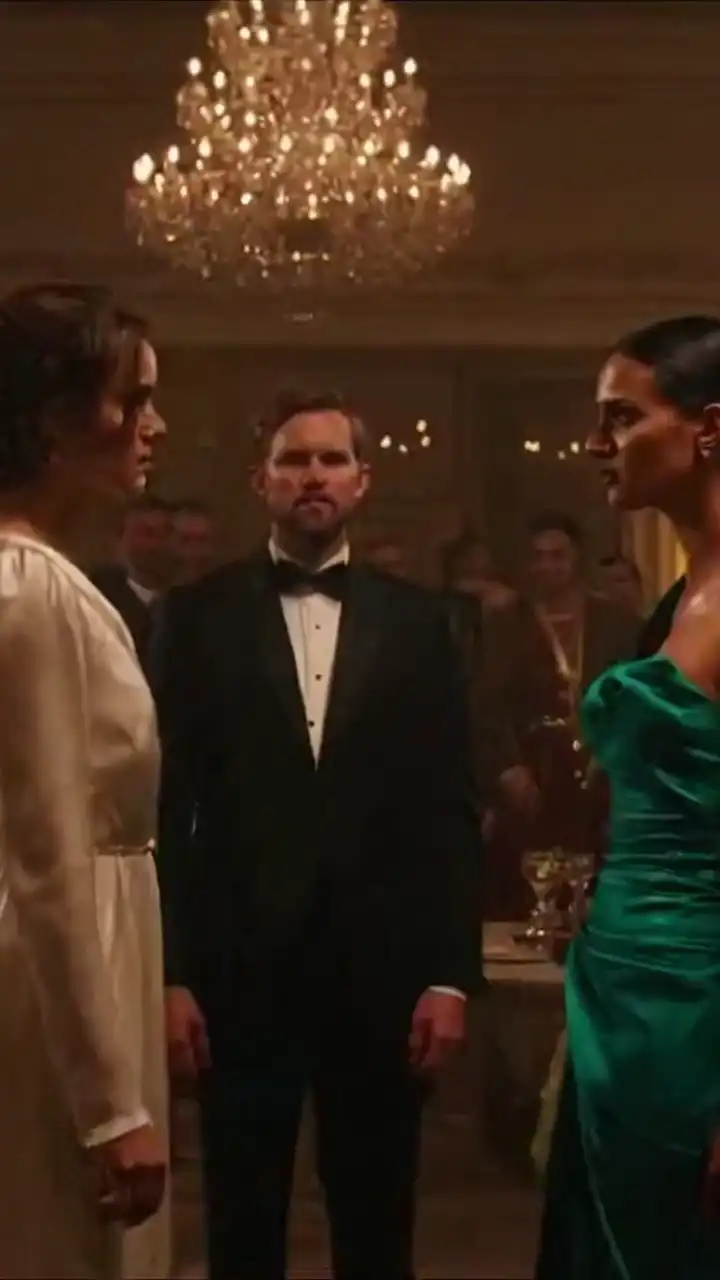
MY HUSBAND USED MY MONEY, GOT ENGAGED TO HIS MISTRESS, AND STOOD THERE WHILE SHE SLAPPED ME

THE MAID OF HONOR POURED WINE ON ME AT MY BRIDAL SHOWER AFTER STEALING MY FIANCÉ. SHE DIDN'T KNOW THE ROOM WAS ABOUT TO HEAR WHAT HE'D BEEN SAYING TO BOTH OF US.

THE MAID OF HONOR POURED WINE ON ME AT MY WEDDING AND CALLED ME CRAZY. SHE FORGOT I STILL HAD THE VOICE NOTE SHE SENT MY FIANCÉ.