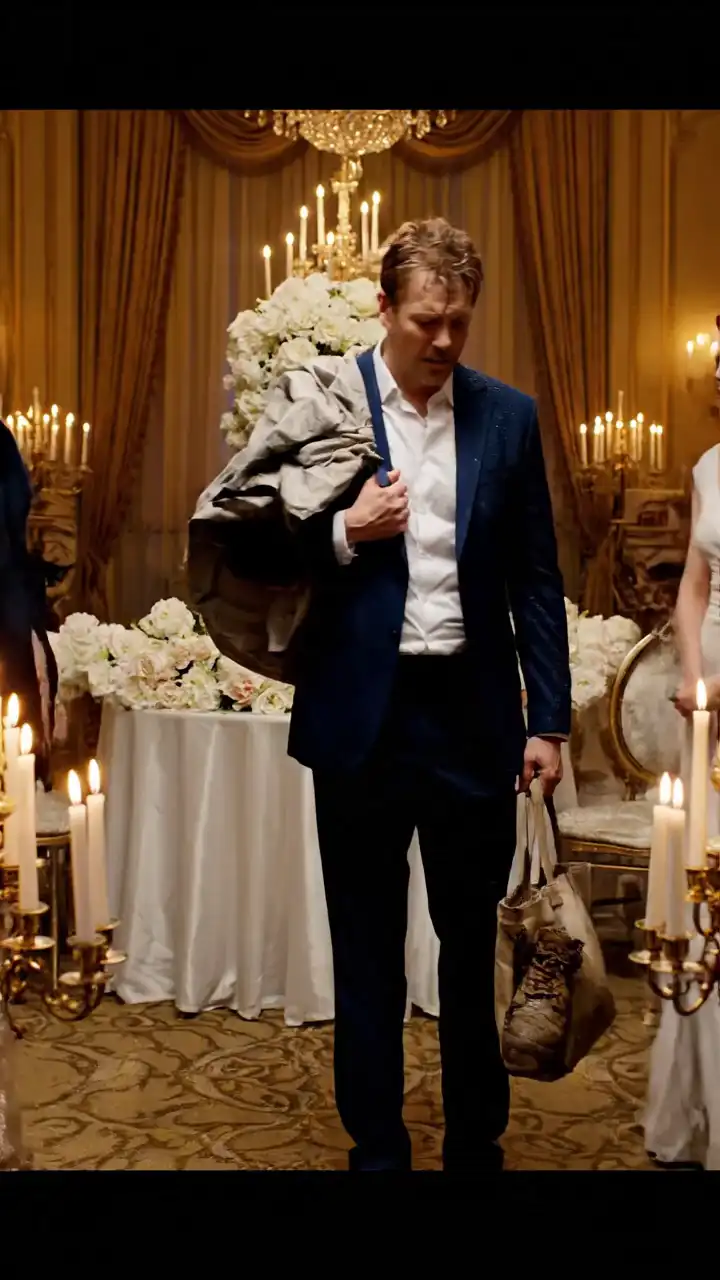
THEY TRIED TO THROW MY HUSBAND OUT OF THE WEDDING UNTIL MY DAUGHTER OPENED HIS BAG
Chapter 1
“Sir, you need to leave. Now.”
The music in the ballroom kept playing as if nothing had happened. A string version of some pop song drifted through the white roses and gold candles while forty, maybe fifty heads turned in the same slow wave toward my husband.
Eli Mercer stood just inside the doorway of the Blackthorn Event House, still holding the wrinkled garment bag that had slipped off his shoulder. His suit was clean but old, pressed too carefully, the cuffs a little shiny from wear. Rain darkened the shoulders where he’d run in from the parking lot. He looked like what my family had always decided he was before he ever opened his mouth: a man who didn’t belong in rooms like this.
My aunt Rowena, the bride’s mother and self-appointed ruler of every oxygen molecule in the room, had her hand lifted toward security without even looking at them.
“I said he is not on the seating list,” she snapped. “And if he’s here to ask for money again, do it somewhere else.”
A few people gasped softly, but nobody corrected her.
My face went hot so fast I thought I might faint. “He’s my husband.”
Rowena turned to me in that slow, elegant way rich women do when they want their contempt to look calm.
“Lenna,” she said, smiling with only her mouth, “you were told to come alone. We made room for you because of your mother. Do not make this ugly.”
Ugly. As if Eli had brought the weather in with him.
At my side, my seven-year-old daughter Mara squeezed my fingers so hard it hurt. She was in the pale green flower-girl dress I’d hemmed myself on our kitchen table in Jasper Mill. Her curls were already coming loose. She looked from Rowena to Eli, confused and frightened.
“Why are they mad at Daddy?” she whispered.
No one answered her.
Two men in black suits moved toward Eli. One was young and stiff-backed, the other older with tired eyes and a gold nameplate that said CLAY DORSEY. Eli didn’t step backward. He never did. That was one of the first things I loved about him. Not that he was loud. He wasn’t. But he had a quiet way of staying in place, even when humiliation was trying to push him out of the room.
“I’m not here for trouble,” he said. His voice was low, almost swallowed by the violins. “I came for my wife.”
“You should have respected the family’s wishes,” Rowena said.
The nearest tables had gone silent. Crystal glasses paused halfway to painted lips. My cousin Belle, the bride, stood frozen near the flower arch, one hand still wrapped around her bouquet. Her new husband, Trevor Wynn, leaned in to say something to her, but his eyes were fixed on Eli like he was worried poverty might be catching.
I stepped forward. “If he leaves, I leave.”
That stirred more whispers than Rowena’s insult had.
My mother, Patrice, sitting three tables back in a lilac jacket she couldn’t really afford, gave me a small warning look. Not because she sided with them. Because she knew exactly what this family was capable of when embarrassed in public.
Rowena folded her hands. “Don’t be dramatic. We all know you’ve had a difficult few years. That does not give your husband the right to turn up uninvited in work boots.”
Eli looked down. He had changed into dress shoes in the car. But his boots were peeking out of the half-zipped tote bag at his feet, muddy from the drive.
That was all they needed.
The younger guard took another step. “Sir.”
Mara suddenly let go of my hand and ran to Eli.
The whole room inhaled.
She wrapped both arms around his leg and pressed her cheek against his damp trousers. “Don’t make my daddy go.”
That sentence landed harder than any shout could have. Even the violins faltered into their next note.
Eli set the garment bag down and touched the back of her head. “It’s okay, baby.”
“No,” she said, louder now, turning her wet face up to the adults around her. “It’s not.”
I saw cameras lift. Not from the hired photographer, but from relatives. People who would later pretend they hated scenes like this while saving every second of them to their phones.
Rowena’s expression tightened. “Someone remove the child.”
I stared at her, and something in me tore clean through. “You will not talk about my daughter like that.”
The older guard, Clay, stopped and looked at Rowena, then at Eli, then at Mara. His jaw moved like he was biting back a thought.
Eli bent, trying to pry Mara gently loose. “Sweetheart, let Mommy hold you.”
But Mara was crying too hard now. “I brought your lucky thing.”
She reached for the old canvas shoulder bag Eli had brought in from the truck. It had been with us through moves, layoffs, bad apartments, and the months when every bill looked like a threat. The zipper was broken on one side. Its bottom sagged. It was the kind of bag rich people noticed only to judge.
Mara tugged at it with both hands. “I put it in there.”
“Honey, not now,” I whispered.
She was already digging inside, small fingers moving past folded papers, a lunch container, a flashlight, and the wrapped heel of a loaf of bread he’d picked up for home on the way.
Then she frowned. “It’s under.”
The bag tipped.
Something round and bronze slid free from beneath a stack of work gloves and dropped onto the polished floor with a sharp metallic clink that cut right through the room.
Every eye fell to it.
It wasn’t shiny anymore. It had been pressed under too many ordinary things for too long. But the blue ribbon attached to it was still visible, and the engraved seal on its face caught the chandelier light.
Eli went still.
I knew that stillness. It meant a part of his life he never volunteered was about to be dragged into daylight.
Mara picked it up with both hands. “See? Daddy’s medal.”
No one moved. No one spoke. The photographer, who had been crouched by the cake table, slowly lowered his camera as if instinct had told him this wasn’t wedding material and was somehow more important than wedding material.
Rowena’s voice came first, thin and irritated. “What is that supposed to prove?”
Eli held out his hand to Mara. “Baby, give it to me.”
But she looked up at the room, at all those dressed-up strangers and blood relatives and careful smiles, and in the innocent cruelty of a child who doesn’t yet understand what adults hide, she asked the question that split the evening open.
“If Daddy is nobody, why does he have a hero medal?”
Chapter 2
You could hear the air-conditioning again.
That’s what I remember most after Mara’s question. Not music. Not conversation. Just the low steady hum in the ceiling and the tiny sound of Rowena’s bracelets slipping down her wrist as she crossed her arms.
Eli took the medal from Mara and closed his fingers over it so quickly you’d think it might burn him.
“It’s nothing,” he said.
I knew that answer too. He had used it for years whenever the past tried to lift its head. It’s nothing. Old stuff. Doesn’t matter. He said it when nightmares woke him. He said it when loud backfires made his shoulders jerk. He said it when Mara once found a scar along his ribs and asked if he’d been bitten by a dog.
Clay, the older guard, didn’t move closer now. He looked at the medal instead. “Sir,” he said, more carefully than before, “may I see that?”
“No,” Rowena cut in. “This is absurd. We are in the middle of a reception, not a street performance.”
I had spent thirty-two years watching my family protect appearances with the energy some families reserve for love. They could ignore grief, debt, loneliness, addiction, divorce, and the dull ache of a child being less favored than another child. But embarrassment? Embarrassment was treated like a house fire.
Eli looked at me once. It was a tired look. Not ashamed, exactly. More like he was asking me whether I really wanted this door opened in front of these people.
I did not know. But I knew I was done watching them grind him down.
“Show him,” I said softly.
Rowena laughed under her breath. “Lenna, please don’t turn this into one of your rescue projects.”
One of my rescue projects.
That was how she had described my marriage from the beginning, back when Eli was doing overnight maintenance work at the paper plant and I was picking up shifts at Holcomb Pharmacy while trying to keep Mara in shoes that fit. In Rowena’s mind, love only counted if it rose in value socially.
Eli opened his hand.
Clay took the medal with the caution of someone handling something official. He turned it over, squinting under the ballroom lights. His face changed in a way so slight most people missed it. I didn’t.
“What is it?” the younger guard asked.
Clay didn’t answer right away. He was reading the back.
A few guests had started to stand now. Curiosity had outranked manners. Trevor’s father, Vaughn Wynn, with his silver hair and country-club tan, drifted closer holding a tumbler of bourbon. “If there’s a security issue,” he said, “handle it outside.”
“It is being handled,” Rowena replied, though her voice had lost some of its polish.
Belle stepped toward me then stopped, bouquet still in hand. We hadn’t been close in years, but we’d once shared a bunk bed at our grandmother’s lake cabin and whispered about leaving this family’s coldness behind. Now her face looked trapped between pity and fear. “Lenna,” she murmured, “why did he come if he knew—”
“He came because I asked him to,” I said.
That was true, though not the whole truth. I had asked him to come because the invitation had only my name on it, and after ten years of marriage I was tired of attending family events like I had no household of my own. Eli had resisted. He’d said, “It’s your cousin’s day. Don’t hand them a reason.” But that morning, after Mara helped knot his tie and said, “You look wedding handsome,” he gave in.
Clay handed the medal back to Eli. “Sir, where did you receive this?”
Eli’s jaw set. “I told you. It doesn’t matter.”
“It matters if it’s military.”
That made three older men at the nearest table straighten at once. One of them, Uncle Deacon’s friend Hal Brees, who never stopped talking about his own years in the reserves, took two steps forward. “Military?” he said. “Let me see.”
Rowena put a hand up. “No. Enough. This man was not invited.”
“This man is my husband,” I said again, stronger this time.
Mara had quieted, but tears still clung to her lashes. She looked at the adults like she was trying to solve a puzzle whose pieces kept changing shape. “Daddy fixed the bridge man,” she said.
I blinked. “What?”
She pointed to the medal. “The one in the newspaper box. At the diner. He was holding a man.”
Eli closed his eyes for one second.
And suddenly I remembered.
Three months earlier, at Della’s Diner in Jasper Mill, Mara had pulled an old local paper from the rack near the register because she liked the crossword on the back. I had been paying for pancakes. Eli had taken the paper from her too quickly, folded it, and tossed it into the recycling bin by the coffee station. I thought nothing of it. We were late. Life was always full of small unexplained motions.
Now I looked at him with a strange chill running through me.
“What paper?” I asked.
“Nothing,” Eli said.
But things were moving now beyond his control. Hal Brees had his phone out already, thumbs working fast. Clay’s expression had sharpened into something like respect mixed with disbelief. The younger guard looked from one face to another, no longer sure who the problem was.
From the back of the room, my younger brother Nolan spoke for the first time all evening. Nolan was the family’s perennial extra chair, the one no one assigned importance to unless they needed a ride or a favor. He had come in a brown suit that fit badly and spent most of the reception carrying gift boxes because nobody had given him a real role.
“I know what it is,” he said.
Heads turned.
Nolan lifted his chin toward Eli’s canvas bag, still gaping open on the floor. “I saw that medal before. At Mom’s place after the storm when Lenna and Eli stayed there one week. It got buried under a bunch of stuff in the hall closet. I picked it up and he took it from me.”
My mother looked startled. “Nolan, I didn’t know that.”
“Most people don’t know stuff if they don’t ask,” he muttered.
That was the kindest accusation anyone in our family had earned in years.
Rowena was losing control of the room, and she knew it. “This is grotesque,” she said. “Belle, Trevor, step away from this. Clay, do your job.”
Clay did not move.
Instead he said, “Ma’am, with respect, I’m trying to.”
Then the ballroom doors opened again.
A woman in navy slacks and a damp trench coat hurried in with a man carrying a hard camera case. They looked windblown and out of place among the satin gowns and champagne towers. The woman scanned the room once, spotted Eli, and stopped so abruptly the man behind her nearly walked into her.
“There he is,” she said.
Eli went pale.
The man beside her lifted his camera by reflex. “Mr. Mercer?”
I felt Mara press into my side.
Rowena stared. “Who are these people?”
The woman stepped forward, catching her breath. “Dana Kessler, Midstate Ledger. We’ve been trying to locate Mr. Eli Mercer for two weeks.”
A noise moved through the guests like a low electrical current.
Eli’s hand clenched around the medal.
“I’m not doing this here,” he said.
Dana looked around at the floral arrangements, the staring faces, the bride in ivory silk, and seemed to understand all at once that she had walked into the center of someone else’s disaster. “Sir,” she said quietly, “I’m sorry. But we were told you might be with your wife’s family tonight.”
“My wife’s family doesn’t claim me,” Eli said.
Nobody had a good answer to that.
Chapter 3
If shame had a temperature, the ballroom shifted by several degrees.
Dana Kessler lowered her voice, but not enough to keep the front half of the room from hearing. “Mr. Mercer, the state veterans office confirmed your name after we filed our records request. We’ve been trying to speak with you about Sergeant Luis Tovar.”
At that name, Eli looked as if someone had struck him in the chest.
Not many people in that room recognized it. I did not. But I knew enough now to stay silent.
The cameraman did not raise the lens. To his credit, he watched Eli’s face and seemed to understand there were moments a camera could steal and moments it should leave alone.
Rowena, of course, heard only one thing. “Veterans office?” she repeated. “What does that have to do with my daughter’s wedding?”
Dana turned to her with the professionally neutral expression of someone used to difficult people. “Ma’am, I’m not here about the wedding.”
“You are now.”
Belle whispered, “Mom, please.”
Trevor put a possessive hand at the small of Belle’s back and guided her a step away from us, as if human discomfort traveled by contact.
I hated him for that more than I hated Rowena’s cruelty. Rowena was open ice. Trevor was polished cowardice.
Dana looked back at Eli. “Sergeant Tovar’s son found your name in archived testimony. He’s been looking for you.”
Eli’s eyes dropped to the medal again. “He shouldn’t.”
“Why not?” Mara asked in that clear child voice that made adults wish they could edit the world before it reached her.
He crouched down to her level. “Because some things are hard, baby.”
She touched his sleeve. “You look sick.”
“I’m okay.”
He wasn’t.
I had seen Eli exhausted, frustrated, and heartsick. I had seen him grin through a broken alternator and laugh in the middle of an eviction notice because panic would only scare Mara. But I had almost never seen him afraid.
“Tell me what’s happening,” I said.
For a second I thought he might refuse. Then he stood, stared past me at the iced sculptures, the draped linen, the family who had always measured human worth in visible comfort, and he gave me the truth in the plainest words.
“I was Army,” he said. “A long time ago.”
It felt ridiculous that this shocked me. We had been married ten years. We had survived layoffs, a miscarriage, my father’s funeral, rent increases, and the mold in the apartment on Pritchard Street. But there are people who survive by chopping their lives into rooms and locking certain doors. If you love them, sometimes you start helping without meaning to. You stop asking because you can feel the bruise under the answer.
“How long?” I asked.
“Before you.”
“Why didn’t you tell me?”
“I told you I served.”
“You said you enlisted at nineteen and got out hurt.”
“That was true.”
The problem with partial truth is how clean it sounds when spoken aloud. It can sit in a marriage for years looking almost like honesty.
Dana glanced at me with sympathy. “Ma’am, your husband was recommended for the Valorous Service Medal after an explosion outside Khost. There was a vehicle collapse and—”
Eli cut in. “Stop.”
His voice cracked for the first time all evening.
Dana stopped.
The room was utterly still now. Even Rowena understood, on some primitive level, that society rules had collided with a larger kind of reality. She just didn’t yet know which parts of her earlier behavior were already becoming unforgivable.
Hal Brees spoke up, softer than before. “You were decorated?”
Eli’s laugh held no humor. “That’s one word for it.”
Nolan had come over to stand by my mother. He looked at Eli not like an intruder, not like a spectacle, but like a man studying another man who had been carrying something too heavy in silence. “Is that why you keep that thing hidden?”
“I keep it hidden because medals don’t bury people,” Eli said.
No one had an answer for that either.
Dana waited, then tried again. “Sergeant Tovar died six months after the blast. His son Mateo found old letters and internal reports among his mother’s things after she passed. Your name came up over and over. He says his father always believed you saved his life first and were denied proper recognition for what happened after.”
A denial of recognition. A state records request. Archived testimony. Hidden medal. Suddenly this wasn’t some sentimental story about a man who once did something brave and forgot about it. Something had gone wrong. Something official. Something unfinished.
Clay, the security guard, took off his earpiece and slipped it into his jacket pocket as if he no longer wanted to represent the room’s first judgment.
Rowena was still trying. “I fail to see what any of this has to do with his behavior tonight.”
“My behavior?” Eli said, finally turning his eyes fully on her.
It was not a loud look. That made it worse.
He did not raise his voice. He just said, “I walked into a wedding with dry-cleaned cuffs and a gift my daughter picked out with five dollars of birthday money. Your people called security before I took three steps.”
The shame in the room shifted direction.
Mara looked up at me. “Did they think Daddy was bad?”
I swallowed. “They were wrong.”
But a child can hear weakness in the words adults use to soften things. She turned to Rowena and asked, “Did you think he was trash?”
Gasps again. Real ones this time.
My mother covered her mouth. Nolan looked at the floor, maybe to hide the flash of satisfaction crossing his face. Belle shut her eyes.
Rowena drew herself up. “I will not be interrogated by a child.”
“She’s seven,” I said. “And she already knows what kind of room she’s standing in.”
Trevor stepped in then, trying to reclaim authority. “This has gone far enough. Whatever he did years ago doesn’t change the fact that this is a private event.”
Dana spoke before I could. “A private event where a veteran was publicly humiliated based on his clothes and assumptions.”
“That is not your concern,” Trevor said.
“It becomes my concern if this turns into a story about local charitable families and how they treat people they think have less.”
That landed.
The Wynns had their name on hospital wings and scholarship dinners. Rowena’s whole spine reacted to the possibility of bad press.
I hated myself a little for noticing. Because in that instant the room’s moral center didn’t wake up from kindness. It woke up from fear.
Eli saw it too. I could tell by the way his mouth tightened.
He reached down for the canvas bag. “Lenna, get Mara. We’re leaving.”
“No,” I said.
He looked at me sharply.
“You came here for me,” I said. “I’m not letting you walk out like they were right to send you.”
His eyes softened, then darkened again with old pain. “You can’t fix this.”
“Maybe not. But I can stand here.”
Before he could answer, Nolan bent and picked up a flattened gift envelope that had fallen from the bag with the other things. Under it was a folded newspaper clipping, yellowed and worn at the seams. He held it open.
“I think this is him,” Nolan said.
He had no instinct for timing, no tact, and for once those defects were gifts.
We all leaned toward the clipping.
The photo was grainy, cropped from some regional paper. Smoke, wreckage, men in fatigues. One soldier half-kneeling in the dirt with another man slumped against him. The kneeling man’s face was younger, sharper, dirt-streaked, but it was Eli.
Below the photo, the headline read: LOCAL SOLDIER CREDITED IN DESERT RESCUE.
The article had been folded so many times the center split was nearly white.
Mara touched the picture with one finger. “That’s the bridge man.”
Not a bridge, I realized. Debris. Twisted steel. In a child’s memory, ruin became the nearest shape she knew.
Belle stepped closer despite Trevor’s hand. “Why would you keep that in your bag?”
Eli answered without looking up. “To remember what newspapers get wrong.”
Chapter 4
The minute Eli said that, I knew the story was larger than a medal.
The room knew it too.
Dana Kessler took one careful step forward. “Mr. Mercer, if there was an error in the reporting, that’s exactly why we need to talk to you.”
He shook his head. “No. You need someone clean. Someone who can tell it straight without the dead getting dragged through it.”
“You think silence protects them?” Dana asked.
For the first time all evening, a little anger lit in his face. “Sometimes it does.”
I looked at the clipping again. The article named him, named Sergeant Luis Tovar, mentioned an ambush, praised “improvised courage under fire,” and ended with a quote from a spokesman saying official review was ongoing. It had the polished incompleteness of a public statement designed to close a door, not open one.
“Eli,” I said quietly, “what was wrong?”
His throat worked.
Then a voice I didn’t know spoke from the ballroom entrance.
“Everything after the blast.”
We all turned.
A young man stood there in a dark suit gone damp at the shoulders, maybe twenty-four, twenty-five. He had the same stunned look people wear when they arrive at a place they’ve built up in their mind for years and discover it full of strangers. His hair was clipped close. In his hand he held a manila folder swollen with papers.
Dana exhaled. “Mateo.”
He nodded once, eyes fixed on Eli. “I’m sorry. They told me I might miss you if I didn’t come now.”
Eli looked like he wanted to vanish.
Mateo took another step. “You don’t know me. I’m Luis Tovar’s son.”
Some names change a room more than any confession. This one did.
No one from my family moved. Their social confidence had curdled into spectatorship. They no longer knew which role to perform.
Eli set the canvas bag down again, almost carefully, as though his hands had forgotten how to grip. “You shouldn’t have come.”
Mateo’s answer was simple. “I had to.”
He held up the folder. “My mother died last fall. In her things, I found letters from my father, copies of statements, and one note with your name underlined three times.”
Mara whispered, “Who is he?”
I knelt beside her. “Someone your daddy knew before us.”
Mateo heard that, and his face softened when he looked at her. Then it tightened again when he looked back at Eli. “My father said you pulled him out. He said you went back for another soldier after your leg was hit. He said the report blamed confusion and weather, but men were left exposed because somebody wanted the road declared secure too early.”
A few guests exchanged glances, already smelling scandal. I despised them for it. Yet I leaned in too, because this was no longer rumor. This was the architecture of Eli’s silence taking shape in public.
Trevor muttered, “This is unbelievable.”
Nolan, bless him, muttered back, “That’s because you’ve never believed much.”
I almost laughed. It came out as a broken breath.
Mateo continued, voice shaking now not from fear but from the strain of holding years together. “My father wrote that you testified. Then you disappeared.”
“I was discharged,” Eli said.
“That’s not the same thing.”
“No,” Eli said. “It wasn’t.”
Dana looked between them. “We obtained part of the review file. Testimony was redacted. We think the case was buried after an officer transfer and a settlement related to equipment failure. But Sergeant Tovar’s letters suggest there were men whose actions were minimized because acknowledging them would have reopened command responsibility.”
Even in my ignorance, the meaning was clear enough. Someone higher up had needed the story tidied. Tidied stories leave people behind.
Hal Brees looked stricken now, his earlier swagger gone. “Son,” he said to Eli, “is that true?”
Eli’s eyes stayed on Mateo. “Your father should have let it die.”
Mateo’s face changed then, grief surfacing under determination. “He tried. But he never forgot you. He wrote that you sat with him in Germany after surgery because he couldn’t sleep with the morphine dreams. He wrote that when the review board came, you told the truth even when your own sergeant warned you not to. He wrote that after, people treated you like the problem.”
There it was. A sentence plain enough for everyone.
People treated you like the problem.
That sentence fit Eli’s whole life with us too neatly. Every job he’d lost after refusing unsafe shortcuts. Every landlord who liked him until he questioned mold, wiring, leaks. Every foreman who called him difficult when all he meant was careful. I had mistaken some of that for bad luck. Maybe some of it was. But maybe the habit had started much earlier: tell the truth, pay for it.
My mother stood slowly from her chair. “Lenna,” she said, voice thin, “why didn’t you know any of this?”
I didn’t answer because the real answer shamed me too. Love does not automatically make people brave enough to ask the right questions.
Rowena still found a way to make it about herself. “I don’t understand why this man’s private military matters are overtaking my daughter’s wedding.”
Belle turned to her then, finally. “Mom.”
Just that one word. But in it was years.
Rowena blinked. “What?”
Belle’s hands trembled around the bouquet. “He was standing at the door and you looked at his bag and his shoes and decided what kind of man he was.”
Rowena scoffed. “Please. Everyone in this room saw it.”
Belle’s voice broke. “That’s the problem.”
Silence again, but this time it belonged to her.
I looked at my cousin and saw the bunk bed girl for the first time in years.
Mateo opened the folder and took out a photocopy, yellowed at the edges. “This is my father’s note.” He held it toward Eli. “You should have had this.”
Eli didn’t take it.
So Mateo read.
“If anything happens to me before they fix what they did, tell Mercer he was the only one who came back.”
No one moved. Even Rowena.
Mateo’s voice shook harder now. “There’s more. He wrote, ‘They gave him metal when they owed him truth.’”
I heard someone crying softly and realized it was my mother.
Eli took one step backward like the floor had tilted. I reached for him, but he wasn’t falling. He was trying not to.
“That’s enough,” he said.
“It’s not enough,” Mateo said. “It was never enough.”
The younger guard had tears standing in his eyes. He turned away fast, embarrassed. Clay looked at Eli with the solemn stillness of one veteran recognizing another. Dana no longer looked like a reporter chasing a story. She looked like a witness to something overdue.
Mara tugged my dress. “Why are grown-ups sad?”
I brushed her hair back. “Because they were late seeing something.”
“Like when I couldn’t find the medal?”
“Yes,” I whispered. “Like that.”
Then the change no one could explain happened in the room, but it wasn’t magic. It was smaller and harder. People began to see their own reflection in what they had done.
Not all of them. But enough.
A server set down a tray with shaking hands. The photographer quietly turned his camera away from Eli and pointed it at the untouched sweetheart table, as if to mark what the evening had become. My mother crossed the ballroom and stood next to my husband, not speaking, just standing. Nolan came too, awkward and loyal and a little late like always.
For once, the right people were forming the circle.
Chapter 5
The truth landed in pieces.
It did not arrive clean and cinematic. It came through folded papers, interrupted sentences, old pain, and the faces of people realizing they had made a man defend his right to stand in a room.
Mateo handed the note to me because Eli still couldn’t take it. His fingers were trembling too much. I read the lines again, feeling the force of them deepen.
They gave him metal when they owed him truth.
Dana asked gently, “Mr. Mercer, can you tell us what happened after the blast?”
Eli stared at the floral carpet for so long I thought he wouldn’t answer. Then Mara slipped her hand into his.
He looked down at her small fingers around his rough ones, and something in him eased just enough.
“There were three vehicles,” he said. “Second one hit the pressure plate. We were told the route had been cleared, but it hadn’t been. Or not right. I don’t know. Dust everywhere. Fire. Radio confusion.” He swallowed. “Luis was trapped. Another kid too. Bannon. Nineteen.”
No one in the room shifted now. They were held by it.
“I got Tovar out first because he was conscious and screaming for the other one. Then I went back.” He touched his thigh as if his body still remembered the wound before his mind chose to. “Shrapnel hit me climbing in. I got Bannon halfway clear. Then the rear axle gave.”
Mateo listened with his mouth pressed tight.
“The report said weather and visibility contributed. That was convenient. What contributed was someone wanting the road open on schedule.” Eli’s eyes had gone flat in that distant way trauma makes possible. “I told the board what I saw. Our platoon sergeant told me to keep it simple. Said nobody wanted to hear about maintenance logs and ignored warnings. I didn’t keep it simple.”
Dana said, “And after?”
“They pinned that on me three months later.” He lifted the medal slightly. “Small ceremony. Handshake. Then reassignment paperwork. Then medical discharge. The kind where nobody says you’re trouble out loud, but doors close anyway.”
Clay asked, quiet as a confession, “Retaliation?”
Eli gave one sharp nod.
There it was.
The hidden truth was not only bravery. It was the cost of it.
My aunt Rowena had humiliated a man already shaped by a deeper betrayal. She had seen old shoes and a cheap bag and assumed failure. But what she was really looking at was the long afterlife of doing the right thing in the wrong system.
I turned toward her before I even knew I meant to.
“He didn’t come here to ask for money,” I said. “He came here wearing the only suit he keeps pressed for funerals, school programs, and holidays. He brought a gift. He stood at your door and let you insult him in front of his child because he didn’t want to ruin Belle’s day.”
Rowena’s face hardened, but fear flickered under it now. “I acted to protect my family.”
“No,” Belle said.
All eyes went to her.
She had set down her bouquet at last. Her hands looked bare without it.
“You acted to protect your comfort,” Belle said. “You always do.”
Trevor whispered, “Belle.”
She ignored him. “You looked at Lenna’s husband and saw a problem because he wasn’t polished enough for your pictures.”
Rowena’s voice went cold. “This is not the time.”
“It should have been time years ago.”
Trevor reached for Belle again, and this time she stepped away from him too.
That movement told another story, but not one for tonight.
My mother put a hand over her heart. “Rowena,” she said, tears finally falling without shame, “the man was standing there with our child holding him and you called security.”
Rowena answered with the last refuge of people like her: technical correctness. “He was not invited.”
Eli’s laugh was soft and bitter. “There it is.”
Technical correctness. The clean language of moral failure.
Mara looked at Rowena with grave concentration. “You can still say sorry.”
It was the simplest line in the room, and maybe the strongest.
Rowena’s mouth opened. Closed.
She could not do it.
That, more than anything, finished her.
Dana glanced at me as if asking permission with her eyes before saying the next part aloud. “Mr. Mercer, the veterans office intends to issue a formal correction and public commendation. Sergeant Tovar’s son pushed for the review. Several men from your unit gave late statements after the file reopened.”
Eli looked stunned. “Why?”
Mateo almost smiled through his grief. “Because my father wasn’t the only one who remembered.”
He took another paper from the folder and handed it to Eli. This time Eli accepted it.
It was a printed letter with official seals and signatures. I couldn’t read all of it from where I stood, but I saw the words REVIEW FINDINGS and ACTS OF EXTRAORDINARY COURAGE and ADMINISTRATIVE FAILURES.
Eli read in silence.
Then he sank into the nearest chair as if his knees had suddenly become negotiable. Mara climbed into his lap without asking. He wrapped one arm around her and kept reading with the other hand.
I watched his face move through disbelief, grief, anger, and something gentler I had almost never seen there.
Relief can look like sorrow when it arrives late.
Mateo spoke carefully. “There’s going to be a ceremony next month in Briar Glen. They want you there. My father wanted your name said right before he died. I can’t fix what happened. But I can come find you.”
Eli looked up, eyes red now. “Your father was a good man.”
“I know.” Mateo’s own eyes shone. “He said you were too.”
The ballroom had become unbearable in a new way. Not because of conflict. Because the truth had made the chandeliers, the linens, the expensive flowers all seem paper-thin beside what had just been uncovered.
Nolan bent to gather the things that had spilled from Eli’s bag. Work gloves. Bread. Flashlight. Newspaper clipping. The ordinary life wrapped around the hidden medal. He handled each item with almost ceremonial care. Then he paused and held up the gift Eli had brought for the wedding, still in silver paper but dented at one corner.
“What is this?” Nolan asked.
Mara answered proudly. “A bowl.”
“For what?”
“So when they have candy, people can share.”
The room nearly broke me then.
A five-dollar glass bowl from the discount shelf at Ravel’s Market, chosen by a little girl who thought weddings were about sharing.
Belle covered her mouth and began to cry.
I went to Eli and knelt in front of him. “Why didn’t you tell me all of it?”
He looked at Mara’s curls against his chest. “Because when people know one brave thing about you, they expect strength forever. I was tired, Lenna. I was tired of being measured against the best minute of my life and the worst one right after.”
I touched the medal in his hand. “So you buried it.”
“Under lunch boxes and tools and bills. Where it belonged.”
“No,” Mateo said gently. “Where they taught you to put it.”
Eli looked at him then with the strange tenderness of one wounded person being seen by another.
And in the middle of my cousin’s lavish reception, with all the families and donors and polished shoes standing around us, the real poverty in the room was finally visible.
Not ours.
Theirs.
Chapter 6
We did not stay for dinner.
No one asked us to. Not because they wanted us gone anymore, but because the wedding had cracked open and everybody knew it could never slide back into polite choreography.
Before we left, Belle came to me in the side hallway near the coat room, where the light was softer and the music sounded far away.
She had taken off her veil. Without it she looked younger, closer to the girl I remembered.
“I’m sorry,” she said.
“For what?”
“For standing there too long.”
That was honest enough to hurt. I nodded. “I know.”
She looked past me at Eli, who was helping Mara into her cardigan. “Your husband deserved better.”
“Yes,” I said. “He did.”
Belle swallowed. “So did you.”
Maybe. But that wasn’t the sentence that stayed with me.
The one that stayed came a minute later, when my mother shuffled over, dabbing at her face with a linen napkin she’d somehow carried out from the ballroom.
She stood in front of Eli with all the frailty pride can hide until it’s too late.
“I judged you too,” she said. “Not like Rowena. But quietly. Which may be worse.”
Eli shook his head once. “It’s done.”
“No,” she said. “That’s the lie older people tell when they don’t want to face themselves.”
For once, my mother sounded braver than her life had allowed her to be.
She touched Mara’s cheek. “That child saw what the rest of us refused to see because she wasn’t looking for status. She was looking for her father.”
After that, nobody said much. Some truths don’t need decorations.
Outside, the rain had stopped. The parking lot behind Blackthorn Event House glistened under the lamps. Wet magnolia leaves stuck to the pavement. Eli carried the canvas bag over one shoulder and Mara on the other hip, though she was getting too big for it. She leaned against him, half asleep, one hand still curled near his collar.
I walked beside them toward our truck.
Behind us, the ballroom lights glowed gold through the tall windows. You could see silhouettes moving inside, trying to salvage the night, rearrange tables, restart music, continue the script.
Maybe they did. Maybe they didn’t.
At the truck, Eli stood for a moment without unlocking it.
“You’re quiet,” I said.
He gave a tired smile. “I’ve been quiet for a long time.”
“That’s not what I mean.”
He looked up into the damp dark. “I don’t know what to do with being found.”
I took the medal from where it stuck out of the open bag. The ribbon was creased. The bronze was dull. It had been under bread and gloves and unpaid-life objects because the man who earned it had learned that institutions honor courage more easily than people protect the person carrying it.
I slid the medal gently into the inside pocket of his jacket.
“Then don’t do anything tonight,” I said. “Just let it be true.”
He closed his hand over the pocket.
Mara stirred and mumbled, “Daddy stays.”
Eli kissed her hair. “Yeah, baby. Daddy stays.”
On the drive back to Jasper Mill, she fell fully asleep between us in the front bench seat, her flower-girl skirt wrinkled, one shoe missing glitter onto the floor mat. The road was dark and wet and ordinary. So was the truck heater that only worked on the highest setting. So were the grocery bags in the back and the bowl still wrapped in silver paper.
For a while we said nothing.
Then Eli spoke into the windshield. “When they pinned that medal on me, one colonel said, ‘This should help.’ Like honor was a bandage. Like recognition could replace what truth would have cost them.”
I reached for his hand across the seat. “Did it help?”
“No.” He looked at me. “But you did.”
It wasn’t a grand line. That’s why I believed it.
A week later, Dana Kessler’s story ran on the front page of the Midstate Ledger. It was careful and documented and impossible for the right people to ignore. The formal review was announced. Old statements surfaced. Names were corrected. The town of Briar Glen scheduled a ceremony. Mateo called twice just to ask if Eli had eaten, which made Eli laugh in spite of himself.
As for my family, the wedding photos that circulated online were beautiful and expensive and faintly haunted. In half of them, you could see people smiling with the strange stiffness of those who know something happened just outside the frame that money cannot retouch.
Rowena never apologized.
That became its own answer.
Months later, when people talked about that wedding, some still focused on the scandal, the interruption, the newspaper, the near-disaster of reputation. But that was not what I remembered.
I remembered my daughter on a polished ballroom floor, hugging her father’s leg while strangers judged his shoes.
I remembered a medal falling out of a tired canvas bag.
I remembered how fast a room can mistake poverty for shame and how slow it can be to recognize dignity when it arrives wearing the wrong coat.
And I remembered the truth that stayed after everything else settled:
Being poor can wear a person down. Being overlooked can scar them. Being betrayed can hollow out whole years.
But coldness—steady, polished, respectable coldness—is worse.
Poverty can be survived.
Cold hearts are what throw human beings away.
Disclaimer: Mention of any brand or trademark is for identification only and does not imply partnership or endorsement
MY HUSBAND USED MY MONEY, GOT ENGAGED TO HIS MISTRESS, AND STOOD THERE WHILE SHE SLAPPED ME
THE MAID OF HONOR POURED WINE ON ME AT MY BRIDAL SHOWER AFTER STEALING MY FIANCÉ. SHE DIDN'T KNOW THE ROOM WAS ABOUT TO HEAR WHAT HE'D BEEN SAYING TO BOTH OF US.
THE MAID OF HONOR POURED WINE ON ME AT MY WEDDING AND CALLED ME CRAZY. SHE FORGOT I STILL HAD THE VOICE NOTE SHE SENT MY FIANCÉ.