THE MAN IN THE WHEELCHAIR THEY TREATED LIKE TRASH KNEW WHY THE OLD WOMAN KEPT CRYING
Chapter 1
They made him pick up pills off the floor while everyone watched.
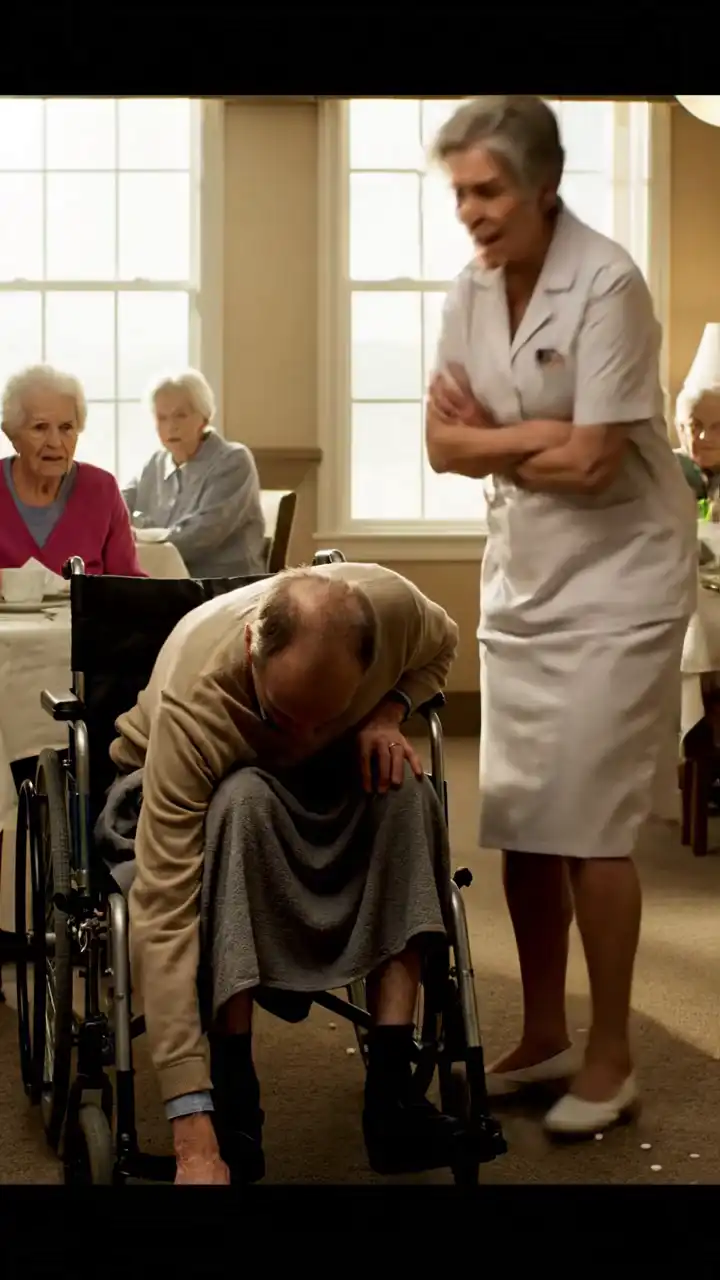
The lunch bell had barely stopped ringing at Cedar Hollow Residence when I saw the orange paper cup bounce across the dining room tiles and scatter little white tablets under three different tables. A spoon clattered. Chairs squeaked. Half the room went quiet in that ugly, alert way people do when they smell trouble and know it does not belong to them.
The man in the wheelchair froze with one hand still on the tray in his lap.
“Pick them up, Mr. Vale,” Nurse Patrice said, loud enough for the whole room. “You dropped them.”
He looked at the pills, then up at her. He could not have been much older than fifty, which made him look even stranger in a room full of residents in their eighties and nineties. His legs were thin under a gray blanket. His left hand shook against the tray. The right one hardly moved at all. His jaw tightened, but he did not answer.
I had only been at Cedar Hollow three days, filling in as activities coordinator while the regular one recovered from surgery. I still had my clipboard in hand. I still believed there had to be some explanation for everything.
Patrice folded her arms. “We’re waiting.”
A few residents lowered their eyes. One old man at the corner table kept chewing like nothing was happening. But Miss Arlene Bixby, who always wore a pink cardigan no matter the weather, began twisting her napkin so hard I thought it might rip.
Mr. Vale bent forward.
It was painful to watch. His wheelchair footrests caught on the tile. His weak hand slipped on the edge of the table. He reached once, missed, reached again, and one pill rolled farther away under another resident’s walker.
Patrice sighed like this was an inconvenience she had suffered personally.
“If you can make a mess,” she said, “you can clean it.”
His voice came out rough and low. “I need the grabber.”
“You had it yesterday. You threw it.”
A tiny sound came from Miss Arlene. Not a word. More like a swallowed gasp.
I stepped forward before I could think better of it. “I can get those.”
Patrice turned to me with a smile so thin it looked painted on. “Staff needs to let residents maintain responsibility, Ms. Weller.”
I had heard that tone before in offices and schools and family courts. It was the voice people used when they wanted power to sound like policy.
The man in the wheelchair kept reaching. His face was red now. One pill crushed under his palm and left a chalky streak on the tile. Behind him, two visitors near the coffee station had stopped talking. One of them, a woman in a navy suit with a leather briefcase, took one sharp step toward the scene, then stopped dead. Her whole face changed, as if she had walked into a room from twenty years ago and found it still waiting for her.
Miss Arlene whispered, “Don’t make him.”
No one answered her.
Patrice crouched just enough to get near Mr. Vale’s face. “Are you refusing a direct instruction?”
He stopped moving.
It took a second for me to understand what had happened. His breathing had changed. Fast, shallow, trapped. His shoulders were locked. His eyes were fixed on the pills under the table like he was not seeing pills at all.
The woman with the briefcase dropped to one knee beside him before anyone else moved.
“Hey,” she said softly. “Look at me.”
Patrice snapped, “Ma’am, you can’t interfere with care.”
The woman did not even look up. “I’m not interfering. I’m preventing harm.”
Mr. Vale still stared at the floor.
The woman put her briefcase aside and spoke like someone trying not to startle a wounded animal. “You don’t have to touch the floor. Do you hear me? You don’t have to touch the floor.”
His lips parted. No sound came out.
Miss Arlene began to cry.
It was not loud crying. It was the kind that frightened me more because it sounded old, practiced, and immediately ashamed of itself.
The whole room had gone still now. Even the TV mounted near the window seemed too bright, too cheerful, flashing a game show no one was watching.
Patrice straightened. “Who are you?”
The woman finally stood. “Elena Firth.”
She reached into her bag and showed an ID so quickly I missed the details, but Patrice’s expression changed from irritated to cautious.
“I’m here to see my client in room fourteen,” Elena said. “And right now I’d like to know why a disabled resident is being publicly ordered onto the floor in a dining room.”
Patrice’s smile vanished. “You’re misunderstanding standard compliance procedures.”
There it was again. Power dressed up in clean words.
Mr. Vale had not moved. I crouched beside the scattered pills, ignoring Patrice now, and started gathering them with a napkin. “Someone should bring water,” I said. “And maybe his chair needs to be moved back.”
Patrice’s voice hardened. “Ms. Weller, if you’re not familiar with our resident protocols, you should not insert yourself.”
Mr. Vale finally spoke, but he was not answering her. He was looking past all of us, at Miss Arlene.
“I’m sorry,” he said.
That broke something in her.
She put both trembling hands over her mouth and whispered, “It happened again.”
I remember every small thing from that moment. The mashed peas drying on a plate near table three. The smell of bleach under the smell of chicken broth. The buzzing light above the window. The way Elena Firth looked from the pills to Mr. Vale to Miss Arlene, and then at Patrice, like she had just found the shape of something rotten.
“What happened again?” Elena asked.
Miss Arlene shook her head hard enough to make her white curls tremble. “Nothing. I said nothing.”
Patrice moved quickly then, too quickly. “Dining hour is over. Everyone back to rooms.”
That should have ended it. In places like Cedar Hollow, endings were usually decided by whoever wore the badge.
But Mr. Vale lifted his head and said, very quietly, “Her room was searched last week.”
Patrice went still.
Miss Arlene looked terrified. “No.”
He kept his eyes on the floor. “And they took the blue envelope.”
I felt the room tilt without moving. Visitors looked at each other. A nursing aide near the juice station backed away like she did not want her face attached to any of this.
Patrice said, “This resident has a history of confusion and boundary issues.”
Elena picked up her briefcase. “Good,” she said. “Then you won’t mind if I start asking questions.”
That was the moment I stopped thinking of it as an ugly scene in a nursing home dining room.
That was the moment I understood something was wrong at Cedar Hollow in a way that had already lasted longer than my three days.
And the man everyone had just watched struggle on the floor was the only person in the room who seemed to know how deep it went.
Chapter 2
By two o’clock, the story had already changed shape three times.
In the staff hallway, Nurse Patrice told anyone who would listen that Mr. Jonah Vale was manipulative, “fixated” on other residents, and prone to creating disruptions when routines did not go his way. In the laundry room, one aide whispered that he used to work in medical transport before a spinal injury, as if that explained anything. In the medication office, someone else muttered that he should have been transferred months ago because “he unsettles people.”
What unsettled them, I was beginning to understand, was not Jonah’s body or his chair. It was his refusal to pretend not to notice what the rest of the building had learned to step around.
I found him later in the sunroom at the end of Maple Wing. A fake ficus tree leaned toward a row of windows streaked with old rain. There was a puzzle on one table, missing all its edge pieces. Jonah sat near the radiator with a paperback face down in his lap.
Up close, he looked more tired than angry. He had a long scar near his right temple and the kind of guarded expression some people wear even when they are alone.
“I’m Tessa,” I said, though he knew that. “From activities.”
“I know.”
I held up the metal reacher I had found behind a cabinet in the supply closet. “This yours?”
His mouth tightened. “Was.”
I handed it to him.
He took it carefully in his left hand and checked the grip like someone making sure an old tool had not been damaged on purpose. Then he set it across his lap.
“Thank you,” he said.
“Why did she say you threw it?”
He looked out the window. “Because she knew no one would ask if I had.”
I pulled a chair across from him. “I’m asking.”
For a moment I thought he would shut down completely. Then he said, “It was gone after evening meds. I asked for it back. Next day she said I’d had a behavior issue and privileges were being reviewed.”
“Privileges,” I repeated.
He gave me a tired half-smile with no humor in it. “That’s a popular word in places like this.”
I wanted to ask about the dining room, about his panic, about Miss Arlene and the blue envelope. Instead I asked, “Are you here long term?”
“Rehab turned into residency.” He shifted his blanket with that one working hand. “Three years, eight months.”
Cedar Hollow had brochures with watercolor leaves on them and phrases like dignity-centered living. Three years, eight months sounded like a sentence.
“Do you have family?” I asked.
“No.”
The answer came too fast. Not angry. Just sealed.
Before I could say anything else, the woman in the navy suit appeared at the doorway. Elena Firth looked different now that she was not kneeling on cafeteria tile. She was maybe mid-forties, composed, silver ring on one thumb, hair pinned back without softness. But there was a strain in her face that told me the scene at lunch had not left her.
“I hoped I’d find you here,” she said.
Jonah glanced at her. “Did you see Mrs. Wain?”
“I did. She signed the release.” Elena looked at me. “Can we talk in front of you?”
“That depends,” Jonah said. “On whether she’s planning to survive this place.”
I almost laughed, but he was not joking.
Elena stepped in and closed the door halfway behind her. “I’m an elder-rights attorney. I was here regarding Bernice Wain in room fourteen. Her nephew wants control of her finances. She says he’s been pressuring her to sign papers she doesn’t understand.”
Jonah nodded once, as if confirming a pattern.
Elena continued. “Then I walked through your lunch scene, and your nurse used language I’ve heard before in facilities under investigation.”
“Compliance,” Jonah said.
“Yes.”
His jaw set.
I asked, “Do you think residents are being abused?”
Elena did not answer right away. She set her briefcase on the puzzle table and opened it. “I think there are institutions where humiliation is used as a shortcut. Public correction. Forced dependence. Taking personal items. Restricting communication. Making complaints sound like confusion.”
She turned to Jonah. “And I think you recognized the script.”
He looked at her for a long time.
“What happened to you?” she asked gently.
“Nothing I can prove.”
That line landed hard. It was too practiced to be casual.
Elena did not push. Instead she took out a legal pad. “Tell me about the blue envelope.”
He rubbed his thumb over the reacher’s handle. “Miss Arlene gets confused with dates, not with people. She had letters. Old ones, tied with ribbon. One new envelope, blue. She said her granddaughter had sent it after years of silence.”
“And now it’s gone?”
“She showed it to me in the hallway last Tuesday. After dinner, two staff went into her room for a ‘safety check.’ Next morning she said the envelope was missing.”
“Did she report it?”
“She tried. Patrice told her she must have misplaced it.”
I thought of Miss Arlene crying into her napkin. “Why would anyone take one letter?”
Jonah looked at me. “Maybe because the letter mattered.”
That afternoon I started seeing things I should have noticed sooner.
A resident named Mr. Kordell asked for his hearing aid batteries three times before anyone answered. A woman in a bed by the window on Birch Hall had her call light blinking for so long I thought it had malfunctioned, until I passed by again twenty minutes later and it was still on. At four, I saw an aide remove a child’s crayon drawing from the bulletin board outside Bernice Wain’s room and toss it in a linen cart because it was “clutter.”
Everywhere I looked, there was a soft, practiced kind of erasing.
At five-thirty, Miss Arlene did not come to supper.
I found her sitting on the edge of her bed in room twenty-two, fully dressed, cardigan buttoned wrong, both hands wrapped around an empty tissue box. The TV played a weather report with no sound. Her room was small and warm and lined with tiny careful things: a china bird, a framed black-and-white wedding photo, a crocheted pillow. On the bedside table sat a pair of thick glasses, a Bible, and a square patch of dust where something had recently been.
“Miss Arlene?” I asked.
She looked at me with eyes swollen pink. “Did I do something bad?”
“No.”
“They all look at me like I did.”
I sat beside her. “Can you tell me about the envelope?”
Her chin trembled. “I shouldn’t.”
“Why?”
“Because they’ll say I imagined it.” She lowered her voice until I had to lean in. “They say that when they want me to stop.”
A cold shiver ran over my arms.
“What was in it?” I asked.
She stared at the dust square on the table. “A note from my granddaughter Lacey. And a photograph.” Her voice cracked. “The little girl is seven now. I only knew because she wrote it on the back.”
“You hadn’t seen them in a while?”
“Ten years.”
I swallowed. “Do you think someone took it because of your family?”
Miss Arlene shook her head quickly. “No. No, it was because I told Jonah.”
“Told him what?”
Her whole body stiffened. Then she whispered, “That Mr. Danner comes into rooms after dark.”
I knew that name. Owen Danner was Cedar Hollow’s administrator. Friendly in public. Perfect teeth. He called everyone “folks” and touched shoulders too easily.
“What does he do?” I asked.
Miss Arlene’s fingers crushed the tissue box inward. “He stands too close. He opens drawers. He says it’s inspection. He reads things that aren’t his.” Tears slipped down again. “He asked if Lacey had money.”
My stomach turned.
There was a knock at the half-open door. We both jumped.
Elena stood there with a paper cup of machine coffee. She took one look at Arlene’s face and set the cup aside. “I’m sorry,” she said quietly. “I didn’t mean to frighten you.”
Miss Arlene looked at her navy suit, her briefcase, her steady gaze. “Are you from the state?”
“No.”
“Will anyone believe me?”
Elena’s expression changed in a way I could not read at first. Then I realized it was not pity. It was recognition, sharp and personal.
“They might,” Elena said. “If we can show them they should have believed you the first time.”
Miss Arlene closed her eyes.
Elena did not move closer. “I need to ask one question. Did anyone else see him go into your room?”
After a long silence, Arlene whispered, “Jonah hears everything.”
That night, long after my shift should have ended, I stood with Elena in the parking lot under a flickering security light while the building glowed yellow behind us.
“You reacted before anyone else at lunch,” I said.
She wrapped both hands around the cold coffee she had never finished. “Because I’ve seen that exact kind of scene before.”
“As a lawyer?”
Her mouth flattened. “As a daughter.”
The wind lifted a strip of paper along the curb and pushed it into a puddle.
“My father lived in a place like this for eleven months after his stroke,” she said. “They called him difficult because he panicked during bathing. They wrote noncompliant in his chart. One aide finally told me they used to pin his wrists when he fought.” Her voice stayed controlled, but barely. “He’d been restrained by kidnappers during a robbery years before. No one had asked why he was afraid. They just punished the fear.”
I stared at the dark windows of Cedar Hollow.
Elena looked back at the building too. “People hide cruelty inside procedure all the time. That’s why I notice the words.”
I thought of Jonah staring at pills like they were something else. I thought of Arlene’s dusty bedside table.
“Then help me,” I said.
Elena glanced at me. “You sure?”
“No,” I said. “But I think they count on that.”
Chapter 3
The next morning, Cedar Hollow held a care review meeting for Jonah Vale, and humiliation was on the agenda before truth ever had a chance.
They called it a behavior conference and scheduled it in the family room off the main lobby, where the floral couch smelled faintly of urine and lemon spray. There were fake landscapes on the walls and a bowl of wrapped mints on the table, as if that could make anything feel kind.
Jonah sat at one end of the table in his wheelchair, blanket smooth over his knees, expression flat enough to hide inside. I sat against the wall with my clipboard because Patrice had insisted only “essential personnel” could participate. Elena was there because she had somehow maneuvered her way in under the pretense of advising another resident and “observing institutional response.” Owen Danner arrived five minutes late in a blue blazer, smiling like a man entering a church fundraiser.
“Let’s all take a breath,” he said. “We’re here to support Jonah.”
Patrice slid a file across the table. “Recent incidents suggest escalating boundary violations, medication refusal, and disruptive influence on more vulnerable residents.”
Jonah let out one short laugh through his nose.
Danner folded his hands. “Jonah, this is your opportunity to reflect.”
“On what?” Jonah asked. “Getting dizzy in front of an audience?”
Patrice ignored that. “You continue inserting yourself into the private affairs of cognitively impaired residents.”
“He talks to us,” came a voice from the doorway.
Miss Arlene was standing there in her pink cardigan, one hand on the frame, breathing hard from the walk down the hall. Behind her hovered a young aide I barely knew, too startled to stop her.
Danner rose halfway. “Arlene, sweetheart, this is not the time.”
She flinched at sweetheart.
Jonah turned his chair just enough to see her. “You should sit down.”
Arlene shook her head. “No.”
It was the first time I had heard that much force in her voice.
Patrice stood. “Ms. Bixby, you need to return to your room.”
“No.”
Danner put on his patient expression. “You may be confused about what this meeting is.”
Arlene’s chin trembled, but she stayed in the doorway. “I’m not confused about who listens.”
The room changed then. Not dramatically. No one gasped. No music swelled. But I felt the balance shift a fraction of an inch.
Patrice looked at the aide. “Please escort her back.”
Before the aide could move, Elena spoke. “I would strongly caution staff against physically redirecting a resident who has independently approached a meeting involving concerns she has previously raised.”
Danner looked at her with that polished smile. “Ms. Firth, your presence here is already unusual.”
“So is public medication degradation,” Elena said.
Silence.
Jonah’s face did not change, but I saw his hand tighten on the armrest.
Patrice opened the file again. “For clarity, Mr. Vale has a documented pattern of fixation. He reports theft, nighttime intrusions, and mistreatment without corroboration.”
“I corroborate it,” Arlene said, almost in a whisper.
Danner gave her a disappointed look that made my skin crawl. “Arlene, no one has stolen from you.”
She looked down at her hands. “Then where is the picture?”
No one answered.
Elena reached into her briefcase and took out a yellow legal pad. “Actually, I have some questions regarding missing personal property reports, room entries after hours, and restricted communication access. Particularly any instances involving residents without regular family visitation.”
Patrice’s jaw hardened. “Are you accusing this facility of misconduct?”
“I’m asking whether your records match your policies.”
Danner sat back down slowly. “You’re making broad assumptions based on emotional scenes.”
Jonah finally looked at him directly. “Then tell them what you do after lights-out.”
A flush rose in Danner’s neck. “This is exactly the kind of inappropriate accusation—”
“Tell them,” Jonah said.
His voice was quiet, but it cut through the room.
Danner leaned forward. “You are in no position to threaten anyone here.”
And there it was. The whole structure of places like Cedar Hollow in one sentence. Not whether he was right. Not whether the residents were safe. Just position.
I stood up before I realized I had done it. “Maybe he’s in exactly the position to notice,” I said.
Patrice stared at me as if I had tracked mud across a chapel floor. “Ms. Weller, you are temporary staff.”
“Yes,” I said. “Which means I haven’t had time to learn what I’m supposed to ignore.”
The aide in the doorway looked down to hide a reaction.
Danner smiled again, but now I could see the effort. “Let’s not let this become theatrical.”
Elena’s eyes sharpened. “Then produce the room-entry logs.”
His smile vanished.
The meeting ended without ending. Danner said legal review would be required. Patrice said all concerns would follow proper channels. Miss Arlene was persuaded into a chair and given juice. Jonah was wheeled out by himself, refusing help from everyone.
As the room emptied, Elena stayed behind with me near the mints.
“You saw his reaction to the pills,” she said.
“Yes.”
“That wasn’t embarrassment.”
“No.”
She lowered her voice. “I want to know what happened to him before Cedar Hollow ever touched him. Because whatever it was, they found the bruise and kept pressing it.”
I found out that afternoon by accident.
Jonah had a physical therapy appointment in the basement gym, and because the transport aide had called out, I was asked to bring him down. He hated every second of being pushed in that chair by someone else, even when I tried to keep it gentle.
“You can tell me if I’m doing this wrong,” I said as we entered the elevator.
“I always can,” he said. “Doesn’t mean people like hearing it.”
In the mirrored elevator wall, he looked older than he had in the sunroom.
The basement hall was colder than the rest of the building. Near the therapy gym, a supply room door stood open. Inside, someone had stacked folded transfer straps and gait belts in neat loops on metal hooks.
Jonah’s breathing changed instantly.
I stopped the chair. “What is it?”
He was staring at the straps.
“Don’t touch me,” he said, too fast.
“I’m not.”
His eyes had gone distant again, but not like in the dining room. Worse. Trapped. Sweat beaded near his temple.
“You’re okay,” I said, though I knew better than to say it like certainty.
“No straps,” he whispered. “No straps.”
I backed the chair away from the open door and shut it with my foot. We stood in the hallway with the elevator humming behind us.
After a long moment, he said, “Sorry.”
“You don’t owe me that.”
He looked furious with himself. “I know how this looks.”
I crouched so he wouldn’t have to crane his neck. “How does it look?”
“Like I’m crazy.”
“No,” I said. “It looks like something happened.”
He stared at me. Then, because maybe the straps had already opened the door too far to close again, he spoke.
“After my accident, I was sent to a rehab center in Dovewell,” he said. “Good reputation. Bright walls. Family brochures. One night I rang because my catheter was blocked. No one came for forty minutes. When I yelled, two orderlies came in mad.”
He stopped. The hallway sounded very loud all at once.
“One held my shoulders down,” he said. “One tied my wrists to the rails because I wouldn’t stop fighting. They said I was making a scene.”
I could barely breathe.
“They left me like that for almost an hour,” he said. “In my own urine. Laughing outside the door.”
The fluorescent lights buzzed.
“I filed a complaint after discharge. Nothing stuck.” He looked toward the closed supply door. “So no, I don’t touch floors when people stand over me. I don’t like straps. And when somebody in a badge says it’s procedure, I hear the rest before they finish.”
There were a thousand things I could have said, and all of them felt too small.
Instead I said, “I believe you.”
His face changed for just one second. Not relief exactly. More like pain meeting less resistance than expected.
“Don’t,” he said. “Not out loud.”
“Why?”
“Because if they think I’m a risk, they can move me. And if they move me before Arlene gets her proof, no one will hear her.”
The physical therapist opened the gym door then, cheerful and oblivious. “There you are. We’re running behind.”
Jonah wiped his face with the heel of his hand as if none of it had happened.
That evening, the wrong-looking thing got worse.
Word spread that Jonah had “set off” one of the female residents. Another visitor complained that he was “agitating the elderly.” Danner posted a memo about preserving therapeutic order. Patrice began speaking to Jonah in that clipped, careful voice institutions use when they are creating a paper trail.
At dinner, a resident’s son openly asked if Jonah belonged in a psychiatric unit.
Jonah heard him. Everyone did.
The son looked at the wheelchair, the shaking hand, the younger face among the old ones, and decided he knew the whole story. “My mother doesn’t need that kind of disturbance around her.”
Jonah took one bite of overcooked carrots and set down his fork.
Miss Arlene, seated two tables away, whispered, “Stop.”
But the son kept going. “Some of these places let anybody in.”
I expected Jonah to lash out. Instead he just turned his chair slightly and said, “You should visit more.”
The room went still.
The son flushed. “What did you say?”
Jonah’s eyes were tired, not cruel. “If you were here more, you’d know who scares your mother.”
No one moved. Then the son stood so abruptly his chair tipped back. Staff rushed in. Patrice called for calm. Danner appeared from nowhere. By the time the room settled, the story had already become that Jonah had threatened a family member.
That night, Elena called me from the parking lot and said, “I think I know where the pressure point is.”
“What do you mean?”
“Money,” she said. “Or something close to it. Residents with little contact. Missing papers. Room checks after dark. If Danner is fishing for assets or trying to intercept communication, the blue envelope matters for more than sentiment.”
I looked down the dim hall toward Miss Arlene’s room. “Can we prove it?”
“I don’t know yet,” Elena said. “But people like him usually get lazy once they think no one important is watching.”
Then she added, quieter, “Stay near Jonah. Men who tell the truth inside systems like this usually get marked first.”
Chapter 4
Two days later, Cedar Hollow announced a fall prevention demonstration in the common room, and that was when people started seeing what they had refused to see.
Families were invited. There were cookies on a folding table, decaf coffee in silver urns, and a poster board about mobility safety decorated with clip-art walkers. Danner stood at the front in his blazer, charming and polished, while Patrice and two aides arranged transfer belts and wheelchairs for the demonstration. It had the cheerful false feeling of a school assembly.
Residents filled the front rows. Visitors lined the walls. I stood near the back beside Elena, who had shown up again in plain clothes and somehow managed to look more dangerous without the suit jacket.
“Why does this feel staged?” I murmured.
“Because it is,” she said.
Jonah had not planned to attend. I knew because I had brought a stack of large-print trivia sheets to the sunroom that morning and found him there, restless and pale. But midway through the demonstration, one of the aides rolled him into the common room anyway.
“Administrator wants all ambulatory levels represented,” the aide whispered, not meeting my eye.
Jonah’s mouth hardened the second he saw the setup.
At the front, Patrice held up a transfer strap for the audience. “These tools preserve dignity and reduce injury.”
The strap hung from her hand like a looped threat.
Jonah went rigid.
Elena saw it too. “Oh no.”
Danner smiled at the room. “We want families to feel confident in our compassionate protocols.”
Compassionate.
The word made my teeth hurt.
Patrice scanned the audience, then landed on Jonah with professional brightness. “Mr. Vale is one of our residents with more complex support needs. Perhaps a live demonstration would help show how safely we assist.”
He said only two words.
“No straps.”
The room stirred. A few people glanced around, embarrassed by his volume though he had barely raised it.
Patrice kept smiling. “This is standard equipment.”
“No straps.”
Danner stepped closer, lowering his voice into faux reassurance. “Jonah, let’s cooperate.”
Every muscle in his face changed. It was like watching a man disappear behind a locked door from the inside.
The nearest residents shrank back. Miss Arlene, sitting in the second row, gripped her handbag with both hands and began shaking her head.
Patrice reached for Jonah’s chair.
He recoiled so violently that one footrest struck the leg of a folding table, making the coffee cups rattle. Gasps scattered through the room.
“Elena,” I said.
But she was already moving.
“Stop,” she said sharply. “Do not touch him.”
Danner turned on her. “You are not authorized to direct care in this building.”
“I am authorized to witness coercion.”
“It is not coercion.”
Jonah’s breathing had become ragged, animal, nothing like ordinary fear. “No straps,” he said again, and this time it sounded smaller, younger, torn loose from somewhere old.
Miss Arlene suddenly stood up.
She was tiny, stooped, pink cardigan buttoned crooked again. But the whole room looked at her.
“Leave him be,” she said.
Danner’s face tightened. “Arlene, sit down.”
“No.”
Her voice cracked, then steadied. “You men always say it sweet first.”
Silence dropped like a sheet over the room.
I saw Elena go still beside me.
Miss Arlene pointed a trembling finger toward Danner, and something in her expression changed from confusion to naked memory. “You stand over us and tell us it’s for our own good.”
Danner laughed once, too lightly. “I think Arlene may be overtired.”
She flinched hard at the sound.
And Elena whispered, almost to herself, “There it is.”
Later she would tell me that certain reactions are not proof by themselves, but they are doors. That day, Arlene was opening one.
Jonah’s chair had rolled half sideways. He was gripping the armrests so hard his knuckles blanched. Patrice was still standing beside him with the strap in hand, no longer smiling now that the room had turned uncertain.
A child’s voice came from the back.
It was one of the visitors, a little boy no older than eight clutching his grandmother’s purse strap. He looked at Jonah and asked, “Why is he scared?”
No one answered.
The question moved through the room harder than any accusation.
Why is he scared
Because once the question was spoken that simply, everyone could see the difference between refusal and terror.
Elena stepped in front of Jonah’s chair, crouched slightly, and said, “Jonah, look at the window.”
He did.
“Tell me one thing you see.”
He swallowed. “Bird feeder.”
“One more.”
“Red truck.”
“Good.”
The room watched while she helped him come back inch by inch with nothing but a voice and patience.
Patrice shifted, uncomfortable now. “This is becoming disruptive.”
Elena stood. “No. This is becoming visible.”
Danner announced a break. Families began whispering in clusters. A woman whose mother lived on Birch Hall asked me, “Has this happened before?” Another said, “Why would they use him like that?” A third stared at Danner with narrowed eyes she definitely had not arrived with.
But the real change came twenty minutes later in the hallway outside the common room.
Miss Arlene had gone pale after standing up, so I walked with her toward her room while Elena trailed us. We had just reached the nurses’ station when Arlene stopped dead and looked through the half-open med-room door.
Inside, on the desk beside a half-eaten granola bar, lay a blue envelope.
Old-fashioned. Powder blue. Bent at one corner.
Arlene made a sound I cannot forget. Not loud. Just stunned. As if a piece of her own body had suddenly been found in a trash bin.
“That’s mine,” she whispered.
I moved before anyone else did and pushed the door wider.
Patrice, who had apparently ducked inside during the break, spun around. “You cannot enter this room.”
Arlene was crying now. “That’s my letter.”
“It was found unsecured among common-area materials,” Patrice said quickly.
That sentence was so absurd it almost worked from the sheer force of official tone.
Elena stepped in. “Do not touch that envelope.”
Patrice reached for it anyway.
Jonah’s voice came from behind us, hoarse but sharp. “Check the drawer.”
Everyone turned.
I had not even heard him wheel up. He was in the hall, pale as paper, but fully present now.
Patrice snapped, “You need to return to your unit.”
He ignored her. “Top right drawer. That’s where he puts things before he decides what matters.”
Danner had appeared at the far end of the hall, moving fast.
“Back away from the medication room,” he said.
No one listened.
Elena crossed the threshold, opened the top right drawer of the desk, and went still.
Inside were six sealed envelopes, two greeting cards, three folded bank statements, a pair of reading glasses, and a child’s crayon drawing of a yellow house.
The hallway erupted.
A daughter near the station said, “What is that doing in there?” A resident started crying. Someone pulled out a phone. Danner pushed forward talking about pending inventory review and temporary safeguarding procedures, but now his voice sounded like what it was: a man trying to talk over evidence.
Miss Arlene clutched the doorframe. “You took it.”
Patrice looked at Danner.
That look told me almost everything.
Elena picked up the blue envelope carefully. “No one touches anything else,” she said. “Call the ombudsman. And the police.”
Danner stepped toward her. “You are making a mistake that could expose you to liability.”
She met his eyes. “Try me.”
Then Miss Arlene whispered, “Read the back.”
Her hands were shaking so badly she could not hold the envelope herself. Elena turned it over.
On the back, in childish purple marker, were the words: FOR GREAT GRANDMA ARLENE DO NOT THROW AWAY
The whole hallway went silent again.
A nurse’s aide near the ice machine covered her mouth.
And Jonah closed his eyes like this tiny, ordinary line from a child was somehow more devastating than everything else.
Chapter 5
The police did come, but truth still did not land all at once. It rarely does. First it arrives as paperwork, denials, sealed smiles, and people pretending there must be some administrative misunderstanding. Then it keeps arriving until no one can stand in front of it anymore.
By evening, the common room had turned into an interview space. Families huddled in corners with purses on laps. Residents dozed and woke and repeated themselves. Two officers spoke separately with staff while a county ombudsman named Rochelle Minter walked the halls with a legal pad and the expression of a woman who had been patient for too many years.
Danner insisted the letters had been “secured for resident protection.” Patrice said she had followed instructions. But once the med-room drawer was opened in front of witnesses, other things started surfacing.
A son found his mother’s missing checkbook in a locked cabinet that should have held incontinence supplies. Bernice Wain admitted Danner had suggested she was “too tired” to review her own financial mail and should let him help sort it. Another resident, Mr. Salas, said his church cards always disappeared
Disclaimer: Mention of any brand or trademark is for identification only and does not imply partnership or endorsement

MY HUSBAND USED MY MONEY, GOT ENGAGED TO HIS MISTRESS, AND STOOD THERE WHILE SHE SLAPPED ME

THE MAID OF HONOR POURED WINE ON ME AT MY BRIDAL SHOWER AFTER STEALING MY FIANCÉ. SHE DIDN'T KNOW THE ROOM WAS ABOUT TO HEAR WHAT HE'D BEEN SAYING TO BOTH OF US.

THE MAID OF HONOR POURED WINE ON ME AT MY WEDDING AND CALLED ME CRAZY. SHE FORGOT I STILL HAD THE VOICE NOTE SHE SENT MY FIANCÉ.