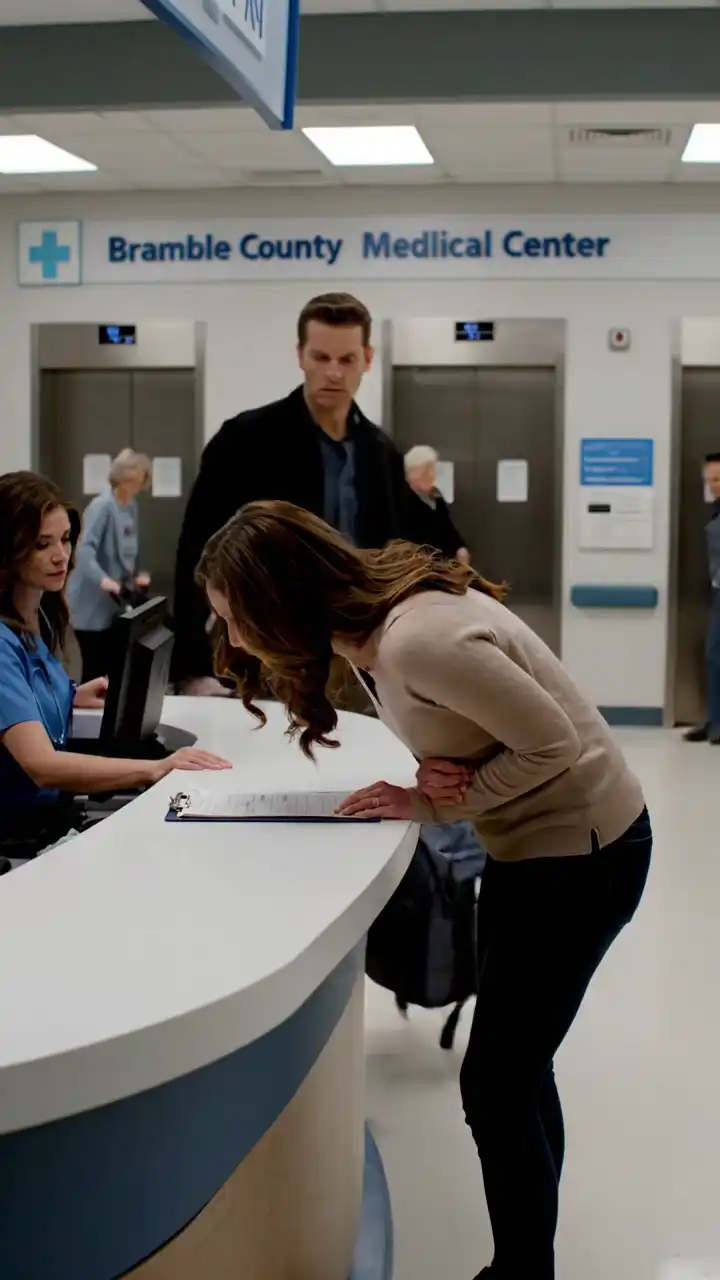
HE TREATED HIS SICK FIANCEE LIKE A FRAUD AT THE HOSPITAL DESK UNTIL ONE NAME CHANGED EVERYTHING
Chapter 1
The first thing people saw was my hospital wristband.
The second was the way my hand moved.
I was standing at the front desk of Bramble County Medical Center with one palm pressed hard against my lower ribs, trying not to fold in half, when the receptionist slid a clipboard toward me and said, without looking up, “Insurance card and photo ID.”
My fingers reached automatically for the forms before she finished talking. I straightened the stack, uncapped the chained pen, flipped to the consent page, and marked the missing fields in three fast taps with the pen tip.
Name here. Date here. Emergency contact there.
I did it the way I had seen done a thousand times.
The receptionist finally looked up.
So did the woman beside me with the stroller.
So did my fiancé.
“Why are you doing that?” Nolan asked.
His voice wasn’t loud at first, but the lobby was one of those bright, polished places where every word carried. Behind me, the automatic doors opened and shut. A little TV in the corner played a daytime cooking show. Someone coughed near the elevators. The smell of coffee from the volunteer cart mixed badly with disinfectant.
I pulled my hand back from the clipboard like I’d touched a hot stove.
“I was just helping,” I said.
The receptionist, whose badge read KELSEY MOTT, narrowed her eyes. “Have you been here before under another name?”
“No.”
“Then how did you know where the hold-harmless line was before you turned the page?”
A few people turned fully toward us now. There is a particular kind of silence that gathers in a waiting area when strangers sense humiliation and decide, almost with relief, that it belongs to someone else.
“I guessed,” I said.
Nolan let out a short, humorless laugh. “You guessed the legal line on the back page?”
His hand tightened around the strap of my overnight bag. My bag. He had taken it from me in the parking lot because I was dizzy, but the way he held it now made it feel like evidence.
I could see exactly what he was thinking because I had been watching him think it for two weeks.
Suspicion had changed the shape of his face.
I wasn’t supposed to be here, not for this. I had come because my primary doctor in Haviland Crossing had seen the scan, gone quiet for too long, and told me to go straight to Bramble County for more imaging. “Today,” she’d said. “Don’t wait till Monday.”
I had told Nolan only half the truth. That the pain in my side had gotten worse. That I was scared. That I needed him to drive.
I had not told him why I had also asked, three times, whether he was absolutely sure he had never brought another woman here.
The receptionist turned the clipboard toward herself and looked at the sticker on my intake packet. “Ms. Wren Halbrook?”
“Yes.”
She typed, frowned, then typed again. “That’s odd.”
Nolan stepped closer. “What’s odd?”
Kelsey looked from him to me and back. “There’s a note attached to your file.”
I felt my stomach turn colder than the pain under my ribs.
“What kind of note?” I asked.
Before she answered, another wave of pain cut through me so sharply that I grabbed the edge of the counter. My breathing went shallow. The pen rolled off the desk and hit the tile.
The volunteer from the coffee cart glanced over. An elderly man in a flannel jacket stared openly.
Kelsey’s expression changed, but only a little. “It says chart hold pending identity verification.”
Nolan’s head snapped toward me. “Identity verification?”
I tried to stand up straight. “There has to be a mistake.”
“Mhm.” Kelsey swiveled her monitor slightly away from us, which only made the gesture look more dramatic. “It also says do not release prior records until approved by patient access supervisor.”
“Prior records?” Nolan repeated.
The woman with the stroller leaned just enough to listen better.
I heard my own voice come out too calm. “Can I speak to the supervisor?”
“You can wait.” Kelsey folded her hands. “If this is really your first time here, it should be simple.”
If this is really your first time here.
Nolan stared at me in a way I had never seen before, as if he was trying to line up my face with somebody else’s story.
“What did you not tell me?” he asked.
My mouth went dry. “Nolan, not here.”
“Then where?” he said. “Because you’ve been asking weird questions for days. You looked through my glove box yesterday. You asked if I’d ever used the Willowmere address before we moved there. Now the hospital says you’ve got prior records and a hold on your identity?”
A teenager near the vending machines stopped pretending not to listen.
“I didn’t say I had prior records,” I said quietly.
“You didn’t have to.”
My side burned so badly I could feel sweat gathering under the collar of my sweater. But the pain was almost easier than the shame. Pain was private. Shame stood under fluorescent lights and let strangers watch.
A janitor pushing a gray cleaning cart slowed beside the information rack. He was a broad-shouldered older man with deep-set eyes and a city maintenance badge clipped to a faded navy jacket. I noticed him because he stopped mopping and looked directly at my hand still resting on the counter.
Not at my face. At my hand.
I pulled it away.
Kelsey clicked her tongue. “Ms. Halbrook, if there’s a discrepancy involving another patient’s chart, I need you to answer clearly. Have you ever worked in healthcare?”
The question hit so hard that for one second I forgot the pain.
Nolan heard the silence before I could break it.
He looked at me as if the floor had shifted under him.
“Why would she ask that?” he said.
Kelsey didn’t answer him. She kept looking at me.
I forced out, “No.”
The janitor was still watching. Something unreadable moved across his face.
Kelsey gave the kind of nod people give when they think they already know the truth. “All right. Sit down. Patient access will come when they can.”
Nolan set my overnight bag on the floor but didn’t touch me. “Wren,” he said, low and flat, “were you using this hospital to check on me?”
The question made the woman with the stroller suck in a tiny breath.
“I came here because I’m sick,” I said.
“Then why do you look like you know the desk better than the staff?”
I wanted to say because once you know a place like this, your hands never forget it. I wanted to say because illness has a smell, and paperwork has a rhythm, and fear looks the same whether it’s yours or somebody else’s.
Instead I said nothing.
The janitor leaned on the handle of his mop and spoke for the first time.
“She didn’t mark the forms wrong,” he said. “Not once.”
Kelsey looked irritated. “Daryl, please.”
But he was still watching me, and now I understood why. He wasn’t just looking at my hand. He was looking at my sequence. Page order. Signature placement. The quick habit of clipping the insurance copy behind the privacy notice.
A skilled habit.
A familiar habit.
Nolan’s face hardened. “What does that mean?”
Daryl looked at him, then at me, then away. “It means either she’s lying,” he said softly, “or she’s done this work before.”
Everything inside me went cold.
Because both of those things, in different ways, were true.
Chapter 2
They made me sit beneath a framed print of blue flowers while the pain in my side kept coming in waves strong enough to blur the edges of the room.
Nolan stayed standing.
That was somehow worse.
He stood with his back to the reception counter, arms folded, jaw set, while people were called in and out around us. A toddler cried near radiology. A nurse in grape-colored scrubs came through the lobby doors balancing charts against her hip. Every few minutes the front desk phone rang, and each time Kelsey answered it in a bright voice she had not used once with me.
I pressed my fingers against the plastic armrest and tried to breathe through the pressure under my ribs.
“You should go home,” I said to Nolan.
He stared past me. “No.”
“You don’t even believe me.”
“I’m trying to decide what I believe.”
That hurt more than I expected. Not because we had never had trouble—we had. Every engaged couple I knew had sharp corners somewhere. Money, in-laws, old habits, timing. But ours had always felt survivable. Nolan and I had been together three years. He poured concrete for Ashwell Contracting and came home dusty and exhausted and proud of what his hands could build. I taught him how to make roast chicken without drying it out. He changed my headlights in winter and left the porch light on when I drove home late.
Then two weeks ago I found a folded billing summary in the pocket of his truck door.
Bramble County Medical Center.
Women’s imaging.
No patient name on the front. Just partial account numbers and a date from six months earlier, before our engagement party.
When I asked him about it, he said it was probably junk mail.
When I asked again, he got offended too fast.
When I asked whether he had ever brought someone here, he said, “What kind of question is that?”
After that, every answer between us felt crooked.
The automatic doors opened, and a woman in a camel coat strode in carrying a leather folder. She was in her fifties, silver hair cut close to the jaw, glasses hanging from a chain around her neck. Kelsey stood up when she saw her.
“Ms. Tripp? This is the patient with the chart flag.”
The woman came toward me. “I’m Sandra Tripp from Patient Access. Ms. Halbrook?”
I rose too quickly and the room tilted. Nolan reached out by reflex, catching my elbow before I could fall. His grip was firm, familiar, and gone again almost immediately.
Sandra noticed everything. “Let’s step into consultation room B.”
Kelsey said, not quite under her breath, “If she can verify.”
Sandra gave her one cool look. “That’s enough.”
Consultation room B was barely larger than a walk-in closet. One table, three chairs, a tissue box, fake fern in the corner. No window. The fluorescent light above us hummed.
Sandra sat opposite me and opened the leather folder. Nolan remained by the door until Sandra said, “Are you her spouse?”
“Fiancé,” he said.
“Then unless she objects, you may stay.”
I almost laughed at the formality of that word. Object. As if I had any strength left to shape what was happening.
“It’s fine,” I said.
Sandra glanced at my wristband, then at a printout. “We flagged your chart because your identifying details partially overlap with a former employee and partially with an existing archived access pattern. Same first initial, similar date of birth, local address overlap through emergency contact mapping.”
Nolan frowned. “In English.”
Sandra folded her hands. “Someone with internal system familiarity accessed the public intake sequence in a way that raised concern. Ms. Halbrook, have you ever worked in admissions, records, nursing support, or patient transport at any medical facility in this county?”
There it was again.
“No,” I said.
She watched me for a beat too long. “Then how did you know to check for the secondary consent packet clipped behind the privacy sheet?”
I hadn’t realized I’d done that too.
My cheeks went hot. “I don’t know.”
“That answer is not helping you.”
Nolan let out a low breath through his nose. “Try a different one.”
I turned to him. “I am in pain.”
“And I’m in a room finding out my fiancée has some kind of hidden history with this hospital.”
My voice came out thin. “It’s not what you think.”
“Then tell me what it is.”
I looked down at my hands.
My left thumb was rubbing the edge of the consent form exactly the way it used to when I was trying not to speak too soon.
Sandra noticed that too. “Ms. Halbrook, I am not accusing you of a crime. I am trying to protect patient records. But if you have concealed prior employment here or used another person’s credentials at any point, we need the truth now.”
“No,” I said, too quickly. “I never used anyone’s credentials.”
That was true.
It was also not the whole truth, and everyone in the room could feel it.
Sandra drew out a photocopied sheet. “Do you recognize this signature style?”
It was a training acknowledgment form from years ago. The signature at the bottom was blurred and cut off. But I knew the slant instantly. The clipped capital R. The habit of dragging the line from the last letter too far right.
My sister’s handwriting.
Ressa.
I stared so hard at the page that the edges doubled.
Nolan leaned over. “Do you know it?”
“No,” I whispered.
Sandra’s eyes sharpened. “You hesitated.”
“Because I’m sick and tired and being questioned like I stole something.”
“Did you?”
The insult of it made my throat close. “No.”
Nolan stepped back from the table as if the room had suddenly become dirty. “Wren, did you come here because you found that paper in my truck? Is that what this is?”
I turned toward him fully then. “Whose paper was it?”
His face changed. Not guilty. Angry.
“I told you I didn’t know.”
“You knew enough not to answer.”
“That doesn’t mean I cheated on you.”
“You still haven’t said whose appointment it was.”
Sandra raised a hand. “This is not couples counseling.”
But it was too late. The real thing had entered the room now, the thing that had followed us all the way from Willowmere Avenue to this square little chamber: not just whether I was hiding something, but whether he was.
Nolan ran a hand over his mouth. “I brought my sister here last spring.”
I blinked. “What?”
“She had a biopsy scare.” He looked furious that he had to say it here, furious that he had not said it sooner. “She made me swear not to tell anyone until it was over. It was nothing. It came back benign. I forgot the paper in the truck.”
I stared at him.
For two weeks I had been carrying a picture in my head of a woman I couldn’t name sitting where I was now, and all that time it had been his sister Corinne, scared and private and embarrassed enough to hide it.
“You should have told me,” I said.
“You should have asked me like you trusted me.”
The shame of that landed hard because he was right.
And yet it did not solve the room we were sitting in.
Sandra looked between us with the patience of someone who had seen every kind of personal collapse happen under institutional lighting. “Whatever is happening between the two of you, I still need to resolve the chart discrepancy.”
A knock came at the door. It opened before Sandra answered.
The janitor from the lobby stood there holding a small stack of clean paper wristbands.
“Sorry,” he said. “Need these dropped in intake.”
Sandra took them with clear annoyance. “Thank you, Daryl.”
He didn’t leave. He looked at me again, then at the photocopied signature page on the table.
His eyes widened slightly.
“That’s not hers,” he said.
Sandra stiffened. “Excuse me?”
He pointed, not at the name, but at the handwriting. “That’s Ressa Vale’s old slant. She worked second-shift intake before they moved records off-site.”
My heart stopped.
Nolan turned toward me. “Vale?”
Daryl looked from him to me and seemed to realize all at once that he had stepped into a trap no one else could see.
Sandra’s voice went careful. “And how do you know that?”
Daryl swallowed. “Because her little sister used to come pick her up.”
No one in the room moved.
Nolan said, very quietly, “Wren. Is your last name not Halbrook?”
It was.
Now.
But there are old names that never stop opening locked doors, even after you bury them.
Chapter 3
My maiden name was Vale.
I hadn’t said it out loud in four years.
The moment Daryl spoke it, the little consultation room seemed to shrink around me. Nolan’s face went white first, then red. Sandra leaned back in her chair as if the air itself had become charged.
I closed my eyes for one second and saw my sister at nineteen in maroon scrubs too big in the shoulders, laughing with a paper cup of vending machine coffee in one hand. Saw myself at seventeen, waiting on a plastic chair near midnight because our mother was too drunk to drive and Ressa hated paying for cabs. Saw winter salt on the hem of her pants. Saw the old side entrance where employees smoked under the awning.
I opened my eyes.
“My legal name is Wren Halbrook,” I said.
Sandra nodded once. “And before that?”
“Wren Vale.”
Nolan made a small sound, almost like a cough. “You changed your name?”
“When I was twenty-two.”
“Why?”
I looked at him. “Because some names are heavy.”
“That’s not an answer.”
“It’s the one I can give right now.”
Sandra picked up her pen. Her entire posture had changed. Less suspicious now, but more alert, as though she could finally see the outline of a pattern and didn’t know yet if it meant danger or grief.
“And your relationship to former employee Ressa Vale?”
“She was my sister.”
“Was?”
I swallowed. “She died.”
The room went still.
“How?” Sandra asked gently.
“Car accident. Four years ago.”
It was true, but still not the whole shape of things. The whole shape was worse. She had died after a double shift, driving home on two hours of sleep, with a bottle of cold medicine in the cup holder and a text from me unanswered on her phone because I wanted gas money and she had started saying no.
Nolan sat down hard in the last empty chair. The anger in him didn’t vanish, but it lost its easy footing.
“You never told me,” he said.
“I never told most people.”
“Why?”
Because grief rots strangely when it starts in shame. Because my sister had been the responsible one and I had been the drifting one, and after she died everyone in Barren Fork looked at me with that awful mixture of pity and judgment, as if one daughter had burned up keeping the house warm while the other just stood there with cold hands. Because I left that town, took my grandmother’s surname after her divorce records gave me a legal route, and built a life where no one knew how much I owed the dead.
Instead I said, “I wanted a clean start.”
Nolan looked down at the table. “With me too?”
The pain in my side sharpened again, and this time I bent forward before I could stop myself.
Sandra stood at once. “You need triage, not paperwork.”
Kelsey must have been watching the clock outside because she opened the door just as Sandra reached for it. “Radiology has a gap if she’s cleared,” she began, then took one look at me folded over and changed tone. “I can call a nurse.”
“Call now,” Sandra said.
Kelsey vanished.
Daryl was still in the doorway, miserable and rooted there by the knowledge that he had dropped a live wire into the middle of our lives. “I’m sorry,” he said.
“No,” I whispered through clenched teeth. “You just remembered.”
That was the problem with hospitals. They remember things your body wishes it could outlive.
Two nurses arrived with a wheelchair despite my protest that I could walk. One of them, a compact woman with braids and a badge that read TIA BRUMM, knelt to my eye level.
“Can you stand for transfer?”
“Yes.”
“On three.”
The move from chair to wheelchair sent a hot, ripping pain through my side so severe I gasped. Nolan reached instinctively for the back of the chair. Tia noticed him.
“Family?” she asked.
“Fiancé,” he said.
Tia gave him the quick, practical look nurses have when deciding whether a man is about to help or complicate things. “Then stay close and stay calm.”
As they wheeled me back through the corridor, I saw people glance at me and then away. Sick woman. Pale face. Hospital blanket over the knees. Standard image. Except Nolan walked beside me looking not just worried, but betrayed, and that changed everything. It invited stories.
In triage, they took my blood pressure twice because the first number was too high. A resident pressed gently under my ribs and I flinched so hard she stopped immediately. Bloodwork was ordered. Ultrasound first, possibly CT after. They spoke in clipped, efficient tones that made my fear feel both smaller and more real.
Nolan stood by the curtain, silent.
At last Tia said, “She needs a urine sample, and then we wait on imaging. You can step out for a minute if she wants privacy.”
“It’s fine,” I said, though nothing was fine.
After she left, Nolan stared at the floor tiles. “Did you think I was cheating on you?”
I was too tired to lie. “Yes.”
He nodded once. “Did you think I’d ask less if you were sick?”
That one I couldn’t answer.
He sat in the chair near the wall and leaned forward, elbows on knees. “I don’t know what hurts more,” he said, not looking at me, “that you thought that of me, or that there’s this whole part of your life you built walls around.”
“I didn’t build them to keep you out.”
“Then who?”
I almost said everyone. Instead I said, “The version of me that existed before.”
He looked up then. “Do you know how that sounds?”
“Yes.”
A silence sat between us, heavy and unfixable.
When Tia came back, she brought pain medication and an ultrasound tech named Maribel who had sunflower pins on her badge lanyard. As Maribel helped shift me onto the imaging table, I reached automatically to tuck the sheet under my hip so it wouldn’t bunch.
She paused.
“That’s a neat trick,” she said.
I froze.
“It’s just habit,” I muttered.
She smiled faintly, but there was recognition in it. “That’s not a patient habit.”
Nolan heard.
He didn’t say anything then, but his face closed all over again.
The ultrasound room was dim and cold. Gel slicked over my skin. Maribel moved the probe slowly, her expression turning careful in the way medical faces do when they are seeing something they won’t discuss yet.
“Breathe in,” she said.
I did.
“Hold.”
I held.
At the far edge of the room, Nolan watched the black-and-white flicker on the monitor without understanding it, which was somehow worse than if he had. Because he was watching me through ignorance and mistrust at the same time, and I was too exposed to cover either one.
Back in the holding bay, the waiting began. Nurses passed. Monitors beeped. A baby cried somewhere beyond the curtains. Nolan got a text, checked it, ignored it. I dozed for maybe fifteen minutes and woke to voices in the hall.
Kelsey’s voice. Tia’s. Daryl’s lower murmur.
Then a line, clear enough to cut through everything.
“I’m telling you,” Daryl said, “she used to sit at the end of intake and sort the discharge packets for her sister. That girl could run a front desk before she was old enough to vote.”
My eyes opened.
Nolan was already looking toward the curtain.
There it was: the wrong-looking thing, fully formed now. A patient in a hospital bed who moved like staff. A fiancée with an old name and concealed skill. A sick woman who looked, to the people around her, less like someone in danger and more like someone caught.
And the truth still wasn’t the truth yet.
Chapter 4
By late afternoon the entire first floor seemed to know some version of my story.
Not the real story. Hospitals are too busy for that. But enough fragments had escaped to make a shape people could use.
The woman in bay three who used to know the system. The fiancée with two last names. The patient who handled forms like an employee. The one with the man who stopped holding her hand.
No one said these things to my face. They didn’t have to. I could hear the soft pivot in voices when someone passed my curtain. The curious slowing. The tiny intake of breath when a name carried rumor attached to it.
A physician assistant named Dr. Elise Vonn—young, serious, dark hair escaping her clip—came in with my preliminary imaging report and that controlled expression medical people wear when they are trying not to alarm you before they have all the facts.
“There’s a mass on the right side,” she said gently. “We don’t know enough yet to characterize it. It may be benign. We need a CT with contrast and likely surgical consult.”
I stared at her mouth, at the precise way she shaped the words. Mass. Characterize. Surgical consult.
Nolan stood up so fast his chair scraped the floor. “A mass?”
“It could be several things,” Dr. Vonn said. “I don’t want you jumping to worst-case conclusions.”
But those words had already jumped.
My hands started shaking. Not dramatic shaking. Small, humiliating tremors at the fingertips that made me tuck them under the blanket. I had come in suspicious and half-angry, ready to uncover something ugly in my engagement if necessary. I had not prepared myself to hear that my own body might be hiding something.
Nolan took one step toward the bed, then stopped as if unsure whether comfort was still his place.
“Wren,” he said, and for the first time all day his voice sounded like the man I knew.
I looked away.
Dr. Vonn explained the next steps. Contrast. Kidney function okay. Keep me NPO for now. Surgery team may want to see me tonight depending on scan. She asked if I had questions, and I had too many and none of them were useful.
When she left, Nolan finally moved closer.
“I’m sorry,” he said.
I laughed once, a short broken sound. “For which part?”
“For not telling you about Corinne. For letting this turn ugly. For…” He dragged both hands over his face. “For standing there while they treated you like a criminal.”
I swallowed hard. “You joined them.”
His shoulders dropped. “I know.”
That should have satisfied something in me. Instead it only made me tired.
The CT took place under brighter lights, colder air. A tech named Owen inserted the IV contrast and warned me about the metallic taste. “Warm feeling is normal,” he said.
Normal.
I lay still as the machine hummed around me, and when the warmth rushed through my veins it felt so much like sudden embarrassment that I almost laughed.
Back in the bay, dusk turned the narrow hall window lavender-gray. Sandra Tripp returned carrying a thin file.
“I owe you an update,” she said.
Nolan stepped back but stayed within earshot.
Sandra opened the file. “The identity flag was triggered by two things. First, the archived employment connection to your sister. Second, an old access behavior pattern linked to manual packet sequencing.”
I rubbed my forehead. “Meaning?”
“Meaning your hands remember systems. Enough to make newer staff think you were bypassing process.”
“I wasn’t.”
“I know that now.”
The apology was there, but wrapped in administrative language. Maybe that was all she knew how to offer.
She continued, “There’s no evidence you improperly accessed records. None. The concern was procedural, and it has been cleared.”
Nolan exhaled.
But Sandra was not finished.
“However,” she said, “there is a discrepancy in the archived training list tied to volunteer support hours under your sister’s supervision. Your name appears repeatedly.”
I looked up.
She slid a photocopy toward me. There I was in faded black ink: Wren Vale, auxiliary intake runner, evening support. Not employee. Not official staff. But there.
The paper seemed to light up the whole hidden strip of my life.
I touched the edge of it with one finger.
“She wasn’t supposed to put me on that list,” I said.
“Why not?” Nolan asked.
“Because I wasn’t old enough at first. And because I kept coming anyway.”
Sandra tilted her head. “You volunteered here?”
I almost said no out of habit. Then I was too tired.
“Yes.”
The word landed quietly.
Not staff. Not thief. Not stranger.
Something else.
Nolan stared at the page. “You worked here?”
“Not exactly.”
Sandra gave me room, which somehow forced the truth further forward.
“My sister worked nights in intake when our mother was drinking bad again,” I said. “If she left me home, I missed school or dinner or both. So sometimes I came with her. At first I just sat there. Then I started helping. Filing discharge packets. Restocking clipboards. Walking forms to the fax room. Showing people where to sign if the desk got slammed.”
A shadow of recognition passed over Sandra’s face, as if she were seeing an old kind of hospital labor she knew very well and had not expected to find in me.
“How long?” she asked.
“On and off from seventeen to nineteen.”
Nolan said slowly, “You said you never worked in healthcare.”
“I said no because I didn’t know what counted.”
“Wren.”
“It didn’t count on paper,” I snapped, then winced from the effort because pain flared again beneath my ribs. “It counted in every other way, but not on paper.”
The curtain shifted. Tia stepped in with a cup of ice chips and must have caught the tail end of that because she said, “Paper misses a lot.”
No one answered.
Tia set the cup down and adjusted my IV line with the easy certainty of someone who had done this ten thousand times. Then she looked at me more closely. “You used to be on the floor?”
“No.”
Tia smiled faintly. “Could’ve fooled me.”
Sandra glanced at her. “She was an unofficial intake runner years ago. Under her sister.”
Tia’s expression changed. “Ressa Vale?”
I nodded.
“Oh honey,” Tia said softly. “I knew Ressa.”
That hit me harder than the scan result.
Tia went on, “She was fast as lightning and always carried peppermint gum in her pocket. Used to cover triage phones when we got slammed.”
I had to look away.
Nolan watched this exchange like a man realizing he had been standing in the wrong doorway all day. Every new person who recognized my sister made my story both stranger and more solid.
Then the shift no one could explain arrived in a way none of us expected.
A man collapsed near the elevators.
It happened with a crash of metal and a woman’s scream. A volunteer cart tipped. Someone shouted, “Help!” and feet started running.
Every curtain in the bay twitched.
Tia was gone before the second scream.
Without thinking, I threw off my blanket, swung my legs over the bed, and stood.
Nolan moved immediately. “What are you doing?”
I was already at the curtain gap.
In the hall I could see the man on the floor half under the cart, gray-faced, one arm bent awkwardly beneath him. His wife—or maybe daughter—was kneeling beside him, crying, “Please, please help him.”
Staff were moving in from three directions, but they were still seconds away.
And my body remembered before my fear did.
“Turn the cart away from his legs,” I said sharply to no one and everyone. “Give him air. Don’t lift his head.”
The woman obeyed me without even looking up.
Nolan stared.
I was barefoot on cold tile, IV line trailing, hospital gown open at the back under a thin robe, but my voice had changed. I heard it. So did everyone else.
Daryl appeared at the far end of the hall with a crash cart and nearly lost grip on it making the turn. “Clear the path,” he barked.
The speed with which he handled the brakes, the drawer latch, the oxygen bracket—far too practiced for a janitor—registered in one bright flash, but there was no time to think about it.
Tia dropped to the floor beside the man. “Sir? Can you hear me?”
He didn’t answer.
“Pulse weak,” another nurse said.
I was already reaching for the blanket from an empty wheelchair to tuck under the woman’s knees because she was shaking so hard she couldn’t stay upright. Tia looked up at me only once, and in that single glance there was no suspicion, no hierarchy, just fierce practical recognition.
“You know where not to stand,” she said.
“Yes.”
“Then stay with her.”
So I did.
The woman clutched my wrist. “Is he dying?”
“No,” I said, though I could not know that. “Stay with me. Breathe.”
Nolan stood five feet away, stunned silent.
The man began to groan. More staff arrived. A physician pushed in. Orders flew. Blood pressure. EKG. Oxygen. Move him now.
In less than two minutes the crisis rolled down the hall on a stretcher and disappeared through double doors.
Only then did I realize I was trembling again.
Tia rose, breathing hard, and looked at me with open astonishment. “You weren’t kidding. You really know the flow.”
Before I could answer, Daryl set the crash cart back against the wall. He had one hand on the handle and one on the top drawer, exactly the way someone does when they’ve opened it under pressure more times than they can count.
Sandra, who had witnessed all of it from the bay entrance, stared at him.
“Daryl,” she said slowly, “why do you know that cart?”
He looked at the floor.
No one spoke.
Then he said, very quietly, “Because I’m not just janitorial.”
The corridor seemed to pause around him.
“I used to be an ER tech,” he said. “Twenty-three years. Lost my certification after my wife got sick and I missed too many renewals. Took this job to keep insurance.”
Tia blinked hard. “Daryl.”
He gave a small ashamed shrug. “A mop pays the bills too.”
There it was: another hidden profession, another life flattened by circumstances until people stopped seeing what had been there all along.
And all at once the entire day rearranged itself.
The man with the mop had recognized me because he knew competence when he saw it. The sick woman at the desk had been judged by hands that remembered service. The people who looked lowest in the room had carried the most knowledge.
Sandra looked from Daryl to me and then toward the front lobby where this whole mess had started.
“I think,” she said carefully, “we have all made some ugly assumptions today.”
Chapter 5
My surgeon introduced himself just after eight at night.
Dr. Beck Rowan had the calm face of a man who had delivered bad news before and learned how not to make it worse with unnecessary drama. He pulled the curtain closed, sat where Nolan had been sitting all afternoon, and showed us the scan on a tablet.
The mass was on my right ovary. Large enough to explain the pain. Twisted enough, he suspected, to be causing intermittent torsion. That was why the pain came in waves and then sharpened into something blinding. It needed surgery. Soon.
“Tonight?” I asked.
“Early morning if we can hold your pain and your vitals stay stable,” he said. “But yes. I don’t want to leave this too long.”
My mouth went dry. “Is it cancer?”
He did not insult me with false certainty. “I don’t know. Some masses look frightening and aren’t. Some behave quietly and are not benign. The first step is getting it out safely.”
Nolan asked practical questions because I couldn’t yet. Recovery time. Risks. Whether they could save the ovary. Whether I would need a bigger operation if pathology looked wrong. I listened to his voice and remembered all over again that love and hurt can occupy the same chair.
After Dr. Rowan left, the room seemed to empty itself of oxygen.
Nolan sat beside the bed for a long time before speaking.
“I should have believed you when you said you came because you were sick.”
I stared at the blanket. “I should have believed you about the paper.”
We let that sit.
Finally he said, “Can I ask one more thing without you shutting down?”
I almost smiled at the bluntness. “Try.”
“Why didn’t you tell me about your sister? Not the whole thing. Just enough.”
The fluorescent light hummed overhead. Somewhere down the hall a patient laughed too loudly at a television show. Ordinary sounds, absurdly normal.
“I was afraid,” I said.
“Of me?”
“Of becoming that version of myself again when I said it out loud.”
He didn’t interrupt.
“My mother drank through most of my teens. Ressa kept us standing. She worked, paid bills, remembered forms, remembered shots, remembered the landlord’s name. She was twenty-one and already acting forty. I floated. I skipped things. I got pretty good at disappearing while she handled consequences.” My throat tightened. “Then she died, and suddenly everybody talked about how strong she had been. Which was true. But no one wanted to talk about what strength had cost her. And no one wanted to talk about me unless it was to compare.”
Nolan was very still.
“So I left,” I said. “I changed my last name. I stopped telling the story. And every time I almost told you, it felt too late.”
He rubbed a hand over his jaw. “You know I wouldn’t have loved you less.”
“I know that now.”
“That’s not the same.”
“No.”
He leaned forward, elbows on his knees, and looked at the floor. “When Kelsey started questioning you at the desk, I had this ugly thought. That maybe you were someone different than I thought. Someone sneaky. Someone checking my records. Someone using being sick to cover something else.”
The honesty stung because it was so exact.
“I know,” I said.
“And then when you stepped into that hallway…” He shook his head once. “I saw people listening to you. Real staff. Without hesitation.”
I looked at my own hands.
“I used to know how to steady people,” I said softly. “Back then. Before everything got ugly at home. Before Ressa died. She’d say, ‘Hands first, panic later.’”
Nolan looked up. “That sounds like her.”
I swallowed. “It does.”
A few minutes later Sandra returned with corrected paperwork and, unexpectedly, Kelsey beside her.
Kelsey no longer looked annoyed. She looked pale.
Sandra spoke first. “Your chart is fully cleared. There will be no additional access hold.”
I nodded.
Kelsey held a manila folder against her chest with both hands. “I owe you an apology.”
I hadn’t expected those words from her, and maybe because of that they landed harder.
“I saw the way you moved and decided what kind of person you were,” she said. “I told myself I was protecting process. Some of that was true. But some of it was just judgment.”
The lobby flashed back in my mind: the clipboard, the stares, Nolan’s voice, my own body folding around pain while strangers watched.
I said nothing.
Kelsey’s eyes dropped. “I’m sorry I treated you like you didn’t belong here.”
Daryl, standing a little behind them, gave the smallest nod, as if to say let it stand.
Sandra added, “For what it’s worth, your volunteer record under Ressa was exceptional. There are old comments in the file.” She glanced at the page. “Fast learner. Calms families. Better with frightened patients than half the paid staff.”
A laugh escaped me before I could stop it, and then to my horror tears came with it.
I covered my face.
Nolan stood up immediately, but it was Daryl who spoke from the doorway, voice rough and quiet.
“Your sister used to say the same thing,” he said. “Said you had the gift for the front part. The scared part. The first five minutes.”
I lowered my hands.
He went on, “She told me once, ‘Wren sees people before they become paperwork.’”
That did it.
I cried then in the ugly, exhausted way that comes when too many things break open at once—fear of surgery, relief over Nolan’s sister, shame over my suspicion, grief for Ressa, humiliation from the lobby, and the terrible tenderness of being remembered well by people I thought had forgotten me.
Nolan put one hand on the bed rail. “Hey,” he said softly.
I shook my head. “Don’t say it’s okay.”
“Then I won’t.” He stepped closer. “But I’m here.”
It was not a full repair. It wasn’t supposed to be. Some cracks need more than one night. But it was a hand placed back where it belonged.
Later, after they wheeled me upstairs to pre-op, I lay awake under a thin warmed blanket while the floor quieted into midnight. A nurse checked my armband. Another reviewed allergies. Nolan signed forms where I needed a witness because my hands were still trembling.
At one point I woke from a half-sleep and saw him in the chair beside my bed, head bowed, my old volunteer file open in his lap. He wasn’t reading the comments anymore. He was looking at the copied name at the top.
Wren Vale.
He sensed me watching and lifted his head.
“I’m sorry,” he said again.
This time I believed he understood what for.
“Me too,” I whispered.
He came to the bedside and bent close enough that only I could hear him.
“I should have stood with you at the desk.”
Those words hurt and healed in the same breath.
I touched his wristband-free hand with mine.
“Yes,” I said. “You should have.”
Chapter 6
They took me into surgery at 5:40 in the morning.
The hallway lights were soft and dimmed for night staff. The wheels of the gurney clicked over seams in the floor. A nurse named Belinda tucked my blanket around my shoulders like I was much younger than I was, and for once I didn’t mind.
At the OR doors Nolan walked beside me until he couldn’t.
He touched my fingers lightly. “I’ll be here.”
I searched his face. There was fear there, and regret, and love stripped of all pride.
“Stay,” I said.
“I will.”
The anesthesia was quick and merciful.
When I woke, everything was cotton and distance at first. A recovery room. A monitor. A dull ache lower than before, cleaner somehow, surgical pain replacing wild pain. Someone said my name. Someone asked me to take a deep breath.
Hours later, in my room, Dr. Rowan told me they had removed the twisted ovary and mass successfully. Frozen section suggested it was borderline, not the worst kind of cancer, but pathology would guide the next steps. There would be more appointments, more waiting, more fear than I wanted. But I was alive, and the thing causing the blinding pain was gone.
I cried quietly after he left.
Nolan cried too, though he tried not to.
He laughed at himself when I noticed. “Rough morning,” he said.
“Understatement.”
He moved his chair closer. Not too close. Just enough to ask without pressing. “When you’re ready,” he said, “I want to know all of her. Ressa. And all of you too. Even the parts that feel late.”
I looked out the window at the pale parking lot, the waking town of Briar Glen beyond it, the church steeple near Ash Street, the gas station canopy just visible past the trees. Ordinary things. The world still there.
“I’m ready for some of it now,” I said.
So I told him.
Not everything. Not all at once. But enough. About the apartment over the shuttered bait shop in Barren Fork. About our mother sleeping through smoke alarms and school mornings. About Ressa making spaghetti from ketchup packets and noodles when there was nothing else. About those nights at Bramble County when she let me sit behind intake and sort forms so I would feel useful instead of abandoned. About learning where people signed and where they cried and how fear changed voices. About the way hospitals taught me that dignity could vanish in seconds if no one protected it.
Nolan listened the whole time.
Near noon, Tia came by with discharge planning notes for later in the week and paused when she saw us talking. “Look at that,” she said. “Different room, different people.”
I smiled faintly. “Same people.”
“Maybe,” she said. “But a little wiser.”
When she left, Kelsey appeared in the doorway with a small paper cup.
“Peach gelatin peace offering,” she said awkwardly. “Best I can do from this floor.”
I laughed despite myself and took it.
She shifted from one foot to the other. “I keep thinking about yesterday. About how fast a desk can become a wall.”
I peeled back the lid. “It can also become a bridge.”
She looked relieved enough to nearly cry. “I’d like to do better.”
“Then do.”
Daryl came by later after his shift ended, no mop with him this time. He wore a plain gray sweatshirt over his work pants and held a folded note card.
“I found this in old staff appreciation stuff years ago,” he said. “Didn’t know if it meant anything.”
Inside was a yellowing card in my sister’s writing.
Hands first panic later You are better at this than you know R
I pressed the card to my chest.
Daryl cleared his throat. “People fall low in places like this,” he said. “Patients. Families. Staff too. Easy to think the badge tells you who matters and who doesn’t.” He looked at my hospital gown, my IV, the bruised back of my hand. “It doesn’t.”
After he left, the room stayed quiet for a long time.
Nolan took the card gently and handed it back as if it were fragile glass. “She was right.”
I looked down at the taped IV line, the hospital bracelet, the tender rise of bandage under my gown. Yesterday all of those things had made me look small. Suspect. Exposed. Less credible. Less worthy.
But sickness had not erased who I was.
Shame had not erased who I was.
Being doubted in public had not erased who I was.
I thought about the woman on the floor by the elevators clutching my wrist. About Kelsey behind the desk. About Daryl pushing a mop and carrying twenty-three unseen years inside him. About Nolan, who had failed me and stayed. About my sister, who had taught me to see people before they became paperwork.
By evening the sky outside turned soft gold over Briar Glen, and the hospital windows caught it like fire.
Nolan stood to close the blinds halfway, then hesitated. “Too bright?”
“No,” I said. “Leave it.”
He sat back down.
After a while he reached for my hand. This time, I let him keep it.
And in that quiet room, with the hospital humming all around us, I understood something simple enough to survive every misunderstanding that had brought me there.
No one should have to prove their worth before they are treated with kindness.
Not the patient at the desk. Not the man with the mop. Not the woman asking too many questions because she is scared. Not the one who looks polished. Not the one who looks broken.
Every person who walks through those doors is carrying something unseen.
Every one of them deserves to be met gently first.
Disclaimer: Mention of any brand or trademark is for identification only and does not imply partnership or endorsement
MY HUSBAND USED MY MONEY, GOT ENGAGED TO HIS MISTRESS, AND STOOD THERE WHILE SHE SLAPPED ME
THE MAID OF HONOR POURED WINE ON ME AT MY BRIDAL SHOWER AFTER STEALING MY FIANCÉ. SHE DIDN'T KNOW THE ROOM WAS ABOUT TO HEAR WHAT HE'D BEEN SAYING TO BOTH OF US.
THE MAID OF HONOR POURED WINE ON ME AT MY WEDDING AND CALLED ME CRAZY. SHE FORGOT I STILL HAD THE VOICE NOTE SHE SENT MY FIANCÉ.