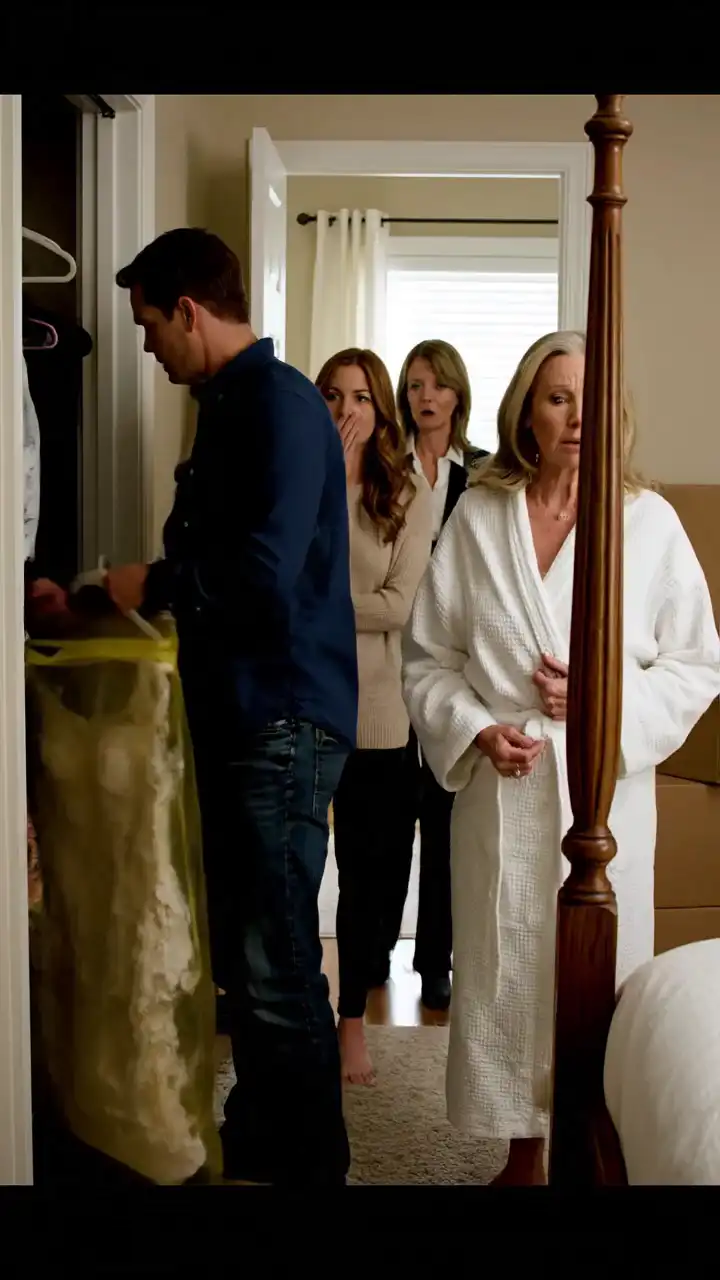
HE THREW OPEN MY CLOSET AND FOUND THE WEDDING DRESS I NEVER TOLD HIM ABOUT
Chapter 1
My son yanked the closet door so hard the hanger rod rattled, and my wedding dress slid forward like a ghost.
Everybody in my bedroom saw it at once.
The room was too full for breathing. My son Nolan stood in front of me with his jaw locked tight, his fiancée Piper beside him in a pale blue sweater, one hand pressed over her mouth. My sister-in-law Doreen leaned in the doorway with that hungry, injured look some people get when they think they were right all along. Behind her were Nolan’s cousin Tessa and two men from the moving company carrying flattened wardrobe boxes, frozen in place like they’d stepped into the wrong house.
The dress was wrapped in old clear plastic that had gone yellow at the folds. Underneath, the lace was still white.
Nolan stared at it, then at me.
“You said Dad only ever married you.”
He didn’t shout. That made it worse.
I held the edge of the dresser with one hand because I had suddenly lost my footing inside my own body. “He did.”
He gave a bitter little laugh. “Then why do you have another wedding dress hidden in the back of your closet?”
No one moved. No one blinked. The movers looked at the floor, but they were listening. Everybody was listening.
My name is Maris Bell. I was widowed at forty-eight when my husband, Glenn, had a stroke in the lumber aisle of a hardware store in Cavan Ridge, Pennsylvania. By fifty-three, I had learned how invisible a widow can become in her own life. People call to check on you for a while, then they begin speaking over you, around you, past you. They turn your quiet into permission.
I had let Nolan move back into the house six months before with Piper while they saved for a place of their own. It was supposed to be temporary. Then it became practical. Then it became crowded. Then Glenn’s old recliner disappeared from the den because Piper said it smelled stale. Then my kitchen got reorganized “for efficiency.” Then Nolan started saying things like We should probably update this place and We need to think long-term, Mom.
That morning, all of them had decided to “help” me clean out the upstairs before an appraiser came next week.
They did not ask.
I was still in my bathrobe when they started pulling boxes from under my bed.
“Mom,” Nolan said again, voice flat now, almost embarrassed for me, “whose dress is that?”
“It’s mine,” I said.
Piper’s hand dropped from her mouth. “Maris.”
The way she said my name made me feel like I had done something indecent.
Doreen folded her arms. “I knew there were things Glenn never told us.”
That cut so fast I almost didn’t feel it at first.
I looked at her. “This is my room.”
“This is our family too,” she said.
Nolan stepped toward the dress and touched the plastic cover. “Were you married before Dad?”
“No.”
“Then what is this?”
I could hear the washing machine downstairs churning through a load of towels. The smell of dust and cedar from the closet felt thick in my nose. On the vanity, my late husband’s wristwatch sat beside a bottle of hand cream. Everything in the room looked painfully ordinary except for that dress, shining there like evidence.
I should have spoken.
I should have said the truth then.
But I had spent twenty-nine years not saying it. Not because it was shameful. Not because I had done anything wrong. I had kept silent because the truth belonged to a day that had cost too much, and because Glenn had once asked me, very softly, to let the dead stay buried if they could.
So I did what I had always done when pain rose too fast inside me.
I went quiet.
Nolan mistook my silence for guilt. I saw it happen on his face.
“Unbelievable,” he whispered.
Piper turned to him. “Maybe there’s a simple explanation.”
“Then why won’t she give it?”
I opened my mouth, then closed it again.
Doreen took one step into the room. “Nolan, you need to know what’s going on before you sign anything on this house.”
I felt my head jerk toward her. “What are you talking about?”
She looked at me but answered him. “If there was another marriage, another family, another legal name—”
“There wasn’t,” I said.
“Then say what the dress is.”
My throat tightened until the words seemed trapped under bone. I could not tell them with men from Cresswell Moving in the doorway, with Piper looking wounded, with Doreen smelling blood in water. I could not drag that day into the open like furniture.
Nolan ran a hand through his hair. “Mom, we are living here. Piper and I are planning our wedding. We have a right to know if there’s something strange in this family.”
Something strange.
I looked at the dress and had the ridiculous thought that I should have burned it years ago. Not because I wanted it gone. Because I was tired of protecting everyone else from what it meant.
“It’s not what you think,” I said.
It sounded weak even to me.
Doreen exhaled sharply through her nose. “That’s what people say when it is exactly what everyone thinks.”
Piper glanced between us. “Maybe we should all just step out.”
But Nolan was too deep in it now, too humiliated by the idea that there might be some secret history he hadn’t known about. He had always hated being the last person told. When he was twelve and found out from a neighbor that Glenn had been in the hospital overnight for chest pain, he didn’t speak to us for three days. Secrets made him feel foolish. And foolishness, in Nolan, almost always came out as anger.
He pulled the dress bag free and held it up.
“Don’t,” I said.
That was the first strong thing I had said all morning, and it stopped him for half a second.
Then he asked the question that made the room go cold.
“Was Dad your second choice?”
Even the movers looked up at that.
I stared at my son. At his father’s eyes in a face that suddenly felt unreachable to me. “No.”
“Then why keep this?”
I took one breath. Then another. But still I could not do it.
Piper whispered, “Nolan.”
He shook his head, still looking at me. “I just want one honest answer.”
I wanted to tell him that honesty is not always one clean sentence. Sometimes it is a locked room. Sometimes it is a hand over a wound. Sometimes it is the thing you carry because saying it out loud would reopen too many graves.
But all I said was, “Put it back.”
His face hardened.
That was the moment I lost the room.
Doreen muttered, “There it is.”
Nolan lowered the dress slowly, as if it disgusted him now. “Fine. If you won’t explain it, I’ll figure it out myself.”
He walked out carrying the dress.
I followed him into the hall in my robe and bare feet, past family photos on the wall, past the framed watercolor Glenn bought me on our tenth anniversary, past the lives I had built with my own hands. Everyone trailed behind us. Piper was saying his name, low and urgent. Doreen was already dialing somebody on her phone.
By the time Nolan reached the kitchen, my home no longer felt like mine. It felt like a courtroom.
He laid the dress across the table where I used to roll out pie crust every Thanksgiving.
“Call whoever you need to call,” he said. “Because I’m done being treated like a child.”
And I stood there in front of all of them, looking at a wedding dress under my own kitchen light, unable to say the one thing that would change everything.
Chapter 2
By noon, three more people had inserted themselves into the disaster.
Nolan had called his cousin Bryce, who worked part-time at a title company and always acted as if access to public records made him a detective. Doreen had called Pastor Lyle from Mercy Street Chapel “for support,” which really meant for a witness. And Piper had texted her mother, Janine Kroll, who arrived with iced coffees and a face pinched tight with concern she hadn’t earned.
I kept thinking how quickly a family can become an audience.
The dress was still on my kitchen table. No one offered to move it. No one asked if I wanted it covered. It lay there beneath the hanging light, lace sleeves folded inward, a satin waistband gone faintly ivory with time. Every time I looked at it, I felt twenty-four and terrified again.
I made myself put on clothes. Navy cardigan. Slacks. Small gold earrings. Armor for a battle I had not chosen.
When I came back downstairs, Bryce was already scrolling through county marriage records on his laptop at the breakfast bar.
Nolan looked at me once and then away.
Piper stood by the sink twisting a paper napkin to shreds.
Pastor Lyle gave me the gentle half-smile clergy use when they want to seem neutral while preparing for a confession. “Maris.”
“Pastor.”
Janine set a coffee in front of Piper and none in front of me.
That tiny thing should not have hurt, but it did.
Bryce cleared his throat. “Okay. So I found your marriage license to Glenn Bell, dated June 11, 1994, Mercer County. That’s there. No problem.”
“No problem,” Doreen repeated, as if that phrase might not last.
Bryce kept typing. “I’m checking for earlier licenses under Maris Hale.” He glanced up. “Your maiden name, right?”
“Yes.”
The keys clicked. The refrigerator hummed. Outside, somebody’s dog barked three houses down on Linden Vale.
My daughter, Elia, should have been there by then, but she lived two hours away in Norcross Hollow and had two little boys and a nursing shift schedule that changed every week. Nolan had texted her around ten. She had sent back one message: Don’t do this without me.
He had done it anyway.
Piper finally spoke. “Maybe if we all calm down—”
Nolan cut in. “I am calm.”
“No, you’re hurt,” she said quietly.
He laughed without humor. “I just found a bridal secret in my mother’s closet.”
I had to sit down.
Pastor Lyle folded his hands. “Maris, silence is making this harder.”
I looked at him. “Then perhaps everyone should leave my kitchen.”
No one moved.
That was the ugliest part. They all believed concern gave them permission.
Bryce leaned closer to his screen. “There’s no earlier marriage license in Mercer or Ashton counties.” He frowned. “Could’ve been out of state.”
Doreen pounced. “Exactly.”
“Or there wasn’t one,” Piper said.
Janine gave her daughter a warning glance, as if defending me was naïve.
Nolan looked at the dress. “There’s no reason to keep a wedding dress for thirty years unless it matters.”
He was right. He just didn’t know how.
I traced the grain of the table with my thumb. Glenn and I had bought that table used from a retired math teacher who was downsizing to a condo. It had ring marks from somebody else’s coffee cups and a scar on one corner where some long-ago child had carved an X with a fork. We kept it because we could afford it, then because we liked it, then because it became ours. Most real things in life were like that. They begin in compromise and end in meaning.
Nolan turned back to me. “Mom. Did you love someone else before Dad?”
I could have answered that. The answer was yes and no in different directions, and neither would have helped.
Instead I asked, “Do you want the truth, or do you want something that fits your anger?”
He flinched. “Don’t do that.”
“Do what?”
“Make me the problem because you won’t talk.”
Doreen put a hand on his shoulder. I hated that. Nolan shrugged her off, but not before I saw him lean toward her comfort for one second. One second was enough to break my heart.
I had not realized how much ground I had lost in my own son’s mind.
The front door opened without knocking. Elia came in with her dark hair pulled into a low knot and her scrub jacket still on over jeans. She must have driven straight from the rehab center. Her face took in the room in one sweep—the people, the table, the dress.
Then she said exactly what no one else had thought to say.
“Why is Mom’s closet in the kitchen?”
No one answered.
Elia crossed the room and kissed my forehead. “You okay?”
“No,” I said.
She looked at Nolan. “What did you do?”
His shoulders went rigid. “I found something.”
“In her room?”
“We were cleaning.”
Elia stared at the movers’ boxes stacked by the wall. “You were taking over.”
Piper whispered, “Elia—”
But Elia was already beside the table, looking down at the dress without touching it. Her eyes shifted to me. Not accusing. Not frightened. Just steady.
I saw then that she recognized it.
Not fully. Not in name. But somewhere in childhood, she had seen this dress bag once or twice when I thought no one was watching. Children notice what adults believe they hide.
“Mom,” she said softly, “is this from before Dad?”
I closed my eyes for a second.
“Yes.”
The kitchen changed shape around that one word.
Nolan stepped back as if struck. Doreen made a little sound of vindication. Janine’s eyebrows rose. Pastor Lyle inhaled.
Piper was the only one who looked sad.
Nolan said, “So you lied.”
“No,” I said. “I withheld.”
He gave a hard laugh. “That’s a fancy word for lied.”
Elia did not take her eyes off me. “Why didn’t you tell us?”
I swallowed. “Because it was not a story I wanted dragged into daylight by force.”
That landed nowhere. Nolan was too angry. Doreen was too eager. Janine was already editing me into a cautionary tale she’d tell her friends over white wine.
Bryce turned the laptop around. “If there was no marriage license, maybe it was a canceled wedding.”
No one had said those words in my house in thirty years.
Canceled wedding.
My hands went cold.
Piper looked from Bryce to me. “Was it?”
I stood up so abruptly the chair legs scraped hard over the floor. “Everybody out except my children.”
Doreen scoffed. “After all this?”
“Yes. After all this.”
Pastor Lyle rose first. To his credit, he did not argue. Janine took Piper’s arm, but Piper gently pulled free.
“I’m staying with Nolan,” she said.
“Then sit quietly,” I told her, and she did.
Doreen lingered in the doorway. “Secrets rot a family.”
I met her eyes. “So does hunger for them.”
She left with Bryce and Pastor Lyle. Janine followed, offended on principle. The front door shut. The house went still in that strange post-conflict way, as if the walls themselves had been listening and were now trying to absorb what they heard.
Only Nolan, Elia, Piper, and I remained in the kitchen.
The dress lay between us.
I wanted to begin. I truly did. But memory is not a faucet. It is a flooded basement. Once the door gives, everything comes at once.
Elia reached across the table and laid her hand over mine.
“You don’t have to rush,” she said.
Nolan looked at her, then at me, and some of his anger cracked enough to show the hurt beneath it.
“Just don’t leave me standing outside it anymore,” he said.
That was the nearest thing to a plea he had offered all day.
I looked at my son, at the man who believed this dress was proof I had cheated him of the truth, and I understood that if I didn’t open the door now, I might lose him in some quieter, more permanent way than a fight.
So I said the first piece.
“I wore that dress on the day I was supposed to marry someone else.”
Chapter 3
No one spoke for several seconds.
The refrigerator kicked on again. A truck rumbled past outside. Somewhere upstairs, a floorboard settled with a soft pop.
Nolan stared at me as if he had expected something ugly and instead gotten something worse—something human.
Piper sat down slowly. Elia did not move her hand from mine.
I looked at the dress and let myself fall back into the year I had spent my whole adult life keeping folded away.
“I was twenty-four,” I said. “I was living in Bracken Mill then, in a second-floor apartment over a pharmacy on Morrow Street. I worked mornings at Fincher’s Bakery and evenings at Stenham Cleaners because your grandfather had already been gone two years, and your grandmother’s lungs were failing. We had hospital bills stacked in a drawer beside the stove. I was tired all the time and convinced that being tired was just what adulthood was.”
Nolan’s face was unreadable.
“The man I was supposed to marry was named Russell Dane. Everyone called him Russ. He was decent. Funny in a dry way. He fixed generators for the county and always smelled faintly like metal and rain. We weren’t some grand tragic romance from a movie. We were two people making a plan. Sometimes that’s more solid than passion.”
Piper looked down. Maybe because she and Nolan were in the middle of making plans and now everything felt fragile.
I went on.
“Russ knew my mother was sick. He knew I was sending money to my younger brother, Darin, who was in community college and too proud to ask for more than he needed. He knew I was scared of debt and public pity and doctors’ waiting rooms. He also knew that once we married, things might get easier. He had a union job. Good health insurance. A rental house lined up through his uncle.”
Nolan’s eyes narrowed slightly. “So the wedding was practical.”
“Yes,” I said. “And kind.”
That seemed to bother him in a different way. People like stories better when someone is clearly foolish or wicked. Kindness complicates blame.
“We set the date for October 14, 1991. Your grandmother wanted to see me married while she was still strong enough to sit through it. She was on oxygen by then but still vain enough to ask for lipstick.”
A small unwilling smile crossed Elia’s face. She had never met my mother, but she knew enough to picture her.
“The dress came from a bridal shop in East Vale called Lark & Linen. I bought the sample because it was half price and two sizes too big. I spent three nights taking it in by hand because I couldn’t afford alterations.”
I could see it as I said it: the little apartment, the yellow lamp by the couch, my mother asleep in the next room, me bent over satin in stocking feet.
Nolan spoke at last. “Then what happened?”
His voice was softer now.
I looked at him and nearly lost my nerve again.
“Two days before the wedding, Darin called me from a gas station outside Selburn.”
Elia frowned. “Uncle Darin?”
“Yes.”
My brother Darin had always been the quiet edge of our family. The one who came to Christmas late, left early, forgot birthdays but remembered how to fix a leaking sink. He lived in New Mexico now, sent postcards with pictures of mesas and never said much about his life. Nolan respected him but did not know him well. No one knew him well. That was partly Darin’s nature and partly my doing.
“He had gone with a friend to Atlantic City,” I said. “He shouldn’t have. He was nineteen and stupid and wanted to act older than he was. His friend drove drunk on the way back. They hit another car.”
Piper drew in a breath.
“Darin survived. The driver of the other car did not.”
The kitchen went silent.
Nolan’s expression changed from suspicion to shock, but I kept going before anyone could interrupt.
“The police found open bottles. The friend’s parents hired a lawyer. Darin had no money and no father and a mother who was already dying. He called me from that pay phone shaking so hard he could barely speak. I can still hear the coins dropping into the slot.”
I pressed my palm flat against the table to steady myself.
“He said, ‘Mari, please come.’”
That line had never left me. Not for one day.
“I took the bus that night. Russ drove me to the station. I told him I’d be back the next afternoon and we would still get married. That was the plan.”
“Was it true?” Elia asked gently.
“At the time, yes.”
I swallowed.
“But by the time I got there, it was worse than I understood. Darin wasn’t just scared. He was facing charges because he had let his friend hand him the registration after the crash. The whole situation was a mess. The dead man’s family was threatening a civil suit. Darin’s friend was already changing his story. And Darin, in his idiotic loyalty, was ready to take blame he didn’t fully deserve because he thought the other family had more to lose.”
Nolan said, “So what does that have to do with the dress?”
Everything, I thought.
But from outside, people never see the chain. They only see the broken link.
“Russ came the next day,” I said. “He brought sandwiches and cash and sat with me in the courthouse corridor. He told me we would postpone the wedding. I said no. My mother was waiting. Deposits had been paid. There were church flowers ordered. I kept saying we can still do this, we can still do this, because I didn’t know how to stand in two disasters at once.”
Piper’s voice was barely audible. “What did he say?”
“He said, ‘Maris, look at me.’”
I did. I was back in that corridor with cinderblock walls and burnt coffee smell and a row of metal chairs. Russ’s tie was crooked. He had dark circles under his eyes because he had not slept either.
“He told me marriage wasn’t a curtain to pull over a fire.”
No one moved.
I went on. “That afternoon, my mother’s doctor called. She had collapsed at home. A neighbor found her. They took her to St. Agnes Regional.”
Elia covered her mouth.
“I spent the next thirty-six hours going between the hospital, the courthouse, and the church office by phone, trying to delay things without fully canceling. Russ stayed. He sat with Darin while I went to the ICU. He brought me clean clothes from Bracken Mill. He paid for a motel room when the buses stopped running. He held everything together.”
Nolan looked down at the dress. “Then why didn’t you marry him later?”
That was the sharpest wound.
“Because two nights after our wedding should have happened, Russ was driving back from St. Agnes after bringing my mother some broth she couldn’t even keep down. A logging truck crossed the center line on Route 16.”
Piper whispered, “Oh no.”
I nodded once.
“He died before the ambulance got there.”
The words still sounded unreal after all this time.
Nolan sat very still.
The kitchen had become so quiet that I could hear the ticking of the cheap clock over the stove.
Elia squeezed my hand harder. “Mom.”
I had not cried yet. Maybe because I had spent years building dry ground around this memory. But grief, when finally invited back into the room, does not arrive politely.
“He was twenty-eight,” I said. “I identified him in a hospital room where the fluorescent light kept buzzing. The dress was still hanging in my apartment. My mother died six weeks later. Darin’s charges were reduced because witness statements finally separated his role from the driver’s, but by then we were ruined financially. There were legal bills, funeral bills, medical bills. I sold my mother’s furniture, worked three jobs, and never put the dress away properly. I shoved it in a closet because I couldn’t breathe when I looked at it.”
Nolan’s lips parted, but nothing came out.
I wiped my face and kept going because if I stopped now, the rest would never be said.
“Glenn came later. Two years later. He delivered wholesale paper goods to the diner where I had started waitressing nights. He asked me out four times before I said yes. I told him enough to be fair. I told him there had been someone before him and that the wedding never happened. I did not give him every detail because by then Darin was rebuilding his life and I had no intention of reopening that case in every family conversation for the next thirty years.”
Nolan looked up quickly. “Dad knew?”
“Yes.”
He leaned back as if the chair had shifted under him.
I nodded. “He knew there was a dress. He knew I had lost someone. He knew my brother had been in trouble and that I had spent years helping him survive it. Glenn was not my second choice. He was my second beginning.”
That finally broke something in Piper. Tears slid down her face, quiet and unshowy.
But Nolan still looked dazed, not only by the story itself but by what it implied: that his father had known a version of me he had never been invited to meet.
He asked, “Then why hide it from us?”
I answered honestly.
“Because every time I thought about telling you, it felt like I would be dragging your father into someone else’s shadow, your uncle into old disgrace, and myself back into the worst year of my life. Then time passed. The longer I waited, the harder it became. Silence turns to cement if you let it sit long enough.”
No one argued with that.
Then Elia asked the question no one else had known to ask.
“Does Uncle Darin know this is happening?”
I looked at her.
“He’s on his way,” she said. “I called him from the driveway.”
Chapter 4
Nolan jerked his head toward her. “You what?”
Elia let go of my hand and sat back. “I called him because I knew this wasn’t just about a dress.”
“You knew?” Nolan said.
“No. I suspected.” She looked at me apologetically. “A few years ago, when Dad was in the hospital with that pneumonia scare, Mom asked me to get her insurance folder from the cedar chest. There was an old envelope under it. I didn’t open it, but I saw a program from a church with October 14, 1991 on the front and the words wedding ceremony crossed out in pen.”
I closed my eyes briefly. So that was how she knew the shape of it.
“I never asked,” Elia said. “Because if Mom wanted me to know, she would tell me.”
The contrast hung in the air.
Nolan heard it. Of course he did.
He stood up and paced to the sink, then back. “So everybody else gets to be calm and patient and I’m the villain because I wanted the truth?”
“No,” Elia said. “You’re the villain because you ripped her closet open in front of an audience.”
“I thought she was hiding something bad.”
I spoke before she could. “I was hiding something painful. That’s not the same.”
He stopped pacing.
For the first time all day, he looked less angry than ashamed. It did not fix anything, but it altered the air enough for remorse to enter.
Piper wiped her eyes. “Nolan, you didn’t know.”
He looked at her. “I should have.”
The doorbell rang.
No one moved for half a second. Then I did.
I opened the front door to my brother Darin Hale, age fifty-four, windblown from the drive and carrying the old denim duffel he used for everything from fishing trips to funerals. His hair had gone mostly silver at the temples. His eyes were mine, only sadder. He took one look at my face and knew exactly how far things had gone.
“Am I too late?” he asked.
“No,” I said. “Come in.”
He stepped into the foyer and saw the kitchen beyond me: Nolan rigid by the sink, Elia seated, Piper pale and shaken, the wedding dress spread over the table like a body.
Darin closed his eyes for one brief second.
“Well,” he said softly. “There it is.”
Nolan had always treated Darin with the casual respect younger men often reserve for distant uncles who never push too hard. But now he looked at him differently, as if he were suddenly standing in front of a witness he had not expected.
“Uncle Darin,” he said, “did you know about this?”
Darin gave him a long look. “I lived it.”
No one spoke.
He set down his duffel and came to the table. He did not touch the dress. He only stood near it, breathing carefully. “You shouldn’t have had to tell this because of a fight.”
“I know,” I said.
He nodded once, jaw tight. Then he turned to Nolan.
“You want answers? I’ll give you one I should’ve given a long time ago. Your mother lost her wedding because she came to save me.”
Nolan’s face changed again, this time with real comprehension beginning to pierce him.
Darin pulled out a chair and sat heavily. “I was a fool. Worse than a fool. I was a boy trying on recklessness because I thought pain made me interesting. The man who died in that crash had two daughters. Your mother made sure I never forgot their names. She also made sure I did not carry guilt for things that weren’t mine while still making me face the things that were.”
He rubbed both hands over his face.
“She sold the little gold bracelet your daddy gave her when she graduated high school to pay my first lawyer. She skipped her own wedding rehearsal to sit in a courthouse hallway with me. She stood next to me when the widow of that man looked at me like I had personally taken the sun out of her sky. And when Russ died—”
His voice broke hard on the name.
Piper put a hand over her heart.
Darin tried again. “When Russ died, your mother still did not leave me. She buried him, buried our mother, kept me from signing a false statement out of guilt, and worked herself to the bone to keep us fed. If anybody in this room thinks that dress is proof of deceit, then you don’t know what sacrifice looks like when it’s wearing house slippers.”
My throat tightened so suddenly I had to look away.
Nolan was staring at him.
Darin reached into his duffel. “I brought something. I should’ve mailed it years ago, but there are things cowards delay.”
He took out a flat tin box scratched at the corners. Inside were papers tied with a faded ribbon, an old church program, and a letter folded into quarters. The paper had gone soft with age.
He placed the letter on the table.
“This is from Glenn,” Darin said. “He gave it to me the year before he died. Told me if anything ever happened and Maris still wouldn’t tell the kids, I should decide whether they were old enough to hear it.”
I stared at him. “You never said that.”
“You never asked.”
That was my brother—loving in angles, silent in all the wrong places.
Nolan looked at the letter. “Dad wrote that?”
Darin nodded. “After he found your mother crying over this dress one night when you were both asleep. He wrote it because he knew she carried too much alone.”
My hands shook as I unfolded the page. Glenn’s handwriting was broad and slightly slanted, the way it always looked on grocery lists and birthday cards.
Maris, if this letter is ever needed, then I’m gone or you’re tired or both.
That first line took the air from me.
I kept reading silently for a second before Elia said, “Mom?”
So I read it aloud.
“If Nolan and Elia ever learn about the dress the wrong way, tell them this for me: your mother did not hide it because she loved us less. She hid it because she loved everybody too much and believed pain was safest when she carried it alone. She was wrong about that, but she was never dishonest in her heart. I married a woman who knew how to keep standing after life took a hammer to her. If you ever judge her for what she did not say, make sure you first understand what it cost her to survive saying nothing.”
I had to stop.
The room blurred.
Elia was openly crying now. Piper too. Darin bowed his head. Nolan had gone pale.
I continued in pieces.
“I also want you to know this: I never felt second to any dead man. Russ was part of your mother’s life before me, and sorrow doesn’t vanish just because love arrives later. I was not her replacement for tragedy. I was her home after it. Don’t insult our marriage by pretending it needed a spotless history to be real.”
I pressed my lips together against a sob.
The last lines were in darker ink, as if he had gone back and added them later.
“And Darin, if you’re the one reading this, stop letting my wife protect you from your own gratitude. She earned better than silence from all of us.”
No one moved for a long time after that.
The clock over the stove ticked on. A car door slammed outside. Somewhere down the block, children shouted at a basketball hoop.
Inside my kitchen, thirty years of silence finally had sound.
Nolan sat down hard in the nearest chair. He looked at the letter, then at me, and all the certainty had gone out of him.
“I thought…” he began, then stopped.
“I know,” I said.
“No.” He shook his head. “I really thought you were hiding something ugly. Or selfish. I thought maybe Dad didn’t know who you really were.”
His voice fell apart on the last words.
Piper touched his shoulder, but this time it was not to steady his anger. It was to help him survive shame.
Darin leaned back, exhausted suddenly. “Your mother gave away a life and then built another one from nails and overtime. That’s who she is.”
Nolan looked at the dress again, and I saw the exact moment it changed in his mind from evidence to relic.
He whispered, “I put it on the table like a crime scene.”
I said nothing. There was nothing useful in punishing a person already awake to what he had done.
Elia rose and took the old church program from the tin. She opened it carefully. Inside, pressed flat after decades, was a tiny spray of dried baby’s breath.
On the back, in my handwriting, were three words I had forgotten writing.
Keep breathing anyway.
Elia held it like something holy.
That afternoon, the house that had felt like a courtroom began, inch by inch, to become a home again.
Chapter 5
We might have left it there if shame were simple.
But families rarely break at the first cut. They fray where old habits live.
By evening, Doreen was back.
She did not knock this time either. She came in carrying a casserole she had no intention of serving, drawn by the scent of revelation and the possibility that she had missed some final twist. The sight of Darin at the table, the open tin box, and Nolan’s wrecked expression told her she had.
“What now?” she asked.
No one invited her farther in, but she entered anyway.
Darin stood. “Not tonight, Doreen.”
She looked at me, then at the dress. “I was worried.”
“No,” Elia said, sharper than I had ever heard her with family. “You were entertained.”
Doreen recoiled. “That’s unfair.”
Piper, who had been quiet for most of the afternoon, surprised us all. “It really isn’t.”
Doreen’s eyes widened. She had underestimated Piper for months, seeing only sweetness where there was also backbone.
“I came because Nolan sounded upset,” Doreen said.
“I was,” he answered.
“And I was trying to protect you.”
Nolan looked tired in a way I had seen on Glenn after overtime shifts—tired not in body but in conscience. “From what?”
Doreen opened her mouth and found nothing solid enough to say.
That would have been enough for me. I did not need a public humiliation in return. But Darin had carried too much guilt too long, and Glenn’s letter had scraped him raw.
He pointed to the chair by the doorway. “Sit down for one minute and then leave.”
To my surprise, she did.
He did not raise his voice. That made every word land harder.
“You remember after Maris got married to Glenn, how everybody said she landed on her feet. Nice man. Nice house. Fresh start. People love a clean ending. What they didn’t see was who made that ending possible.”
Doreen folded her arms, defensive already. “I know she had a hard time.”
“No,” he said. “You know she got quiet.”
The sentence hit so cleanly I saw her flinch.
Darin continued. “When I got in trouble, half this family wanted me cut loose. Said I’d shamed the Hales, that Maris should let me deal with the consequences alone. She didn’t. She took every ugly thing on herself because she was the only one in the room willing to stand still when pain got loud.”
Doreen looked away.
He was not done.
“You want another truth? Glenn loaned me money twice after he and Maris married. Once for trade school when no bank would touch me, and once when my first truck died and I was driving three counties for work. Maris picked up extra diner shifts to pay back their own savings because she refused to let me know they were short. That house you all treat like future real estate? Some of those mortgage payments got made late because she was keeping me afloat.”
Nolan stared. “Mom.”
I had not wanted that part said. The money was old. Buried. But buried things were having a hard day.
Darin looked at him steadily. “You think sacrifice is dramatic. Sometimes it looks like a woman eating tomato soup three nights in a row so her brother can keep a job.”
Piper turned toward me with fresh tears in her eyes.
Doreen said weakly, “She should have told people.”
I almost laughed at that. Not because it was funny. Because it was exactly the shape of the world’s cruelty. People wanted sacrifice displayed if it would make them admire you. Hidden sacrifice they resent, because it reveals how little they noticed.
Elia answered before I could. “Why? So everyone could approve of her properly?”
Doreen stood. “Fine. I’m the villain now.”
“No,” I said, finally speaking into the center of it. “You’re just not the victim of my silence.”
That shut the room still.
She looked at me with something between offense and dawning embarrassment. For years Doreen had treated my quiet as moral fog, assuming if I wasn’t explaining myself, I must have something to hide. It had never occurred to her that some people stay silent because they are tired of turning their scars into evidence.
She set the untouched casserole on the counter. “I didn’t mean for this to happen.”
“But you enjoyed it while it was happening,” Piper said softly.
Doreen’s eyes flicked to Piper, then to Nolan. She must have seen then that the balance had shifted. Not against her exactly, but away from the old easy habit of letting suspicion lead.
She left without another word.
When the door shut, Nolan covered his face with both hands.
“I can’t believe I brought people in,” he said into his palms. “Pastor Lyle. Bryce. Her.” He looked up at me. “In your room.”
The humiliation in his voice made him sound younger than thirty.
I sat across from him. The dress was still between us, but no longer like a weapon.
“You did,” I said.
He nodded once, accepting it.
“I thought I was being responsible. I kept telling myself that. House records, family history, legal names. I made it sound sensible so I didn’t have to admit I was mostly… afraid.”
“Of what?” I asked.
He swallowed. “That I didn’t know my own family. That maybe Dad had and I hadn’t. That maybe I was living in a house built on something fake.”
There it was. The child beneath the man.
I understood then that the appraiser, the moving boxes, the wedding planning, the pressure about the house—it had all stirred up his fear of unstable ground. Glenn was gone. Marriage was ahead. Home itself was turning into a question. He had seen the dress and poured all of that panic into it.
“It wasn’t fake,” I said.
“I know.”
“But it was incomplete.”
That took him a second.
Then he nodded. “Yes.”
Elia leaned against the counter, arms folded. “Everybody thinks they deserve the whole map of a person just because they share blood or space. Sometimes they only deserve the part you’re ready to hand them.”
Piper smiled faintly through tears. “That was annoyingly wise.”
Elia shrugged. “I’m exhausted. It makes me philosophical.”
Darin gave a low laugh, the first real laugh in the house all day.
Then Nolan stood and came around the table. He stopped in front of me, uncertain suddenly, as if he were six years old again and not sure whether I would let him climb into my lap after something he’d broken.
“I am so sorry,” he said.
Simple. Direct. No defenses left in it.
I looked up at him. This son I had raised through fevers and Little League and algebra panic and his father’s funeral. This son who had hurt me terribly because he was scared, not because he was cruel. The distinction mattered.
“I know,” I said.
He knelt beside my chair.
“I’m sorry I made you explain your pain like proof. I’m sorry I turned your room into a show. I’m sorry I touched that dress after you told me not to.”
My chest hurt with love and anger both. That is motherhood, even when your children are grown.
I touched his face.
“You don’t get to do that again.”
He let out one broken breath that was almost a laugh. “I won’t.”
Piper crouched beside him and took my hand too. “I’m sorry I didn’t stop it sooner.”
“You tried,” I said.
Not enough, maybe. But she had tried.
Darin rose and went to the counter, where he finally opened the casserole dish because life, after all its revelations, still asks whether anyone plans to eat.
Elia looked at the dress. “What do you want to do with it now, Mom?”
That was the question I had avoided for three decades.
I stood and lifted the dress carefully in both arms. It was lighter than memory had made it. Lighter and sadder. The lace at the sleeves was still beautiful. The satin still held the shape of hope interrupted.
“I don’t know yet,” I admitted.
Nolan rose too. “Then nobody touches it except you.”
For the first time all day, that house felt like it had heard the right sentence.
Chapter 6
Three weeks later, the dress was no longer in my closet.
It was in a long archival box on the cedar bench at the foot of my bed, wrapped in acid-free tissue paper Elia ordered online after reading far too much about fabric preservation. She said if we were going to keep history, we might as well keep it properly. That was her way—tenderness disguised as practicality.
Nolan helped me pack it.
He asked before he touched anything.
That mattered more than he knew.
The appraiser still came, but not because Nolan and Piper were “thinking long-term” in the way that had made me feel like furniture in my own life. They found a rental over a bookstore in Ashcreek Square and signed the lease a week after the fight. Piper said they needed walls where they could make mistakes without standing on someone else’s memories. Nolan admitted she was right.
Before they moved out, he put Glenn’s recliner back in the den.
“I had it cleaned,” he said, almost sheepish.
It did still smell faintly like cedar and the peppermints Glenn kept in the side pocket. When I sat in it that first evening, I cried so hard I had to laugh at myself.
Darin stayed four days after coming for the storm. On the third night, we sat on the back porch under the yellow bug light and talked until midnight about our mother, about Russ, about Glenn, about all the years we had called silence loyalty when sometimes it was only fear wearing respectable shoes.
“I should’ve said thank you sooner,” he told me.
“Yes,” I said.
He smiled at that, because there was no point pretending otherwise.
Then he said it anyway.
“Thank you.”
Pastor Lyle stopped by one afternoon with a loaf of raisin bread and an apology that was clumsy but sincere. Bryce texted Nolan to say he had deleted every search record and was sorry for acting like a courthouse hound. Even Janine, in her own strained manner, sent Piper flowers with a note that read, Some histories need gentler hands. I could not tell if that was growth or performance, but I accepted the flowers.
Doreen took longer.
A month later, she came to my door without a casserole, without urgency, without witnesses. She stood on the porch twisting her car keys in one hand.
“I was wrong,” she said.
I waited.
“I have a bad habit,” she continued. “If someone is quiet, I fill in the blank with my own ideas. Usually the worst one.”
“That is a bad habit,” I said.
A corner of her mouth twitched. “I know.”
She did not ask forgiveness in a dramatic way. She did not cry. She simply stood there in the cool afternoon light and let herself be small for once. It was enough for me to invite her in for coffee. Not because what happened didn’t matter. Because I had finally grown tired of living among verdicts.
Nolan and Piper got married in late October at a brick church in Ashcreek, with orange leaves blown across the sidewalk and a florist who kept losing boutonnières. On the morning of the wedding, Piper came to my seat in the front pew holding a square white box.
“For you,” she said.
Inside was a small silver pendant shaped like a pressed flower.
“There’s baby’s breath etched on it,” she said. “Elia told me.”
I could not speak for a moment.
When the music started, Nolan took his place at the front and looked out at the room until he found me. In that glance was apology, gratitude, and something steadier than either—understanding hard won and still a little tender.
After the ceremony, during the reception at Halloran House, he tapped his glass and asked for a moment.
He hated speeches. Everyone knew that. So the room went quiet fast.
He looked at me first.
“I embarrassed my mother in her own home,” he said. “Some of you know that. Some of you don’t need the details. But I learned something I should’ve known before. Love in a family is not measured by how much access you force. It’s measured by how gently you hold what is finally given.”
The room stayed still.
He continued, “My mother has spent most of her life carrying more than anyone saw. I used to think silence always meant there was something wrong underneath it. Sometimes it means someone has already survived more than they wanted to explain.”
I looked down because if I had kept watching him, I would have wept in front of two hundred people and a carving station.
Then he smiled a little and said, “So if you get a chance tonight, be nice to Maris Bell. She has earned a soft place to land.”
People laughed softly, then clapped, but I hardly heard them.
I heard Glenn’s letter. I heard Russ in a courthouse hallway. I heard my brother at a pay phone saying, Mari, please come. I heard my own younger self writing Keep breathing anyway on the back of a canceled church program.
And for the first time, none of those voices were fighting each other inside me.
Later that night, when I got home, the house was quiet in the good way. Not empty. Resting.
I walked through the den, touched the top of Glenn’s recliner, and went upstairs. The archival box sat at the foot of my bed. I laid my hand on it once, not with grief exactly, and not with shame.
Just recognition.
A life can hold more than one love, more than one loss, more than one unfinished sentence. The mistake is thinking we can judge another person by the locked door without asking what they had to survive behind it.
Acceptance, I learned too late and just in time, is not pretending the silence never hurt.
It is choosing to hold the person more carefully once you understand why it was there.
Disclaimer: Mention of any brand or trademark is for identification only and does not imply partnership or endorsement
MY HUSBAND USED MY MONEY, GOT ENGAGED TO HIS MISTRESS, AND STOOD THERE WHILE SHE SLAPPED ME

THE MAID OF HONOR POURED WINE ON ME AT MY BRIDAL SHOWER AFTER STEALING MY FIANCÉ. SHE DIDN'T KNOW THE ROOM WAS ABOUT TO HEAR WHAT HE'D BEEN SAYING TO BOTH OF US.

THE MAID OF HONOR POURED WINE ON ME AT MY WEDDING AND CALLED ME CRAZY. SHE FORGOT I STILL HAD THE VOICE NOTE SHE SENT MY FIANCÉ.