THE LITTLE GIRL THEY HUMILIATED AT THE LAW OFFICE WAS THE ONLY ONE WHO KNEW WHY HE SIGNED NOTHING
Chapter 1
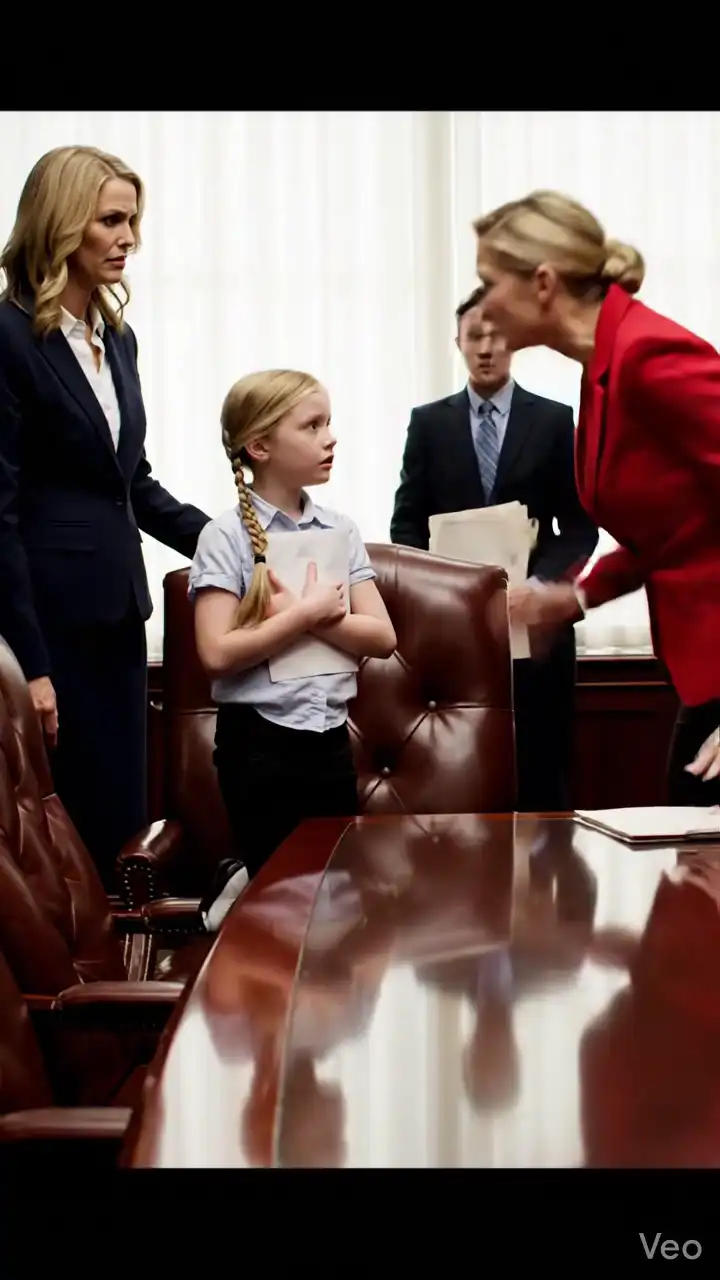
The first thing everyone in the conference room saw was my daughter standing on a leather chair because she was too small for the table.
The second thing they saw was the envelope in her hands.
“Give that back,” my husband’s sister said, loud enough to make the receptionist near the glass wall look up.
My daughter, Wren, froze with both hands around the white envelope like it might tear if she breathed too hard. She was eight, all knees and thin shoulders, with one braid half-loose because I had done it in the car while trying not to cry.
“It has Daddy’s name,” she whispered.
That should have softened the room. It should have reminded everybody that a child was in front of them, in a downtown law office with fake orchids and cold air and grown people saying ugly things over a dead man’s money.
It did not.
“No,” said Corinne Vale, my husband’s sister, stepping closer in heels that snapped against the polished floor. “It has your mother’s fingerprints all over it.”
My husband, Silas, sat at the far end of the table looking gray around the mouth. His left hand was flat on a stack of papers from Hollen & Pike Legal, but he hadn’t turned a page in ten minutes. He looked at me once, then down again, like eye contact itself was too expensive.
I was standing beside Wren. I remember because my palm was hovering over the back of her little sweater and I still didn’t touch her. I thought if I touched her, I would lose my composure in front of all of them.
Corinne turned to the room as if she were performing.
“Let’s stop pretending,” she said. “This woman dragged a child into an inheritance meeting because she knew she couldn’t win this alone.”
I heard a chair creak. Someone near the door sucked in a breath. The junior associate, a young man named Bram Dillard, lowered his eyes to his legal pad with the desperate focus of someone praying not to become part of a family disaster.
Wren looked up at me. “Mama, did I do wrong?”
That was the moment the room really went quiet.
She was still standing on the chair, one sock slipping inside her shiny Sunday shoe, clutching that envelope with my father-in-law’s handwriting across the front. Silas’s name. Thick blue ink. The old man’s shaky hand.
“No, baby,” I said. “You did not do wrong.”
Corinne gave a dry laugh. “Of course she’d say that.”
The senior attorney, Marla Pike, finally stepped in. She was in her sixties, silver-blond hair, navy suit, a face trained by years of probate fights to look calm around greed. “Ms. Vale,” she said, “this office will remain civil or we end the meeting.”
Corinne crossed her arms. “Then tell her to stop using the girl as a shield.”
Wren’s fingers tightened around the envelope.
I should explain how we got there, but the truth is it felt like we had been walking toward that room for months without knowing it.
My father-in-law, Gerard Vale, had died three weeks earlier after a long slide no one in the family wanted to call dying until he actually did. He had owned a small chain of hardware stores across North Alder County, and after my mother-in-law passed years before, everybody quietly assumed the estate would be simple. The stores would be divided. The house on Larchmere Drive would be sold. Corinne would get the lake parcel she had always wanted. My husband, the younger child and the more obedient one, would sign what needed signing and keep the peace.
That was how his family had always worked. Corinne was weather. Silas was shelter. Everybody else adapted.
Then came the first surprise. Gerard’s final will, signed fourteen months earlier, left almost everything in trust until a separate letter of instruction and transfer affidavit could be verified. The second surprise was worse: several business signatures from the last year were missing. Not delayed. Missing. Gerard had expected Silas to take over certain decisions, but some key documents had never been executed.
Corinne decided this meant one thing—that I had interfered.
She had reasons people would believe. I had not come from money. I had worked the front desk at a physical therapy clinic in Bracken Hollow when I met Silas thirteen years earlier, when he came in after wrenching his shoulder unloading drywall at one of the stores. I was the outsider, the second wife in everyone’s mind even though I was his only wife. We rented for years. I clipped coupons. I once patched Wren’s winter coat at the elbow with blue thread that didn’t match. Corinne noticed all of that and stored it like evidence.
By the time we were called to Hollen & Pike, she had already told two cousins, one pastor, and possibly half the county that I was trying to push a sick old man into changing papers he barely understood.
None of it was true. But truth is weak when people already like the lie.
That morning had started with Wren refusing to stay with my neighbor, Miss Dottie Creel. She had a stomachache and shadows under her eyes from too many whispered arguments overheard through vents and doorframes. When Silas said, “She can’t come,” Wren had stood in the hallway hugging her backpack and asked, “If Grandpa wrote Daddy’s name, why can’t I carry it?”
Silas had no answer.
So she came.
Now there she was, in a law office conference room on the seventh floor of a building that smelled faintly of coffee and toner, being looked at like she was part of a scheme.
Marla Pike held out her hand toward Wren. “Honey, can I see the envelope?”
Wren looked at me first. That nearly broke me.
“Yes,” I said gently.
Wren handed it over.
Marla opened it carefully. Inside was not money, not a codicil, not a dramatic confession. It was a single folded note and a copy of an appointment card from Briar Mercy Medical Center.
Marla frowned. “What is this?”
Corinne leaned in. “Exactly. More nonsense.”
Silas lifted his head at the hospital card. I saw it then—that tiny flinch around his eyes, not surprise exactly, more like dread finally finding its name.
Marla read the card aloud because no one else moved. “Consult follow-up. Dr. Elias Venn. Patient: Silas Vale.”
The room shifted.
Corinne looked from the card to my husband. “What is that supposed to mean?”
Before Silas could answer, the side door opened and a woman in pale blue scrubs stepped in carrying a tray of bottled water. She had probably been sent by building management from the small wellness clinic two floors down that shared after-hours staff with several offices. I had seen her in the hallway earlier. Thin woman, dark curls pinned up, badge clipped crooked.
She glanced at the card in Marla’s hand.
Then she looked at Silas.
And paused.
It was not a dramatic pause. That almost made it worse. It was the involuntary stop of someone who sees a name that has lived somewhere painful in their memory.
“Sorry,” she said softly. “I didn’t mean to interrupt.”
But she didn’t leave right away.
Her eyes stayed on my husband one second too long.
Marla noticed. So did I.
Corinne did too, but she mistook it for confirmation. “Wonderful,” she said sharply. “Now we have hospital paperwork and strangers. Is there any part of this circus your wife didn’t arrange?”
Silas pushed his chair back so suddenly it scraped hard across the floor.
“Enough,” he said.
But his voice was hoarse, unsteady, already too late.
Because every face in that room had turned toward him.
And for the first time all morning, I understood that the envelope was never the dangerous thing.
The dangerous thing was whatever my husband had been hiding with his own name on it.
Chapter 2
The woman in scrubs left the water tray on the sideboard and murmured something apologetic, but the room had already moved past politeness.
Corinne stepped in before anyone else could. “What hospital appointment, Silas?”
He didn’t answer.
I watched his throat move.
Marla Pike held the card between two fingers. “Mr. Vale, this appears relevant if it was enclosed with a note from your father.”
“Read the note,” Corinne snapped.
Marla unfolded the paper. The old stationery shook slightly in her hand. Gerard Vale’s handwriting had grown uneven near the end of his life, letters wandering downhill as if gravity had changed just for him.
She read it once silently, then looked up with a face that gave nothing away.
“Read it,” Corinne repeated.
Marla did.
“If this meeting happens before my son tells the truth, ask Dr. Venn why I would not let anyone force a signature from a sick man or from a son trying to hide how sick he is himself.”
Nobody moved.
Wren reached for my hand. I took it this time.
Corinne blinked twice, then laughed with pure disbelief. “Oh, come on.”
Silas stared at the tabletop.
I felt all the blood leave my face. Not because I suddenly understood everything. I didn’t. But pieces I had lived beside for months, maybe longer, began sliding toward each other with a horrible, soft click.
The cancelled fishing trip with Wren because of “migraine.” The locked bathroom door one night and the sound of him being sick. The fatigue he blamed on stress. The fact that his father had started watching him instead of arguing with him. The signatures left blank.
“Silas,” I said quietly.
He still didn’t look at me.
Corinne planted both palms on the table. “This is absurd. Gerard was confused at the end. You all know that. He could barely hold a fork. Now suddenly there’s a mystery illness and no one can produce a diagnosis, no one can produce records, but somehow this dead-man note appears exactly when money is on the line.”
She turned toward me. “You coached this.”
“No,” I said.
“You always needed drama to cover your angles.”
That stung because it was so unfair and so public. People can say almost anything when they know a room has already sorted you into the lower pile.
Bram Dillard shifted uncomfortably. Marla shot him a warning look as if telling him without words not to react.
Silas finally lifted his head. “Don’t talk to her that way.”
Corinne’s mouth tightened. “Then explain the note.”
He opened his mouth and closed it again.
That was when the woman in scrubs spoke from the sideboard.
“I know I shouldn’t be in this,” she said. “But I know that doctor’s name.”
Everybody turned.
She looked embarrassed to be visible. Her badge read TESS BARNETT. Not lawyer, not family, just support staff from the clinic downstairs. The kind of person nobody notices until they happen to be carrying the wrong truth through the wrong doorway.
Marla stepped in. “Ms. Barnett, if this concerns private medical information, be careful.”
Tess nodded quickly. “I understand. I’m not saying I know his case. I don’t. I just worked registration at Briar Mercy before I came here part-time. Dr. Venn is hematology.”
The word landed heavy.
I had to think through it. Blood. Bone marrow. Cancer. Things treated in quiet wings with artificial plants and bad coffee and families who stop making plans past Thursday.
Corinne scoffed. “That proves nothing.”
But it proved enough to alter the room.
I looked at Silas. “Why didn’t you tell me?”
His eyes came to mine then, and what I saw there was not guilt over money.
It was fear.
“I was going to,” he said.
When someone says that after months of silence, it means they were not going to. Or they wanted to but loved denial more than truth. I didn’t know which was worse.
Corinne seized the opening. “There. Listen to him. He was going to. This is just another stall. He always does this. He freezes, he says nothing, and then everyone else pays for it.”
“Corinne,” Marla warned.
“No.” Corinne pointed at the unsigned transfer papers. “Dad waited for him. The stores froze because of him. Taxes are hanging because of him. Employees are asking questions. We are sitting in a law office with a child and a fake hospital clue because my brother refuses to act like an adult.”
Wren pressed against me. Her hand was damp and cold.
I knelt so I could see her face. “You okay, baby?”
She nodded, but children lie with their eyes before they lie with words. Hers were glassy.
“Can I go out there?” she whispered, glancing through the glass wall toward the reception area.
“Yes.” I looked up. “Bram, would you—”
“I can sit with her,” Tess said quickly. “If that’s alright.”
I hesitated only a second, then nodded. Something about her quietness felt trustworthy.
Wren looked at Silas before she climbed down from the chair. “Daddy?”
He swallowed hard. “Go with Ms. Tess for a minute.”
Wren nodded and went. She carried her backpack by one strap, moving with the solemn care of a child trying not to make things worse. Tess took her hand and led her into the waiting area, where the city spread gray beyond the windows and a bowl of hard peppermints sat untouched on the reception desk.
The conference room felt harsher without her.
Marla placed the note on the table. “Mr. Vale, I cannot administer your father’s estate around riddles. If there is a medical issue affecting your capacity or timing, then we need facts. If there is not, then this note becomes a source of further dispute.”
Corinne leaned back like she had won. “There is no issue. He’s overwhelmed, as usual. He’ll say he was tired. He’ll say he was grieving before the man even died. He’ll say whatever she”—she flicked two fingers toward me—“told him to say.”
I should have kept my voice even. I didn’t.
“You think I wanted this?” I asked. “You think I wanted to stand here and find out with strangers that my husband may be sick?”
Corinne’s expression didn’t change. “I think you knew enough to use it.”
Silas stood up. “Stop.”
This time the word came out low and dangerous.
For one second I thought he might finally tell the truth.
Instead he braced both hands on the table and said, “I’ve had tests. That’s all.”
Tests.
Not what kind. Not why. Not what happened after.
Marla’s gaze sharpened. “When?”
He hesitated.
Corinne jumped in. “See?”
“When did your father write this note?” I asked.
Marla checked the date. “Three months ago.”
Three months.
Three months of pill bottles turned labels-down in the bathroom drawer. Three months of him stepping outside to take calls. Three months of me believing our marriage was under pressure from grief and family money, not from a secret growing in his body.
“You let me think you were pulling away from us,” I said.
His face broke at that, just slightly. “I know.”
That hurt worse than if he had shouted.
Corinne, somehow, still found room for contempt. “This is unbelievable. You are all acting as if he’s already been martyred. For all we know he’s anemic.”
Marla ignored her. “Do you have a diagnosis, Mr. Vale?”
He looked at the note again, then toward the glass wall where Wren sat on the reception sofa coloring on the back of an intake form while Tess watched over her.
“Not exactly,” he said.
Marla folded her hands. “Then what exactly do you have?”
He closed his eyes.
The silence stretched so long that I could hear the HVAC click on, a low mechanical breath above us.
Finally he said, “A biopsy. More bloodwork. A recommendation for treatment in Crestfall.”
I didn’t know whether to be relieved or more afraid. Treatment meant something real. Crestfall was where serious cases went. The regional oncology center was there.
Corinne stared. Even she had to slow down then.
But slowing down was not stopping.
“So all this time,” she said carefully, “while Dad was waiting on signatures, while I was handling the stores, while the estate got messier by the day, you were hiding specialist visits from your wife and letting everyone else clean up after you.”
“Yes,” he said.
The honesty of that one word changed the room in a way excuses never could.
Then Corinne delivered the cruelest line yet, because some people hear weakness and rush toward it.
“If you were that sick,” she said, “you’d have said so.”
I looked at him.
He didn’t answer her.
And in that silence, I understood there was still something missing—something worse than tests, worse than delays, worse than a man too scared to tell his wife he might be dying.
His father had not written ask Dr. Venn because he suspected illness.
He had written it because he knew.
Chapter 3
By noon, the law office had become a holding pen for judgment.
Marla Pike called for a recess and moved Corinne into another room with two bankers’ boxes and a paralegal. Bram went to make copies. Phones buzzed. Doors opened and shut. But tension did not break. It just changed shape.
I found Wren in the reception area sitting cross-legged on the sofa, drawing a house with a purple roof on the back of a legal notice. Tess Barnett sat near her with a paper cup of apple juice and a stack of old magazines nobody had read in years.
Wren looked up at me quickly, searching my face the way children do when they know adults are deciding what kind of day this will become.
“Are we in trouble?” she asked.
“No.”
“Did Grandpa leave Daddy a secret?”
I sat beside her. “Maybe he left him a truth.”
She considered that. “Is truth bad?”
Tess looked away, politely pretending not to hear.
“Sometimes it feels bad before it helps,” I said.
Wren nodded as if that made sense. Children accept complexity when it is offered gently.
She leaned against my arm. “Aunt Corinne is mean in her teeth.”
Despite everything, I almost smiled. “That’s not a kind thing to say.”
“But true.”
I kissed the top of her head.
Across the reception area, Silas stood by the windows with his back half-turned, phone pressed to his ear. He was speaking too softly to hear, but I could see the tension in his shoulders. The city below looked washed out, all concrete and slow traffic and a strip of river under cloud.
Tess cleared her throat. “I’m sorry if I overstepped in there.”
“You didn’t,” I said.
She twisted her badge lanyard between her fingers. “I just recognized Dr. Venn’s name. He’s… memorable.”
“Do you know him personally?”
“No. Just from Briar Mercy. He was one of the doctors who always came upstairs to registration himself when there was a paperwork problem. Most physicians send a resident or leave it for staff. He didn’t.” She hesitated. “He only did that for cases he considered urgent.”
I felt a chill run through me.
“Urgent,” I repeated.
She gave a small, apologetic shrug. “I’m sorry.”
Silas ended his call and came toward us. Wren sprang up at once.
“Daddy, are we going home?”
“Soon,” he said, though his face said he didn’t know.
She wrapped her arms around his waist. He bent to hold her, and the sight of his big hand spread across the back of her sweater nearly undid me. I watched him close his eyes against her hair like he was memorizing something.
When he straightened, Tess stood to leave. “I should get back downstairs.”
“Thank you,” I said.
But before she could go, Marla stepped out of the conference room and called, “Ms. Barnett? One moment, please.”
Tess stopped.
Marla approached with the hospital card in hand. “Do you recall whether Dr. Venn might still be practicing at Briar Mercy or only through Crestfall Oncology now?”
Tess blinked, surprised. “I think both, but his specialty referrals usually route through Crestfall.”
Marla nodded. “Thank you.”
Corinne emerged behind her, already agitated. “Why are we asking a temp worker for medical guidance?”
“Because,” Marla said coolly, “someone in this building may know how to verify whether your father referenced a real physician attached to a real treatment path.”
Corinne’s eyes flicked to Tess with naked disdain. “Wonderful. Let’s run the estate through receptionists now.”
Tess’s face colored, but she kept her voice level. “I was registration coordinator, not a receptionist.”
The correction was tiny, but it landed.
Corinne dismissed it with a laugh. “Fine. Coordinator.”
I saw then what kind of woman Corinne was under pressure—not just controlling, but hungry for witnesses. She needed people below her in the room. She needed me there, needed Tess there, needed even Wren there in some awful way, because humiliation only satisfies if somebody sees it.
Marla ushered us back into the conference room.
This time Wren sat beside me instead of climbing on the chair. She kept her backpack in her lap and her chin tucked down. Silas sat opposite Marla. Corinne angled herself toward him like a prosecutor.
Marla folded the note and set it near the unsigned documents. “Here is where we stand. Gerard Vale conditioned significant transfer authority around concerns he linked—however indirectly—to his son’s medical situation and his own unwillingness to force signatures. That affects motive, capacity, and potentially timeline.”
Corinne tapped the table. “And none of it changes the fact that the stores need management and the estate needs action.”
“Correct,” Marla said. “But if your father intentionally withheld transfer because he believed Mr. Vale was medically compromised and concealing that compromise, then his estate plan may reflect protective intent rather than confusion.”
Corinne stared at her. “Protective of whom?”
Nobody answered.
Wren’s voice came quietly from beside me. “Maybe of Daddy.”
Every adult in the room looked at her.
She shrank under it at once, and I put my arm around her shoulders.
Corinne gave a short exhale through her nose. “This is exactly what I meant. We are now taking legal insight from a child.”
Silas’s chair scraped again. “Enough, Corinne.”
“You say enough every time somebody says the thing you don’t like.”
“And you say whatever hurts most.”
For the first time that day, genuine sibling history rose between them. Not just estate conflict. Old roles. Old bruises.
Corinne leaned forward. “Then tell the room the whole thing.”
Silas didn’t answer.
She went on. “Tell them why Dad started driving you to appointments himself. Tell them why he called me and said you were being ‘stubborn.’ Tell them why the transfer packet sat on his kitchen counter for six weeks while you kept promising to stop by.”
I turned to Silas sharply. “He knew?”
Silas nodded without looking at me.
That nod was somehow worse than any spoken confession. His father knew. His father carried it with him. His father died carrying it while I slept beside my husband night after night, hearing him breathe in the dark and not understanding what he was withholding.
“Why not me?” I asked.
Silas looked wrecked. “Because once I told you, it would become real in the house.”
There are lies told for advantage and lies told from cowardice and lies told from love twisted into something harmful. This was the third kind, and it left damage just the same.
Corinne, perhaps sensing she had regained control, reached into her leather tote and pulled out a document folder. “If we’re doing whole truths, let’s do them.”
She slid a photocopy across the table to Marla, then to me.
I saw my own name before I understood what it was.
A credit report.
Attached to a rental court filing from nine years earlier, from before I married Silas, after my mother had gotten behind on bills and I had co-signed a lease I could not rescue.
Heat flashed through me so hard I thought I might faint.
“Corinne,” Marla said, warning clear in her voice.
Corinne ignored her. “I thought everyone should know the financial history of the woman suddenly so invested in trust language.”
Wren looked from the paper to me. “Mama?”
I could not speak for a second.
Silas stood up so fast his knee hit the table leg. “How dare you.”
“How dare I?” Corinne shot back. “You hid possible incapacity while she hovered over Dad’s paperwork. You want clean rules now?”
That moment was the ugliest of the day. Worse than accusations, worse than the note, because it had turned personal history into a public stain. My old poverty. My old humiliation. The years I had worked two jobs, eaten canned soup, and prayed my paycheck would clear before rent did. She had dragged it into fluorescent light in front of lawyers and my child.
Wren touched my sleeve. “Mama, what is that?”
I forced my voice steady. “An old hard thing. It’s over.”
Corinne gave a cold smile. “Some patterns aren’t over.”
I looked at her then, really looked. Perfect coat. Perfect nails. Grief sharpened into entitlement. And beneath it, fear. Not just of losing money. Of losing the story she had built, the one where she alone was competent, where her brother was weak, where I was opportunistic, where everyone’s place stayed fixed.
Marla closed the folder with a hard snap. “That was inappropriate and irrelevant.”
“It goes to motive.”
“It goes to cruelty,” Marla said.
Silas pressed a hand to his temple. He had gone pale. Sweat stood at his hairline.
Wren noticed first. “Daddy?”
He waved weakly. “I’m alright.”
He was not alright.
Tess appeared in the doorway then, having returned for the empty tray. Her eyes went straight to Silas’s face.
“Sit down,” she said.
Everyone stared at her.
She stepped in anyway. “I’m sorry, but he doesn’t look good.”
“I’m fine,” Silas muttered.
Tess’s voice changed, firmer now, stripped of deference. “No, you’re not. I’ve seen that color before.”
Corinne folded her arms. “Oh, for heaven’s sake.”
But Tess was already looking at Marla. “Does this building still keep emergency clinic staff on call on Tuesdays?”
Marla nodded slowly. “Yes.”
“Then call downstairs.”
Silas started to object, but before he could, he swayed.
Just slightly. A small human motion. Enough.
The room erupted.
Chapter 4
Everything after that moved in jolts.
Bram called downstairs. Marla cleared the table. Corinne backed away, startled into silence for the first time all day. I got to Silas just as he sank into his chair, one hand braced against the wood as if the room had tilted.
“Look at me,” I said.
He did, barely.
His skin had gone an odd waxy gray, and there was a sheen over his eyes that frightened me more than if he had collapsed outright.
“I’m okay,” he whispered.
“No,” I said. “Don’t do that to me now.”
Wren had started crying without sound, tears just sliding down. Tess crouched in front of her and said, “Come with me to the door, sweetheart. Just right there. Your mom needs room.”
Wren shook her head violently. “I want Daddy.”
Silas reached one hand toward her. “It’s okay, birdie.”
Birdie. He had called her that since she was a toddler, because she used to sleep with both arms tucked under her chin.
Within minutes a physician from the clinic downstairs arrived with a rolling bag and a nurse in charcoal scrubs. The doctor was a broad-shouldered man with reading glasses and a trimmed beard. His badge read DR. QUINCY REED.
He took one look at Silas and switched from polite office mode to medical speed.
“How old are you?” “Thirty-nine.” “Any diagnosed conditions?” Silas hesitated. Dr. Reed’s eyes sharpened. “Now is not the time to edit.”
Silas exhaled. “Possible lymphoma. Not confirmed. Waiting on final pathology.”
The words seemed to suck all sound from the room.
Even Corinne went still.
Dr. Reed glanced up at me. There was no pity in his face, just competence. “Has he started treatment?”
“No,” I said, because I knew as much as anyone now.
“Any recent fever? Night sweats? Shortness of breath?”
Silas gave small answers. Yes. Yes. Sometimes.
Dr. Reed checked his pulse, his pupils, asked for water, then looked at Marla. “He needs an ER evaluation if this is new or worsening.”
“It’s worsening,” I said before Silas could deny it.
He shut his eyes.
Corinne whispered, “Lymphoma?”
I turned on her with a force that surprised even me. “Don’t say it like you found gossip.”
She stepped back.
Wren broke from Tess and came to my side. She laid one tiny hand on Silas’s arm. “Daddy, are you sick sick?”
No parent should have to answer that in a law office conference room with legal pads and sealed affidavits on the table. But life rarely waits for proper rooms.
Silas opened his eyes and looked at her. “I think so, baby.”
Wren started sobbing then, full-body, unable to stay brave one second longer. I gathered her close while still trying to keep one eye on him.
Dr. Reed stood and said quietly, “He shouldn’t drive. Someone needs to take him now.”
Marla was already reaching for her phone. “I’ll have my assistant bring the car around.”
“No ambulance,” Silas said at once.
“Silas—” I began.
“No ambulance. Please.”
It was such a human plea, foolish and proud and frightened. The kind of request people make when they are trying to preserve one last piece of normal.
Dr. Reed didn’t argue, but his face said he disliked it. “Then now. Not in an hour.”
Things should have ended there. We should have left. The meeting should have dissolved under the simple truth that health outranks property every time.
But old conflicts die hard.
As I helped Wren into her coat and Marla gathered papers into neat stacks, Corinne stood at the far end of the table staring at Gerard’s note. Her face had changed. Not softened exactly. Disturbed.
“What did Dad know?” she asked no one.
Silas answered from his chair. “Enough.”
She looked at him. “Since when?”
“Last fall.”
“Last fall?” Her voice rose. “He knew since last fall and said nothing to me?”
Silas gave a tired laugh with no humor in it. “He begged me to tell Mara. He drove me to Briar Mercy twice because I said I was too tired. He sat in parking garages with me after appointments because I couldn’t start the truck. But no, he didn’t call you first.”
Something cracked across Corinne’s face then, a hurt older than anger.
“I’m his daughter,” she said.
“Yes,” Silas replied. “You’re also a storm.”
Marla looked down, pretending not to hear.
Corinne’s eyes filled but did not spill. “So he trusted you with that and not me?”
Silas shook his head slowly. “He trusted me to tell my wife. I didn’t.”
There it was. The true center of things. Not money. Not even the estate. A broken line of trust inside a marriage, hidden under legal folders until it burst in public.
Dr. Reed urged us toward the door, but Tess spoke up from beside the sideboard.
“There may be records,” she said.
Everyone paused.
Tess swallowed. “If Gerard Vale came with him to Briar Mercy and if there were consent forms for discussion or transport, there could be dated paperwork that supports the timeline.”
Marla turned to her at once. “Can those be requested quickly?”
“Not by me,” Tess said, “but if Dr. Venn is involved and the patient consents, there may be a direct release option.”
Dr. Reed nodded. “Yes. If this concerns current treatment planning, records can move fast.”
Corinne looked dazed, as if the ground beneath her argument had become unfamiliar.
I should have taken satisfaction. I didn’t. I only felt tired and hollow and scared.
We got Silas to Marla’s car in the parking garage under rain-dark concrete and flickering lights. Wren sat in the back beside him, clutching his hand with both of hers. I rode in front. Tess came too at Marla’s request because she knew how Briar Mercy’s intake system worked and because, by then, she had become one of those accidental witnesses fate assigns to a family on the wrong day.
At Briar Mercy, the emergency department smelled like bleach and coffee and tired people. Monitors beeped. A baby cried somewhere behind a curtain. A man in work boots held a bloodied towel to his forehead.
At registration, a clerk took Silas’s ID and insurance card and typed his name.
Then she stopped.
Not dramatically. Just like Tess had earlier. A pause. A name recognized. A history surfacing.
She looked up. “Mr. Vale?”
“Yes.”
“I’m going to flag hematology immediately.”
The pause hit me like ice water. Names carry weight in hospitals. They become files, scans, blood counts, half-finished plans.
We were taken back faster than expected. Blood was drawn. Vitals repeated. Dr. Reed gave report to the ER physician. Wren sat in a vinyl chair hugging my purse while I signed forms with a hand that didn’t feel attached to me.
Hours blurred. Corinne arrived eventually, somehow having followed or been told. She stood near the wall, coat still on, looking less like an accuser now and more like someone who had taken a wrong turn into a reality she had not prepared for.
Near evening, a tall man with a narrow face and tired kind eyes entered the curtained bay.
“Silas?” he said. “I’m Dr. Elias Venn.”
The name from the card.
The room held its breath.
He glanced at me, then at Corinne, then at Wren. When his eyes returned to Silas, there was no surprise there—only the weary frustration of a doctor seeing a patient who has waited too long.
“We need to stop meeting like this,” he said softly.
Silas gave the faintest, broken smile.
Dr. Venn looked at the chart, then at the note Marla had sent over by secure scan. “Your father was right to be worried,” he said.
Corinne made a strangled sound. “He knew?”
Dr. Venn’s professional caution flickered across his face. “I will discuss what Mr. Vale authorized me to discuss with family, once current consent is signed.”
Silas closed his eyes. “Give them access.”
That was the first full surrender I had seen from him all day.
Dr. Venn nodded. “Then yes. Your father was present for several discussions. He was particularly clear on one point.”
He looked directly at me.
“He said your husband would try to protect his family by hiding this until he ran out of strength.”
I pressed a hand over my mouth.
Silas turned his face away.
And suddenly Gerard’s note was no longer a puzzle or a legal device.
It was the last thing a dying father could do to drag the truth into daylight before his son buried himself under silence.
Chapter 5
The real reveal did not happen in one cinematic burst.
It came in documents, signatures, test results, and one conversation too intimate for how many people it had to wound.
Dr. Venn moved us into a consult room off the hematology wing after Silas was stabilized. Wren had fallen asleep curled in two waiting-room chairs pushed together, wrapped in Marla Pike’s wool coat. Corinne stood by the vending machines outside, refusing coffee she clearly needed. Tess had gone home hours earlier, but not before quietly telling me where the family restroom was and pressing two packets of crackers into my hand like a nurse would.
The consult room had a fake landscape print on the wall and a box of tissues nobody mentioned.
Dr. Venn sat across from me and Silas with a tablet in front of him.
“I’m going to be direct,” he said. “The biopsy and blood findings strongly support an aggressive lymphoma. We were already moving toward a treatment plan. The reason everything felt drawn out is because we were staging, confirming subtype, and addressing severe anemia and exhaustion.”
I heard the words. My mind still balked at arranging them into my life.
“How long?” I asked.
Silas rubbed both hands over his face.
Dr. Venn answered gently. “Symptoms likely began months before he sought evaluation. When he finally came in, he was already significantly compromised.”
Finally came in.
I looked at my husband. “When did you know enough to tell me?”
His eyes filled. “Around Thanksgiving.”
Thanksgiving.
I had sat across from him while he passed the sweet potatoes to Wren and asked if she wanted marshmallows on top. He had kissed my cheek while I washed dishes. He had gone outside afterward and stood in the dark for twenty minutes, and I thought he needed space from Corinne.
Thanksgiving.
“You let me decorate a Christmas tree with you,” I said, because strange details become unbearable when big truths arrive. “You let me buy wrapping paper. You let me think next summer mattered the same way.”
He made a sound then, small and wrecked. “I wanted one more normal season.”
Anger rose in me, hot and clean.
“You wanted it,” I said. “What about me? What about Wren? What about our right to know the life we were standing in?”
He nodded as if every word were deserved. “I know.”
“No, you don’t.”
Dr. Venn waited in silence, giving grief room to be ugly.
Finally I asked the only question that truly sat under all others. “Why hide it?”
Silas stared at the floor a long time.
Then he said, “Because my mother died in a hospital bed, and I watched my father become half a person before she was even gone. Because Wren still leaves the hallway light on when she hears sirens. Because when they said cancer the room changed shape and I wanted just a little more time before our house changed too.” He swallowed. “And because if I told you, you would look at me the way you’re looking at me now.”
I wasn’t looking at him with pity.
I was looking at him with heartbreak and fury and love that had nowhere gentle to go.
“That look,” I said quietly, “is what happens when you make me grieve alone while you’re still alive.”
He broke then. Not loudly. Not theatrically. Just shoulders bending inward, hands over his eyes, all the held-in fear finally spilling where no one could mistake it for stoicism.
Dr. Venn slid the tissue box toward him and then, with the precision of someone who has spent years balancing medicine with human damage, opened the rest.
Gerard Vale had attended three appointments.
Gerard had signed as emergency contact once when Silas was too weak after a procedure.
Gerard had argued with him in the parking structure at Crestfall Oncology for forty minutes because Silas refused to start treatment until after the estate transfer season and holiday inventory.
Gerard, already sick himself by then, had gone to Hollen & Pike afterward and amended handling instructions around the business succession because he no longer trusted delays to be harmless.
“Your father believed that if he put the pressure on legal timing,” Dr. Venn said, “the truth would eventually be forced into the open.”
Silas gave a bitter laugh through tears. “That sounds like him.”
I thought of Gerard’s rough hands, his old truck smelling of cedar and metal shavings, the way he had once fixed Wren’s broken toy kitchen with a tiny screwdriver while pretending not to be sentimental. He had known he was dying. He had known his son might be entering his own fight. And even then, he had found one last practical way to protect us all.
Not from illness. From secrecy.
Corinne knocked once and stepped into the room before anyone answered. Her eyeliner had smudged at the corners. For the first time in the thirteen years I had known her, she looked uncertain of her rank in the world.
“Can I come in?” she asked.
No one stopped her.
She looked at Dr. Venn. “I heard enough outside to understand I was wrong about the estate.”
Silas didn’t respond.
She kept going, voice thin now. “I thought you were doing what you always do. Avoiding. Freezing. Letting everyone else handle consequences.”
Silas lowered his hands and looked at her. “I was.”
“Yes, but not for the reason I thought.” Her mouth trembled once, almost imperceptibly. “Dad drove you?”
Silas nodded.
Corinne laughed once in disbelief, then covered her face. “He never said a word.”
“Would you have let him keep the stores frozen if he had?” Silas asked.
She did not answer. That was answer enough.
I expected her to defend herself. Instead she turned to me.
“I pulled your records,” she said. “The eviction filing. I knew it would shame you.”
It was so direct it nearly knocked me back.
“Yes,” I said.
“I wanted the room against you.”
“Yes.”
Her eyes dropped. “I’m sorry.”
It was not enough to repair what she had done. Some apologies arrive too late to feel clean. But I believed she meant it.
Outside in the hall, a child cried, then laughed at something immediately after. Hospitals hold reversals like that every minute.
Marla Pike arrived before midnight with a folder and two overnight bags she had somehow persuaded Bram to fetch from our house. She set them down and spoke in that competent, unsentimental way that suddenly felt merciful.
“I have enough now,” she said. “With consent-based records confirmation and your father’s note, the estate dispute changes materially. Gerard did not exclude anyone out of confusion. He delayed authority because he understood his son’s health issue affected timing and judgment. The trust mechanism stands.”
Corinne sat down hard in the corner chair.
Marla continued, “And before either of you worries about optics, let me be plain: no court worth the filing fee is going to look kindly on a daughter publicly humiliating an eight-year-old while ignoring documented medical context.”
Corinne closed her eyes.
Then Marla handed me one additional paper.
It was a scanned release form from Briar Mercy, dated four months earlier.
Patient: Silas Gerard Vale.
Emergency contact present at consultation: Gerard Vale.
Below that, in shaky witness signature, was the old man’s name.
The middle name hit me first.
Gerard.
Silas had carried his father’s name in his own body all along.
I looked at the signature and finally understood the envelope Wren had carried into the law office.
It wasn’t evidence against anyone.
It was a dying grandfather’s way of sending his son’s hidden truth to the only room powerful enough to stop everyone from forcing him forward while he was quietly falling apart.
And my little girl, standing on a chair with that envelope in her hands, had not embarrassed us.
She had delivered the truth.
Chapter 6
Three months later, the conference room at Hollen & Pike looked smaller.
Maybe that was because nobody was shouting.
Rain traced the windows in fine silver lines. The fake orchids were still fake. The peppermints were still untouched. But the room had lost its cruelty.
Silas was thinner now, his hair cut close after treatment started taking what it wanted. He wore a knit cap Wren had picked out in a ridiculous bright green because she said hospitals needed more frog colors. His skin was pale, but his eyes were clearer than they had been the day of the meeting.
Wren sat beside him swinging her legs, drawing in a real notebook this time. Every few minutes she leaned against his arm as if checking he was still there. He let her.
Marla Pike reviewed the final settlement in a voice smooth from long practice. Gerard’s estate would be administered under the trust exactly as revised. Corinne would oversee interim operations of two stores under supervision, not sole control. Silas’s ownership share remained protected during treatment. A portion of the liquid assets would be used to stabilize payroll and healthcare obligations. No one contested the note anymore.
Truth had done what argument could not.
Corinne sat across from us in a camel-colored coat with no sharpness left in how she carried herself. She had apologized to Wren separately two weeks earlier, kneeling in our living room until she was eye level and saying, “You should never have been treated that way.” Wren had studied her for a long moment and replied, “Then don’t do it again.”
That was that.
Some forgiveness begins with rules.
When Marla finished, she asked if there were questions.
Wren raised her hand.
All four adults looked at her.
Marla smiled despite herself. “Yes, Miss Vale?”
Wren glanced at her father. “Does Grandpa know we fixed it?”
Silas’s mouth trembled into a smile that carried grief inside it. “I think so.”
Wren nodded, satisfied, and went back to drawing.
After the papers were signed, Bram—who had become unexpectedly kind in the months since—brought in hot chocolate from the café downstairs instead of coffee because he remembered Wren hated coffee smell. Little things matter after public pain. They become how people repair the room they once stood in doing nothing.
As we gathered our coats, Tess Barnett stopped by the doorway on her lunch break from the clinic annex. She had changed jobs again, this time back into patient coordination at Briar Mercy, and somehow still found time to wave at Wren whenever we came for appointments.
“How’d it go?” she asked.
Marla answered, “Resolved.”
Tess smiled. “Good.”
Wren ran to show her a drawing. It was of a man in a green hat holding hands with a girl under a purple-roofed house. Beside them was another older man with a toolbox and a crooked smile. Above all three she had written, in uneven block letters, STILL FAMILY.
Tess blinked hard and praised the picture like it belonged in a gallery.
I stood by the window and watched my husband with our daughter. He was tired. He would be tired for a long time. We did not know yet what treatment would finally do, what would return, what would stay gone, what future had been bruised but not broken. Illness had not become beautiful just because it had become known. It was still hard, still expensive, still frightening at three in the morning.
But it was no longer hidden.
Silas came to stand beside me when the others drifted into the hall.
“I was wrong,” he said.
“Yes.”
He accepted that. “I thought keeping it inside was strength.”
I looked at him, at the man I loved, at the damage silence had done and the tenderness still left to build with. “No,” I said. “It was weight.”
He nodded. “And you carried the consequence.”
“So did Wren.”
He looked toward her and swallowed. “I know.”
After a moment, he reached for my hand the way a person reaches for something not guaranteed. I let him take it.
Beyond the glass wall, Corinne bent to zip Wren’s backpack because Wren had tied the strings into a knot. Bram held the elevator. Tess laughed at something Wren said. Marla tucked legal folders under one arm and watched all of us with the tired satisfaction of someone who had seen plenty of families lose themselves and was relieved this one had at least found the right truth in time.
Silas pressed my hand once.
“I’m done hiding,” he said.
This time I believed him, not because he sounded dramatic, but because he sounded plain.
That was what truth had cost us. And that was what it had finally bought: not certainty, not a miracle, not an easy ending—but a life where the people who loved each other were at least standing under the same weight.
We walked out of the law office together, our daughter between us, and for the first time since Gerard died, it felt like nobody in the room was carrying the wrong story anymore.
Truth, I learned, is often heavier than appearances.
But it is still the only thing strong enough to hold a family when everything else starts to give way.
Disclaimer: Mention of any brand or trademark is for identification only and does not imply partnership or endorsement
MY HUSBAND USED MY MONEY, GOT ENGAGED TO HIS MISTRESS, AND STOOD THERE WHILE SHE SLAPPED ME

THE MAID OF HONOR POURED WINE ON ME AT MY BRIDAL SHOWER AFTER STEALING MY FIANCÉ. SHE DIDN'T KNOW THE ROOM WAS ABOUT TO HEAR WHAT HE'D BEEN SAYING TO BOTH OF US.

THE MAID OF HONOR POURED WINE ON ME AT MY WEDDING AND CALLED ME CRAZY. SHE FORGOT I STILL HAD THE VOICE NOTE SHE SENT MY FIANCÉ.