HE CALLED ME A CLEANING LADY IN HIS FATHERS WILL READING
Chapter 1
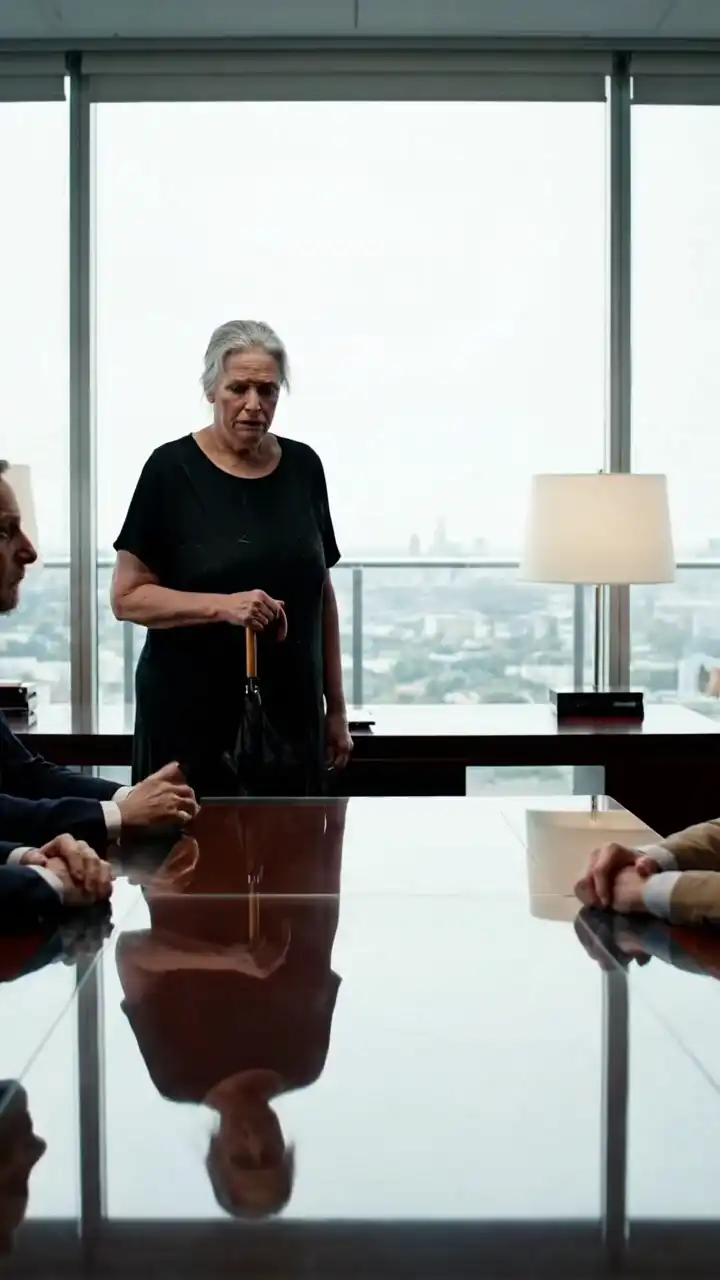
The first thing I saw when I stepped into Halbrook Pike and Vann was my own reflection in the glass conference wall: black dress from three funerals ago, sensible shoes damp from the bus stop, a grocery-store umbrella dripping onto expensive carpet. Behind that reflection sat six strangers in polished chairs, all of them already looking at me like I had tracked mud into a church.
Then a man in a navy suit held up a yellowed photograph between two fingers and smiled without warmth.
“I think housekeeping should wait outside.”
The room went very still.
For one half second, nobody moved. The junior assistant froze with a legal pad in her hand. A silver carafe of coffee sat untouched in the middle of the table. A woman with pearl earrings sucked in a breath so softly I still heard it. Even the copier humming down the hall seemed too loud for that sentence.
My fingers tightened on the strap of my bag.
“I’m here for the reading of Warren Vale’s will,” I said.
The man in the navy suit leaned back, all polished ease and expensive confidence. His name, I had been told downstairs, was Grady Vale. Warren’s son. He looked like the kind of man who had never once doubted any room would make space for him.
He lifted the photograph higher, as if it proved something. It was old and curled at the corners, the kind of picture that lived too long in a drawer. “And yet you walked in carrying this from my father’s things,” he said. “You were employed in his house. Let’s not pretend there’s confusion.”
I knew exactly which photograph he meant. I had found it three days earlier tucked inside a Bible in Warren’s bedroom, after the coroner, after the casseroles, after the silence that follows a death when the house finally belongs to echoes. I had put it in my purse because something about it bothered me. Or maybe because something about it recognized me before I recognized it.
“I was not employed in his house,” I said.
A woman beside Grady let out a dry little laugh. She was maybe forty, glamorous in the thin, sharp way of women who live on coffee and anger. “Then what were you, exactly?”
His sister, I guessed. Later I learned her name was Lenora.
At the head of the table, the attorney cleared his throat. “Mrs. Bell, please have a seat. We can sort out introductions in order.”
Mrs. Bell. Widow. That was how I had been listed on the call I got that morning from the law office. Mrs. Della Bell, please come at ten-thirty regarding the estate of Mr. Warren Vale. They had not said why. They had not said who else would be there. They had not said I would walk into a room full of Vale blood and be told to stand by the wall.
I sat in the last open chair near the end of the long mahogany table. I placed my wet umbrella on the floor, my purse in my lap, and kept my back straight. I had learned after my husband died that dignity is often the only thing people will leave you if they think you have nothing else.
Grady kept looking at me as if he could force me smaller.
“Before this goes further,” he said to the attorney, “I want it on record that this woman inserted herself into my father’s life after my mother died. She was always hanging around the property. Bringing food. Running errands nobody asked for. If she’s here because my father decided to reward loyalty, fine. But let’s use honest words.”
I could feel every eye shift toward me again.
I knew what I looked like to them. Sixty-one, plain-faced, widow from the lower end of Mercer Hollow, hands that still showed the wear of ten years in a laundry press room before arthritis made me quit. A woman who had spent the last fourteen months helping an old man with groceries, soup, and doctor rides because he was alone and because loneliness speaks in a language I know.
My husband, Calvin, had died in a hospital room with no drama and no last revelation. Just one long machine tone and my own hand cooling against his. Since then, my life had narrowed into bus routes, church suppers, and trying not to answer silence with television.
Warren Vale had lived four blocks over in one of the old brick houses on Ridgemont Lane, where the porch columns were thicker than my kitchen table legs. He had started speaking to me because I dropped a bag of oranges one winter in front of Dobbins Pharmacy and he knelt to help me pick them up, though his own hands shook.
“You should let somebody help you,” I had told him.
“You first,” he had said.
That was all it was at the beginning. Two lonely people making room for one another. I never crossed lines I thought would shame me. I never asked for money. I never asked for favors. I brought him soup when his cough got bad. I read him the sports page when his eyes blurred. I argued with him when he skipped his pills. That was the whole ugly scandal.
But from the look in Grady’s face, you would have thought I had climbed through the window carrying a silver tray.
The attorney folded his hands. His nameplate read EAMON STRAKE. “Mr. Vale, we will proceed under the terms of your father’s documents. If anyone has objections, they can be made in proper sequence.”
Grady gave a tight nod, but he wasn’t finished. “Then start with her status.”
Eamon glanced down at his file. “Mrs. Bell was named in your father’s final estate memorandum as a person to be present for the reading.”
Lenora laughed outright this time. “A person to be present. That’s elegant.”
I looked at the yellowed photograph in Grady’s hand. “May I see that?”
“No.”
The answer came too quickly, too hard. That made something in me sit up.
The picture had shown Warren much younger, maybe in his thirties, standing beside a dark-haired woman on a porch I didn’t recognize. In the woman’s arms was a baby wrapped in a white blanket. The edges were cracked. The back had a date but no names. I had only looked at it for a few seconds before someone from the funeral home arrived, and then the house turned practical again. But the woman in the photo had my chin. Or maybe I was imagining that now because Grady was using the picture like a weapon.
“Mr. Vale,” the attorney said, more sharply this time, “place the photograph on the table.”
For the first time, Grady hesitated.
That tiny pause mattered.
He laid it down in front of him but kept two fingers on one corner.
Eamon opened the estate packet. “This is the last will and testament of Warren Elias Vale, executed nine months before his death and witnessed according to state law—”
“Did she know he was sick?” Lenora cut in, staring at me. “Is that when she got close?”
I didn’t answer her. Sometimes silence makes cruel people louder.
She leaned toward me. “Women like you always say it was companionship.”
The words landed harder because they were said so lightly.
I felt heat rise into my face, but I kept my voice even. “Women like me bury husbands too.”
That shut her up for one breath.
The assistant looked down fast, pretending to straighten papers. Eamon adjusted his glasses and resumed reading, but the room had changed. It felt less like an office and more like a trial where the verdict had been decided before I came in.
Then he read the first line that truly mattered.
“To my children, Grady Vale and Lenora Kells, I leave the holdings already transferred to them in trust and the remaining shares of Vale Hardware equally, with the exception of the property known as Briar Glen House, and with the exception of all materials contained in the blue cedar box in my study cabinet, which are to be delivered unopened into the hands of Mrs. Della Bell.”
Grady slammed his palm on the table.
“This is absurd.”
The coffee cups rattled. The assistant jumped.
Eamon kept reading over him, but I no longer heard every word. All I heard was blue cedar box. I had never seen a blue cedar box. Warren had never mentioned one. I had never once asked what would happen after he died, because asking felt too much like calculating.
Lenora stared at me like I had turned into something unclean in front of her.
“What did you tell him?” she asked.
“Nothing.”
“You expect us to believe that?”
“I don’t expect anything from you.”
That seemed to enrage Grady more than tears would have.
He pushed back his chair and stood. “My father was in decline. He was manipulated. If this woman touched one document in that house, I want it examined.”
Eamon’s expression tightened. “Sit down, Mr. Vale.”
Instead, Grady grabbed the photograph again and flicked it toward me across the polished table. It spun once and stopped near my purse.
“If you want proof of your little role,” he said, “there it is. A servant holding onto old family scraps.”
I looked down.
The baby in the photograph was wearing a tiny knitted cap. The woman holding the child had soft, dark eyes and a tired mouth. Behind them, just visible on the porch post, someone had written a date in chalk.
August 14.
The same birthday my mother had always claimed she wasn’t sure about.
A chill moved through me so suddenly I forgot the room for a second.
“Mrs. Bell,” Eamon said quietly, “are you all right?”
No. Something was wrong. Something old. Something bigger than insult.
I touched the edge of the photograph with one finger.
And for the first time since I walked into that office, I was no longer sure I had come there by mistake.
Chapter 2
The reading should have stopped after that, but wealthy families do not stop when they lose control. They become more polite, which is worse.
Grady sat down slowly, jaw set so hard I could see the pulse flickering near his temple. Lenora crossed one leg over the other and began tapping one manicured nail against the arm of her chair. Attorney Strake continued with the will in the calm voice of a man used to storms he could bill by the hour.
I heard numbers, property descriptions, percentages, clauses. It all drifted around me like radio static. My eyes kept returning to the photograph on the table.
There was something familiar in the woman’s face, but not in the simple way people say a stranger resembles someone from church. It felt nearer than that and farther at the same time, like remembering a dream from childhood only after hearing a sentence you were never supposed to hear again.
My mother, Iris Bell, had died ten years before Calvin. She had been a woman of careful silences. She kept a canning shelf organized by month, folded old wrapping paper for reuse, and never spoke of my father except to say, “He was not built to stay.” When I was little, I asked if he had brown hair like mine. She said maybe. I asked if he was dead. She said, “For us, yes.”
That was all I got.
At the table, Eamon finished the reading and closed the folder. “Formal copies will be distributed once acknowledgment is signed.”
“No,” Grady said.
It was a small word, but he said it like a door slamming.
“No,” he repeated, louder. “I am not acknowledging any document that hands part of my father’s personal estate to a stranger before we verify his state of mind.”
Lenora nodded. “And the house exception?”
Eamon steepled his fingers. “As stated, Briar Glen House is not included in the equal transfer.”
“To whom, then?” she asked.
He looked at me.
My mouth went dry.
“To Mrs. Della Bell,” he said.
If someone had struck the center of the table with a hammer, the sound could not have felt sharper.
Lenora went white first, then red. “The house.”
Grady made a hard, disbelieving sound in his throat. “That woman gets the house?”
“The deed transfer was prepared before Mr. Vale’s death but held pending this reading.”
“That can be challenged.”
“Many things can be challenged,” Eamon said. “Not all of them successfully.”
I should have spoken then. I should have said I didn’t want the house, that there must be some mistake, that Warren had gone too far and I would not be used as a match thrown into old family gasoline. But shock has its own manners. It holds your tongue while everyone else invents your motives for you.
Lenora stood so quickly her chair scraped. “He gave her my mother’s house.”
“No,” Grady snapped, “he gave it to a widow from nowhere because he liked being needed.”
I looked at him then. “I never asked him for anything.”
“You didn’t have to.”
The assistant near the wall lowered her eyes again. Another man in the room, someone from the firm’s probate department, shifted uncomfortably with a stack of folders in his arms. Nobody wanted to be looking directly at the humiliation, but nobody looked away either.
That is how public cruelty works. It makes witnesses out of people who would prefer to call themselves uninvolved.
Eamon tried to restore order. “Mr. Vale, Ms. Kells, if you wish to contest the will, you may do so through legal channels. Today’s purpose was notification and transfer.”
Grady pointed at the photograph still near me. “Then explain why my father ordered a box of personal materials delivered to her. Explain why that picture was hidden in his room and not with our family albums.”
“Perhaps because your father intended those materials to answer questions,” Eamon said.
“What questions?”
Eamon paused too long.
Grady saw it. Lenora saw it. I saw it.
A thin current passed through the room.
“What did he tell you?” Lenora asked.
“Confidentiality extends beyond death in some matters,” Eamon replied carefully. “Especially where instructions require documents to be opened in sequence.”
My stomach tightened.
“In sequence?” I said.
Eamon turned to me. “Mrs. Bell, there is indeed a blue cedar box. It is secured in our records room. Mr. Vale left instructions that it be delivered only after the will was read in the presence of his children and after you accepted receipt.”
“I don’t know what I’m accepting.”
“You may decline,” he said gently. “But I advise you not to do that without seeing the contents.”
Grady let out a bitter laugh. “Of course.”
Lenora folded her arms. “This is theater.”
“No,” Eamon said. “This is estate law.”
But it felt like theater. A cruel one. The widow in the wrong shoes, the rich children with sharpened voices, the dead man’s lawyer standing between everyone and whatever truth had been delayed too long.
I looked again at the photograph. “May I have it now?”
Grady opened his mouth to refuse, but Eamon spoke first. “Yes.”
I picked it up with both hands.
The paper was thinner than I expected. On the back, in faded blue ink, someone had written:
For Maribel So she will know
My heart gave one hard, painful beat.
Maribel was not my name.
But when I was young, once—only once—I had heard my mother say the name into the kitchen sink while she washed dishes. Not to me. To herself. Or maybe to a ghost.
I had asked, “Who’s Maribel?”
She dropped a plate so suddenly it cracked in the basin.
“Nobody,” she had said.
In the law office, the room blurred for one second around the edges. I had to force my breath to slow.
“Mrs. Bell?” Eamon said.
“I’m fine.”
It was a lie. But I knew enough about pride to dress my lies neatly.
He signaled to the assistant, who left and returned a minute later carrying a rectangular cedar box no larger than a bread loaf. Its wood was dark blue washed almost gray with age, the brass clasp tarnished. When she set it in front of me, a faint smell rose from it—cedar, dust, old paper, the locked-up smell of attics and decisions.
Lenora gave a thin, angry smile. “Go ahead. Open your prize.”
“It may be wiser,” Eamon said, “for everyone to remain seated.”
“Why?” Grady said. “What exactly are you expecting to happen?”
Eamon did not answer. That frightened me more than if he had.
My fingers shook when I touched the clasp. I hated that they could see that. I hated more that I could not stop it.
Inside the box were three things.
A sealed envelope with my name written in a careful hand I knew at once as Warren’s.
A second envelope marked FOR COUNSEL IF CONTESTED.
And a smaller packet wrapped in cloth.
No money. No jewelry. No obvious confession. Nothing theatrical enough to satisfy the room.
“Read it,” Lenora said.
Her voice had gone low and tight.
I opened Warren’s envelope first.
Della, If this is being placed before you, then I have died before doing the one decent thing I owed many years ago. Read everything in this box before you speak. If my children are in the room, let them stay. They deserve anger, but not ignorance. Your mother was named Maribel Hart. She came to Briar Glen in the summer of 1964 carrying you in her arms.
I stopped.
The words would not move at first. The room seemed to tilt, not enough to fall, just enough to make me distrust my own balance.
“Keep going,” Grady said, but there was less confidence in him now.
I read again, silently, because I could not yet give those words to the air.
Your mother was not employed at Briar Glen. She was brought there in secrecy. My father, Silas Vale, fathered her child and paid to have them kept away from town until arrangements could be made. Those arrangements were never honorably made. Maribel left before the matter was settled. I learned the truth years later, and by then too much cowardice had hardened into family history.
I looked up.
Nobody spoke.
The office had gone so quiet I heard the assistant breathe.
“What is it?” Lenora said.
I swallowed. “It says my mother’s name was Maribel Hart.”
Grady frowned. “And?”
I forced myself to say it. “It says your grandfather fathered her child.”
Lenora’s face changed first—not into belief, not yet, but into offense so deep it looked like pain. “That’s impossible.”
Eamon stood. “Mrs. Bell, please continue.”
My voice barely sounded like mine.
“Silas Vale fathered her child,” I repeated. “He paid to keep them hidden. Warren learned the truth later.”
Grady shoved back from the table again. “No.”
But I had seen something in his eyes. Not shock alone. Recognition. The fearful kind that appears when a family secret is not impossible, only finally spoken.
I opened the cloth packet with numb fingers.
Inside was a birth certificate copy, browned at the folds. No father listed. Mother: Maribel Hart. Child: female, named Delilah Hart, born August 14 in Cresswell County.
Delilah.
Della.
My mother had changed our last name. Maybe my first too. Or shortened it because names can be made smaller when people are trying to survive.
There was one more document under the certificate: a letter from a retired nurse named Odessa Wynn, notarized two months before Warren died, swearing she had assisted in the confinement of Maribel Hart on instructions arranged through Silas Vale’s office manager and that the child born that night had “the clear gray eyes common in the Vale line.”
My hand flew to my mouth.
Gray eyes.
Calvin used to tease me that my eyes looked like rainwater in a tin bucket. My mother’s had been dark brown.
“No,” Lenora said again, but now it sounded weaker. “This is disgusting.”
Grady stared at me as if my face had become evidence against him.
And I sat there with a dead man’s handwriting in my lap, realizing the room had called me a stranger only because the truth had been hidden long enough to make it convenient.
Chapter 3
The contest began that afternoon.
Truth does not arrive clean. It arrives with signatures, accusations, old resentments, and people suddenly desperate to protect the version of the past that kept them comfortable.
By two o’clock, Grady had called his own attorney. By three, Lenora had phoned two cousins and an uncle in Addison Parish as if blood could be voted on. By four, I was still in a consultation room at Halbrook Pike and Vann while Eamon Strake explained, in the measured way lawyers do, that a buried family line can be both obvious and difficult at the same time.
“Your legal position regarding the house is stronger than they want it to be,” he said. “Your position regarding lineage may depend on corroborating evidence.”
I sat in a leather chair too soft for the day I was having. The photograph, letter, and copy documents lay on the table between us in neat plastic sleeves now, as if preservation could make the contents less violent.
“You’re saying it might all be true and still become a fight.”
“Yes.”
“It already is.”
He gave a tired nod. “Yes.”
Outside the frosted glass wall, I could see people moving through the office with lowered voices and professionally blank faces. The gossip had begun. It always does, especially when money gives people permission to call their interest concern.
“I didn’t know any of this,” I said.
“I believe you.”
“That doesn’t help much.”
“No,” he said. “But it matters.”
I looked at the photograph again. “Why would Warren leave me the house?”
Eamon exhaled slowly. “Because Briar Glen was where your mother was hidden. Because he considered the house part of the original wrong. Because he believed restoring it to you was the only act available to him that resembled justice.”
“Why not tell me when he was alive?”
“That,” Eamon said, “I asked him more than once.”
“And?”
“He said shame matures slowly in old men.”
I looked away before my face could give anything up.
Warren had been kind to me. More than kind. Steady. Attentive. Funny in a dry, sideways way. But kindness and courage are not twins. Some people die with one and not enough of the other.
There was a soft knock. The assistant stepped in. Her name was Nia; I had finally read it on her badge.
“Mr. Strake,” she said, “there’s a woman asking for Mrs. Bell. She says she’s family.”
I frowned. “Family?”
“She gave the name Vonda Reese.”
I blinked. “My cousin Vonda?”
Nia nodded.
Of all people.
Vonda Reese was my mother’s sister’s daughter, a woman I saw mostly at funerals and church fish fries. She lived out in Brant Wash with three little dogs, dyed copper hair, and the kind of memory that always sounds like gossip until it turns out to be history.
“Send her in,” I said.
Vonda entered carrying a giant purse and wearing a raincoat patterned with faded strawberries. She stopped short when she saw the office.
“Lord,” she whispered. “These chairs look expensive.”
Then she saw my face. Her own changed immediately. “Della. What happened?”
I hadn’t called her. I still don’t know who did. Maybe one of the church ladies who heard I’d gone downtown. News in Mercer Hollow traveled through women who said they hated gossip and then carried casseroles straight through it.
I stood up, and before I could decide not to, I hugged her.
That alone told her how bad things were.
She patted my back once. “All right. Start small.”
I showed her the photograph first.
The moment she saw it, all color left her face.
“Oh,” she said.
Eamon and I looked at each other.
“You know this picture?” I asked.
Vonda sank into the nearest chair without being invited. “I know that porch.”
Something moved in me like a door unsealing.
“Whose porch?”
“Old tenant cottage behind Briar Glen.” Her voice had gone thin. “My mother took me there one time when I was maybe seven. Just once. She told me not to mention it to anybody because rich people ruin poor women and then bury the shovel.”
Eamon straightened.
Vonda pointed at the woman in the photograph with a shaking finger. “That’s your mama.”
I sat down hard.
“You’re sure?”
“I’m sure.”
“How?”
“Because she used to sing while she ironed. Same mouth. Same eyes.” Vonda looked at me, then at the photo again. “And because my mother cried over this exact picture one night after too much cooking sherry. Said Maribel should’ve burned every scrap that tied her to that place.”
I felt suddenly cold all through my arms.
“Why didn’t anyone tell me?”
Vonda made a helpless sound. “Because your mother swore folks to silence. Because she left town for a while and came back with you and a new last name. Because she said if the Vales wanted forgetting, then forgetting could cost them the rest of their lives.”
That sounded like my mother in a way silence never had.
Eamon spoke carefully. “Mrs. Reese, would you be willing to provide a statement?”
“If it keeps these people from calling Della a liar, yes.”
As if summoned by the words, the door opened before anyone could stop it.
Grady stepped in.
He had removed his suit jacket and loosened his tie, but he still carried himself like a man trying to stand on the last stable board of a collapsing dock.
“You can’t be in here,” Nia said from behind him, flustered.
“I won’t be long.” He looked at Vonda, then at me. “Of course you found a witness.”
Vonda’s eyes flashed. “Found? Honey, I walked in.”
He ignored her and spoke to me. “My father was lonely. That made him gullible.”
Eamon stood. “Mr. Vale, leave now.”
But Grady didn’t move. He kept his gaze fixed on me.
“I want one answer,” he said. “Did you know before today who you might be?”
“No.”
“Then why keep that photograph?”
“Because it felt important.”
He gave a hard, joyless smile. “Convenient.”
I stood up too. My knees were weak, but anger can brace a person better than certainty.
“You humiliated me in front of your father’s lawyer,” I said. “You called me a cleaning lady. You called me a stranger. And now you want to ask for honesty like you’ve earned it.”
His expression tightened, but he still would not step back.
“You appeared in our lives out of nowhere.”
“No,” I said quietly. “I was placed outside your lives before I could walk.”
That hit him. I saw it.
Not surrender. Not belief. But a crack.
He looked past me to the photograph and then away too quickly.
“What are you not saying?” I asked.
He gave me nothing.
Eamon moved toward the door. “Mr. Vale.”
Grady finally turned. “If this goes to court, they’ll strip every story down to documents. Remember that.”
Then he left.
The room stayed tense after he was gone, as if some part of him had remained there on purpose.
Vonda muttered, “That one knows more than he should.”
I thought the same thing.
By evening, I was back in my apartment over Denton’s Appliance Repair, sitting at my small kitchen table with the copies Eamon had allowed me to take. Rain pressed against the window. The radiator hissed. Across the street, the neon from Lou’s Bait and Tackle flashed weak red over puddles.
I made tea and didn’t drink it.
I laid out the photograph, the letter, and the notarized nurse statement. Beside them I placed the one thing I had brought home from my mother’s dresser after she died: a tiny silver locket with no picture in it. Just a dry pressed sprig of something brittle and pale.
I had opened it a dozen times over the years and found nothing useful.
That night, on a feeling I couldn’t explain, I turned the locket over under the kitchen light.
There was an engraving on the back so faint I had never really seen it.
M.H.
Maribel Hart.
My hands began to shake again, only now there was no room full of strangers to witness it.
I sat there until the tea went cold and the rain slowed and the shape of my life shifted into something I could no longer name. Widow. Neighbor. Useful woman people underestimated. Those still fit. But now there was another truth trying to force itself into place.
Not stranger.
Not servant.
Not charity.
Hidden.
At nine-thirty, my phone rang.
It was Eamon.
“I’m sorry to call late,” he said. “But there’s something you need to know.”
I gripped the phone tighter. “What now?”
“Mr. Vale’s children have requested an emergency injunction regarding the house transfer.”
Of course they had.
“And?”
“And there’s more. Their filing includes a claim that your presence around Warren was part of a deliberate deception aimed at gaining estate access.”
I let out one short breath that felt almost like a laugh. “They’re saying I seduced an old man for his porch columns.”
“I’m saying they are escalating.”
I looked at the photograph under my kitchen light. “Then I guess I’ll have to stop being polite.”
There was a brief silence on the line.
Then Eamon said, very quietly, “That may be wise.”
Chapter 4
The hearing was set for Thursday morning in a probate courtroom above the old county records office, but the real damage started before that.
By Tuesday, people in Mercer Hollow had begun looking at me with the hot, quick curiosity usually reserved for lottery winners and women caught in church scandals. At Bellamy’s Market, a cashier asked too casually whether I planned to “move up the hill now.” At prayer circle, one woman squeezed my hand and said, “The Lord sees hidden things,” which might have been comfort or warning. Another asked if Warren and I had been “close,” holding the word in her mouth like something sour.
I stopped going out except for necessity.
That was not entirely from shame. It was from exhaustion. Public humiliation drains the body in odd ways. I would stand at the sink and forget why I had turned on the water. I would sit in Calvin’s old chair and realize I had been staring at the wall for twenty minutes.
The worst part was not the gossip. It was the uncertainty. If this bloodline was true, then my mother had lived and died carrying a silence that bent every room she stood in. If it was false, then a dead man had thrown me into a war I did not deserve. Either way, my old life was gone.
On Wednesday afternoon, Vonda arrived with fried hand pies and a cardboard file box.
“I went through my mother’s attic,” she said, setting both on my table like evidence and comfort belonged together. “You need to see this.”
Inside the box were recipe cards, old church bulletins, three unpaid utility bills from 1982, and at the bottom, an envelope brittle with age.
Vonda pulled it out carefully.
“My mother kept everything,” she said. “Mostly because throwing things away made her nervous.”
She handed me the envelope. On the front, in slanted fountain-pen script, was written:
Miss Eunice Reese Personal
Eunice had been Vonda’s mother. My aunt.
Inside was a folded letter and a smaller snapshot.
The snapshot showed two young women standing beside a clothesline. One was my mother, younger than I had ever seen her, laughing at something off-camera. The other had to be Eunice. On the back, in pencil, someone had written:
M and E after the storm Do not send this to the hill
I unfolded the letter.
Dear Eunice, I am writing because I cannot stay in the cottage another week. Mr. Silas says arrangements are coming, but arrangements for women like me always mean being carried somewhere quiet and told gratitude is better than justice. The baby has his eyes and that frightens them. Warren is the only one who looks ashamed when he passes the back walk. He leaves milk by the door when he thinks I am asleep. If I leave before dawn Sunday, do not tell them where. If they ask, say I chose trouble because they will believe that easier than truth. I would rather scrub floors in three counties than let them decide my child’s name. Maribel
I read it twice. Then a third time.
The baby has his eyes.
I put the letter down because my hands had stopped feeling like mine.
Vonda sat across from me, suddenly quiet. “I’m sorry.”
“For what?”
“For how long all this sat in a box while you lived your whole life without it.”
I looked at my mother’s younger face in the photograph. She looked alive in a way I had not known was possible for her. Not happy exactly. But not sealed shut.
“She named me before she left,” I said softly. “That’s what this means.”
Vonda nodded. “Looks that way.”
I thought of my birth certificate copy in Warren’s cedar box. Delilah Hart. Not Della Bell. Not the name my school records carried. Not the one Calvin had spoken with sleepy affection across thirty-two years of marriage.
A person can survive under one name and still be wounded by the theft of another.
Thursday morning the courtroom was crowded beyond reason for a probate injunction. Word had spread. Rich family dispute, dead industrial hardware man, widow from the flats, secret bloodline. Mercer Hollow had not seen better entertainment in years.
I hated every face in that room for one minute.
Then I sat up straighter and stopped giving them that satisfaction.
Grady was there with his attorney, Nolan Frisk, a tall man with a smooth voice and the cold eyes of someone who has built a career on sounding reasonable while cutting people apart. Lenora wore cream silk and looked like sleeplessness had sharpened her bones.
Eamon sat beside me with our documents arranged in clean stacks.
“You only answer what’s asked,” he murmured.
“I’m not likely to volunteer a speech.”
That almost made him smile.
The judge, Vera Sontag, had silver hair pulled back tight and a face that suggested she had no sentimental use for anyone’s family mythology. I loved her instantly for that.
Nolan Frisk opened with polished outrage. “Your Honor, my clients contend that Mrs. Bell cultivated a dependent relationship with the decedent, gained access to private areas of the residence, and now seeks to profit from speculative claims tied to unverified lineage allegations conveniently surfacing after death.”
Conveniently.
That word again. As if poor people schedule truth for strategic timing.
Eamon rose next. “Mrs. Bell did not introduce the lineage allegation. The decedent did, in writing, with supporting documents placed into legal custody before his death. The property transfer likewise predates his death and follows deliberate instruction.”
Nolan gestured toward me without looking directly at me. “A lonely old man can be influenced without formal coercion.”
Eamon didn’t blink. “A wealthy family can ignore its own history without innocence.”
Murmurs moved through the courtroom until Judge Sontag shut them down with one look.
Then came the part I had dreaded: testimony.
I took the stand and swore in. The wood chair felt harder than church pews. Nolan approached with a folder in his hand and sympathy arranged carefully on his face.
“Mrs. Bell,” he said, “you were widowed how long before meeting Warren Vale?”
“About eleven months.”
“And after meeting him, you visited his home regularly?”
“Yes.”
“Brought meals?”
“Yes.”
“Handled household tasks?”
“Sometimes.”
“So you performed domestic labor.”
“I helped a man who lived alone.”
He nodded as if indulging a child. “And in return, you now stand to inherit his residence.”
“I didn’t know that until the will was read.”
“But you accept it now.”
Eamon objected. “Argumentative.”
“Sustained,” Judge Sontag said.
Nolan changed tack. “Did you ever suspect you had a biological connection to the Vale family before these documents surfaced?”
“No.”
“Never heard the name Maribel Hart?”
My pulse kicked.
I thought of the kitchen sink, the cracked plate, my mother’s face closing.
“I heard it once as a child,” I said. “I did not know it belonged to my mother.”
He pounced lightly. “So you did know the name.”
“I knew a sound. Not a history.”
A few people in the gallery shifted.
Nolan glanced down at his file. “Mrs. Bell, is it true your mother never identified your father?”
“Yes.”
“And is it also true she changed your surname?”
“Yes.”
He spread his hands. “So there is a lifelong pattern here of uncertainty, concealment, and undocumented claims.”
The words were smooth. The insult underneath was not.
Before Eamon could object, I heard myself speak.
“No,” I said. “There is a lifelong pattern of richer people deciding that what happens to poorer women counts as uncertainty when they’re the ones who caused it.”
The courtroom went still.
Even Nolan stopped moving.
Judge Sontag looked at me over the rim of her glasses. She did not smile. She did not scold me. She simply said, “Answer the question asked, Mrs. Bell. But the court heard you.”
Nolan recovered, but he was careful after that.
Then Eamon called Vonda.
If anyone in that room expected a timid witness, they had not met my cousin.
She sat down, adjusted her purse in her lap, and answered every question directly. She identified my mother in both photographs. She described what her own mother had told her. She authenticated the attic letter by handwriting she had seen on Christmas cards and recipe notes for years.
Nolan tried to shake her.
“Mrs. Reese, are you aware that family stories often evolve?”
She gave him a flat look. “Honey, this one was hidden, not evolved.”
A ripple of laughter spread before the judge shut it down.
Then came the moment that shifted everything.
Eamon asked to introduce one additional item, newly located the night before among Warren Vale’s files: a private memorandum attached to an order for DNA testing kits never used.
Nolan objected. Judge Sontag reviewed it in silence, then allowed limited admission.
Eamon read aloud.
If Della learns the truth before I speak it, and if Grady denies the possibility, ask him what he found in Silas’s lockbox at nineteen and why he burned only one letter instead of both.
Every eye in the room turned to Grady.
He went rigid.
Lenora slowly looked at her brother, confusion giving way to something much uglier.
Judge Sontag leaned forward. “Mr. Vale, stand.”
He did, but not with his old confidence.
Eamon’s voice stayed calm. “Mr. Vale, did you access your grandfather’s lockbox at age nineteen?”
Nolan was on his feet at once. “My client is not on direct examination.”
Judge Sontag cut him off. “He can answer whether the statement is factually grounded.”
Grady swallowed.
“Yes,” he said.
The room exhaled in one shocked sound.
Lenora whispered, “What?”
Grady kept staring ahead. His face had lost all color.
“Did you find letters concerning Maribel Hart?” Eamon asked.
Nolan objected again. This time the judge overruled.
Grady’s mouth worked once before sound came out. “I found one envelope addressed to my father.”
“One?”
He said nothing.
Eamon’s next question was soft. “Mr. Vale, did you destroy evidence related to Ms. Hart and her child?”
Lenora made a small broken sound. “Grady.”
Finally he looked at her.
And that was when I knew. Not from his words. From the shame.
“I was nineteen,” he said hoarsely. “Granddad had just died. I found letters saying he got a girl pregnant and paid to hide her. One letter said Father knew. Another said there was a baby.” He looked at me then, and there was no superiority left in his face, only panic and old guilt. “I burned one.”
“Why only one?” Judge Sontag asked.
His answer came out almost like a child’s. “Because I couldn’t make myself burn the picture.”
Silence flooded the courtroom.
The yellowed photograph.
He had known.
Not everything. Maybe not enough. But enough to recognize the possibility the moment it entered that law office. Enough to insult me first so he would not have to fear me.
Lenora stood halfway up from her seat. “You knew there might be someone.”
He didn’t answer.
She sat back down as if her bones had failed her.
For the first time since this began, the people watching no longer looked at me like I was the scandal.
They looked at the Vales like they were finally standing in their own light.
Chapter 5
After the hearing, the hallway outside the courtroom filled with the strange hush that follows public exposure. Not loud sympathy, not apology. Just the uneasy quiet of people rearranging their opinions without wanting to admit they had one.
Judge Sontag did not settle the full inheritance fight that day, but she denied the emergency injunction. The house transfer would stand pending full review. More importantly, she ordered preservation and examination of all remaining family records and authorized expedited DNA comparison using samples already available from Warren’s medical file and, if necessary, exhumation petitions tied to Silas Vale’s remains.
It was grim, procedural, and somehow satisfying.
Truth, when it finally gets institutional support, sounds less like thunder than paperwork.
I should have gone home after that. Instead, I found myself standing alone near a window at the end of the corridor, watching wind bend the courthouse flags.
“Della.”
I turned.
Lenora was a few feet away, clutching her handbag with both hands like she needed something to hold or she might drift apart.
Up close, without the conference room polish and the courtroom anger, she looked older. Not in years. In shock.
“What do you want?” I asked.
She flinched at the bluntness but did not retreat. “I don’t know.”
That was honest, at least.
For a moment neither of us spoke.
Then she said, “I truly thought you were after money.”
“I know.”
“And I thought my father had been made foolish.”
I held her gaze. “Maybe he was. Just not in the way you meant.”
Her eyes filled suddenly, though no tears fell. “Did he know you were his sister?”
I almost answered no. Then I remembered the letter.
“Warren knew I was his half-sister,” I said. “Or believed it strongly enough to put it in writing. That makes us both children of Silas Vale. Which means I was not your father’s invention. I was your father’s burden.”
Lenora closed her eyes.
The words sounded harsher in the air than they had in my chest, but I did not take them back.
“He should have told us,” she whispered.
“Yes.”
“He should have told you first.”
“Yes.”
She nodded like each yes landed separately.
I might have hated her then if she had asked for forgiveness. She didn’t. She just stood there in the wreckage of a family story she had been taught as fact.
“I don’t know what to call you,” she said finally.
“Then don’t call me anything yet.”
She gave one small, broken nod and walked away.
Grady did not approach me in the hallway. He waited until evening.
I was at home shelling peas into a bowl because my hands needed work and my mind needed the lie of an ordinary task. The knock came after sunset, slow and deliberate.
I opened the door with the chain still on.
Grady stood on the landing without an umbrella, his hair damp from mist, his suit gone in favor of a dark sweater that made him look less armored and somehow more tired.
“I’m not here to argue,” he said.
I stared at him through the narrow opening. “That would be new.”
He took that without complaint.
“May I speak to you?”
I should have said no. Instead, I closed the door, slid off the chain, and opened it again. He stayed on the landing until I stepped back once.
My apartment looked exactly as humiliating to me as I had feared it might in front of him: old floral sofa, lamp with a crooked shade, peas on the table, Calvin’s framed fishing photo by the television. But Grady did not look around with contempt. He looked around like a man entering a place where he had no right to be comfortable.
“I found the second letter,” he said.
Everything in me went still.
“What second letter?”
“The one I didn’t burn.”
He reached into his coat pocket and brought out a folded sheet inside a plastic protector. He held it carefully, both guilty and reverent.
“I kept it all these years,” he said. “I told myself it was because I didn’t understand what it meant. That wasn’t true. I understood enough.”
I did not take it yet. “Read it.”
He looked at the page. His voice was rough.
“Silas, the girl left before dawn and took the infant. You may consider the matter removed from the house, but it will not stay removed from blood. The boy Warren sees more than you know, and the child has the Vale eyes. If your intention is silence, know that silence grows relatives.”
He stopped there.
My throat tightened.
“At the bottom,” he said, “it’s signed by Reverend Abel Tindry. Apparently he brokered some of the hiding.”
“Of course he did,” I said. Rich families always have a respectable man to carry the uglier envelopes.
I reached for the letter then. Our fingers almost touched. He pulled back first.
“I’m sorry,” he said.
The apology was quiet. No courtroom audience. No siblings to impress. No attorney to advise phrasing.
I believed he meant it.
I also knew meaning it was not the same as repairing anything.
“You called me housekeeping,” I said.
His eyes dropped. “I know.”
“You looked at me like I was filth.”
“I know.”
“You stood in that office and used the word woman like a stain.”
He swallowed. “I know.”
I took the letter from him and set it on the table beside the peas.
For a second, the only sound was the radiator clicking.
Then I asked the question that had stayed under every other one.
“Why did you really do it?”
He didn’t answer quickly, which made me trust the answer more.
“When I was nineteen,” he said, “I found that picture and those letters in my grandfather’s lockbox. My father caught me with them. He didn’t deny it. He just said there had been mistakes before my time and that decent families survive by not feeding old disgrace.” Grady gave a thin, miserable laugh. “I wanted to be the kind of son he respected. So I burned one letter and kept the other because part of me thought I might need to remember what kind of respect that was.”
“And when you saw me in the office?”
“I recognized the photo,” he said. “Not you. The photo. I knew immediately what it could mean. And if it meant what I feared, then my father had known, and my grandfather had done exactly what those letters said, and our whole family was standing on a lie polished into tradition.” He looked straight at me then. “So I humiliated you before anyone could make me small.”
There it was. Not greed. Not even only cruelty.
Cowardice.
Old, expensive cowardice inherited like silverware.
I leaned against the kitchen counter because my legs felt weak again. “My mother spent her whole life carrying what your family did. I carried it too and didn’t even know its name.”
He nodded once.
“I can’t fix that,” he said.
“No.”
“But I can stop fighting the truth.”
I studied him. “Will you?”
“Yes.”
I wanted to believe him. I wanted not to care. Both feelings made me tired.
Before I could answer, my phone rang on the table. It was Eamon.
I picked up.
“Mrs. Bell,” he said, and for once his lawyer voice had cracked open into plain astonishment. “The preliminary DNA comparison is back. There’s enough from Warren’s stored sample to establish a close biological relationship consistent with half-sibling status.”
I closed my eyes.
Across from me, Grady understood from my face before I spoke.
“It’s confirmed,” I said.
No one moved.
No one spoke.
For all the noise this story had made, the truth itself arrived in one simple sentence and a quiet apartment that smelled faintly of peas and radiator heat.
Half-sibling.
Warren had not simply pitied me. He had found me.
The rides to the doctor, the extra questions about my mother, the way he once stared at my face too long in late afternoon light and then asked what month I was born. The Bible in his bedroom with the photograph hidden inside. The cedar box. The house.
He had known enough to feel both love and guilt. Enough to try, too late, to return a stolen branch to its tree.
After I hung up, Grady stood there with rain still dark on his shoulders.
“You were never the stranger,” he said.
The words cut deeper because he finally understood them.
“No,” I said. “I was the part your family buried.”
Chapter 6
The full settlement took four months.
Long enough for the town to lose interest, then regain it, then lose it again when a school principal ran off with the choir director and gave everyone fresher material. Long enough for the lawyers to turn blood into affidavits and grief into filed exhibits. Long enough for me to walk through Briar Glen House three times before deciding whether I could bear to keep it.
In the end, I did.
Not because it was grand. Though it was. The place sat behind old iron gates with white columns and warped floorboards and too many rooms for one woman who still preferred tea in a chipped mug. I kept it because my mother had once been hidden on that property and told her child’s life would be managed from a distance. Taking possession of that house felt less like winning and more like answering her.
I moved slowly. One bedroom, the kitchen, a small back sitting room that looked over the old tenant cottage ruins. The rest I left mostly untouched while I decided what memory and justice could live together under one roof.
The legal resolution named me what the courtroom had finally accepted: the biological daughter of Silas Vale and thus Warren Vale’s half-sister. The house transfer remained valid. The personal papers were placed in archival storage, with copies to all interested parties whether they liked it or not.
Lenora sent one note during that time.
I was wrong I am not asking for closeness Only for the chance to stop being cruel
I wrote back two weeks later.
Then stop
It was not forgiveness. But it was true.
Grady did more than write. He withdrew the contest publicly, amended the filing that had accused me of manipulation, and gave a statement through counsel acknowledging family concealment of my lineage. It did not undo that first day in the conference room. Nothing could. But it mattered.
One crisp October morning, he came to Briar Glen carrying a flat parcel wrapped in brown paper.
We stood on the front porch where, sixty-two years earlier, my mother had been photographed with me in her arms.
“I had this restored,” he said.
Inside the parcel was the yellowed photograph, professionally cleaned but not over-polished. The creases remained. So did the truth in my mother’s eyes.
“For Maribel,” I read softly from the back. “So she will know.”
“I think,” Grady said, looking past me toward the yard, “my grandfather meant the baby. Not your mother.”
“Maybe,” I said. “Or maybe he feared both.”
He nodded. We were not family in the easy sense. Too much had been delayed, denied, and spoken badly. But we were no longer strangers wearing that word like a weapon.
Before he left, he said, “I’m ashamed of what I did.”
I answered with the only honest thing I had. “You should be.”
He took that, then walked down the porch steps without asking for more.
Later that afternoon, Vonda came by with a pie and marched room to room declaring which curtains needed burning. We ended up at the back edge of the property where the tenant cottage had once stood. Only the stone footing remained under weeds and late goldenrod.
“This is where she was,” I said.
Vonda slipped her arm through mine. “And now you’re here in daylight.”
We stood there a long time.
The wind moved through the dry grass. Somewhere down the hill, someone was splitting wood. The house behind us creaked with its age, no longer hiding anything from me.
I thought about Warren often after that. About what he gave and what he withheld. About how a person can spend years being kind while still failing the bravest task. I never decided whether to forgive him completely. Maybe some debts should stay named even after they’re paid in part.
But I did understand him better.
He had spent the end of his life trying to drag one truth into daylight before death shut his mouth. He had done it imperfectly, too late, and with too much legal choreography. Still, he had done it.
My mother never got to stand on that porch again and see her name restored. That grief will always have teeth. Yet her silence did not win in the end, and neither did the family that benefited from it.
The photograph hangs now in the back sitting room at Briar Glen. Not in the front hall where guests can admire it without context. In the room where the light turns soft before dinner and the windows face the place they once tried to erase her.
Sometimes I sit there with my tea and look at the young woman holding the baby. I look at her tired mouth, her stubborn hands, the way she stands as if leaving is already in her shoulders.
Then I say what no one said in time.
“I know who you are.”
And finally, because truth is slow but stubborn, I know who I am too.
Disclaimer: Mention of any brand or trademark is for identification only and does not imply partnership or endorsement
MY HUSBAND USED MY MONEY, GOT ENGAGED TO HIS MISTRESS, AND STOOD THERE WHILE SHE SLAPPED ME

THE MAID OF HONOR POURED WINE ON ME AT MY BRIDAL SHOWER AFTER STEALING MY FIANCÉ. SHE DIDN'T KNOW THE ROOM WAS ABOUT TO HEAR WHAT HE'D BEEN SAYING TO BOTH OF US.
THE MAID OF HONOR POURED WINE ON ME AT MY WEDDING AND CALLED ME CRAZY. SHE FORGOT I STILL HAD THE VOICE NOTE SHE SENT MY FIANCÉ.