The Sound of Raindrops
At 1:47 a.m., the lights in the west wing study of the Calder estate still burned against the rainy dark.
Westhaven, Oregon, slept under a blanket of mist and pine-scented wind, but inside the mansion, no one slept easily anymore. The house was too large for grief. It held sound strangely. Every footstep echoed. Every closed door felt final. Every silent hallway seemed to preserve the memory of laughter that had once lived there and then vanished all at once.
Rowan Calder sat behind a black walnut desk that had cost more than some people’s cars, his elbows braced on the polished surface, his face in his hands. He was thirty-nine years old, the founder of a tech logistics empire worth several billion dollars, a man who could move markets with a phone call and reroute aircraft before breakfast.
Tonight, he could not help a three-year-old child sleep.
On the desk before him lay a silver-framed photograph. Rowan in a dark suit, his wife Maris laughing beside him, wind lifting her honey-brown hair, and between them their baby daughter in a white knit cap, all cheeks and wonder. He had stared at that photo so long over the last two years that he knew every crease in Maris’s smile.
“I’m trying,” he said to the empty room.
The rain tapped softly against the tall windows.
He let out a shaky breath and leaned back in his chair. His tie was loosened, the top button of his shirt open. A crystal glass of untouched whiskey sat near his right hand. He had poured it an hour ago and forgotten it existed.
There was a knock on the half-open door.
His house manager, Della Mercer, stepped in with careful quiet. She was in her late fifties, capable and loyal, and had been with the family long enough to stop sounding like staff and start sounding like conscience.
“She’s awake again,” Della said gently.
Rowan closed his eyes. “How long?”
“Twenty minutes.”
“Did Evan try the music?”
“Yes.”
“The weighted blanket?”
“Yes.”
He looked up, already knowing the answer. “And?”
Della hesitated. “She pushed everything away. She’s in the corner by the bookshelf.”
He swallowed. “Crying?”
“No,” Della said, and somehow that was worse. “Just… there.”
Rowan stood so quickly his chair rolled back. “I’ll go.”
The nursery had once been painted under Maris’s supervision. Not pink, she’d insisted, because girls deserved more than pink. The walls were a soft gray-blue with hand-painted stars above the crown molding. A low shelf held wooden puzzles, cloth animals, and neat rows of sensory toys that therapists had recommended in careful, expensive lists. The room was beautiful. Ordered. Thoughtful.
And untouched by joy.
His daughter sat on the rug in the corner, knees tucked under her tiny body, pale curls spilling over her forehead. Her name was Elodie. She had just turned three three weeks earlier. In photographs, strangers called her angelic. In person, people lowered their voices when they learned how little she spoke, how rarely she looked anyone in the eye, how quickly the world overwhelmed her.
A night-light cast a warm amber circle over the room. She was holding one of Maris’s silk scarves, the faded lavender one that still smelled faintly of a perfume no one had the heart to wash away. Elodie pressed the fabric to her cheek and stared at the bookshelf as if it were the only safe thing in existence.
“Hey, bug,” Rowan said softly from the doorway.
No response.
He crossed the room slowly, trying not to rush, trying not to fill the air with his own desperation. He crouched a few feet away from her.
“Elodie? Daddy’s here.”
Her fingers tightened around the scarf. Her shoulders went rigid.
He felt that familiar knife of guilt. Even now, after all this time, his nearness could make her pull further into herself.
“It’s okay,” he whispered. “You don’t have to look at me.”
He sat on the rug, expensive slacks wrinkling instantly, and followed her line of sight to the bookshelf. A stuffed rabbit had fallen sideways. One board book sat slightly farther out than the others. Nothing he could identify as threat. But Elodie lived in a world of textures, sounds, and invisible storms no one else could always reach.
When Maris died, Elodie had been fourteen months old. Old enough to know warmth, scent, rhythm. Old enough to lose them.
The specialists used terms like trauma-linked developmental withdrawal, sensory dysregulation, delayed expressive language. One neurologist had said emotional freeze response. Another had recommended an intensive residential program. Rowan had nodded through all of it, paid all the invoices, signed every form, and come home each time with less certainty than before.
“Elodie,” he tried again. “Do you want water?”
Nothing.
“Your moon light?”
Nothing.
He reached for a stuffed fox on the floor and nudged it gently toward her. “Mr. Fox is worried you’re up past bedtime.”
No flicker. No smile.
His throat burned. “I miss her too,” he said before he could stop himself.
Elodie’s hand moved then, not toward him but toward the scarf, pulling it closer.
The movement was small, but it carried the full weight of the house.
Rowan stared at his daughter and felt, as he had felt too many nights, that he was losing her in slow motion. First Maris had been taken from them by a sudden postpartum cardiac complication no one had seen coming after a surgery tied to long-term damage from a traumatic birth. Then came months of hospitals, funeral flowers, casseroles from people who meant well, and board members asking when he would return. Then came the silence in his daughter, the vanished milestones, the shrinking of her little world.
He had tried talking more. Talking less. Specialists in Portland, Seattle, San Francisco. A private sensory gym on the estate grounds. Three speech therapists. Two developmental psychologists. Six nannies in eleven months.
Some lasted days. One lasted six weeks and left crying. Another told Della in the kitchen, not quietly enough, “She’s impossible to reach.”
Impossible.
He hated that word.
He hated that he had started to fear it.
Della appeared quietly in the doorway again. “Mr. Calder?”
He stood, knees aching. “Yes?”
“The center in Chicago called back,” she said. “About the evaluation slot. If you still want it.”
Rowan looked at Elodie, at the tiny curl of her body around her mother’s scarf. He imagined sending her away, imagined strangers with clipboards and schedules and institutional white walls. He imagined waking in this giant house and hearing no small footsteps at all.
“No,” he said hoarsely. Then, after a moment, “I don’t know.”
Della’s face softened. “You don’t have to decide tonight.”
But he did. It felt like every night was a decision now. Fight for one more attempt, one more person, one more method—or admit that love and money and effort were not the same thing as knowing how to help.
He looked back at the photo in his mind: Maris laughing, sunlight on her face.
“I need one more chance,” he said.
“For whom?” Della asked quietly.
He watched Elodie rub the silk edge between two careful fingers.
“For her,” he said. Then, after a pause thick with shame, “And maybe for me.”
The next afternoon, the emergency began with a kitchen fire that never became a disaster.
One of the newer cooks overturned a pan of oil, alarms blared through the lower floor, and half the domestic staff rushed in opposite directions while Della coordinated with the precision of a field commander. No one was hurt, the damage was contained, and Rowan—already late for a video conference with investors in Singapore—was informed of it as he came down the central staircase with one hand on his phone and the other raking through his hair.
“Della, I can’t have chaos today.”
“With respect, sir,” Della said, “chaos did not ask your permission.”
Under any other circumstance, he might have smiled. Instead he glanced toward the morning room, where Elodie sat in her little white sensory tent, hands over her ears after the alarm. Her face was ghost-pale.
“We need quiet,” Rowan said.
“We need another pair of hands,” Della replied. “Evan called in sick. Mrs. Halpern can only stay until four. And the temporary sitter the agency promised backed out the moment she reviewed Elodie’s care notes.”
Rowan muttered something under his breath.
That was when the side door opened and a young woman stepped inside carrying a canvas tote, rain on her denim jacket and curls escaping a loose braid. She stopped at once, taking in the commotion without looking startled by it.
“Sorry,” she said. “I was told to come for the emergency childcare shift?”
Della blinked. “You’re from Alder Home Staffing?”
The young woman nodded. “Tessa Lane.”
She was maybe twenty-three, with clear brown eyes and a face made more striking by how unadorned it was. No polished performance. No stiff professionalism. Just a steady, open expression that somehow made the whole room feel less frantic.
Rowan barely glanced at her at first. “This is not a good time.”
Tessa looked past him—not rudely, just honestly—and saw Elodie crouched inside the tent. The child’s small body was trembling.
“It might be exactly the time,” she said.
He turned to her fully then, already irritated. “You understand this is not babysitting.”
“I read the file they’d let me read,” she answered. “Three years old. Significant expressive delay. Sensory overwhelm. Grief trauma after maternal loss. History of shutdown after sudden noise.”
Della looked impressed despite herself.
Rowan crossed his arms. “And your qualifications?”
“Two years at an inclusive early childhood center. One year as a respite caregiver for a little boy with complex communication needs. Before that, I helped raise three younger cousins because my aunt worked nights.”
“That last part is not a qualification.”
“No,” she said evenly. “But it taught me that children know when adults are scared of them.”
The words landed harder than he expected.
He should have dismissed her. She was young, underdressed for the estate, and spoke with the kind of calm that often turned into arrogance ten minutes later. Still, Elodie was inside that tent, shrinking further into herself with every passing second.
Tessa unzipped her jacket and handed it to Della without taking her eyes off the child. “May I?”
Rowan hesitated. “She doesn’t respond well to strangers.”
“Then I won’t act like a stranger who expects something from her.”
Without waiting for praise, Tessa crouched a few feet from the tent entrance and sat cross-legged on the floor. Not reaching. Not coaxing. Just settling in.
“Elodie,” she said softly, as if introducing herself to a skittish woodland creature and a queen at the same time, “I’m Tessa. I heard the house got too loud.”
No answer.
“That would bother me too.”
Rowan stood near the archway, phone forgotten in his hand.
Tessa glanced around once, spotted a wooden spoon on the breakfast counter, and tapped it lightly against her sneaker sole in a slow, steady rhythm. Not music exactly. More like a heartbeat with room to breathe between beats.
Tap. Pause. Tap. Pause.
Then she spoke into the pauses.
“I’m not coming in there. You don’t have to come out.” Tap. “You can just know I’m here.” Tap. “And I’m very good at waiting.”
Elodie’s trembling did not stop, but it changed. Less sharp. Less frantic.
Tessa kept the rhythm going. “One time I hid in a laundry basket when my cousins got too loud. It was not my finest moment.”
A tiny pause. Elodie’s fingers loosened from her ears.
“I ate crackers in there,” Tessa continued. “Found a sock. Regretted everything.”
Della put a hand over her mouth to hide a laugh.
For one impossible second, Elodie looked up.
It was not a full turn. Not eye contact. Just a quick, startled glance toward the unfamiliar voice that had not demanded anything from her and had somehow made room for ridiculousness inside distress.
Tessa saw it. She did not pounce on it.
“Yeah,” she murmured, still tapping softly. “Laundry baskets are dramatic.”
Rowan saw the glance too and immediately told himself it meant nothing. Children looked around. Reflexes happened. Patterns fooled desperate men.
Still, he stayed where he was.
Five minutes later, Elodie’s hands had dropped from her ears. Ten minutes later, one small foot appeared at the edge of the tent opening. Tessa looked at the foot as if it were ordinary, not miraculous.
“That’s a very brave foot,” she said. “No pressure on the rest of you.”
Della turned to Rowan and whispered, “She hasn’t come out of one of those on her own after an alarm in months.”
“She’s still in there,” he said quietly.
But his voice lacked conviction.
When Elodie finally emerged, it was not to go to her father. It was not dramatic. She simply crawled out on her knees, clutching the lavender scarf, and sat exactly two arm-lengths away from Tessa on the tile floor.
Tessa set the spoon down between them like a peace offering and said, “Good call. The floor out here is less stuffy.”
Elodie stared at the spoon.
Then, after a long moment, she nudged it once with her finger.
Rowan’s chest tightened.
Tessa smiled—not triumph, just warmth. “Hi there.”
Elodie did not smile back. But she stayed.
That evening, after the investors had been postponed and the kitchen restored to order, Rowan found Tessa in the conservatory playroom sitting on the rug while Elodie lined up smooth river stones from the decorative planter beside them. Technically that planter had cost thousands and was not meant for toddler therapy. Tessa seemed unconcerned.
“She likes the cool texture,” Tessa said without looking up. “I asked before I borrowed them.”
“You asked whom?”
“Elodie.”
“She doesn’t talk.”
Tessa finally looked at him. “She communicates.”
He opened his mouth to object, then shut it again.
Elodie picked up a gray stone and held it near Tessa’s knee. Not giving. Not exactly. Offering proximity.
Tessa nodded as if receiving royal instruction. “That one’s important? Okay.”
Rowan stood in silence.
He had interviewed specialists with glowing resumes and impossible fees. None had made his daughter look less alone in a single afternoon.
“What are you doing tomorrow?” he asked.
Tessa blinked. “Was that a job offer?”
“It was a question.”
“Tomorrow,” she said, glancing at Elodie, “I was supposed to work a four-hour shift at a family in Alder Creek. But if you mean here…”
“I mean here.”
Tessa looked down at the little girl beside her. “Then I think I’m busy.”
For the first time in months, Rowan felt something dangerous rise in him.
Not certainty.
Hope.
Tessa did not begin by trying to pull Elodie into the world.
She stepped into Elodie’s.
That was the first thing Rowan noticed over the following days, and the first thing he mistrusted. Every other professional had arrived with goals, charts, reward systems, target words, timed exercises. Tessa arrived with soft-soled shoes, plain sweaters, a tote bag filled with odd little objects, and an unnerving willingness to spend forty straight minutes doing what appeared to be almost nothing.
Except it wasn’t nothing.
Elodie had rhythms. Everyone in the house knew that much. She touched corners before entering rooms. She rubbed silk edges when overwhelmed. She circled the sunroom table clockwise exactly three times before breakfast if she was having a hard morning. If interrupted, she spiraled into distress that could last an hour.
Most adults tried to stop the rituals.
Tessa learned them.
On the third morning, Rowan paused in the doorway of the breakfast room and watched Tessa walk one slow circle around the sunroom table behind Elodie, then another, matching the child’s pace without crowding her.
“Left turn,” Tessa murmured. “Very official business.”
Elodie continued her careful orbit, expression solemn.
“Second lap. Stunning form.”
Della, carrying a tray of fruit, whispered to Rowan, “Should we stop this?”
He surprised himself by saying, “No.”
At the end of the third circle, Elodie stopped near the chair she preferred but did not climb into it. She stood very still, breathing shallowly.
Tessa did not say sit down.
She lowered herself onto the floor beside the chair instead. “Breakfast can wait,” she said. “Bodies first.”
Then she took a breath so visibly slow and deep that even Rowan felt it from across the room.
Inhale.
Exhale.
Again.
Elodie’s eyes flickered toward her. Her shoulders rose, held, and then dropped a fraction.
Co-regulation, one therapist had called it months ago. Nervous systems borrowing calm from one another. Rowan had heard the phrase and thought it sounded too simple to matter.
Now he watched Tessa place both palms flat on the hardwood floor and whisper, “The ground is holding us. We don’t have to do all the holding.”
Elodie copied her.
It was such a tiny act that no one else in the room would have called it significant. But Rowan saw Della look away quickly, blinking hard.
The healing activity began by accident, or maybe by Tessa’s mysterious talent for turning ordinary things into refuge.
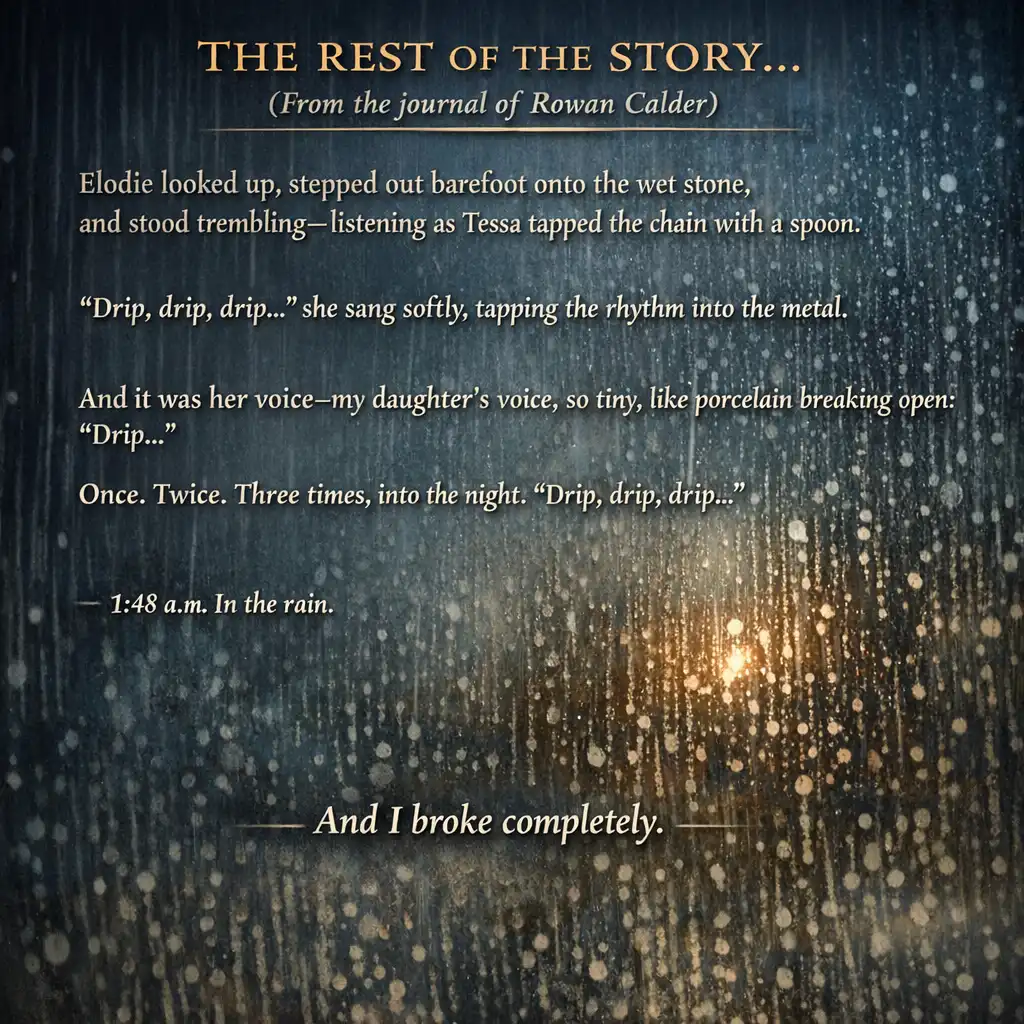
Rain had trapped them indoors for two straight afternoons. Instead of pushing toys or flashcards, Tessa dragged a large metal bowl, a wooden spoon, and a stack of plastic cups onto the heated terrace just outside the conservatory doors where rainwater trickled from the gutter chain into a stone basin.
“Elodie,” she said, crouching under the covered overhang, “I have a wildly important scientific question.”
Elodie stood at the doorway, thumb rubbing the edge of her mother’s scarf.
“What sound,” Tessa asked, tipping a cup to catch dripping rain, “does the sky make in a blue cup?”
Plink-plink-plink.
She poured the water into the bowl. Then into a red cup.
Plunk.
Then into a shallow tin lid.
Ting.
Elodie’s head tilted.
Tessa widened her eyes as if she had discovered magic. “No way. Blue is plink, red is plunk, silver is ting?”
She handed nothing over. Just demonstrated again, giving the child time to choose.
Three minutes passed. Five.
Then Elodie took one step onto the terrace.
Another.
She reached for the red cup.
Tessa moved her own hand away immediately. “Good choice.”
Water overflowed onto Elodie’s fingers. Normally an unexpected wet sensation could trigger a shutdown. Rowan, watching unseen from inside the conservatory, tensed.
Elodie stiffened.
Tessa didn’t apologize or wipe her hands. She simply touched her own wet fingertips together and said, “Cold surprise.”
Then she held them under the drip again. “Want to tell it that was rude?”
Elodie looked at the rain chain. Looked at the cup. Then—astonishingly—did not retreat.
For the next twenty minutes, they caught raindrops in different containers, listening to the changes in sound. Tessa named each one with playful seriousness.
“Bloop.”
“Tick.”
“Bonk.”
“Fancy bonk.”
Once, Elodie made a sound back. Not a word exactly. More breath and tone combined.
“Ti.”
Tessa froze only for half a heartbeat, then said, “Yes. Ting.”
No celebration. No clapping. No pressure.
Just understanding.
That night, Rowan stood outside Elodie’s room while Tessa gave her a bath. He heard the water running, then Tessa’s voice.
“Can this duck swim?”
Silence.
“Terrible suspense.”
A small splash.
“Oh! The duck says yes.”
Then something he had not heard in so long he thought at first he had imagined it.
A tiny laugh.
Not full. Not easy. But real.
He stepped back against the wall, hand over his mouth.
The first real changes were not dramatic miracles. They were anticipations. Elodie waiting by the conservatory door at two in the afternoon because that was when Tessa usually brought out the rain cups. Elodie allowing Tessa to brush her hair if Tessa hummed first. Elodie pressing a smooth stone into Tessa’s palm and then taking it back, a game of trust in miniature. Elodie beginning to recover faster after overwhelm because Tessa knew when to lower lights, when to stop talking, when to stay near without touching.
And then came the setback.
It started after four good days in a row, which everyone in the house had privately begun to fear as much as cherish. Progress had a way of making loss sharper when it disappeared.
A landscaping crew arrived unexpectedly on Friday morning with industrial hedge trimmers and a wood chipper scheduled by the estate manager weeks earlier. The noise exploded across the grounds just as Tessa and Elodie were building a rain rhythm station in the covered courtyard.
Elodie dropped the metal cup. It clanged against stone. Her face went blank in an instant.
Tessa moved immediately. “Too loud. I know.”
But the child was already gone somewhere inward.
She screamed once—a raw, startling sound torn out of silence—then crumpled to the ground, hands over ears, kicking hard enough to bruise herself against the stone. Della rushed in. Rowan, in the middle of a conference call upstairs, came running. Two housekeepers hovered helplessly at the doors.
“Turn it off!” Rowan shouted.
The landscaping noise died, but too late. Elodie was in full distress, breath hitching, body rigid, the lavender scarf tangled beneath one knee.
Tessa knelt beside her but did not touch her. “I’m here. No more noise. You’re safe. I’m here.”
Elodie did not respond.
“Should we get Dr. Heller?” Della asked.
“No sudden hands,” Tessa said.
Rowan crouched down opposite her, panic in every line of him. “Elodie, baby, look at me. Look at Daddy.”
Nothing.
His voice cracked. “Please.”
Tessa glanced up. “Mr. Calder, lower your voice.”
He stared at her as if she had slapped him. “My daughter is falling apart.”
“She’s overloaded,” Tessa said, still calm but firmer now. “She cannot organize your fear and hers.”
The words hit him like an accusation because they were true.
He sat back on his heels, stunned.
For forty minutes the storm continued. Longer than any episode since Tessa arrived. House staff exchanged grim looks. One of the housekeepers muttered, “It was too good to last.”
By evening Elodie had still not spoken even her few breath-sounds. She refused dinner. Refused the bath. Refused the terrace. Sat in her room with the scarf and would not let Tessa within three feet.
The next day was worse.
And the day after that, worse again.
The rain-cup game no longer interested her. She flinched when Tessa entered the room. She would not sleep unless Della sat outside the door. Three steps backward for every one they had dared believe in.
By Monday morning, Rowan’s hope had curdled into something jagged.
He found Tessa in the laundry room filling a basket with folded towels and said, in a low controlled voice, “What happened?”
Tessa looked tired for the first time since arriving. “She got overwhelmed.”
“She’s been overwhelmed before.”
“Yes.”
“She’s never come back this slowly after one episode.”
“That’s not something anyone can promise.”
He crossed his arms. “You told me you understood her.”
“I do.”
“Then why does it feel like she’s worse?”
Tessa set the basket down. “Because when children begin to feel safe, setbacks can look bigger, not smaller. They’re not robots. Healing is not a staircase.”
His jaw tightened. “Don’t give me slogans.”
Her eyes flashed. “And don’t ask me to lie because you’re scared.”
The room went still.
A dryer hummed in the corner. Rain struck the narrow basement windows.
Rowan lowered his voice even more. “Do you have any idea how many people have stood in this house and told me to trust the process?”
“I’m not asking for that,” Tessa said. “I’m asking you not to punish her because progress frightened you.”
“I am not punishing her.”
“You’re already looking for a way to quit.”
He said nothing, which was answer enough.
That afternoon he called Dr. Ira Heller, Elodie’s developmental specialist, and requested an urgent review. By evening a recommendation arrived by email: reduce variables, return to structured methods, minimize unconventional sensory play, and consider temporary separation from the current caregiver if attachment disruption was intensifying episodes.
Temporary separation.
Della found Rowan reading the email in his study after dark.
“Are you dismissing her?” she asked.
He rubbed a hand over his face. “I don’t know.”
From the upstairs hall came no laughter, no tiny voice, no sound at all.
And somehow that silence was heavier now, because they had all finally learned what it meant when it cracked.
The next two days stretched the house thin.
Tessa stayed professional, almost painfully so. She followed Rowan’s request for “more structure” without arguing in front of the staff. She kept to a schedule. Meals at fixed times. Quiet blocks. Simple routines. Fewer improvised rain games. Fewer odd little jokes spoken into silence.
Elodie shrank further.
Not dramatically. That was the cruel part. She did not melt down. She did not scream. She simply withdrew into such complete stillness that the whole mansion seemed to lean toward her, listening for something that did not come.
On Wednesday morning, Rowan stood in the doorway of the playroom and watched Tessa place a stack of picture cards on the rug.
“Cup,” Tessa said softly.
Elodie sat by the window without looking at them.
“Ball.”
No response.
“Book.”
Nothing.
The cards remained untouched.
Tessa lowered her hand to her lap. “We can stop.”
Rowan heard the exhaustion beneath the words. He also heard the restraint. Tessa was trying to obey him. Trying not to challenge him. And it was failing everyone.
He should have admitted it then.
Instead he said, “Dr. Heller thinks a reset might help.”
Tessa looked up slowly. “A reset.”
“Some distance. A day or two.”
She stared at him as if testing whether he understood what he was saying. “For you, maybe that means schedule adjustment. For her, it means someone safe disappears.”
“She knew caregivers before you.”
“And they all left.”
The truth of that sat between them like broken glass.
He forced himself to continue. “I’m not doing this lightly.”
“No,” Tessa said quietly. “You’re doing it because this hurts.”
“That’s enough.”
“For whom?”
He took a breath that did not steady him. “You can finish through tonight. Della will cover tomorrow. I’ll reassess after the weekend.”
Tessa’s face went very still. Not pleading. Not angry. Somehow that was worse.
“Okay,” she said.
“That’s it?”
“What would you like from me, Mr. Calder? A speech?”
He almost said yes.
Instead he turned and walked away before he could hear himself sound weak.
That evening the rain came harder than it had all week, a silver sheet against the conservatory glass. Elodie had barely eaten. She would not let Della change her sweater. She refused her bedtime book. At seven thirty, Tessa asked if she could have one last half hour with her on the terrace.
Rowan nearly said no. Then something in Tessa’s posture—dignity mixed with grief—made him nod.
The covered terrace glowed under warm wall lanterns. Beyond the stone balustrade, the estate grounds blurred into wet darkness, cedar trees swaying under wind. Tessa had set out the bowls and cups one final time, not in the playful sprawl of earlier days but neatly, carefully, like a ritual.
Elodie stood in the doorway clutching the lavender scarf.
Tessa crouched near the rain chain. “I thought the sky might want to say goodbye.”
The word should have been too big. Too loaded. But she said it gently, like weather.
Rowan, unseen inside the conservatory shadows, stopped breathing.
Elodie did not move.
Tessa picked up the blue cup and held it under the dripping chain. “Plink,” she murmured.
Then the red. “Plunk.”
Then the silver lid. “Ting.”
She smiled faintly. “I’m going to miss the fancy bonks.”
Elodie’s fingers twisted in the scarf.
Tessa set the cup down. “You don’t have to come out. I just wanted to tell you that being with you has been my favorite part of this house.”
The child looked at the terrace floor.
“I liked learning your quiet,” Tessa went on. “I liked your brave foot. I liked how serious you are about water science.”
A gust of wind blew mist across the stone. Tessa
Disclaimer: Mention of any brand or trademark is for identification only and does not imply partnership or endorsement

MY HUSBAND USED MY MONEY, GOT ENGAGED TO HIS MISTRESS, AND STOOD THERE WHILE SHE SLAPPED ME

THE MAID OF HONOR POURED WINE ON ME AT MY BRIDAL SHOWER AFTER STEALING MY FIANCÉ. SHE DIDN'T KNOW THE ROOM WAS ABOUT TO HEAR WHAT HE'D BEEN SAYING TO BOTH OF US.

THE MAID OF HONOR POURED WINE ON ME AT MY WEDDING AND CALLED ME CRAZY. SHE FORGOT I STILL HAD THE VOICE NOTE SHE SENT MY FIANCÉ.