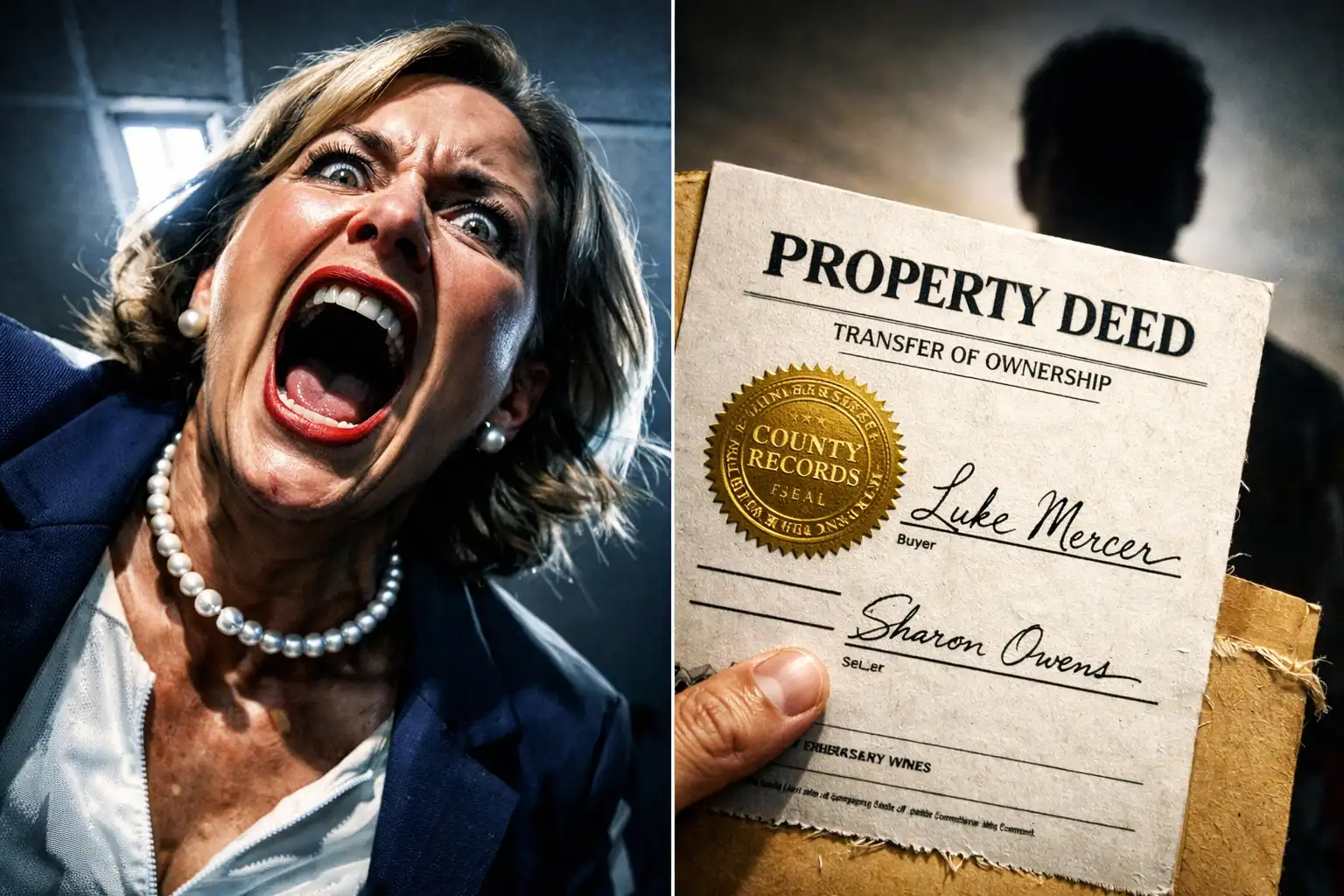
SHE CALLED HIM A KIDNAPPER AT HIS FATHER'S MANSION—UNTIL THE BULLET AND THE DEED HIT MARBLE
"Kidnapper! He's kidnapping that boy! Somebody call 911!"
The word echoes off the coffered ceiling and the marble ribs it like a tuning fork. Champagne flutes freeze midair. A tiara of pearls wobbles on a realtor's throat as she points—sharp, decisive, the way you'd point at an infestation you can solve with a call. Phones lift. Screens paint you in their glass. A security guard's hand clamps your wrist and shoves it hard against the console table until your watch face smashes into spiderwebs.
"Daddy—" Evan coughs, a birdish sound, fingers clawing at your hoodie.
You swallow drywall dust and copper. You're half an inch taller when you breathe through your heels the way your old boxing coach taught you. You're used to that taste. You got it on a sidewalk less than a week ago, when someone shouted Run and three quick pops cracked open the afternoon. You sprawled over Evan, forearm braced and head low, the third bullet finding the glass of your watch instead of your kid's skull. You don't say any of this. You know the rule by now: explanations are currency only when someone values your voice.
"Not in Crestview," somebody snorts from a bank of gray tufted chairs. "Hoodie thinks he can just scoop a kid and bounce."
"Is this live?" A woman with acrylics taps her screen. "Oh my God, it's live."
You don't argue. You could. You won't. Air first for Evan. Your watch ticks its last at 2:17 and gives up, a cold circle bracing your damp skin.
The chandelier above is new. You remember the old one: tarnished rings and bulbs cracked like bad teeth, the chain oiled with salt and olive oil because your father believed in thrift above all else. Now it's brushed nickel and spotless, the kind of clean that smells expensive. Piano music sighs from the ceiling speakers. The staging company arranged fake books with titles like Quiet Affluence and Coastal Minimalism. It is your father's house—Harlan Mercer's fortress, with new lipstick—and you're here to sign papers with your name on them. You're here because it was time to buy back everything you swore you'd never touch.
Blue light paints the leaded panes out front. An officer strides in, hand at his hip. You know the way he scans the room, the quick triangles, the weight on the ball of the foot—habit you learned in basements and parking lots. He looks from the pearls to you.
"Sir," he says, voice clipped, "I'm going to need you to step away from the child."
The pearls beam like she just solved a puzzle. "That's not his son."
Evan presses closer into your ribs. He's a small heat with a cowlick that never lays down, breath like apples. He trusted you when the world broke open. He trusts you now. You lift your hand, slow, the way you do around men who need control to feel safe. You unbuckle the cuff, peel the broken watch off, and lay it on the marble console between a bowl of decorative orbs and a coffee table book about Nantucket.
The face is soot-streaked, webbed with impact. A tiny copper shard—a flattened, ugly petal—knocks loose and skitters with a delicate ring. A man in a blazer flinches. A camera catches the officer's eyes, the way they narrow.
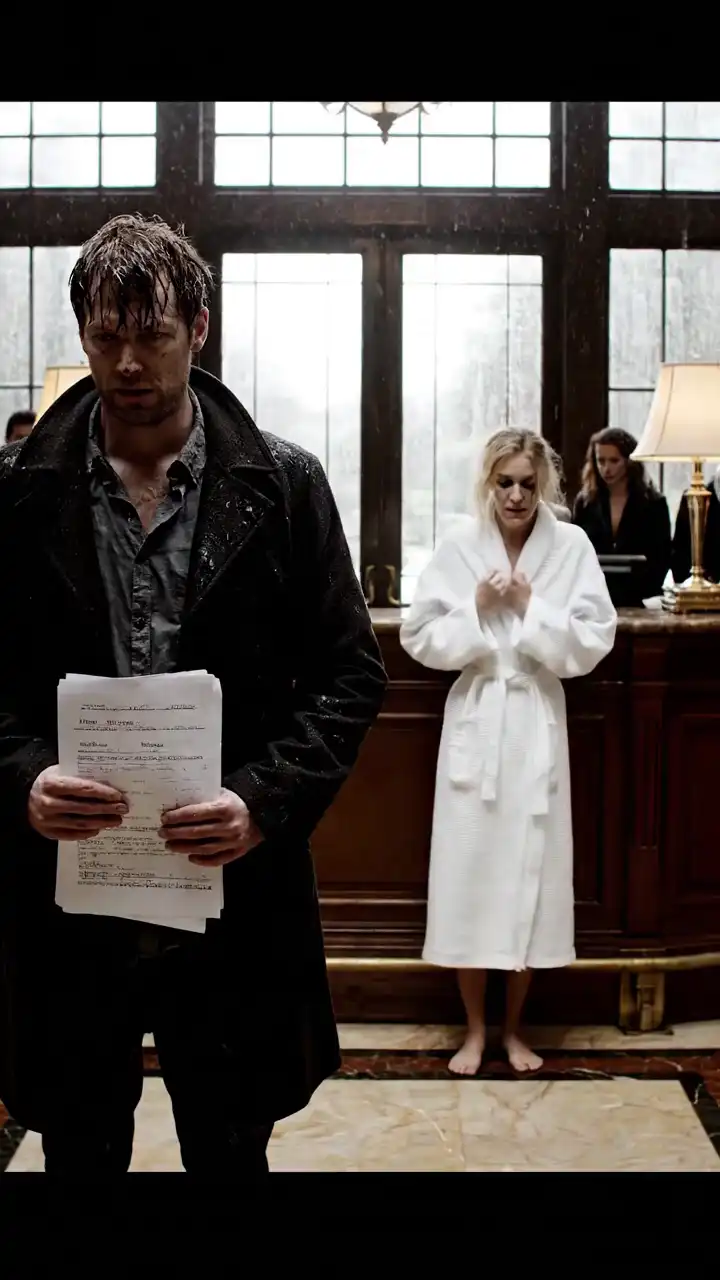
You pull a manila envelope from your hoodie pocket. Your palm leaves a crescent of sweat on the flap. You don't rush. You have learned the difference between panic and speed. Papers unfurl with that thick county parchment sound. The deed gleams with a notary stamp. The officer's lips move as he reads.
LUKE MERCER. Grantee. Effective today.
The realtor's smile cracks.
"This is—" she starts and loses color.
"Stop," the officer says, but it's not to you. He looks at the fallen bullet, the deed, the boy, and something like shame flickers through the men who haven't put down their phones. He turns to the pearls. "Ma'am, I need you to listen carefully. Mr. Mercer—"
"Is the owner," you say. The word fits in your mouth like something you used to wear and forgot. You feel the old floorboards under the staging rugs, the way they complain under your weight. You think of your father's boots, of cigar smoke and shouting, of your mother folding laundry in silence at the top of the stairs, the house at once shelter and weapon.
Evan's fingers knit into your sleeve. The chandelier hums. A neighbor you remember from eighteen years ago—Mrs. Kline with the pomeranians and the whiskey—takes off her glasses and looks at you. Really looks.
"Luke?" she says, breathless. "Harlan's boy?"
"Yeah," you say.
The room holds its breath over a cliff. The officer shifts his grip to easy. The guard lets go of your wrist and steps back, muscles going slack with realized mistake. The pearls—Valerie, you remember now; Valerie Pike, the agent with ads on bus benches, always smiling like a hostess ready to solve your problems—adjusts her necklace with shaking hands.
"Mr. Mercer," the officer says, a formal apology tucked in the shape. "May I see your ID?"
You hand it over. He glances, nods, gives it back. "We're done here," he says to the room. "Ma'am, lower your voice. Everyone else—back away, please."
"He's—he's dangerous," Valerie says, but even her voice knows it's lost. She makes a sound like laughter swallowed wrong. "I didn't know. I—someone said—"
"I said he's not safe," a tall man in a Crestview Country Club polo mutters, eyes sliding to the officer. "Look at him."
"Look at him," Mrs. Kline snaps back. "He's Harlan's. He carried groceries up my steps when he was ten."
You lift Evan to your hip and his arms come around your neck, automatic. He tucks his face into your jaw and you swallow again, the taste of copper and old cleansers. The officer clears a path with his palm.
"Do you need medical?" he asks, glancing at your wrist.
"No."
"Do you want to file a report?"
"Not now." You find the part of your voice that is for business. "We'll come by the precinct this afternoon."
The room relaxes a fraction. The phones lower, embarrassed, then rise again for different angles. Someone's mouth twitches with the idea of going viral in a different way: the man they tried to accuse is the owner.
You step toward the staircase.
"Wait," Valerie breathes, following. "Mr. Mercer, I—this is an open house."
"It's closed," you say without looking at her. "Get your stagers out by three. My son's nap is at four."
"You can't just—"
"I can," you say, and you're suddenly tired through your bones. "Call your broker. Call the seller's attorney. It's my house."
From the landing you look back. The chandelier throws stars across the wall. The watch face, dead at 2:17, lies on the console beneath it. The little copper petal gleams like something you could wear around your neck if you were the kind of man who needed trophies to remind you of what you already know.
You are not.
You climb.
Two days earlier the afternoon tasted like metal. The kind of day when heat sticks the air to your teeth. Evan had sticky hands from a popsicle and blue around his mouth, and you had your forearm on the handle of his stroller just for something to do with your hands while you waited in line at the taco truck. He laughed at a dog—some kind of terrier wearing a bandana—and then somebody yelled and the terrier yelped and the sound that came next was small and cruel and precise.
Pops. Three. Close enough you didn't see who.
You didn't think. There wasn't time to think. The stroller wasn't even buckled because you'd told yourself two minutes, just two minutes to feed your kid, and you hate that you do that sometimes, forget systems, trust the bubble of afternoon. You were already moving before your brain had a word for it. You grabbed Evan, he was light and solid and alive, you threw your body over him and tumbled against the SUV parked near the curb. It kissed your forearm with a metal edge. Your watch took the worst of it. You felt something hot smack your wrist and the watch face laugh and crack and the hands stop for good at 2:17.
"Evan," you breathed, and he was wailing into your shirt, fine seeing you panic as an invitation. The terrier ran. A woman screamed. People dropped, froze, scattered. The taco guy ducked behind his grill. The smell of cilantro and fat turned to the smell of asphalt and the taste of blood. You pressed your cheek to the rubber of the tire and made your breathing small. "We're okay, baby. We're okay."
You don't like the word hero. You're not one. You learned a long time ago the difference between reflex and virtue. You learned it in a house where noise meant danger and quiet could mean the same. You learned it with a father who did not believe in softness.
After, when the scene was tape and statements and the world's appetite for drama satisfied for the day, you realized your wrist hurt. The little copper petal was lodged in the shattered glass of your watch. A man in a tie with a half-eaten mango on his desk at the precinct told you lucky. He wrote something on a form. He said they'd find the guy. He asked if you wanted to sign up for counseling. You said no because the room was full and the AC was bad and you could feel your son's attention span dwindling like sugar in tea.
At home you washed Evan with a washcloth and microwaved dinosaur nuggets. You texted Maya that he was okay. You typed "shot at." Then you deleted and typed "long day, all good" because you do not get to ruin her workday with the full shape of your fear. You're not together anymore, not in the way you were when you were nineteen and ready to burn everything for love. You're two people who grew something precise and alive and take turns keeping him alive. You watched him fall asleep with graham cracker dust on his cheek.
Then, because you cannot stop, because when you get scared you act, you pulled the manila envelope from the top of your fridge and ran your fingers across the notary's raised seal.
Harlan Mercer died a month ago in a hospice bed that looked like cheap furniture from a good hotel. You didn't go. You were a dutiful son until you were a son who left at 17 with a bag and a bleeding lip and a girl with a wild laugh waiting in a borrowed car. You waited for an apology that never came. You grew a new life in a small apartment with walls that didn't know your history. You were so used to gripping your own shirt at the collar to keep your chest still that when Evan was born and his tiny ribs moved up and down under your palm it felt like a revolution.
You told Maya you would not bring him into that house. She nodded. She had her own decisions to make, her own mother with expectations like iron. For three years you avoided Crestview and its brick gates and its HOA newsletters with their quiet threats and holiday photos. You lived in a place above a nail salon that smelled like acetone and warmth. You fixed things. You're good at that. You have the hands for it. You patch drywall and hang cabinets for people with more money than time. You don't miss the old life until you have to drive past sometimes for work and you're back inside your body at twelve, counted steps between you and a voice that could turn sharp without reason.
Then the letter came from the bank.
Final notice. Default. Estate sale.
You didn't go to the funeral. You went to the courthouse. The house wasn't Harlan's to bequeath anymore. He'd mortgaged the bones of it to float a new business that didn't float. He'd bled equity to pay for a younger woman's smile. He'd missed payments. The bank wanted a quick sale.
You could have let it go. You could have watched a developer buy it, tear out your mother's sink and your childhood, add quartz and wolf appliances, list it for triple to some dentist with taste. You tried to want that—the clean violence of it—but the thought made your hands shake, and not from anger. From something else. From a little boy with a cowlick and a laugh who loved cartoons with bears who lived in caves and ate syrup drenched pancakes.
It was a physical thing, the wanting. The way you imagine a haunted house might feel if it were desperate to keep its ghosts.
Sierra Nolan was the first person you called. She'd sat two rows over from you in sophomore algebra and had grown up to practice real estate law in a building with brushed concrete and a view of the river that made everybody feel wealthier. She didn't laugh when you told her what you wanted.
"He didn't leave it to you, Luke," she said, fingers drumming on her desk. "It's not an inheritance. You'll be dealing with the bank and the estate. You can't get sentimental in there. They'll eat you."
"I'm not sentimental."
She raised her eyebrows. "Mmm."
"I just want it."
"Why?"
You stared at the glass of water she put in front of you, the ring of condensation on the coaster, the way your fingers looked like your father's when they curled but your knuckles were your mother's. You thought of Evan. You thought of sleeping without listening for footsteps on the stairs.
"Because it's mine," you said.
She didn't argue. Sierra used to be the kind of girl who wore flannel and painted her nails with White-Out in detention. She'd grown into a woman who never wasted time on reasons when a thing felt true. "Okay. We get ready to fight."
She made a plan and you did tasks the way you always do tasks: list, box, check. Bank statements. Offer letters. A letter from a contractor you worked for saying your business had consistent cash flow. A note from Maya explaining your co-parenting arrangement and why you wanted a stable neighborhood close to her job.
When Sierra's emails started pinging at weird hours, you knew someone else wanted the house more. She wouldn't tell you who. She said she couldn't. She said "anonymous LLC," and "private equity fund," and "cash buyer." She told you what she'd tell any client: "Stay calm. Build a clean argument. Verify everything."
You asked if it helped that your name was Mercer, that you'd lived there, that you'd pick up plastic cups at the Fourth of July picnic and help old people put up their lights. She didn't smile. "Sometimes that helps," she said. "Sometimes it makes them dig in."
"Why?"
"Because people want stories about who belongs where more than they want facts."
Two weeks ago you drove through the iron gates that said CRESTVIEW in letters like a country club plaque and pulled up under your father's portico. The porch still had the crack in the top step where he'd missed with a sledgehammer and refused to call a professional because he couldn't stand for somebody else to be right. The lawn was scalped short, the gardeners paid until the auction because weeds would lower comps. The air smelled like your childhood, like boxwoods and gasoline and the memory of a summer storm that never arrived.
The open house was scheduled for the end of the week. Sierra told you not to go. "It will be public," she said. "They want to build momentum. Don't give them a face to attach their favorite story to."
You went anyway.
You put Evan in a clean shirt with little whales on it. You put yourself in a hoodie because it was easy and the sleeves hid your forearm and the muscle memory there. You parked on Broadleaf, two houses down, because you didn't want to make a show of parking in the circular driveway the way your father did when he was in a mood and wanted to announce it. You held Evan's hand and he bounced, pointing at a scooter abandoned on a lawn and a mailbox shaped like a barn.
Inside, piano music and fake lemons and free champagne. People you didn't know and people you did, older and softer and more polished. Valerie in pearls. Men in blazers. Women in white sneakers with gold initials. You kept your eyes on the stairs. You wanted to see if the dent you'd made on the banister when you were nine and slid down it with socks was still there.
Someone said "kidnapper" and it all went quick.
And now you were at the top of the stairs with the officer saying "Mr. Mercer," and you were counting breaths and telling your son safe and your brain was in two places at once: here in this foyer where you got your first scar on your shin on the second stair from the bottom and also kneeling behind an SUV smelling tacos and hot metal and hearing the world lift its mask long enough to let you know what it could do.
"Do you want me to escort people out?" the officer asked.
"Doesn't matter," you said, and your voice sounded like your father's voice on the sweetest days—grit taken out, just the steel. "I'll be upstairs."
Valerie swallowed and looked at the ceiling like the light fixture might help her. "Mr. Mercer, I deeply apologize for the misunderstanding. We were told—"
"Who told you?" you asked.
"A neighbor. Someone. I can't—"
"Names matter when they ruin things."
She blinked. "You're right. I just—"
"Three o'clock," you said. "I want the house."
Evan picked at a nick in the banister and looked up. "Can I have a popsicle?" he asked.
The world tilted back to ordinary. "Yeah," you said. "I'll find one."
You took him to the kitchen you hated and loved, the one with the stove your mother cooked on and the microwave your father never bothered to learn, both replaced by gleaming strangers. The drawers had been staged with fake dishtowels. You opened the refrigerator and it was full of Perrier and nothing else, glossy green bottles lined up like soldiers. Someone had wedged a single box of store-brand popsicles between them like a joke. You held it up at the ceiling, at the God of Real Estate, at your mother if she was watching.
"Look at that," you said. "Miracles."
You peeled plastic and handed your son a purple one. He sat on the counter and swung his legs and left a purple drip on marble the color of a rich man's teeth. He said "thank you," because he knows please and thank you are armor and also because you asked for them until they were habits.
And then you walked down the hall, turned right the way your feet remembered, and opened the door to your old room.
There was a bed made with white linens someone ironed like the Virgin Mary might stop by. There was a fake plant and a leather bench and a photograph of a boat you'd never owned. There was no poster of Allen Iverson. There was no hole in the closet door from when you slammed it the night your father told you you were trash. There were no trophies on the shelf because you never kept them. There were no marks on the floor from the nights you did pushups until your shoulders burned because strength was the only language your father praised and you were starving.
You set the envelope on the dresser. You took a sheet of paper from the back. It had Sierra's signature. It had yours.
Everything else would happen after.
When the stagers left, they moved like astronauts in reverse: slow because gravity had returned. A man in skinny jeans rolled up rugs that had never seen a foot long enough to leave a dent. Two kids in matching T-shirts with a moving company's name carried chairs with unnatural care, smoothing the air they displaced like it might wrinkle.
Valerie stood helpless in the foyer, tethered to her phone. Her hair didn't look so sharp without the light dancing on it. She kept opening and closing her mouth like she was about to say something that would fix the day and then hearing it in her head and letting it die.
"Is there a garage code I should know?" you asked, not because you couldn't find out later, but because you wanted her to face the fact that there was information you owned now and she was the one behind.
She flinched at your voice and managed a paper-thin smile. "It's in the packet," she said, dropping her eyes to the floor. "I'm sorry."
"For what?"
"The... misunderstanding." She almost choked on the word. "The way I escalated. I was trying to make sure everyone was safe."
You looked at her the way your father looked at poor workmanship, as if it were something you might forgive if you weren't so tired of doing so. "You tried to make sure your comfort stayed intact."
Her hand went to her pearls like a girl and it irked you that the move made her pretty because you wanted to be done with her. "I—may I ask—why this house? I'm not trying to pry, it's just—"
"It's mine," you said again, because the more you say it the more real it feels. "And I'm going to raise my son here."
"This neighborhood," she began, and then to her credit stopped. She took a breath and tried another tack. "It's very competitive. There were other—strong offers. Some of those buyers are... disappointed."
"You'll survive the commission."
Something flickered in her eyes then. Fear? Or the calculation that comes from playing a game and realizing you might not like the stakes. "It isn't the commission I'm worried about."
"Then what is it?"
She didn't answer. You're decent at reading people. It was there: a shadow of another player, someone with more to lose than a staged afternoon. You thought of Sierra and the anonymous LLC. You thought of the way Sierra scratched the back of her neck when she was thinking so hard she could feel it under her skin. You slid the deed papers back into the envelope and tucked the envelope under your arm.
"Two hours," you repeated. "I want this place empty. If it's not, I'll move it myself."
"That's not—"
You smiled and it wasn't kind. "Valerie, the only thing I won't move is the piano. And I can learn."
She stood in the doorway like she might still protect it. You walked past her like water around a rock.
In the backyard you saw your father's shade. He used to sit in the metal chair under the oak tree with a beer and a face like a closing gate. He'd say, "Grass too long," and "Where is your mother?" and "You think you're special?" and sometimes he'd just say your name like a question he was tired of answering. You'd swing a bat until your palms blistered because that was a way to be loud without speaking. You'd mow lines into the lawn so straight he couldn't find fault with them. He'd find fault anyway. "Crooked," he'd say, and show you your crooked with one finger, and you'd want to break the finger.
It was perfect afternoon now with the stagers gone. It felt like a cathedral empty between concerts. The light slid through the oak leaves in coins. Evan ran across the grass and you watched his feet and the shape of his spine and you felt that same ache as when he was born: a good ache, the kind you want to take out and examine like a bruise you're proud of because it means you tried.
A woman with a long skirt and a little dog stopped at the open gate. She looked at you like she'd reached the wrong backyard, then at Evan, then back at you, her hand tightening on the leash. The dog's pink tongue hung like a ribbon.
"Afternoon," she said.
"Afternoon."
"You—you're Harlan's son."
"Yes, ma'am."
"I'm Lila Kline."
You nodded toward the house. "I remember. Mexican wedding cookies at Christmas."
She smiled, surprised. "You remember those? I burned the first batch every time. Your mother said it meant I'd live a long life."
"She'd say that," you said, and your chest tightened again for a different reason. "She was good at making bad days feel expensive."
"She was good at making everything lovely."
You didn't trust yourself to talk. Mrs. Kline glanced at Evan and her face softened.
"This is your boy."
"This is Evan." You could feel her wanting to ask whose, but she didn't. "Evan, this is Miss Lila."
"Hi," Evan said, then lifted the dog's leash with two fingers. "Can I pet?"
"You can ask Daisy if she'd like that," she said. "Daisy is particular. She has... opinions."
Evan lowered one hand. Daisy sniffed, then leaned into him like a small furry drunk and Evan beamed.
"You'll get complaints," Mrs. Kline said, half under her breath. "About the open gate. About the day." She looked at your forearm like she'd seen the way you moved and knew what it meant. "They like things quiet around here."
"I can do quiet," you said.
"I didn't say they could."
You laughed. She offered a small smile. Then she got serious in a way that made you ache to be twelve again and have someone older tell you what to do. "You have more friends here than you think," she said. "Don't let the loud ones convince you otherwise."
"Who are the loud ones?"
She wrinkled her nose. "Graham Price thinks he runs the street because he got himself elected HOA president. He doesn't, but the newsletter makes a lot of noise. And that woman with the pearls—"
"Valerie."
"She likes to be important. She thinks being a gate is the same thing as having a garden." Mrs. Kline glanced at the oak tree. "Harlan hurt you."
You stared at the grass. "Yes."
"He hurt a lot of people. He liked it. I never knew what to do with that except bring cookies."
"You brought good cookies," you said, and your voice was raw. "That mattered."
It felt like something growing where you'd seen only land before. You didn't have a word for it yet. You watched Evan throw himself onto the ground to feel the grass itch his arms and you realized the itch was an update you'd been waiting for the way you used to wait for hand-me-downs: impatient, convinced they'd never fit, until they did.
At four o'clock you shut the doors. Valerie sent a text that the piano would need to be picked up tomorrow. You answered with a photo of Evan asleep on your old bed with his purple mouth open and her reply—"Noted"—felt like a white flag.
At five, Sierra called.
"I heard you acquired an audience," she said. You could hear traffic through the speaker, a bus sighing into a stop. "You okay?"
"Alive."
"Good. Did Val Pierce give you any problems?"
"Val Pierce?"
"The realtor. The pearls."
"She said her name was Valerie Pike."
Sierra swore. "Of course it is."
"What?"
"They probably assigned two agents to keep it hot. If there's a Pierce, there's a Pike. The snakes are named."
"You're mixing species."
"Shut up and listen. You're going to get pressure. It might look like legal pressure. It might look like social pressure. Smile and keep receipts."
"From whom?"
Sierra told you something you didn't know about law and about money: that when someone with more of it wants your thing, they don't necessarily grab. They make you want to hand it to them. They make it feel like it was your idea, your exhaustion, your failure. They make you throw it away.
You said you had a spine. She said, "Even spines get tired."
That night you slept in your father's house with the AC too low because you didn't know how to work the system yet and you didn't care. You woke to the smell of dawn and a blue strip across the floor you remembered from your childhood, the way the window threw it. You woke to your son's breath. You woke to the sound of sprinklers ticking like mechanical grasshoppers on the street.
In the morning you made coffee with a machine you didn't like and sat on the back steps. Mrs. Kline waved from her driveway with Daisy trotting at her heels. A man in a golf shirt glared as if your existence was a violation of code. The mail hit the slot with a clean sound. Among the catalogs and the HOA newsletter was a thick envelope with Crestview in raised cursive and a balance due in the corner.
You didn't open it yet. You could feel the weight of it against your thigh and knew you'd need your whole spine for it. You took Evan to daycare on Maple with his small backpack on both shoulders. You watched him go without crying because you had a thing to do.
You went home. You lifted the envelope with two fingers like you didn't care either way. You slit it with the house key that still felt like a stranger. You read the letter in the kitchen where you had bloodied your lip as a child because you'd said the wrong thing in the wrong tone of voice. You read at your father's counter.
Dear Mr. Mercer,
Welcome to Crestview. As the Homeowners Association President, I'm delighted to welcome you and your family to our community. There are a few friendly reminders for new members to keep our neighborhood safe, cohesive, and thriving.
We enforce our bylaws with equal treatment for all. Please review the attached covenants. Key points include:
It went on. You didn't say anything for a long time. The words that made you stop were not the ones that should. It wasn't the hoodie line (thin, obvious) or the noise line (the neighborhood's heartbeat). It was the line about "equal treatment for all."
You laughed without humor. It came out like something a man would cough up in a cartoon.
At the bottom of the letter, next to the signature of Graham Price and a monogram that looked like a boutique toothpaste brand, there was a line about fines and due dates and compliance. There was also a note, handwritten, jotted on.
Please use the BACK entrance for construction crews. We don't want to diminish curb appeal. Thanks in advance.
You folded the letter so precisely you thought your father might rise from wherever he was and clap. Then you put the letter in the drawer and called Sierra.
"Read me the language about fines," you said.
"Let me guess—Graham got spicy."
"What if I told you there was a 'no hoodies' policy?" You could hear her eyebrow lift through the phone.
"I'd say we'd just found our story line."
"What do you advise?"
"Two tracks," she said. "One quiet, one loud. Quiet: document, comply where it doesn't diminish you, contest where it does. Loud: be so good a neighbor their teeth hurt."
"That's a plan?" you asked.
"It is when the law is written to normalize somebody else's comfort. You get to be better. It's the long road. You love the long road."
"I love naps," you said. "And cheap solutions."
"Then please don't piss off your HOA for sport. Buy them cookies."
"They'll call the cops," you said, and you didn't mean to say it out loud.
"I know," she said. "We'll be ready when they do."
It started not with the cops but with plastic cups.
You took Evan to the clubhouse on Saturday because the pool had a mushroom fountain and he'd never seen a mushroom fountain. He shrieked the way joy rips out of children, whole and ugly and perfect. You watched him from the deck chairs and a man in mirrored sunglasses watched you. He had a belly built on bread and craft beer and tennis. He wore a visor like it was a crown. When Evan tripped and went under for a second, you stood so fast your chair squealed. He popped up coughing and laughing and you breathed again.
"Please don't run on deck," the visor said to Evan, but his eyes were on you.
"Evan, walk," you said. Your son, who is a scientist at heart and considers all data, reduced his speed by a tenth and satisfied his inner prosecutor.
"New here?" Visor asked.
"Yes," you said. "Luke Mercer. Nice to meet you."
He blinked at your hand like a trick. Then finally took it. "Graham Price," he said, savoring his own name. "HOA President."
"Thought so," you said, and his face did a thing you pocketed for later.
"We love to see engaged homeowners," he said. "Remember quiet hours are eight to eight, and if you have—" he paused, as if the word tasted bad—"company, use the back entrance for their trucks. Curb appeal is the first line of defense."
"Against what?" you asked, genuinely. You wanted to understand the enemy. He smiled with everything but his eyes.
"Decay," he said. "Enjoy the pool."
Two hours later, at home, there was a note on your door like an invitation to a pity party. It was from Graham, of course. It said:
Hi, Luke!
We noticed you left a cup on your lawn last night. Please pick up all refuse from your yard to maintain our standards.
Best, Graham
There had been a purple popsicle stain and a cup next to it. You had planned to get it after Evan’s bath and fell asleep reading a book about dump trucks. You felt the old burn of being policed for existing, hot and specific.
You picked up the cup. Then you walked down the street and picked up every single cup you could find and every straw wrapper and every cigarette butt hidden at the curb and every plastic bag snagged on the privet. You filled three contractor bags. You set them at the end of the street and sent a photo to the HOA group email with a note:
Hi, neighbors—
New guy here. Found these on a ten-minute walk. Happy to organize a community clean-up next week. Cookies on me. Let me know what works.
Best, Luke (house with the oak)
Within fifteen minutes your phone filled up with good jobs and grateful emojis and one long message about organized litter being a sign of the apocalypse from a woman named Carol who had thoughts about graffiti. Graham didn't respond. Valerie did.
Count me in. And be nice to Carol. She's our chaos fairy.
The next day there was a post about you on the neighborhood social media platform whose name should be Mayonnaise because that's its spiritual composition. The post was anonymous. It suggested that a man in a hoodie had "trespassed" the open house and "brandished" something metal. It implied the little boy with him had been in distress. It noted that the new homeowner "had a criminal vibe." The post was typed like a smile with fangs.
You didn't respond. Sierra did, from an account with a cat as its avatar.
Funny how your anonymity is the same color every time.
The post came down within an hour, but not before a woman named Tricia slid into your messages to ask if you'd be willing to do a safety seminar for neighborhood kids given your "experience." You said yes because the thing you learned about power is that you gain more by giving it away in strategic doses than you do by hoarding it like cash under a mattress.
Then a man in a white pickup sat at the curb outside your house for twenty minutes one afternoon. He wore a hoodie thrown over a polo, like he'd tried to dress to stereotype and got the layers wrong. He stared at your front door, then wrote something in a notebook, then drove away.
You called Sierra. She said she had ideas. She said she'd tell you to get cameras even if she didn't love their aesthetic. You bought two and you put one under the eave where your father used to hang Christmas lights and refuse help.
"You're going to war," Mrs. Kline said when she saw the camera. "Wear good shoes."
"I'm not sure I want a war."
"Nobody asks."
You didn't sleep easily after that. You woke at two thinking the stove was on. You woke at three with the image of your son in a grocery store aisle at sixteen and some store manager with power like Graham calling him boy. You woke at four with the taste of your father's bourbon, a taste you never wanted but knew like your own name. When you did sleep, you dreamed of doors that would not open and your hands slick with something that made the knob turn ugly.
Thursday morning arrived with sunlight that felt almost like a joke, too bright, too clean. You drank coffee. You rubbed the little copper petal between your finger and thumb. You read sports news and nothing about politics because your brain was a fridge and couldn't take another container.
Then someone pounded on your door.
"Child Protective Services," a woman said when you opened. Her partner was beside her, wearing a jacket that said her agency because she had to make things obvious to avoid getting shot. The woman had kind eyes and the expression of someone who has done this enough to know that kindness is strategy and compassion and also good liability. "We received a call."
You felt your vision fuzz at the edges. You kept your voice normal through practice. "Come in. Do you need to see him?"
"Yes, sir. I'm sorry, I know this is intrusive. It's my job."
"I get it," you said, and if you hadn't been practicing for years you would have stopped there to breathe. "He's at daycare. We can go there."
"We'll need to see your home. Do you have any firearms?"
"No," you said, and your chest hurt because of your father's gun locked in his closet when you were ten and your small hands trying keys while he snored.
The woman walked through the house with her clipboard. She ran a finger along the baseboard the way your father used to do and you hated that your chest did the same panic dance. She looked at the kitchen, the fridge, the living room. She stared too long at the dead watch on your counter.
"You sure you don't want to get that looked at?" she said, and you realized your wrist had gone hot under the strap of your bandage. "Infection is a sneaky bastard."
"I will," you said.
She nodded and scribbled and you followed her out. On the way to daycare you stopped at Mrs. Kline's because she was in her yard with a watering can and you wanted a witness who remembered you before you were the man wearing a hoodie in a house in a neighborhood where some people thought that meant a script they'd seen before.
"This is Ms. Kline," you said to the caseworker. "She's known me since I had a bowl cut."
"He did," Mrs. Kline said, and laughed softly. "It was awful. I made him cookies anyway."
The caseworker's mouth crinkled. "He has a phenomenal snack drawer," she said. "We just need to see the child. The call said—"
"What did the call say?" you asked, because you wanted it in the clear air where it had to stand on its own legs.
She looked at you like she hates this part. "It said the child appears to be living with a non-parent in a home where 'unsavory elements' are present. It said the child cried. It said the parent 'flaunted' a weapon."
It was good you'd trained yourself to not break on the steps of battles. It was good you didn't slam your fist against the door because you remembered the feel of your father's hand around your wrist when he did that and you will not be him. You inhaled the smell of Mrs. Kline's hydrangeas. You said, "We will absolutely cooperate."
At daycare, Evan looked up from painting a paper plate blue and said "Daddy!" so loud his teacher smiled like she'd needed that after two hours of six three-year-olds. He ran into your legs and said "I made a planet," and you kissed his hair and his paint got on your cheek and you didn't care.
"We don't want to scare him," the caseworker said gently. "Just a quick look. Maybe you can show me your room, buddy?"
Evan did. He showed her the cubby with his name. He showed her the dinosaur he carries in his pocket when he's nervous. He showed her a bruise on his knee from falling off the little trike because he refuses to learn some lessons slow.
She wrote things down. She looked at you and something in her face softened. "This is nonsense," she said. "But we have to close the loop. You'll hear from us in a day."
"Thank you."
She squeezed her pen like she wanted to break it. "If you get any more calls like this, call me. Direct."
"Do you tell people who called?"
"No. Even when I want to. But sometimes it's obvious."
You looked at Mrs. Kline's hydrangea, then at your house across the street framed by a tree older than any of you. You had a crisp vision of Graham's visor and Valerie's pearls and a white truck and a man sitting, writing, waiting. You didn't speak it. You didn't give it breath.
That afternoon, a certified letter arrived from the HOA. It said you had been observed with "semi-permanent storage" visible from the street (a ladder left propped against the house while you replaced a gutter nail). It detailed a fine schedule that made you laugh because laughter was all that kept you from punching walls. It ended with a note suggesting you attend the next HOA meeting to discuss "the optics of your residency."
Optics.
You printed the letter and put it in a binder because Sierra told you to keep a binder. You slipped the CPS card into the front. You took a picture of the cups you picked up and wrote the date in the margin. You texted Sierra a photo of the binder. She sent back a row of clapping hands.
At dinner, you made pasta with butter and peas. Evan complained, then ate it anyway because he trusts you. You read him a book about a bear who doesn't want to move houses and then realizes trees are the same everywhere. After you turned off the light, you sat in the hall with your back against the wall where you once banged your head to stop the sound of your father's voice and you listened to your son breathe until your shoulders dropped enough that you knew you could stand without breaking.
You were going to the HOA meeting.
You were bringing cookies.
The clubhouse smelled like lemon cleaner and brand-new carpet. The chairs were set in a semicircle like a polite firing line. People filed in with water bottles and whispers. You brought a Tupperware of snickerdoodles because your mother taught you that sugar keeps people from eating each other.
Graham wore a navy blazer like it might keep his marrow in place. He smiled at you and it felt like walking into a fake Instagram bathroom: surface, no plumbing. Valerie sat two rows back, her pearls deliberately absent like she was auditioning for an apology.
"Call to order," Graham said, rapping a pen against the table.
"Do you get paid extra for that?" someone muttered.
"Order," he said again, louder. "First item: landscaping committee report. Second item: pool safety. Third item: homeowner concerns."
They talked about grass like it was a character in a story with a redemption arc. They discussed whether to replace the blue umbrellas at the pool with gray ones to match "the palette." They argued about teenagers. You waited. You placed the Tupperware on the table next to Graham's paper stack and watched his lip curl like sugar was an insult.
"Homeowner concerns," he said, eyes sliding to you. "Luke—"
"Mr. Mercer," Valerie said abruptly. "Sorry, protocol. We refer to board members formally."
"I'm not a board member," you said.
"My mistake," she said, and you couldn't tell if it was.
"Mr. Mercer," Graham corrected. "The floor is yours. Please limit remarks to three minutes."
You stood the way you used to when your father demanded it. Straight, not stiff. "Thank you," you said. "I'm Luke Mercer. I live at 17 Broadleaf."
"Formerly Harlan's," someone said under their breath, like a ghost.
You smiled. "Formerly Harlan's," you said. "Now mine. For better or worse."
There was a chuckle. You breathed.
"I want to start by saying I'm glad to be here. I grew up here. Left. Came back. I want to raise my son here. I also want to be an asset. I'm good with my hands. I can fix a fence faster than your cousin. If you need help, call me."
A murmur like wind in a wheat field. People want to be helped. People want someone else to fix their lives.
"Now," you said. "Housekeeping. Someone called CPS on me. Someone called the police and told them I was kidnapping my own son. Someone posted online and suggested I 'brandished' a weapon. There's also been... interest in my hoodie. And my ladder. And the way I park. And my lids to my trash cans were observed to be at a 'jaunty angle.'"
A laugh, real, and then a woman shushed herself because she caught Graham's eye.
"I'm going to be here," you said. "I know some of you think you know my story because you knew my father. You don't. I don't either, most days. But I can tell you what I'm not: a problem. I'm not here to lower your property values. I'm not here to be a symbol for your fears. I'm here to make lunches and watch cartoons where people don't die and fix gutters and keep promises."
You took the binder out of your bag and set it on the table. You opened it to the CPS card and the letter and the post you printed before it went down.
"I brought cookies," you said, and lifted the Tupperware because props work. "I also brought receipts. I'd like to start with that hoodie policy? I don't think that's real."
Graham's mouth pinched. "Dress codes are standard at many clubhouses, Mr. Mercer. We want to maintain a certain level of decorum—"
"There's a difference between decorum and dog whistles," you said, gently, because you have learned that anger is a tool, not a place. "And between policy and power. If you say we can't wear hoodies, what you're saying is you don't want to see certain people. Maybe you should just say that. You'd be surprised how quickly a judge helps with clarity."
Someone's mouth made an O. Someone else smiled into their lap. Valerie watched you like she didn't agree with you, but she also liked seeing a door she'd had to walk through kicked open for once.
"Our bylaws cover appearance standards that have been in place for decades," Graham said. "If you don't like them, you can move."
"I bought," you said. "And I'd rather fix what I can. Sierra?" You lifted your phone like a baton and Sierra, who was sitting in the back row because she likes entrances, stood.
"Name is Sierra Nolan, real estate attorney," she said crisply. "I reviewed your documents. Your bylaws don't prohibit hoodies. They also don't permit selective enforcement based on taste. If you want a dress code, you'll need to vote on one. And if you write one that targets styles associated with certain age groups or communities, I will be filing an injunction before your pens dry."
Graham looked like a man who had practiced a speech with a mirror and found the mirror broken. "No need to bring the law into this," he said. "We can be neighborly."
"You called CPS," Sierra said, teeth showing. "That wasn't neighborly."
"I did no such—"
"Don't lie in public," Sierra said. "It ages you."
"Let's not," Valerie cut in, voice lower. "Let's de-escalate. There are other concerns on the agenda—"
"Yes," you said. "Here's one: the safety of the clubhouse door. The lock sticks. If there's a fire, it could be a problem. I'm a contractor. I'll fix it for free if the HOA approves."
"Is the lock in compliance?" Graham asked, looking at one of his lieutenants.
"I—" the lieutenant looked at the ceiling, like compliance was written there.
You stepped in. "Listen. We can do this two ways. We can keep finding reasons to be irritated by each other and waste time. Or we can make a schedule. You tell me what annoys you about me and I'll tell you what threatens me about you and we'll see which ones are wastes of oxygen. In return, I expect you to stop using the cops as your concierge and CPS as your weapon. We can do that. We're adults."
There were nods. A woman with a complicated braid said, "I saw the post. It was gross. It came down because people flagged it."
"Thank you," you said.
"I didn't write it," Valerie said, and you believed her. "But I should've said something sooner."
"Good," you said. "Say it now. Out loud."
She looked like someone planning a run. She took a breath and faced the room.
"Mr. Mercer is the owner of 17 Broadleaf," she said. "He was accused at the open house. That wasn't just wrong. It was dangerous. It wouldn't have happened if he'd looked like me."
She looked shocked she said it. So did Graham. Mrs. Kline clapped by herself, then several other people joined and then there was a real thing happening in a room where fake things get made every day.
"Okay," Graham said too loudly. "We've gotten off track. Let's table Mr. Mercer's concerns for formal review and move on to pool wristbands—"
"One more," you said, and this was the moment you had decided to use as your hammer if you needed it. "Before we table anything: the developer interest in my house. The cash offer that came through Val's brokerage? The LLC? The one your cousin Darren runs?"
The room inhaled. Graham didn't blink. "I have no idea what you're talking about."
"You don't?" Sierra said. "That's weird because I have an email from a 'D. Lowell' offering to expedite closing in exchange for an 'exclusive first look' at any properties with liens or foreclosures. And I have a CC to '[email protected].' So. Pressure on the bank to take a lower offer? Pressure on a new owner to give up and sell? Sounds like a conflict of interest. Or three."
Valerie didn't sit down; she held her ground. She looked at you, then at Sierra, then at Graham. Her face did that thing a face does when it realizes it's been protecting the wrong wolf. She stepped away from the table and put space between her and Graham that the whole room could see.
"Is that true?" a short man in a baseball cap asked. "Graham?"
"You can't possibly suggest—" Graham started, but two phones were already up, not recording you this time, recording him.
"Fine," you said. You lifted the binder again and took out a glossy color photo you'd printed from a public site. It showed a rendering of a "Creekside Estates at Crestview" plan with ten parcels labeled where Broadleaf's older houses live. It had Curtis & Lowell Development at the bottom. It had "Projected ROI: 32%."
"Found this on a public server where Curtis & Lowell stores their investor decks," you said. "Careless. It labels my house as 'open to acquisition.' It labels Mrs. Kline's as 'turnover likely.' It lists your address as 'influencer,' Graham. Did you know you're a social media platform?"
He swiveled red and purple. Someone laughed. Someone else hissed. Valerie looked at the ceiling like she was trying not to cry for reasons you didn't entirely understand.
"You're lying," Graham said in a voice that cracked. "This is... you're making us look like fools."
"You're doing that," you said softly. "I'm just here with my kid and a filing system."
The room shifted. A small shift. But like an earthquake starting twenty miles underground, it mattered. The braid lady stood. "Motion to create an ad hoc committee to review HOA board conflicts of interest and to revisit our code of conduct," she said.
"Second," Mrs. Kline said before anyone could stop her. "And motion to say sorry to Luke and to stop calling police because our feelings are hurt."
A dozen mumbles of "Second."
Graham held on to the table with fingers white. "Fine," he said. "Fine. Let's vote."
They did. It wasn't perfect. People didn't suddenly change hearts because you'd brought cookies and receipts. But a crack opened. Light got in.
When you left the meeting, Valerie waited by the door, her hands empty. You knew that look. It was a look you wore at nineteen when you realized you'd been siding with your father against yourself because that felt like safety.
"I'm sorry," she said. "I told myself I was protecting the neighborhood. I think I was protecting my commission and my boss and the story where I'm a gate."
"You can be a garden," you said.
"It pays less."
"Sometimes not," you said. "Sometimes it keeps you alive."
She swallowed and nodded once. "You're going to make my life harder."
"Probably," you said. "But only if you keep making mine impossible."
She stared at you like she wanted you to give her a clean product. You didn't. You don't believe in those anymore. You believe in messy things with dirty hands.
"Okay," she said. "Okay."
You walked home in the dark with your son asleep on your shoulder and your keys between your fingers in that automatic defense pose you hate that you know. The street lights were pale in their circles. The oak leaves clicked against each other like teeth.
You were not naive. You knew what happened when you poked a man like Graham: he stopped being polite and started being inventive. You lay in bed and counted the places the house could be breached. You thought of your father's closet and his gun. You decided to buy a safe.
In the morning, you found a note on your front step tucked under the mat.
You're making enemies. Be careful.
No signature. A little dot of oil at the corner like it had touched a garage floor.
You didn't show it to Sierra. You didn't show it to anyone. You put it in the binder. You took the binder to the top shelf of the closet you swore you'd never use. You ordered extra smoke detectors.
Then the clubhouse door stuck.
It happened on a Sunday. It was hot the way the Midwest gets hot—flat and heavy, like somebody laid a heated blanket over the entire county. The clubhouse air conditioning went out. The pool filled up. The lifeguard went home because somebody decided a high school senior was expendable. You offered to check the AC unit and Graham said, "I've got a guy," and you said, "I am a guy," and he said, "We have our vendors," and you said, "Cool," and you went home and ate a sandwich.
Then, just as you sat with your feet in a kiddie pool in the backyard with Evan, you heard the siren.
It wasn't the cop siren. It was the one nobody loves. Fire. You stood before you told yourself to. Evan's eyes lit like cars.
"Firetrucks!"
"Stay with Miss Lila," you said to Evan as Mrs. Kline walked by with Daisy. "Please."
He grabbed Daisy's leash like a sobriety coin. You ran.
Smoke licked the eaves of the clubhouse. The crowd was a stew of voices. The door—the one you'd offered to repair—stuck. People pulled. The metal was hot. It had that smell, not yet big, the smell of plastic more than flesh, but a hint. You gagged and then moved.
"Anyone inside?" you shouted to the cluster near the gate.
"Kids in the bathroom," Carol shrieked. "The lock—"
You stopped hearing. There is a bag in your brain labeled USE ONLY WHEN. You opened it. You pulled out a shoulder you got from your father and a scream you learned from your mother and you threw both at the hinge of the clubhouse door. It gave a howl. The frame splintered. The heat hit your face like an open oven. You ducked. You slid on your own sweat past a table with a sign that said No Outside Food and thought of your mother smuggling Tupperware like contraband love.
"Kids!" you yelled. "Hey! Anybody in here?"
A small voice "Here," from toward the back. The bathroom door was closed. The handle was hot. Somebody had installed a lock that turned too cleanly because they hadn't thought about what happens when heat warps metal and children panic.
"Stand back," you said to the door that had no ears. You put your weight into the handle once, twice. The third time it snapped. You stumbled in and there were indeed two boys, white as bread, crying the way fear hits the soft parts. You didn't think. You carried them like sacks of flour, one under each arm, and you laughed because being afraid and acting makes you laugh sometimes and you don't like that about yourself and you also love it because it means you're alive.
People outside grabbed them like something precious and in danger. You backed out coughing because your throat had forgotten what breaths are supposed to feel like. And then the firemen were there with boots like gods and foam and competence and you let them take over. You sat on the curb with your hands on your knees and coughed until you thought you'd see breakfast, then coughed more. A hand appeared in your field of view with a bottle of water. Another hand pressed a wet towel against your neck.
"You okay?"
Valerie. Her hair was stuck to her forehead. She smelled like fear and Chanel. She looked like somebody who had almost watched children die and would always carry it in that nerve where shame goes.
You nodded because you didn't have voice yet. You wiped your mouth and it came away black.
"They could have—" she started, then shut her mouth so hard you heard her teeth. "Graham's vendors," she said, like a curse.
Graham stood a little distance away with his hands up at his shoulders like a man caught without a story. He looked at the door. He looked at you. He looked at the people watching him. He opened his mouth.
"This is a tragedy," he announced, like he'd practiced in front of a mirror. "We're going to get to the bottom of—"
"Of your kickbacks?" Sierra asked. She wasn't supposed to be there. She appeared like water. Mrs. Kline waved at your son perched on her hip. He waved back like the world hadn't just got close to becoming a cinder. Sierra's expression was a geometry you'd seen at depositions. "Because your emails are public record. And because when you made the clubhouse renovation bid 'exclusive' to Curtis & Lowell subcontractors, you violated about six things that would take me the rest of the afternoon to list."
"Who do you think you are—"
"A taxpayer," she said. "A neighbor. An attorney. The person who is going to request your resignation tonight."
You didn't stand. You'll stand for certain things. This you knew needed to happen with your knees bent. Valerie stepped forward like she wanted to be a wall between you and what came next. Carol wrung her hands. The lifeguard, who had returned with a bag of ice like penance, looked like he wanted to run and couldn't because his feet had sunk in shame.
The fire chief came over. He was a small man with a bald head and a big voice. "We got lucky," he said. "Kids are fine. It was a wiring issue. That lock—" he scowled at it like it had cheated on a test. "That's not up to code."
"Who's responsible for that lock?" Sierra asked, not making it a question.
Graham opened his mouth. Before he could speak, your voice returned.
"I offered to fix it," you said.
"We had vendors," he said weakly.
"You have a conflict," Sierra said. "And a problem."
The chief shrugged. "If you want my advice? Fire your vendors and hire people who know what they're doing. And listen when they offer help."
The kids' mother hugged you like you were squeezing air. The crowd murmured like a machine warming. The heat broke with a gust of wind and the smell of wet burned stuff made you think of s'mores at a camp you never went to because your father said camp was for other people.
"Meeting tonight," someone said. "A real one."
"Graham's going down," braid lady whispered to Valerie.
Valerie's eyes were wet. "He should."
"Are you okay?" she asked you again.
"No," you said, because you were done performing okay. "But I will be."
It wasn't that night that Graham resigned. Men like Graham don't go down on the first punch. They watch the room to count who nods with them and who is calculating. They find allies. They try to pivot. They say The optics and We all made mistakes and Let's not get litigious in a tone like they're doing you a favor. But the fire made a thing people could feel. That mattered more than your binder.
The next morning, a post went up online from a woman named Alexis who had one of those profile photos where someone cropped her ex out badly. The post was about how the door stuck and how "the new guy" went in anyway and brought out her boys and how she shouldn't have had to need him but did. She called you by name. She tagged the HOA. She tagged Valerie. She tagged the fire department and the county and "sometimes heroes wear hoodies."
You flinched. You don't like hero. You liked that she spelled your name right.
Then a series of emails surfaced. Valerie sent them. She'd been asked to forward them to "a lawyer" and decided the room should be bigger. There were messages from Darren at Curtis & Lowell to Graham discussing the "development plan" for Broadleaf and which homeowners might be "tired enough" to sell low. There were references to a "referral fee" that smelled like kickback but wore a suit. There was a photo of Graham next to a rendering of a quartz waterfall island and an outdoor kitchen. There were hearts.
Someone sent the emails to a local reporter who covers "real estate and lifestyle" and is smarter than the beat suggests. She called you. You didn't pick up. She called Sierra. Sierra did. By the afternoon there was a story on a website with a headline that made you laugh and then ache: Crestview HOA President Linked to Development Firm Amid Safety Violations.
There was even a photograph from the open house: you placing the watch on the marble, the bullet petal caught just before it fell. Someone had layered the photo with the line "Wrong hoodie, wrong story" and you hated it and you also watched it move through the world like a knife and cut things that needed cutting.
Graham resigned the next day.
He did it with a letter that said nothing and everything. He didn't mention you. He didn't mention the door. He mentioned "the challenges of leadership in a changing neighborhood," which is code for the fight against reality. He mentioned his family. He copied the developer with a blind CC that wasn't blind.
Valerie stopped by your house that afternoon with two coffees. You took one and held it under your nose like medicine.
"I blew up my job," she said, sitting on your front steps.
"You did," you said.
"They told me to keep it hot and to 'steer' certain buyers. They used that word. Steer. Like I'm a hand on a horse."
"You quit?"
"I asked to be reassigned. They told me to take some time. Which is like being dumped kindly." She laughed, then didn't. "I hate that it took me being scared for me to care differently. But it does, doesn't it? Always takes a fire."
"Sometimes it just takes one person who doesn't leave," you said, thinking of your mother. "Sometimes it takes your kid asking for a popsicle in a staged kitchen and your whole life rearranging itself.”
She stared at the oak leaves. "Do you think people can be fixed?"
"No," you said, then amended. "I think people can decide to be different. And then they have to decide again the next day. And the next."
She nodded. You wondered who she'd learned to be in this neighborhood, who she'd had to be to pay her rent and hold on to some power. You didn't forgive her. Forgiveness is a bank account you don't let other people spend. You gave her a glass of water. You decided not to drag her in your stories. That's not nothing.
There were still problems. The anonymous note on your doorstep became a smear of dog poop one morning smeared against your mailbox like somebody thought feces was a language. You cleaned it with gloves and a quiet face. The white truck came back and lingered. You wrote down the plate. Sierra found the name: a subcontractor who worked with Curtis & Lowell. You sent the name to the reporter. She sent it to the county. The county sent it to the attorney general's office because they were moving their own pieces on their own board.
A letter arrived from your father's lawyer, to your surprise. It was handwritten and sealed in an envelope with a stamp like it had passed through several hands that didn't love touching it.
It said:
Luke,
I thought leaving you the house would undo anything. I didn't realize I'd already done that for you. It's not an apology. I don't know how to make one. I owe too many. I always thought I was making you strong. I was making you something else.
I had a watch stop when your mother told me she was pregnant with you. It felt like the world held its breath and then it didn't start again. I didn't know what to do with the quiet. I'm sorry. That's not the word. But it's the only one that fits in your ear.
Do what you want with the house. Burn it if you want. It isn't me.
It wasn't elegant. It didn't undo anything. It made you sit on the steps with your face in your hands. It made you think of the bullet in your watch and the way Evan held your sleeve like your pulse was the only thing worth keeping. It made you want to set a place at the table for ghosts.
You took the letter to your mother.
She lived in a small apartment with a balcony full of plants. She wore a sweater even when it was hot, because she said air conditioning argued with her blood. She poured you lemonade and said, "You're thin in the eyes. Eat."
You gave her the letter after the grilled cheese. She read it twice. Her mouth made a shape like she might smile and then didn't. She folded the letter very small and unfolded it carefully and put it on the table like a map.
"He was a hard man," she said. "He wasn't all of him one thing. Nobody is."
"You don't have to defend him," you said, amazed and angry that your throat could still find that burn.
"I'm not," she said. "I'm defending myself. I married him. I loved the parts that were easy and then I tried to convince myself the other parts were my fault. You can't be alive and not do the wrong math sometimes."
"I want to not be him," you said, and if you'd been thirteen you would have thrown a glass. Now you watched the lemon pulp float and bob. "Every day I look at Evan and I feel my hand want to push him harder and then I pull it back, and sometimes I don't know which one is me."
"Both are," she said. "You have him in you. And me. And you. The you with the little boy who made you look at your own heart with a flashlight. That's the you you trust. And when you don't, you call me. Or you sit. And you breathe." She drank lemonade like communion. "You did good, coming back there. It hurt. It was time."
She held your hand so small, the same shape it was when she pressed a bandaid to your knuckles and kissed it with ridiculous theater so you'd laugh instead of cry. You didn't cry now. You wanted to and you will, later, when you're ready.
Instead, you went home and made a list.
You put the list on the fridge. You took a photo of it for Sierra, who responded with a middle finger and a heart. You sat on the back steps and watched Evan chase a dragonfly and you thought about time, and clocks, and mercy, and the ways a man can break and not break others.
And then you found the box.
It was in the attic, behind a roll of carpeting someone had shoved up there in a hurry. You were hunting for a fan because the AC was stubborn and because you needed movement to sleep. The box was wooden, the corners reinforced with metal like a trunk on a ship. You didn't remember it. That didn't mean it wasn't here when you were a kid; there were whole rooms in this house you didn't see because that was a rule.
You dragged the box to the landing and sat with it between your knees. You didn't want Evan to see it yet. The lid creaked like a thing that wanted a story badly. The smell that came out was old paper and tobacco ghosts.
Inside, stacks of receipts bound with rubber bands. A ledger. A photo of your father with a man in a suit at a groundbreaking, shovels with ribbons like carnival toys. A letter from Curtis & Lowell new in the days when they sent letters, congratulating Harlan on a successful rezoning. And a set of keys.
Your father had been the kind of man who kept returns and warranties and news articles about himself. He'd also kept, you realized, a separate set of books. Not his tax books. Books for favors. Two columns. Names. Dates. Sums. IOU. PAID. There was a line for "G. Price," an amount circled twice. There were notes about "moving the fence" and "easement" and "noise complaint 'lost.'"
You closed your eyes and swore because this is not what you wanted. You didn't want to use Harlan's tools. You didn't want to fix a problem by picking up the weapon he left and swinging it at your neighbors. You didn't want to be the kind of man with a binder of blackmail.
But you also didn't want a man like Graham to run a neighborhood through a straw he hid in his pocket. You didn't want the white truck to feel bold. You didn't want Evan to learn you survive by becoming the person who hurt you.
You took the ledger to Sierra.
"I hate this," she said, flipping through it. "I am also proud of you for not pretending it's not useful."
"What do we do?"
"We don't extort. We give it to the reporter. We give it to the AG quietly. We take ourselves out of the narrative where we can. And we keep showing up for meetings with cookies because the news cycle is short and neighbors last longer."
"Do I confront Graham?"
"Only if you want him to burn his house down on his way out of town," she said, dropping the ledger into a large ziplock like it was evidence, which it was.
"What about Mercer," you said, which felt like saying your father's last name as if it were a brand you could choose not to wear and also not.
She pursed her lips. "We don't burn him for sport, either. He's gone. The ledger is about the living."
You left feeling like you had scraped something off your tongue that had been growing for years. You went home and made dinner and pretended your hands didn't shake. Evan asked for pancakes and you made pancakes with blueberries even though it was dinner, listening to a cartoon voice talk about kindness like it was a spell.
There was a knock at the door just as you were flipping the second batch.
It was Graham.
No visor, no blazer. No apology in his face.
"Can we talk?" he said, like he was doing you a favor again by making words.
"What's to talk about?" you asked.
"What do you want?"
It was so naked it made you laugh. "I'm not sure you're supposed to ask that like a ransom note."
"I'm resigning," he said. "You got what you wanted."
"Did I?" you said. "I wanted you to not call CPS on me. I wanted you to not try to flip this street so your friend could buy a boat. I wanted our clubhouse door to open when children pulled on it."
He flinched like you slapped him. "I didn't know—"
"That one of your vendors liked cheap locks? Or that heat warps metal? Two phone calls would’ve told you."
He grimaced. "It gets hot. People sweat. People overreact. I'm not the villain here."
"You're not the only one," you said. "But you're a perfectly adequate placeholder until we have time to think big." You held his gaze. "Why did you call CPS?"
He blinked. "I didn't."
"Come on," you said, because you had no patience left for this dance. "You had them on speed dial in your brain."
He looked at his shoes. "I thought you were a threat," he said. "You are. To the way things have been done. To... me. That feels—"
"Scary?"
He made a face. "Unpleasant."
"Good," you said. "You deserve unpleasant."
He stood there like a boy with his hand caught in the jar. He looked up and past you into the living room where Evan had built a tower of blocks in the corner and was narrating to himself about a garbage truck saving the day. Something in his face changed. Not a lot. But something.
"I have a son," he said.
"Do you?"
"He's at college. He barely answers my texts. I wanted—" He stopped and rubbed his forehead. "I wanted to build something he'd see and think I mattered. I thought I had to pay for that by being someone people moved for. I didn't think about the cost."
You could have said something wise. You could have told him about your father and the way men use other men to build walls around their fear. You didn't. You didn't because your pancakes were burning and your kid was hungry and sometimes a conversation is a luxury. You said, "You have to show up for the work, not the plaque. If you want to be different, be different. If you want me to forgive you, you'll have to earn it. If you want to know what I want? I want you to stay out of my way and own what you did and stop hiding behind the word 'we' when you mean 'I.'"
He shuffled like a boy who didn't actually grow into his feet. "Okay," he said. "Okay." He turned to go, then paused. "Watch your back," he said over his shoulder. "Darren doesn't like losing."
"Thank you for the heads-up."
He laughed, one quick bark. "Don't thank me. It doesn't help you."
After he left, you lifted the pan off the burner and scraped what you could salvage. Evan ate happily. The pancakes were a little burned and he preferred them that way today. You cleaned up. You turned the watch over in your hand. You put the tiny copper petal in a little glass dish next to the sink.
Valerie texted you a picture of a deed to a tiny house in a less glamorous neighborhood. Bought my first house. Take that, Lowell.
You texted back a photo of your pancakes. Burned. We're all learning.
She sent back a laugh and a crying emoji and a heart. You didn't name it anything bigger than what it was: two people who had been on different sides of a fire sending each other proof they weren't dead.
The AG took the ledger. The reporter wrote a piece about "legacy deals" and "the architecture of influence," and your name appeared in the fifth paragraph and then disappeared in the seventh because the story isn't your name, not really. It's all the little ways neighborhoods decide who gets to belong and the work it takes to change that decision.
The white truck stopped parking in front of your house. It did not stop existing. Darren's firm issued a statement with a lot of words that meant nothing. Graham posted a photo of a sunset with a caption about "new beginnings."
Meanwhile, you replaced the clubhouse lock. The board, newly meek, voted to approve your proposal to audit vendor relationships. Mrs. Kline brought cookies to the next meeting and you rolled your eyes and ate three. The braid lady got elected to the board. The "no hoodies" policy died in an agenda system the way bad ideas sometimes do: not with a bang, but with boredom.
Maya came by with Evan on a Tuesday. She stood in the kitchen and looked at the light and said, "It's different," and you thought she meant the countertops and you were going to tell her you hated them anyway, and then she lifted her hand and placed it on the doorframe where your height marks used to be and said, "No. Different-different."
"Good?" you asked, and felt yourself like a boy with his report card.
"Good," she said. "You okay?"
"No." You smiled. "Better."
She looked at your bandaged wrist and then at your face. "Evan told me about the fire."
"He thinks I carry water like a superhero. I didn't disabuse him of the notion."
"He told me 'Daddy is a water truck.'"
You laughed, helpless. "I love him."
"I know," she said. "It's making you weirder."
"Sorry."
"Don't be." She took a breath. "I was scared for you when you said you were buying this place. I saw you go small when you drove past. I thought, he's going to go back and become a ghost he recognizes."
"Am I?" you asked.
"No," she said. "You're becoming a man your father wouldn't understand."
That was the best thing anyone had said to you in a very long time.
Summer bled into fall. The leaves on your oak went burnished and then brown and then let go. Evan picked them up and held them like currency. The Halloween party at the clubhouse was mostly children with inflatable swords and adults with cups of wine trying not to count sugar intake. You came as "Evan's Dad," which is your favorite costume.
Graham moved away. The "for sale" sign outside his house had the name of a new agent you didn't know; not Curtis & Lowell's in-house friend. The house went to a family with three girls and a minivan with a dent and you liked the sound of them. Darren tried a different street. He made money. Men like Darren always do until they don't, and even then they very often do. That's not your job to fix. Your job is smaller and somehow heavier.
You fixed the steps on Mrs. Kline's porch. You joined the email chain about snow removal and made a spreadsheet with an efficiency that made Sierra proud. You helped Carol set up a little free library and she confessed she wrote the anonymous post and cried hard in your driveway. You said, "Don't do that again," and hugged her when she wanted too much penance. You and Valerie put together a "welcome bag" for new neighbors with cookies and a list of who to call if the door sticks, and you put your number on it.
You keep the watch on the console in the foyer. You don't need it to tell time. You like how it lies there like a miniature planet that failed and didn't. When Evan asks, you tell him the truth: "It caught a piece of a bad day for you." And he nods like that's math he can do later.
On a Sunday afternoon, you and Evan lie on the floor on your backs and look at the ceiling fan and make stories about clouds even though you're inside. He tells you about a dragon that lives in the old HVAC vent and only eats bad thoughts. You tell him about a bear that moved to the city and learned to love ambulances because they sound like help. You stay there until the light slides off the wall and the house breathing sounds like someone you love snoring.
You think of your father less and more. Less, because the present makes room. More, because you are not pretending a ghost isn't stepping into your path. You tell your mother the truth when she asks you if you still hear him. You say yes. She says put on music. You put on music. You teach Evan to dance badly.
You're in the kitchen when the doorbell rings one night. It's a gentle ring, not a slam. You open and find Mrs. Kline holding a small box wrapped in butcher paper and tied with twine.
"I found this," she says. "In a drawer. I think your mother left it here once and I... kept it."
"Why?"
"Because I thought he'd throw it away," she says, and you know which he she means. "And because I wanted to have something of hers when I baked."
You open the box and inside is a bundle of recipe cards in your mother's slanted hand. Lemon squares. Chicken and rice. Sofrito the way your grandmother made it when she was sad. Notes in the margins: more salt; do not let Harlan see the sugar; add cloves only for holidays; remember to laugh here.
You sit down on the floor because your knees give. Evan sits with you and takes a card and says, "Is this cookies?" and it is, it is, everything is.
"Thank you," you tell Mrs. Kline, and she touches your hair like you're still twelve and she can fix your life. "I'll bring you pie. From the recipe."
"I'll hold you to it," she says and leaves. Daisy barks once and Evan barks back because he still thinks language is a game he can win just by wanting it.
You find a card labeled "Mercer Pie," written in a hand that isn't your mother's. It's your father's. The recipe is short and wrong because he didn't cook and you laugh, one ugly and beautiful sound. You make it anyway. It's terrible. You eat it with Evan on the back step at dusk and add notes on the card: add sugar; add love; add patience.
When you go upstairs that night to tuck Evan in, he asks you to tell the story again. "The one where you threw the bullet on the table," he says, eyes proud.
"I didn't throw it," you say. "It fell."
"On purpose," he says, sure. "It wanted to be loud."
Maybe it did. Maybe it didn't. Maybe the story is that you can hold something hot and ugly long enough for it to cool, then set it down in public where it belongs.
You kiss your son's forehead and his hair smells like smoke and sugar and shampoo. You turn out the light. You stand in the hall and listen to the house settle. It doesn't creak in anger. It sighs. It sounds like somewhere you can live.
You go downstairs and pick up the watch. You look at the stopped hands. You don't need time to move to make sense of it. You know the second hand is a liar. It thinks the only way to live is to chase the next click.
You lay the watch back on the table. You pick up the envelope with the deed. You touch the raised seal with your thumb. You touch the little copper petal with your finger. You place both in the drawer with the recipes.
The room holds its breath. It doesn't break. It waits for you to walk through it. You do.
Winter is rude in Crestview. It storms in without knocking and leaves the door open behind it. People complain more about snow here than they do about politics. You get a snowblower on Craigslist and fix it with a $12 part that makes you feel like a wizard. You run it up Mrs. Kline's walk and pretend you are a ship.
Valerie comes by with a man named Ben she introduces as "The good kind of boyfriend." He is quiet and has hands like he works for his life. You like him. He and Valerie bring chili and don't expect you to be impressed. You are anyway. They sit at your table and tell you about a modular housing project in a neighborhood that used to be a dead mall, and you think about what it means to make something inside something that failed.
Sierra meets someone and sends you a photo of her with a woman at a bowling alley where the lights are purple. She writes, She gets mad at the right things. You're happy for her. You tell her so. She writes back, Eat pie. You send her a photo of your pie. It is still terrible. She writes, More love.
The AG's office files charges against Darren's firm for bid-rigging and conflict of interest. You read the news with a feeling like indigestion and victory. You don't crow. Men you grew up around loved to crow; it was foreplay to hurting. You email the reporter and say, Good work. She sends back a smiley face like she's not supposed to but couldn't help it.
One morning in January, you're walking Evan to the car for preschool when a man you don't recognize approaches the end of your driveway. He holds his hands up empty like he's walked past enough security guards to know the drill. He has the look of somebody fouled by other people's decisions.
"I'm looking for Luke," he says.
"That's me."
"I'm Darren," he says.
It would be funny if it weren't so on the nose. He looks like a man whose gym membership is expensive and whose sleep is cheap. He has a little scar near his lip that suggests he isn't unfamiliar with fists. He has the eyes of a man who likes numbers but hates math when it doesn't favor him.
"Evan, get in the car," you say, and he does, because you say it that way and because you've rehearsed this drill.
"Darren," you say. "I'd invite you in but I just cleaned the floors."
He laughs in a way that means he's not going to. "You made this complicated," he says.
"I made my life less so," you reply.
"You could have sold. You should have. That house needs a hundred grand just to not look like it ate the '90s."
"It loves the '90s," you say. "Has a poster of Allen Iverson in its heart."
He steps closer. You don't move. You wouldn't give him that. "Men like you," he says, and the way he says it is lazy and precise and the opposite of nice, "get ideas. You make it hard for men like me to just do business."
"Boo," you say, gently. "Take your small violin and go home."
He smiles in a way that is beautiful and rotten. "I'm just here to tell you," he says, "that you won the skirmish. The war is bigger than your yard. Be ready. The world doesn't care about your daddy plot."
You feel your face go still. "You think this is about my father."
"It's always about fathers."
He lifts his hands, mock surrender. "Later, Mercer," he says, like it's a threat and a promise.
You watch him go. You look up at the sky and it's so white you can't discern edges. Evan kicks his heels against his car seat and sings "Wheels on the Bus" in a voice that would make you war crimes to protect.
You text Sierra: Darren showed. She texts back: Want me to call him? You: No. Me: I have words. You: Don't use them. The law is better.
You drink coffee and read a book about plumbing. You go to work and hang cabinets for a woman who says, "I picked the knobs myself," like she made fire. You come home and fix your own leaky faucet and think about that watch. You think about how your father tried to stop time and didn't. You think about mercy, and how it isn't a gift you give to people who didn't earn it, but a thing you do so you can live without the acid eating you.
You see Valerie at the grocery store staring at the avocados like they might confess their ripeness to her if she stared harder. You wave. She waves back. She says, "Do you forgive me?" and you say, "I'm working on forgiving myself," and it makes both of you breathe funny. She holds up an avocado. "This is dramatic," she says. "It wants to be that poem about God."
You blink. "The foot-steps one?"
"No," she says. "The one where you think it's a rock that broke your teeth but it was your own mouth."
"You get weird when you're tired," you say.
"You don't?" she says.
She squeezes the avocado and nods, not because it's ripe, but because you're both telling the truth.
When you get home that night, you find Evan asleep on the couch with a book open on his chest. You carry him upstairs and his breath warms your neck and you think about that afternoon at the taco truck. About that bullet. About that watch. About that room full of faces saying a word that would have killed you if the world had been a little different.
You stand at the console and pick up the watch one more time. You feel the rim of the broken glass. You hold the copper petal up to the light. It's small. It's not a symbol. It's metal. It is also the shape of something you don't want to write nouns for because writing them makes them true.
You put it down. You pull a sticky note from a drawer and write:
You stick it to the edge of the console. You turn off the light. The room goes quiet. The blade of the ceiling fan continues to move even after you think it stopped because momentum is tricky like that. You go upstairs to check on your son. You stand at the window and look out over the street where you were accused and you were made and you remade yourself.
It's snowing. The flakes look like forgiveness falling because it's work and requires weather and time.
You exhale like you haven't in years. You close the door.
Tomatoes grow ugly before they grow. You didn't know that. They sulk. They clutch. They refuse. Then one morning, there they are, yellow flowers like a small private parade.
Evan points at the first tiny green fruit and says, "We did that," and you say, "You did," and he says, "No, we," and you decide you like the pronoun anyway. You bring a bowl of your first crop to Mrs. Kline. She cries. You pretend you don't see.
The HOA sends out a newsletter with a new logo that looks like someone learned Canva. The word "community" appears so often you get hives. But there's also a section called "Neighbor Spotlight" and the first photo is of the lifeguard, who is also a paramedic now, and the second is of Carol next to the little free library, which has become a little riot of notes and snacks and a place people tuck secrets because nobody knows how to not leave things behind once they start.
Sierra comes by to shake your new mailbox because she says it looks crooked. It is. You like it that way. She laughs and says, "You cannot be cured," and you say, "Of what?" and she says, "Wanting to win without hurting," and you say, "Watch me," and she says, "I'm watching," and for a moment you feel like you're a person in the middle of your story, not at the beginning or the end.
Valerie starts a small business with Ben fixing up houses on the other side of town where people need work done they can afford. She asks you to consult. You say yes. You spend a Saturday teaching somebody how to grout and you feel your body tender the next day in the places where you hold tension when you hold yourself back from throwing hammers. You like this version of sore.
Graham sends a letter. It's short. It says, I'm sorry. It says, No excuses. It says, If you ever need anything. You don't. You write back, Thank you. That's enough.
Darren's trial begins in an ugly courtroom where the fluorescent lights flicker and everybody looks washed. You don't go. You choose Evan's preschool art show instead, and triumphant glitter. Sierra goes and texts you, He looks small. You write back, Good. She writes, No. He looks like a child who grew up and never learned to share. You write, Same thing.
On the anniversary of the day your watch stopped, you wake up early and make pancakes not burned. You put a candle in one because Evan asked for one and you don't correct his theology. You take a picture of the watch under the candle. You send it to your mother. She writes, The world stopped and then started again when you were born. You write back, It will stop again and start again until it doesn't. She writes, Look at you getting poetic. You write nothing because the ball in your throat is a whole orange.
You carry the watch to the backyard. You let Evan hold it. He says, "Is it broken?"
"It did its job," you say.
"Can we fix it?"
"Some things you don't fix," you say. "You keep them to remember how not to break."
"That's silly," he says because he's four. "You fix everything."
"Not everything."
He tilts his head. "Most things," he decides, and it's not wrong.
You consider burying the watch under the oak like an offering. You don't. You leave it where it belongs: on the table where people tried to rewrite your story and failed.
You take a deep breath. The yard smells like wet soil and your son's shampoo and the gasoline tang of the neighbor's mower. The oak murmurs. The light does that thing it does when it decides to bless an afternoon for no reason. You sit on the steps and lean back on your hands.
Your phone buzzes. It's a number you don't know, with a message: Saw your tomatoes. They're beautiful. Welcome home.
You don't ask who it is. You don't care. You write back, Thanks. They're ugly. The best kind.
You close your eyes and you hear it—what you hadn't believed you might ever be able to hear in this house. Quiet. Not the kind that means waiting for a footfall that will hurt you. The kind that means you can nap. The kind that means the work you have left is worth doing.
You smile. It fits.
You go inside to start the sauce.
Disclaimer: Mention of any brand or trademark is for identification only and does not imply partnership or endorsement
MY HUSBAND USED MY MONEY, GOT ENGAGED TO HIS MISTRESS, AND STOOD THERE WHILE SHE SLAPPED ME

THE MAID OF HONOR POURED WINE ON ME AT MY BRIDAL SHOWER AFTER STEALING MY FIANCÉ. SHE DIDN'T KNOW THE ROOM WAS ABOUT TO HEAR WHAT HE'D BEEN SAYING TO BOTH OF US.

THE MAID OF HONOR POURED WINE ON ME AT MY WEDDING AND CALLED ME CRAZY. SHE FORGOT I STILL HAD THE VOICE NOTE SHE SENT MY FIANCÉ.